
best kitchen sink material for everyday use and easy care
The best kitchen sink material depends on what matters most in your kitchen: easy care, scratch resistance, low noise, appearance, budget, or long-term durability. Stainless steel is the strongest general-purpose starting point for many homeowners, while granite or quartz composite offers color, quieter operation, and strong resistance to visible everyday wear. Fireclay and enameled cast iron provide a substantial traditional look but require more attention to weight and installation.
No material wins every category. The better choice is the one whose tradeoffs fit your household.
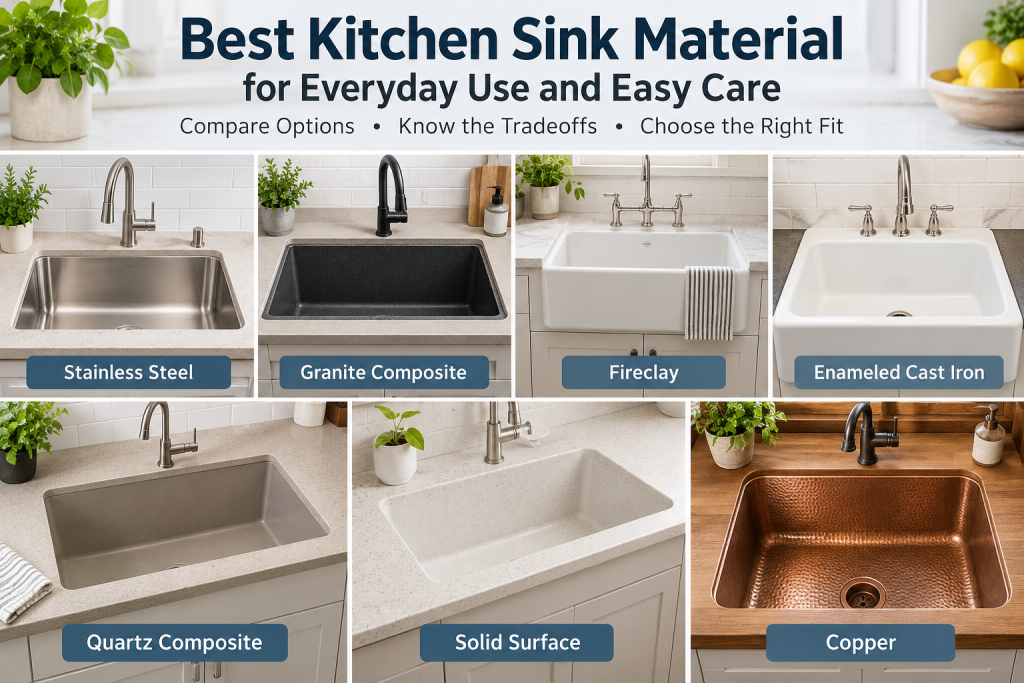
| Material | Best For | Wear and Stains | Noise and Care | Cost and Main Tradeoff |
|---|---|---|---|---|
| Stainless steel | Value and versatility | Scratches show; stains resist well | Varies by construction; easy care | Low–moderate; water spots |
| Granite composite | Color and busy kitchens | High resistance; marks vary | Quiet; moderate care | Moderate–high; heavy |
| Fireclay | Farmhouse style | Hard surface; can chip | Quiet; easy routine care | High; heavy and brittle |
| Enameled cast iron | Traditional durability | Hard enamel; can chip | Quiet; easy routine care | High; very heavy |
| Quartz composite | Color and durability | Generally high resistance | Quiet; moderate care | Moderate–high; formulas vary |
| Solid surface | Seamless integration | Repairability varies | Quiet; easy visual continuity | Varies; tied to countertop system |
| Copper | Distinctive character | Finish changes with use | Quiet; specialized expectations | Premium; patina changes |
What Is the Best Kitchen Sink Material Overall?
For the broadest combination of price, availability, durability, and straightforward care, stainless steel is the best all-around starting point. It is relatively light, widely available, resistant to chipping, and offered in many sizes, configurations, and mounting styles.
Its weakness is cosmetic wear. Scratches and water spots can be visible, especially on a newer or more reflective sink.
Granite or quartz composite is a strong alternative when you want color, a quieter and more substantial feel, and less-visible everyday wear. Fireclay and enameled cast iron make sense when traditional appearance and solidity outweigh concerns about weight. Integrated solid surface is mainly a design choice for coordinated countertops, while copper suits homeowners who actively want a changing patina.
How the Main Kitchen Sink Materials Compare
Stainless steel kitchen sinks
Stainless steel combines broad availability, relatively low weight, resistance to chipping, and easy routine care. It also works visually with almost any kitchen style.
Scratches are the main tradeoff. Fine marks are normal, although some brushed or grained finishes allow light scratches to blend into the surface as it wears. Water spots may also be conspicuous.
Gauge refers to steel thickness, with lower gauge numbers indicating thicker steel. Thickness can affect stiffness and feel, but it is not a complete measure of sink quality. Finish, bowl construction, mounting, and sound-deadening pads or coatings matter too.
If noise is important, compare the actual sound-control construction rather than assuming thicker steel automatically guarantees a quiet sink.
If discoloration becomes a maintenance issue, see our guide to removing stains from a stainless steel sink without damaging the surface.
Granite composite sinks
Granite composite sinks blend mineral material with a binder, often acrylic or another resin. Formulations differ by manufacturer, so the label does not describe one universal recipe.
Their main advantages are color, a dense feel, naturally lower resonance than bare metal, and strong resistance to common stains, scuffs, and scratches. Some marks from cookware may be transferred metal rather than damage to the sink.
Mineral deposits are another consideration. Pale hard-water residue can be noticeable on dark composite colors even when the sink itself is not stained.
Heat performance and cleaner compatibility vary by formulation, so use the specifications for the exact sink rather than applying one manufacturer’s claims to every composite.
Composite sinks are also substantially heavier than many stainless models. Check the sink’s weight and support requirements before purchase.
Fireclay sinks
Fireclay is a ceramic sink material that is formed, glazed, and fired at very high temperatures. Its hard, smooth surface resists ordinary staining and gives the sink the substantial appearance associated with farmhouse and apron-front designs.
The tradeoff is that a hard surface is not unbreakable. Severe cookware impacts can chip the glaze, and fireclay sinks are heavy enough that cabinet support and installation requirements deserve attention before purchase.
Because fired ceramic products may have dimensional tolerances, verify the specifications for the actual sink before cabinetry or countertop openings are finalized.
Fireclay is especially appealing when traditional style and a solid, quiet feel matter more than low weight or maximum installation flexibility.
Enameled cast-iron sinks
Enameled cast iron consists of a heavy iron body covered by a hard enamel finish. The body provides mass and rigidity; the enamel provides the visible color and working surface.
The result is a substantial, naturally quiet sink with strong traditional appeal. The enamel handles everyday kitchen use well, but hard impacts can damage the finish, so it should not be treated as chip-proof.
Weight is the major buying consideration. Large cast-iron sinks can be extremely heavy, which can affect cabinet support, handling, and mounting.
For homeowners who like the look and plan appropriately for the weight, enameled cast iron offers a durable, relatively straightforward surface to live with.
Quartz composite and similar engineered sinks
“Quartz composite” and “granite composite” are not consistently separated categories across manufacturers. Both labels can describe sinks made from mineral particles combined with a resin binder.
Many quartz composites offer the same broad advantages that attract buyers to granite composite: color choices, a nonmetallic appearance, sound damping, and resistance to common stains and scratches.
Instead of choosing by the marketing label alone, compare the actual formulation, care instructions, heat limitations, mounting options, dimensions, and weight of the sinks you are considering.
Solid-surface and integrated sinks
Solid-surface sinks are most relevant when they are part of a compatible countertop system. They can create a visually continuous counter-to-sink transition with inconspicuous seams.
Another advantage is repairability. Depending on the material and finish, scratches and some surface damage can often be refinished or professionally repaired.
Choose solid surface mainly when seamless appearance and integration with the countertop are priorities rather than as a universal replacement for stand-alone sink materials.
Copper sinks
Copper is a specialty choice whose biggest attraction is its distinctive appearance. It is a living metal, so the surface develops and changes patina through use and exposure.
That characteristic should be a deliberate choice. Some homeowners value the evolving finish as character; others may see the same changes as uneven discoloration.
Finishes and care expectations differ, so understand how the particular sink is intended to age before buying. Copper also tends to occupy the premium end of the sink market.
Which Material Is Easiest to Maintain, Most Scratch-Resistant, and Quietest?
Which sink material is easiest to maintain?
Stainless steel, quality mineral composites, fireclay, and enameled cast iron can all be straightforward to maintain. The bigger difference is often how visible normal use becomes between cleanings.
Stainless steel may show water spots and fine scratches. Dark composite surfaces can contrast with pale hard-water residue. Glazed sinks may hide some mineral film better depending on their color but remain vulnerable to chips from severe impacts.
If appearance maintenance matters most, choose a color and finish whose normal wear you can tolerate rather than expecting a maintenance-free material.
For routine care after installation, see how to clean a kitchen sink without damaging the finish.
Which sink material resists scratches best?
Quality composite and hard glazed surfaces resist ordinary scratching well, but scratch resistance does not equal total damage resistance.
Stainless steel acquires fine scratches more readily, yet those marks are usually cosmetic and some grained finishes disguise them over time. Hard fireclay or enamel may resist scratching better but can chip if hit hard enough. Composite sinks can also collect cookware transfer marks that resemble scratches.
The practical decision is whether you would rather live with fine scratches, possible chips, scuffs, or—in copper—a changing patina.
Which sink material is quietest?
Fireclay, cast iron, and mineral composites generally have a quieter, more solid character because of their mass and construction.
Stainless steel varies more. Sound-deadening pads and coatings can substantially reduce ringing and vibration, so compare those features on the actual model instead of choosing by material or gauge alone.
Cabinet construction, mounting, bowl shape, and garbage-disposal operation can also affect perceived noise.
Which sink material is best for hard water?
No sink material prevents hard-water minerals from leaving deposits.
What changes is visibility. Stainless steel frequently shows water spots, while black or dark composite sinks can strongly contrast with pale mineral buildup. Lighter or patterned surfaces may make deposits less conspicuous.
If hard water is common in your home, consider how the sink will look between cleanings and how willing you are to wipe it dry. Do not choose a material expecting it to eliminate mineral deposits.
Which sink material is best for a busy family?
For frequent dishes, cookware, children, and daily food preparation, start by comparing stainless steel with a reputable granite or quartz composite.
Choose stainless steel when versatility, lighter weight, value, and tolerance of cosmetic scratches matter most. Choose composite when color, quieter operation, and resistance to conspicuous everyday wear have higher priority.
Fireclay and enameled cast iron can also serve busy kitchens well, but they reward households willing to be more careful with heavy cookware around the finished surface.
Cost and Long-Term Value
Kitchen sink costs vary widely by size, bowl configuration, brand, finish, mounting style, and accessories. Stainless steel offers one of the broadest ranges of price points, while composite, fireclay, enameled cast iron, and copper often move higher depending on the model and design.
Do not compare sink prices in isolation. A heavy or apron-front model may also affect cabinet support, countertop work, handling, or installation complexity.
Long-term value is therefore less about finding the cheapest material and more about choosing a sink whose appearance, maintenance needs, and installation requirements you are comfortable living with.
Installation Considerations That Affect Material Choice
Installation matters here only because it can rule out an otherwise suitable sink or change the project cost.
Heavy fireclay, cast iron, and some composite sinks may need more support than stainless steel. Apron-front models can also impose specific cabinet and dimensional requirements. Mounting compatibility depends on the individual sink and countertop.
Before buying, verify:
- Overall sink dimensions
- Required minimum cabinet size
- Sink weight and support requirements
- Approved mounting method and countertop compatibility
- Bowl depth and available space below
- Faucet, soap-dispenser, air-gap, and accessory-hole needs
- Drain location and room for plumbing or a garbage disposal
- Apron dimensions for farmhouse models
Use the specification sheet for the exact sink. Similar-looking models can have different measurements and installation requirements.
Once you have chosen the sink itself, our guide to the best kitchen sink strainer can help you match the drain hardware to your everyday needs.
How to Choose the Right Kitchen Sink Material
1. Set your budget. Include the sink plus any likely countertop work, cabinet changes, support, and installation consequences.
2. Decide how much cosmetic wear bothers you. Stainless steel tends to show fine scratches, while hard glazed materials trade better scratch resistance for some risk of chipping.
3. Consider your maintenance tolerance. Think about visible water spots, mineral buildup, finish changes, and how often you are willing to dry or wipe the sink.
4. Decide how important quiet operation is. Consider naturally massive materials as well as the sound-deadening construction of individual stainless steel sinks.
5. Check cabinet and countertop limitations. Weight, minimum cabinet width, mounting style, bowl depth, and apron dimensions may narrow the choices quickly.
6. Match the material to your preferred style. Stainless steel is versatile, composites add color, fireclay and cast iron emphasize traditional solidity, and integrated solid surface prioritizes continuity.
7. Verify the manufacturer’s specifications. Confirm dimensions, weight, mounting method, care guidance, heat limitations, and other requirements for the exact model before ordering.
Common Kitchen Sink Buying Mistakes
- Choosing only by appearance. Consider the material’s normal scratches, marks, chips, spots, or finish changes too.
- Ignoring sink weight. A heavy sink can change cabinet support and installation requirements.
- Assuming every composite is identical. Formulations and manufacturer guidance vary.
- Buying before checking cabinet dimensions. Sink width alone does not tell you the required cabinet size.
- Ignoring mounting compatibility. Drop-in, undermount, and apron-front models have different requirements.
- Overlooking faucet and accessory holes. Make sure the planned faucet and accessories can be accommodated.
- Expecting a scratch-proof sink. Every material has some form of cosmetic wear.
- Focusing only on purchase price. Installation consequences can change the real cost of the choice.
Kitchen Sink Material FAQs
What is the most durable kitchen sink material?
There is no single durability winner. Stainless steel is difficult to chip and tolerates cosmetic wear, while quality composites and glazed fireclay or cast iron offer hard, stain-resistant surfaces. The better choice depends on whether scratches, impacts, chips, or finish changes concern you most.
Is stainless steel or granite composite better?
Stainless steel is generally the better starting point for lighter weight, versatility, broad availability, and value. Granite composite is compelling when you place more value on color, quietness, and resistance to visible everyday wear. Both can be good long-term choices.
Is fireclay better than cast iron?
Neither is universally better. Both provide substantial traditional styling and hard finished surfaces. Cast iron uses an iron body beneath enamel, while fireclay is fired ceramic. Compare the actual sink’s weight, dimensions, mounting requirements, appearance, and care expectations.
What is the best kitchen sink material for low maintenance?
The best kitchen sink material for low maintenance is often stainless steel or a quality granite or quartz composite, depending on which cosmetic issues bother you. Stainless steel is simple to care for but shows spots and scratches; composites often hide scratches better but some colors make mineral deposits more visible.
Final Thoughts
There is no universal best kitchen sink material for every household. Stainless steel remains the strongest general-purpose starting point, while granite and quartz composites are compelling for color, quieter operation, and resistance to visible everyday wear. Fireclay and enameled cast iron suit homeowners who want substantial traditional style and can accommodate the added weight.
Solid surface makes the most sense in an integrated countertop system, while copper is a specialty choice for homeowners comfortable with an evolving patina. Choose the tradeoffs you can live with, then verify the exact sink’s dimensions, weight, mounting requirements, and manufacturer specifications before buying.