
Cabinet Hinge adjustments: how to fix crooked or loose doors
Cabinet hinge adjustment can usually correct a door that hangs crooked, rubs another door, sits unevenly, or has shifted out of alignment—as long as the hinges, screw holes, door, and cabinet are still sound. Start by identifying how the door is misaligned, tighten any loose mounting screws, and then make one small adjustment at a time.
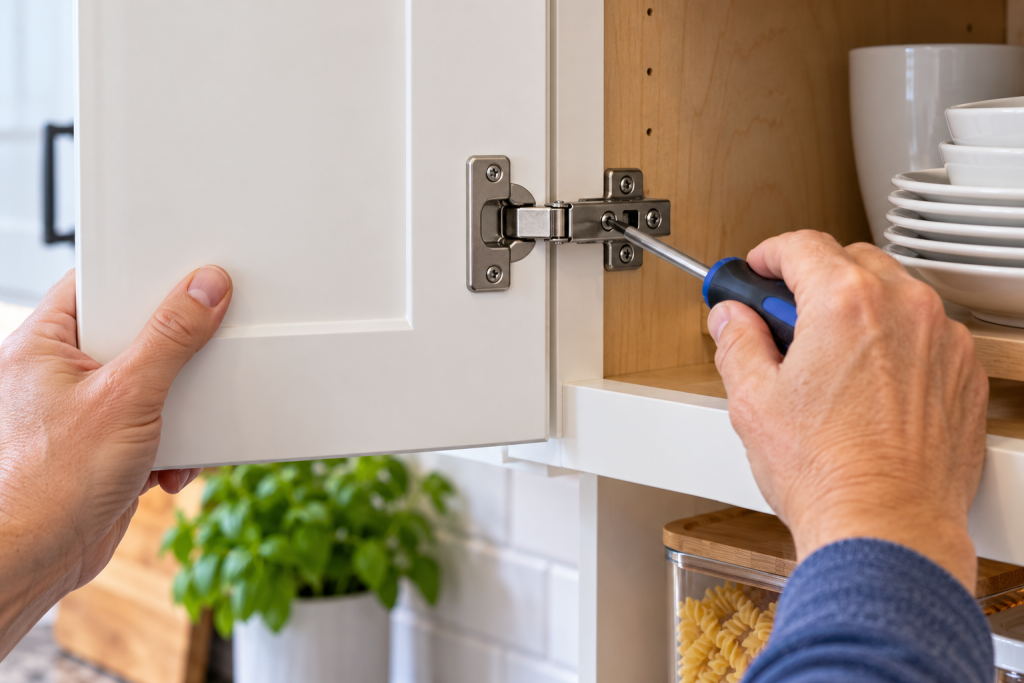
| Problem | Likely adjustment | Check first |
|---|---|---|
| Door hangs low | Height or side-to-side | Loose hinge screws |
| Doors touch or overlap | Side-to-side | Which door is actually out of line |
| Door rubs the frame | Height or side-to-side | Loose mounting plate |
| Door sticks out | Depth | Hinge or plate looseness |
| Door shifts when opened | Tightening or repair | Screws and mounting holes |
| Door will not align | May not be adjustable | Bent hinge, warped door, cabinet damage |
Identify the Alignment Problem Before Turning Screws
Close the cabinet door and look at the gaps around all four edges. If there is another door beside it, compare the spacing at the top, center, and bottom.
The pattern usually tells you which direction needs correction.
A door that has dropped may have a wider gap above one corner and may rub below. Two doors that touch near the handles usually need a side-to-side correction. A door that lines up around its edges but projects farther from the cabinet than its neighbors may need a depth adjustment.
Also open the door gently and watch the hinges. If the door or mounting plate visibly shifts, solve that looseness before trying to fine-tune alignment.
Do not try to make several adjustments at once. You can quickly lose track of the original position and make the alignment worse.
Identify the Hinge Type and Check for Loose Screws
Modern kitchen cabinets commonly use concealed hinges, but their designs are not all the same.
Concealed or European-style hinges are hidden when the door is closed. Many provide adjustments for side-to-side position, height, and depth.
Face-frame concealed hinges mount to cabinets that have a frame around the front opening. Some are highly adjustable, while others use a different mounting arrangement than hinges found on frameless cabinets.
Frameless cabinet hinges mount to the side panel or a mounting plate inside the cabinet. Many common versions provide multiple adjustment points.
Traditional exposed or butt-style hinges usually do not have dedicated three-way adjustment screws. Correcting their position may require tightening or repositioning the hinge rather than turning an adjustment cam.
Before changing any alignment setting, check the screws that attach the hinge cup to the door and the hinge or mounting plate to the cabinet.
If a screw is merely loose, snug it with a manual screwdriver. Do not overtighten it. Particleboard, MDF, plywood, and solid wood can all be damaged if a screw is driven beyond what the material can securely hold.
If a screw keeps spinning without becoming snug, stop. The hole may be stripped, which requires a repair rather than more hinge adjustment.
If the existing hinges are worn, damaged, or no longer suitable, see our guide to the best soft-close cabinet hinges for help choosing compatible replacements.
Minimal Tools
- Manual Phillips screwdriver or the driver that correctly fits your hinge screws
- Flashlight
- Straightedge or small level if it helps compare door positions
- A helper or temporary support for a large or heavy door
A manual screwdriver gives better control during final adjustment than aggressively using a drill or impact driver.
Understand the Three Common Concealed-Hinge Adjustments
Many adjustable concealed hinges let you change the door position in three directions. The exact screw location and adjustment mechanism depend on the hinge.
Side-to-Side Adjustment
Side-to-side, sometimes called horizontal or overlay adjustment, moves the door left or right.
Use it when two doors touch, the gap between paired doors is uneven, or a door sits too close to one side of the cabinet opening.
Small changes can noticeably alter the reveal between doors. Adjust one door first rather than moving both doors without knowing which one is actually misaligned.
Height Adjustment
Height or vertical adjustment moves the door up or down.
Depending on the hinge system, height may be controlled by a dedicated adjustment feature or by the mounting plate. Some designs require loosening mounting screws slightly so the plate can move; others provide a cam-style adjustment.
Support a sagging or heavy door while working. Do not rely on an adjustment screw alone to hold its weight while mounting hardware is loose.
Depth Adjustment
Depth adjustment moves the door closer to or farther from the cabinet.
Use it when a closed door sticks out farther than surrounding doors, sits too deeply, or does not close flush with the cabinet face.
Do not move the door so far forward that the hinge no longer closes or supports the door correctly.
There is no universal rule such as “turn clockwise to move left.” Screw locations, mechanisms, and turning directions vary. Make a small adjustment, observe what happened, and reverse direction if necessary.
Cabinet Hinge Adjustment Step by Step
Work slowly and change only one direction at a time. Checking the door after each change makes it much easier to understand what each adjustment is doing.
Step 1: Inspect the closed door
Close the door without forcing it. Compare the top, bottom, hinge side, and handle side gaps, along with the neighboring door if there is one.
Decide whether the primary problem is height, side-to-side position, depth, or simple looseness.
Step 2: Identify the hinge and its adjustment points
Open the door and inspect the hinge. Look for the screws securing the hinge to the door, the mounting hardware securing it to the cabinet, and any separate adjustment screws.
If you cannot distinguish the mounting screws from the adjustment screws, look for the hinge manufacturer’s identification or instructions before proceeding.
Step 3: Tighten loose mounting screws
Snug any screws that are visibly loose before changing the door position.
Close the door again. A loose mounting plate or hinge cup can cause enough movement to create sagging or uneven gaps by itself.
Step 4: Support the door if necessary
Support a large, heavy, or noticeably sagging door before loosening mounting hardware.
The support should carry the door’s weight while you work rather than leaving that load on a partially loosened hinge.
Step 5: Correct the height
If the entire door sits too high or low, use the hinge’s vertical-adjustment method.
Make only a small change, secure any mounting screws that were loosened, and close the door to check the result.
Step 6: Correct side-to-side alignment
Adjust horizontally when the door is too close to the cabinet edge or neighboring door.
If the door is crooked rather than uniformly shifted, the upper and lower hinges may require different small corrections. Check the result after each change instead of turning both adjustment screws repeatedly.
Step 7: Correct the depth
If the door sticks out or sits too far inward, make a small depth adjustment.
Compare the closed door with nearby doors or the cabinet face. Aim for an even position without interfering with proper hinge movement.
Step 8: Recheck both hinges
An adjustment at one hinge can change the way the opposite end of the door sits.
Inspect the upper and lower gaps again before making another correction.
Step 9: Open and close the door several times
The door should move freely without rubbing, shifting at the mounting plate, or contacting the neighboring door.
Check alignment while fully closed after cycling it several times.
Step 10: Make final small adjustments
Fine-tune only the direction that still needs correction.
Once the gaps look even and the door operates smoothly, stop. Continuing to turn adjustment screws after the problem is solved can create a new alignment issue.
If you are also updating the visible cabinet hardware, compare cabinet knobs vs pulls before choosing a style for the doors and drawers.
Fix Common Cabinet-Door Problems
How to Fix a Sagging Cabinet Door
A sagging door often has a handle-side corner that sits lower than the hinge side. You may also see a gap that changes from one side of the top edge to the other or notice the door rubbing near the bottom.
First check the hinge-cup and cabinet-side mounting screws. If everything is secure, determine whether your hinge allows vertical adjustment, side-to-side adjustment, or a combination that can square the door.
Do not assume one adjustment screw automatically fixes every sagging door. A door that continues to drop after adjustment may have stripped mounting holes, worn hardware, or a loose hinge cup.
How to Fix Uneven Gaps Between Two Doors
Close both doors and compare the space between them at the top, center, and bottom.
If one door is clearly shifted sideways but remains parallel to the other, a small horizontal adjustment may correct it. If the gap widens from top to bottom, one door may be tilted and may require different corrections at its upper and lower hinges.
Adjust one door at a time. Moving both doors immediately can make it harder to identify which door caused the original problem.
There is no single correct gap for every cabinet. The practical goal is a consistent reveal appropriate to that cabinet design.
When a Door Rubs the Cabinet Frame
Rubbing can result from horizontal misalignment, a dropped door, a loose mounting plate, or a combination of those problems.
Identify where contact occurs before adjusting anything. A door rubbing at the bottom may need a different correction from one touching the cabinet along its vertical edge.
If several doors rub or the cabinet opening itself is visibly out of square, hinge adjustment may not fully solve the problem.
When a Door Sits Too Far In or Sticks Out
Check depth when the perimeter gaps look reasonable but the face of the door does not line up with adjacent doors.
Make a small depth correction and close the door after each change. Compare both the hinge side and handle side because a door can sometimes be twisted out of plane rather than uniformly too far forward or back.
A warped door cannot be straightened by repeatedly changing hinge depth.
When Adjustment Will Not Fix the Problem
A cabinet door can be out of position because the hardware or cabinet is physically damaged. Continuing to adjust the hinge in these situations often wastes time and can make the damage worse.
What If a Hinge Screw Keeps Spinning?
A screw that tightened normally after becoming loose is different from one that spins without gripping.
A spinning screw usually indicates that the mounting hole no longer holds the fastener securely. At that point, the problem is no longer an ordinary cabinet hinge adjustment.
Repair options depend on whether the mounting area is solid wood, plywood, MDF, particleboard, or another construction and on how the hinge is attached.
A simple damaged hole in suitable wood may be repairable, but engineered cabinet materials can require a different mounting repair. Do not repeatedly drive larger screws into the cabinet without confirming that there is adequate material, clearance, and a secure attachment method.
If the mounting area is crumbling, badly enlarged, or unable to hold the hinge securely, cabinet repair is the better next step.
Check for Damaged Hardware or Cabinet Parts
Adjustment may not solve a door with:
- A bent or worn hinge
- A damaged hinge arm or mounting plate
- A loose hinge cup in damaged door material
- An adjustment mechanism that no longer works
- Stripped mounting holes
- A warped cabinet door
- A damaged cabinet side
- A cabinet box that is significantly out of square
- An incorrect hinge installed during a previous repair
Replacement is usually more sensible when a hinge is bent, broken, badly corroded, or cannot hold its adjustment. Replacement hardware must still be correctly matched to the cabinet and door.
Soft-close hinges can have the same basic alignment functions as other concealed hinges, depending on the model. The damping mechanism is separate from door positioning. If the door is properly aligned but the soft-close mechanism has failed, further alignment adjustment may not correct the damping problem.
Common Mistakes and When to Get Help
Common cabinet-hinge mistakes include turning several screws before identifying their purpose, making large adjustments, adjusting before tightening loose mounting hardware, and overtightening screws.
Also avoid using a drill aggressively for final adjustments, moving both doors unnecessarily, ignoring a screw that no longer grips, or trying to force a bent hinge back into alignment through its adjustment mechanism.
Consider a cabinet professional or experienced handyman when the door is warped, the cabinet box is out of square, the mounting area is damaged, or screw holes no longer hold securely. Professional repair also makes sense when a hinge cup is loose in damaged door material, several doors shifted because the cabinet moved, replacement hardware cannot be confidently matched, or adjustments repeatedly move out of position.
Frequently Asked Questions
Which screw adjusts cabinet doors left and right?
On many concealed hinges, a dedicated side-to-side or overlay adjustment controls left-right positioning. Its location and operating direction depend on the hinge model, so identify the hinge rather than assuming a particular screw always serves that function.
How do I raise or lower a cabinet door?
First tighten loose mounting hardware. If the door still needs vertical correction, use the height-adjustment method provided by the hinge. Some hinges use a dedicated cam, while others adjust at the mounting plate.
Why does my cabinet door keep sagging?
Repeated sagging can point to loose mounting screws, stripped holes, damaged hinge hardware, a loose hinge cup, or a door that is putting more load on the hinge than the mounting area can securely support. If cabinet hinge adjustment will not hold, inspect the attachment points instead of continuing to turn the adjustment screws.
Why does one cabinet door stick out farther than the others?
The hinge may need a depth adjustment, or one of its mounting points may be loose. If the door remains uneven after careful adjustment, check for a bent hinge, damaged mounting plate, or warped door.
Can all concealed cabinet hinges be adjusted?
No. Adjustment capability and mechanism vary by hinge design. Many modern concealed hinges provide multiple adjustments, but not every hinge offers the same range, screw arrangement, or adjustment method.
Final Thoughts
Successful cabinet hinge adjustment starts with diagnosis, not with randomly turning screws. Inspect the gaps, identify the hinge, tighten loose mounting hardware, and then correct height, side-to-side position, or depth one direction at a time using small changes.
Check the door after every adjustment and stop when it opens, closes, and aligns correctly. If stripped holes, a warped door, broken hardware, or cabinet damage is causing the problem, repairing that defect is more useful than continuing to adjust the hinge.