cabinet knobs or pulls: which is better for your kitchen?
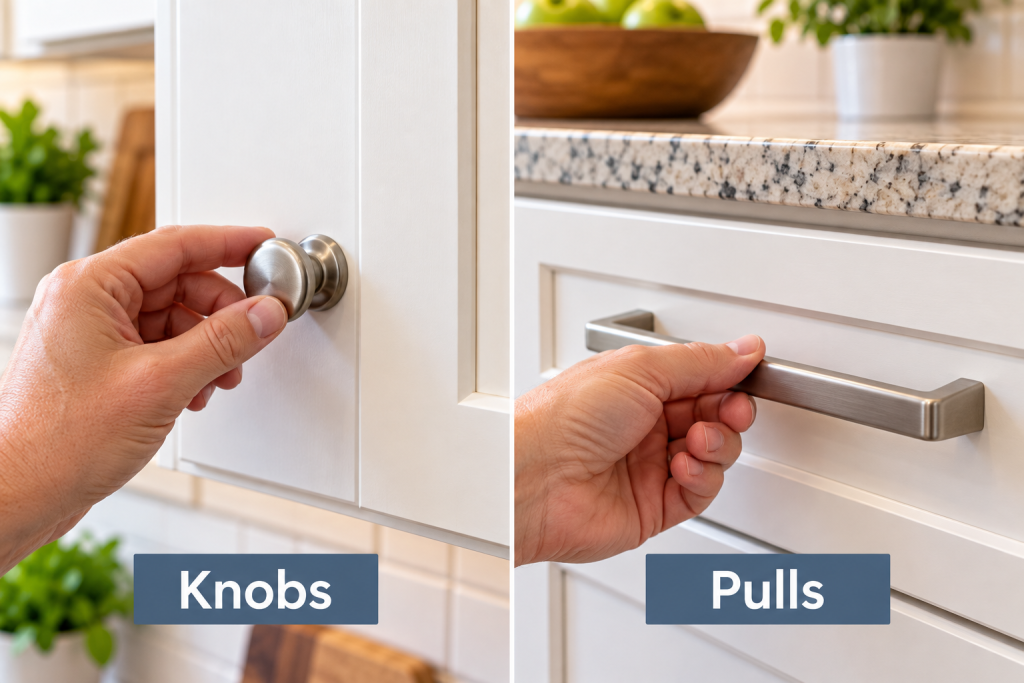
When comparing cabinet knobs vs pulls, the better choice depends on where the hardware will be used, how easy it needs to be to grip, whether you want to reuse existing holes, and the look you prefer. Knobs keep mounting simple and visually compact, while pulls provide a larger gripping surface and often suit wide or frequently used drawers.
Choose knobs when simple one-hole mounting, a smaller visual footprint, or reusing existing knob holes matters most. Choose pulls when you want more room for your fingers, have larger drawers, or already have matching two-hole mounting. Using both can also work well, such as knobs on doors and pulls on drawers.
| Factor | Knobs | Pulls |
|---|---|---|
| Grip area | Smaller | Larger |
| Mounting holes | Usually one | Usually two |
| Installation | Simpler | Requires matched spacing |
| Wide drawers | Can work | Often easier to grasp |
| Cleaning | Small surface | More surface to wipe |
| Visual impact | More subtle | More noticeable |
| Existing-hole fit | Simple for knobs | Match hole spacing |
| Accessibility | Shape matters | Often more grasping room |
| Cost | Varies widely | Varies widely |
| Replacement | Flexible with one hole | Spacing matters |
Cabinet Knobs vs Pulls: The Basic Difference
A cabinet knob normally attaches through a single mounting point. Knobs are compact and come in round, square, oval, rectangular, and many other shapes. They are commonly used on cabinet doors and smaller drawers, although there is no rule limiting them to those locations.
A pull normally attaches at two points and provides a longer surface to grasp. Bar pulls, arch pulls, cup pulls, and handle-style pulls are common examples. Pulls can be used on both doors and drawers.
The practical difference is more important than the label: knobs take up less space and usually require one hole, while pulls give your fingers or hand more hardware to hold.
Which Is Easier to Use?
A well-shaped knob may be perfectly comfortable for a cabinet door or light drawer. You can often open it using a fingertip grip without taking up much space on the cabinet face.
Pulls provide a larger gripping area. Depending on their shape and clearance, you may be able to place several fingers behind them instead of pinching a smaller piece of hardware. That can be useful on frequently opened cabinets, deeper drawers, and locations where a larger grip simply feels more comfortable.
For practical accessibility, look beyond whether the hardware is called a knob or pull. Consider:
- How much of your hand or fingers can contact it
- Whether there is comfortable clearance behind it
- How far it projects from the cabinet
- Whether the edges feel smooth in your hand
- Whether opening it requires an awkward pinch
- How easily it can be used in frequently accessed locations
Larger, easy-to-grasp pulls may be more comfortable for people with limited hand strength or dexterity, but that does not make every pull suitable for every person or make a particular kitchen installation automatically compliant with an accessibility standard.
Cabinet Doors: Knobs or Pulls?
Knobs work well on many cabinet doors because doors often require less pulling force than loaded drawers. Their single mounting point also keeps installation and replacement straightforward, and their smaller size can make the cabinet face look less hardware-heavy.
Pulls provide more gripping room and may be easier to grab quickly. They can also create a stronger visual line and coordinate directly with pulls used on drawers.
Either can work. Base the decision on grip, appearance, existing holes, and how frequently the door is used.
If the cabinet door itself hangs crooked, rubs, or has uneven gaps, use our cabinet hinge adjustment guide before changing the visible hardware.
Drawers: Knobs or Pulls?
Pulls are often a practical choice for wide, deep, or heavily loaded drawers because the longer gripping surface gives you more room to hold the hardware.
Small or lightly loaded drawers can work perfectly well with knobs. On very wide drawer fronts, homeowners sometimes use one pull, two pulls, or two knobs depending on the cabinet design and desired appearance.
Avoid choosing hardware by drawer width alone. The drawer’s weight, ease of movement, hardware scale, existing mounting holes, and how the grip feels all matter.
One Hole vs. Two Holes Matters When Replacing Hardware
The mounting-hole difference can determine whether a hardware change is simple or requires cabinet modification.
A knob normally uses one mounting hole. Replacing one knob with another is often straightforward when the new hardware fits the existing opening, and the supplied or compatible screw works with the door or drawer thickness.
A pull normally uses two mounting holes. When replacing a pull, the distance between those holes is one of the most important measurements to know.
Changing from a knob to a pull normally means adding a second hole. Changing from a pull to a knob creates the opposite problem: one of the existing pull holes may remain visible.
Changing from one pull to another can also leave old holes exposed if the mounting spacing differs. For that reason, measure before buying an entire kitchen’s worth of hardware.
What Does Center-to-Center Mean?
Center-to-center is the distance from the center of one mounting hole to the center of the other mounting hole on a pull.
If you are replacing existing pulls and want to reuse their holes, measure that spacing before shopping. The replacement pull needs compatible mounting centers even if its overall shape or length is different.
Do not confuse three separate dimensions:
- Center-to-center: Distance between the two mounting-hole centers
- Overall length: Total end-to-end length of the pull
- Projection: How far the installed hardware extends outward from the cabinet surface
Two pulls can have similar overall lengths while using different mounting spacing, so appearance alone is not enough to establish compatibility.
Should You Switch From Knobs to Pulls?
Switching can make sense if you want more gripping room, find drawers uncomfortable to open, or prefer the appearance of pulls.
The tradeoff is mounting. A pull normally needs two holes, so an existing single knob hole does not provide the complete mounting pattern. New drilling may be necessary, and placement needs to be accurate.
This selection guide does not cover the drilling procedure itself. Before committing to the change, confirm that you are comfortable modifying the cabinet fronts and that the new hardware will cover or incorporate the existing hole appropriately.
Should You Switch From Pulls to Knobs?
Replacing a two-hole pull with a one-hole knob can leave one mounting hole exposed.
That may be acceptable only if the new hardware covers the old openings or the unused hole will be addressed appropriately as part of a separate cabinet repair or refinishing project.
If preserving the existing cabinet surface matters, choosing another pull with compatible center-to-center spacing is often the less disruptive option.
Appearance, Proportion, Finish, and Maintenance
Knobs have a smaller visual footprint. Depending on their shape and finish, they can look understated, decorative, traditional, contemporary, or somewhere in between.
Pulls create a stronger horizontal or vertical line and tend to be more visually noticeable. They also come in styles ranging from simple and minimal to highly decorative.
Neither type belongs exclusively to one kitchen style.
Hardware should also feel proportional to the cabinet front. A very large pull can visually dominate a small door, while a tiny knob may feel undersized on a substantial drawer. Rather than following a rigid size formula, consider visual balance, comfortable grip, and how the hardware relates to surrounding doors and drawers.
Mixing Knobs and Pulls
Using both is a practical option. One common approach is knobs on doors and pulls on drawers, but it is not the only combination that works.
A mixed layout usually looks more deliberate when the pieces share some visual connection. That might be a similar finish, shape language, design family, or overall scale.
You do not need every metal surface in the kitchen to match exactly. Consider the cabinet color, appliances, faucets, lighting, and the amount of contrast you want.
Cleaning Differences
Knobs have less total surface area, although residue can collect around the base where the hardware meets the cabinet.
Pulls provide more surface to wipe and may collect grime around their posts or ends. Their larger gripping area also means there is more hardware being touched.
Shape and finish can matter as much as whether the hardware is a knob or pull. Choose something you can comfortably wipe around without treating cleaning as the primary reason to select one style.
If grease and fingerprints have built up around the hardware and cabinet fronts, see how to clean greasy kitchen cabinets safely without damaging the finish.
Cost Considerations
There is no reliable rule that knobs are always inexpensive, or pulls are always expensive.
Price can vary with material, finish, size, construction, manufacturer, and design. Some pulls may cost more per piece because they are larger or use more material, but decorative knobs can also cost more than simple pulls.
For a whole-kitchen replacement, compare the total quantity you need rather than judging the project from the price of a single piece.
Replacing Existing Cabinet Hardware
Before ordering a full set, inspect what is already installed. Existing holes can narrow your options or make one hardware type much easier to use than another.
Step 1: Count the existing holes
Remove or inspect one piece of hardware and determine whether the cabinet front has one mounting hole or two.
Step 2: Measure pull spacing
If you have pulls, measure from the center of one mounting hole to the center of the other. Record that center-to-center measurement.
Step 3: Check projection and clearance
Consider how far the new hardware will extend from the cabinet and whether your fingers will have enough room behind it.
Also check nearby doors, walls, appliances, and other hardware for possible interference.
Step 4: Consider cabinet-front thickness
Hardware screws need to work with the thickness of the door or drawer front and the specific hardware being installed.
Do not assume every replacement uses the same screw simply because the visible hardware looks similar.
Step 5: Decide whether to reuse the holes
Reusing existing holes usually reduces the amount of cabinet modification required.
If the new hardware needs a different pattern, account for new holes and any old holes that could remain visible.
Step 6: Compare the actual hardware dimensions
Check center-to-center spacing, overall size, projection, gripping clearance, and the area where the hardware meets the cabinet.
Do not buy based only on a product photo or stated overall length.
Step 7: Test one location first
When practical, try one knob or pull before buying or installing the full quantity.
Confirm that it feels comfortable, clears nearby surfaces, looks proportional, and works with your existing mounting arrangement.
A Simple Decision Guide
Choose knobs if:
- You want straightforward one-hole mounting
- You are replacing existing knobs
- A smaller visual footprint suits the kitchen
- The doors or drawers are comfortable to operate with a smaller grip
- Minimizing additional drilling is important
Choose pulls if:
- You prefer a larger gripping surface
- You have wide, deep, or frequently used drawers
- Easier grasping is a priority
- More visible hardware fits the design
- Existing pull holes already match the hardware you want
Consider using both if:
- Knobs feel appropriate on doors, but pulls are more comfortable on drawers
- You want different hardware functions without making the kitchen look inconsistent
- A coordinated combination fits the existing holes better than choosing one type everywhere
Common buying mistakes include confusing overall pull length with center-to-center spacing, ignoring projection, choosing hardware that feels uncomfortable, and ordering an entire set before testing a sample.
Also account for existing holes before switching hardware types. A knob-to-pull change usually requires another mounting hole, while replacing a pull with a knob can leave an unused hole visible.
Frequently Asked Questions
Are knobs or pulls better for kitchen cabinets?
Neither is universally better. The best cabinet knobs vs pulls decision depends on grip, cabinet location, existing holes, visual preference, and how much modification you want to make.
Are pulls better than knobs for drawers?
Pulls can be easier to grasp on wide, deep, or heavily loaded drawers because they provide more gripping area. Small or light drawers can still work well with knobs.
Can you mix knobs and pulls in the same kitchen?
Yes. Knobs on doors and pulls on drawers are one common arrangement, but other combinations can work. Consistent finish, scale, placement, or design details can help the mix look intentional.
How do I measure replacement cabinet pulls?
Measure from the center of one existing mounting hole to the center of the other. That is the center-to-center measurement. Do not substitute the pull’s overall length for this measurement.
Should all kitchen cabinet hardware match?
Not necessarily. Hardware can coordinate without being identical. Consider finish, shape, scale, and the rest of the kitchen rather than assuming every metal component must match exactly.
Final Thoughts
There is no universal winner in the cabinet knobs vs pulls comparison. Knobs offer compact, usually one-hole mounting, while pulls provide a larger gripping surface and may be especially comfortable on larger or frequently used drawers.
Before buying, consider how the hardware feels as well as how it looks. Count existing holes, measure center-to-center spacing on pulls, check projection and proportion, and test one piece when practical before replacing hardware throughout the kitchen.