
best kitchen sink strainer for everyday use
The best kitchen sink strainer is one that fits your sink and drain hardware correctly, catches food without unnecessarily restricting normal drainage, and is easy to remove and clean. For everyday use, compatibility matters more than appearance. Before buying, determine whether you need only a removable basket or the complete drain-mounted strainer assembly, and check whether that sink opening serves a garbage disposal.
| What to compare | What to look for | Why it matters |
|---|---|---|
| Fit | Correct opening, basket size, and depth | Prevents an incompatible purchase |
| Strainer type | Basket, insert, stopper, or deep basket | Changes how it catches debris |
| Drainage | Openings suited to normal sink use | Balances flow and food capture |
| Stopper | Sealable design if you fill the sink | Not every basket stops water |
| Cleaning | Removable, accessible basket | Makes daily cleanup easier |
| Material | Corrosion-resistant, cleanable construction | Affects durability and appearance |
| Disposal use | Disposal-specific compatibility | Standard assemblies do not replace disposal hardware |
| Installation | Basket only or complete assembly | Determines whether plumbing connections are involved |
What a Kitchen Sink Strainer Actually Does
A kitchen sink strainer keeps larger food scraps and debris from passing directly into the drain. Depending on its design, it may also close the drain so you can fill the sink with water.
The term “sink strainer” can describe two different parts, which is an important distinction when shopping.
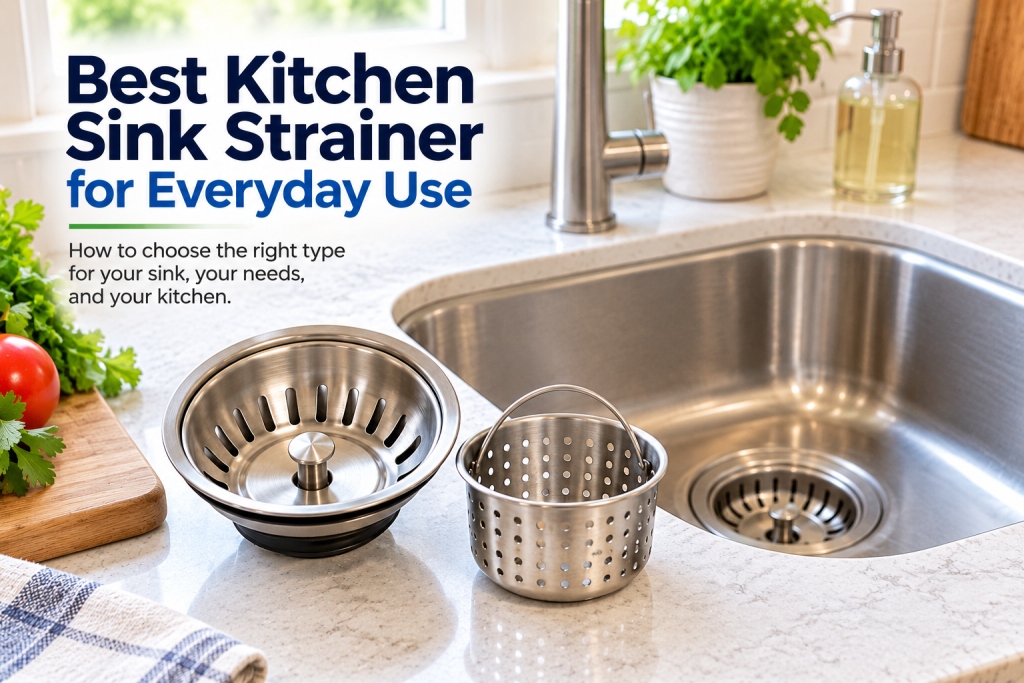
A removable strainer basket or insert sits inside existing drain hardware. You lift it out to empty collected debris, and replacement may require no plumbing work at all.
A full strainer assembly is the drain fitting mounted through the sink itself. It can include the visible flange or strainer body, removable basket or stopper, seals, retaining hardware, and the connection to the drain below.
Knowing which part you need is the first step toward buying the right replacement.
How to Choose the Best Kitchen Sink Strainer for Your Sink
Start with fit rather than finish. Kitchen drain systems are not all identical, and similar-looking strainers can have different dimensions, mounting arrangements, or basket designs.
If you are replacing only the removable basket, inspect the existing drain assembly before shopping. Compare the basket’s diameter and depth, the shape of its stem or center mechanism if present, and how it sits or locks into the existing strainer body. Model information from the sink or drain manufacturer can be more reliable than appearance alone.
If you are replacing the complete assembly, check:
- The sink’s drain opening and the specifications for the replacement
- The existing flange or mounting arrangement
- Available space and connections below the sink
- Whether the assembly includes the basket, stopper, seals, and necessary mounting parts
- Whether the sink manufacturer specifies a particular sealing material
- Whether that drain opening is connected to a garbage disposal
Do not assume a basket that drops into the opening is automatically compatible. It may be too shallow to catch enough debris, too deep to seat properly, or unable to operate the existing stopper mechanism.
Removable Basket or Full Assembly?
Choose a replacement basket when the existing drain body is sound and you are dealing with a missing, damaged, corroded, or inconvenient removable basket. This is usually the simplest purchase because the drain fitting remains in place.
A complete assembly makes more sense when the drain-mounted hardware itself is damaged, badly corroded, incompatible with available replacement baskets, or otherwise needs replacement.
Changing a full assembly is a different job from dropping in a new basket. It can involve disconnecting the drain below the sink, removing retaining hardware and seals, fitting the new drain body, using plumber’s putty or another manufacturer-approved sealing method, and reconnecting the drain. Buy with those installation requirements in mind even if you plan to have a plumber perform the work.
Compare Basket Design, Drainage, and Stopper Function
Strainers need to balance two competing jobs: catching debris and allowing water to drain freely.
A basket with many small openings may capture relatively small food particles, but those openings can also become covered by scraps more quickly. Larger or more open patterns may drain readily but allow smaller particles through. There is no single hole pattern that is best for every kitchen.
For ordinary daily use, look for a design that catches the scraps you commonly deal with while remaining easy to empty.
Common options include:
- Standard basket strainers: A familiar removable basket fitted into a conventional sink strainer assembly.
- Removable basket inserts: Simple inserts intended to work with existing drain hardware.
- Basket-and-stopper combinations: Designs that catch debris but can also seal the drain when positioned correctly.
- Deep baskets: Larger baskets that can hold more scraps before they need emptying.
- Disposal-specific strainers or splash guards: Accessories designed for compatible garbage-disposal openings rather than conventional strainer assemblies.
Basket depth deserves attention. A deeper design can hold more debris, but it still has to fit the drain assembly correctly. Do not choose depth based only on capacity.
Decide Whether You Need a Stopper
A stopper is useful if you regularly fill the sink for soaking or washing. Some basket strainers seal the drain when pressed, turned, or positioned a particular way, while other baskets only catch debris.
If you want this function, check how the stopper operates and whether the seal depends on a particular basket, rubber component, or drain body. A basket that physically fits the opening may still fail to seal if it was not designed for that assembly.
If you rarely fill the sink, an easy-to-remove strainer without a stopper mechanism may be simpler to maintain.
Choose Materials and Cleaning Features for Daily Use
Stainless steel is a common choice for kitchen strainers because suitable grades provide corrosion resistance, a familiar appearance, and surfaces that are generally straightforward to clean. However, the material label does not compensate for poor fit or an incompatible design.
Other strainers may combine plated metal, plastic or polymer parts, and rubber or silicone sealing components. These materials can be perfectly appropriate when they are part of a compatible assembly. What matters is whether the complete product is designed for kitchen sink use and for the hardware you already have.
Decorative finishes can coordinate with a faucet or sink, but appearance should come after compatibility and function. A matching finish does little good if the basket will not seat correctly.
For easier everyday cleaning, look for:
- A basket that lifts out without a struggle
- Smooth, accessible surfaces
- Few narrow crevices where food can collect
- A shape that empties without having to pick debris from deep recesses
- Openings that can be rinsed clear easily
Very fine perforations can be useful for catching small particles, but consider whether you are willing to clear them frequently. The most practical design is one you will actually empty and rinse regularly.
For broader sink-care guidance across different materials and finishes, see how to clean a kitchen sink without damaging the surface.
Kitchen Sink Strainers and Garbage Disposals
A sink opening connected to a garbage disposal needs different treatment from a conventional drain.
Garbage disposals generally mount to their own sink flange and mounting system. Depending on the disposer design, the opening may also use a manufacturer-specific splash baffle, stopper, or compatible removable accessory.
Do not substitute a conventional full sink-strainer assembly for the disposal’s required mounting hardware. If you want a removable strainer or stopper for a disposal opening, identify the disposal manufacturer and model and confirm which accessories are approved or compatible.
This distinction is especially important with double-bowl sinks. One bowl may use a conventional basket-strainer assembly while the second bowl has a garbage disposal with completely different drain hardware. The visible pieces do not need to be identical when the systems beneath them serve different purposes.
If the sink is also draining slowly, see our guide to a kitchen sink draining slowly for safe checks that can help separate a strainer issue from a broader drain restriction.
When to Replace the Whole Strainer Assembly
A worn removable basket does not automatically mean you need a new drain assembly. Replacing only the basket can save unnecessary work when the installed strainer body remains in good condition and a compatible replacement is available.
Consider the complete assembly when you find:
- Corrosion or physical damage to the drain-mounted strainer body
- A damaged basket seat that prevents the correct basket from fitting properly
- A broken integral stopper mechanism
- Missing hardware for which no compatible replacement is available
- Damaged mounting components
- Leakage at the flange associated with deteriorated or damaged assembly components
A leak does not automatically identify which component has failed. If the source is unclear or connections below the sink need to be disturbed, avoid turning a simple buying decision into guesswork and have the drain inspected.
Kitchen Sink Strainer Buying Checklist
Before ordering, confirm these points:
- Are you replacing only the removable basket or the complete drain assembly?
- Is a garbage disposal connected to this opening?
- What dimensions, model numbers, or manufacturer information can you identify?
- Does the replacement specify compatibility with your drain arrangement?
- Do you want the strainer to double as a stopper?
- Is the basket deep enough for your needs without creating a fit problem?
- Can you remove, empty, and rinse it easily?
- Are its materials appropriate for kitchen sink use?
- Does the visible finish coordinate reasonably with the sink and faucet?
- If buying a complete assembly, are the required mounting parts included?
Avoid buying by appearance alone. Other common mistakes include assuming all kitchen drain openings are identical, confusing a replacement basket with a complete strainer assembly, and buying conventional strainer hardware for a disposal opening.
Also be cautious about extremely fine basket openings if easy maintenance is a priority. Catching more tiny particles is not necessarily an advantage if the basket constantly becomes covered with debris and slows drainage.
Finally, inspect what you already have before replacing more parts than necessary. A missing or damaged removable basket may require only the correct replacement insert, not a complete drain rebuild.
Frequently Asked Questions
What is the best kitchen sink strainer for everyday use?
For most households, the best kitchen sink strainer is a correctly fitted removable basket that catches common food scraps, drains freely during normal use, and can be lifted out and rinsed easily. Choose a stopper-equipped version if you regularly need to hold water in the sink.
Are all kitchen sink strainers the same size?
No. Drain openings, strainer bodies, baskets, specialty drain systems, and mounting arrangements can differ. Verify the existing sink and drain hardware rather than assuming a product marketed for kitchen sinks will universally fit.
Can I use a regular sink strainer with a garbage disposal?
Do not replace a disposal’s required sink flange and mounting hardware with a conventional basket-strainer assembly. A compatible removable stopper, strainer, or splash-guard accessory may be available, but it should be matched to the disposal manufacturer’s specifications.
Is stainless steel better for a sink strainer?
Stainless steel is often a practical choice because of its corrosion resistance and clean appearance, but it is not automatically the right choice for every drain. Fit, construction, basket design, and compatibility should come first.
Do I need to replace the whole strainer or just the basket?
Replace only the basket when the existing drain assembly is sound and you can identify a compatible replacement. Consider a complete assembly when the drain body, basket seat, stopper mechanism, seals, or mounting hardware require replacement.
Final Thoughts
Choose a kitchen sink strainer by compatibility first. Determine whether you need a removable basket or the complete assembly, verify the existing drain hardware, and treat a garbage-disposal opening as a separate system.
Once fit is confirmed, prioritize reliable drainage, effective debris capture, easy cleaning, useful stopper function if needed, and durable materials. Those practical details matter far more in everyday use than buying by appearance alone.