
attic temperature: how hot or cold should an attic get?
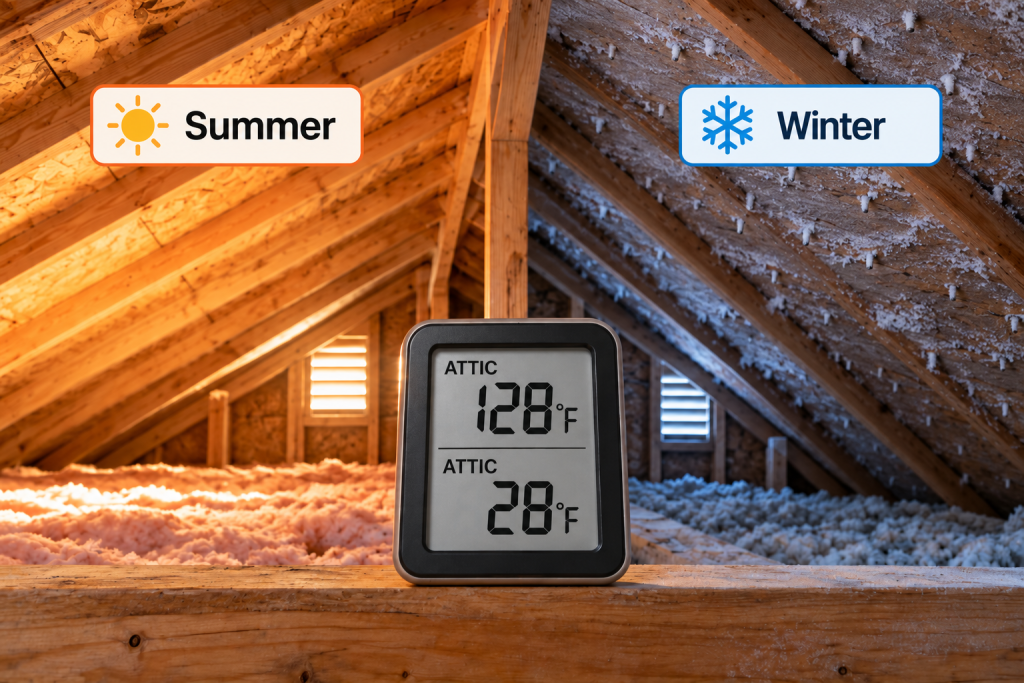
There is no single correct attic temperature for every home. A conventional vented attic can become much hotter than outdoor air on sunny summer days and can approach outdoor conditions during winter. Conditioned or unvented attics behave differently. A temperature reading is most useful as a clue when you compare it with patterns over time and signs such as blocked airflow, condensation, frost, moisture staining, or insulation problems.
| Attic Condition | What Temperature May Do | What Matters More |
|---|---|---|
| Vented attic in summer | Rise well above outdoor air | Airflow, insulation, and heat patterns |
| Vented attic in winter | Become quite cold | Condensation, frost, and air leakage |
| Conditioned or unvented attic | Stay closer to indoor conditions | How the assembly was designed |
| One unusually high or low reading | Reflect temporary weather conditions | Repeated patterns and other symptoms |
Temperature alone does not establish whether an attic is working correctly.
Why Attic Temperature Varies So Much
An attic sits directly below a roof that is exposed to sun, wind, rain, snow, and changing outdoor temperatures. Its temperature can therefore shift substantially over a single day.
Several factors influence how hot or cold an attic becomes:
- Outdoor air temperature
- Direct sunlight and cloud cover
- Roof orientation and slope
- Roofing color and material
- Amount and location of attic ventilation
- Insulation condition and distribution
- Air leakage from the living space
- Attic size and configuration
- Whether the attic is vented or conditioned
A south- or west-facing roof section may receive more intense afternoon sun than another part of the roof. Darker roof surfaces may absorb more solar energy than lighter ones, while different roofing materials can heat and cool at different rates.
For these reasons, comparing one attic temperature with a universal target is rarely useful.
Vented and Conditioned Attics Behave Differently
Before interpreting a temperature reading, identify what type of attic you have.
Vented attics
A conventional vented attic is generally outside the home’s conditioned building envelope. Insulation is typically located at the attic floor or ceiling level, while outdoor air can enter and leave through attic vents.
Because the attic itself is unconditioned, substantial temperature swings are expected. It may become very hot beneath a sun-heated roof in summer and quite cold in winter.
Ventilation can help remove heat and moisture, but it does not function like air conditioning. A properly vented attic should not be expected to remain at or within a fixed number of degrees of the outdoor temperature.
Conditioned or unvented attics
An unvented or conditioned attic is designed differently. Insulation and air-control layers may be located at the roofline, placing some or all of the attic within the building envelope.
Its temperature should therefore not be judged using the same expectations as a conventional vented attic.
If you are unsure which assembly you have, identifying that difference is more useful than comparing the temperature with a generic target. Converting one attic type to another is a building-envelope project, not a ventilation adjustment to make based on a thermometer reading.
What Attic Temperature Means in Summer
On a sunny day, the roof absorbs solar energy and can become much hotter than the surrounding air. Some of that heat transfers toward the attic, so a vented attic can run substantially hotter than the outdoor temperature.
Short periods of high attic heat are not automatically a problem. The time of day, roof orientation, roof material, cloud cover, wind, and recent weather all influence the reading.
A closer inspection makes more sense when prolonged or uneven heat appears alongside other clues, such as:
- Soffit intake blocked by insulation
- Missing or displaced airflow channels
- Weak or restricted exhaust paths
- Large temperature differences between attic sections
- Uneven or displaced insulation
- Signs of moisture or roof-deck deterioration
The important point is the combination of conditions. A hot attic by itself does not prove that ventilation is defective.
Insulation does not control attic air temperature
Homeowners sometimes expect more insulation on the attic floor to make the attic itself much cooler.
In a conventional vented attic, the primary job of that insulation is to slow heat transfer between the attic and the rooms below. The attic can still become very hot, while good insulation helps limit how much of that heat enters the living space.
Uneven, compressed, or missing insulation can affect comfort and heat transfer even when the attic air temperature seems typical.
What Attic Temperature Means in Winter
A cold vented attic during winter can be completely normal. Because it sits outside the conditioned envelope, its temperature may move toward outdoor conditions.
Cold temperature alone is usually less important than what happens to moisture in the attic.
Look more closely when cold conditions are accompanied by:
- Condensation on roof sheathing or fasteners
- Frost on attic surfaces
- Damp or darkened sheathing
- Moisture staining
- Wet insulation
- Persistent musty odors
These signs can indicate that moisture is reaching cold surfaces. Ventilation may be one factor, but indoor air leakage, high indoor moisture, roof leaks, or improperly routed exhaust ducts may also be involved.
A cold attic is therefore not automatically an under-insulated or poorly ventilated attic. The surrounding evidence matters more.
Why Air Sealing and Ventilation Both Matter
Temperature patterns can be misleading when warm household air is leaking into a vented attic.
Openings around ceiling penetrations and other gaps can allow heated, moisture-containing indoor air to move upward. In winter, this can create locally warmer areas and increase the chance of condensation or frost on nearby cold surfaces.
Ventilation and air sealing serve different purposes. Ventilation manages airflow through a vented attic, while air sealing limits unwanted air movement between the living space and attic.
This is why simply adding vents may not correct an attic temperature or moisture problem caused primarily by air leakage.
Bathroom or dryer exhaust that terminates in the attic can also introduce heat and moisture. During a visual inspection, note any duct that appears disconnected or ends in the attic rather than assuming temperature is the main problem.
If ceiling-plane leakage is affecting attic conditions, our attic air sealing guide explains the common gaps and penetrations that can allow warm indoor air into the attic.
How to Measure Attic Temperature Safely
You do not need sophisticated equipment to observe attic temperature trends. A basic digital thermometer, remote temperature sensor, or temperature-and-humidity monitor can provide useful information.
Remote monitoring is often convenient because it allows you to compare readings over time without repeatedly entering the attic.
Measurement location matters. A sensor near the attic floor may report a different temperature from one close to the roof deck. Readings can also differ near a soffit, ridge, gable end, or isolated roof section.
For useful comparisons, place a sensor in a safe, representative location and keep it there. Compare similar times and weather conditions instead of moving the device around and treating the readings as equivalent.
Do not walk on unsupported ceiling drywall or enter areas without secure footing. Avoid exposed or questionable electrical wiring, and do not disturb vermiculite or suspected asbestos-containing insulation.
Air temperature and surface temperature are different
A standard thermometer measures the temperature of the surrounding air.
An infrared thermometer measures the surface temperature of the object it is aimed at. A sun-heated roof deck can therefore produce a very different infrared reading from the attic air a short distance away.
Surface readings can help identify hotter or colder areas, but they should not be interpreted as the attic’s air temperature. Distance, angle, surface characteristics, and measurement location can also affect what an infrared thermometer reports.
Why Trends Are More Useful Than One Reading
One measurement captures only one moment.
A remote sensor that records attic conditions through hot afternoons, cool nights, or several days of changing weather can reveal more useful patterns. You may notice that temperatures rise sharply during direct afternoon sun, that one attic section remains unusually different from another, or that temperature changes coincide with moisture conditions.
Temperature monitoring is especially useful when you can compare it with outdoor weather and other observations.
Alongside temperature, look for:
- Blocked soffit intake
- Restricted exhaust pathways
- Missing or displaced baffles
- Uneven insulation
- Evidence of air leakage from below
- Bathroom or dryer exhaust problems
- Condensation or frost
- Dampness or moisture staining
These clues provide context that a thermometer cannot.
When Attic Temperature Justifies a Closer Inspection
An isolated hot summer reading or cold winter reading usually tells you little by itself.
Further inspection is more reasonable when unusual temperature patterns persist and appear with airflow restrictions, moisture, or obvious insulation defects. Large differences between connected attic areas may also justify checking whether airflow pathways or insulation conditions differ.
A safe visual inspection can often identify blocked soffits, displaced baffles, uneven insulation, moisture staining, or suspicious duct termination.
Do not climb onto a steep roof, cut vent openings, alter roof ventilation, or work around unsafe wiring to investigate a temperature concern. If the attic lacks stable flooring or an accessible platform, limit the inspection to areas you can view safely.
If high or uneven temperatures appear alongside blocked intake, condensation, or weak airflow, see our guide to the signs of poor attic ventilation.
When Professional Evaluation Makes Sense
Consider a qualified roofing, insulation, building-envelope, or attic professional when temperature concerns appear alongside conditions you cannot safely identify or correct.
Professional evaluation is especially appropriate when:
- Condensation or frost repeatedly develops.
- Roof sheathing or insulation remains damp.
- Significant moisture staining or mold-like growth is present.
- Several attic sections show very different conditions.
- Intake or exhaust pathways cannot be safely inspected.
- The attic contains unsafe wiring or suspect hazardous insulation.
- Roof modifications would be needed.
- You cannot tell whether the attic is vented, conditioned, or performing as designed.
The goal is to evaluate the entire attic assembly rather than prescribe a ventilation change from one temperature measurement.
Frequently Asked Questions
How hot is too hot for an attic?
There is no universal temperature at which every attic becomes “too hot.” Weather, sunlight, roof construction, ventilation, and attic design all affect temperature. Persistent heat is more meaningful when it occurs with blocked airflow, insulation problems, moisture, or other abnormalities.
Should attic temperature be the same as outside temperature?
Not necessarily. A vented attic can become much hotter than outdoor air when the roof is exposed to strong sunlight. In winter, it may be closer to outdoor conditions, but there is no fixed temperature difference that applies to every home.
Is a very cold attic bad in winter?
Not by itself. A conventional vented attic is expected to be cold because it is outside the conditioned envelope. Condensation, frost, damp sheathing, and air leakage are more useful warning signs than cold temperature alone.
Where should I measure attic temperature?
Use a safe, representative location away from direct contact with the roof deck and keep the sensor in the same place when comparing readings. Avoid unsupported drywall, hazardous insulation, and areas near exposed or questionable wiring.
Final Thoughts
Attic temperature is best treated as a clue rather than a pass-or-fail measurement. A hot summer attic or cold winter attic can be normal, especially in a conventional vented design.
What matters more is whether temperature patterns appear alongside blocked airflow, condensation, frost, moisture staining, uneven insulation, or air-sealing problems. When those conditions occur together or cannot be inspected safely, a professional evaluation can provide a more useful answer than another temperature reading.