
signs of poor attic ventilation: heat, moisture, and airflow clues
The most common signs of poor attic ventilation include trapped heat, condensation or frost, damp roof sheathing, blocked soffit intake, and weak airflow through the attic. None of these symptoms proves that ventilation is the cause. Air leakage, insulation defects, roof leaks, improperly routed exhaust ducts, and other moisture sources can create similar clues, so inspect the attic system before adding vents.
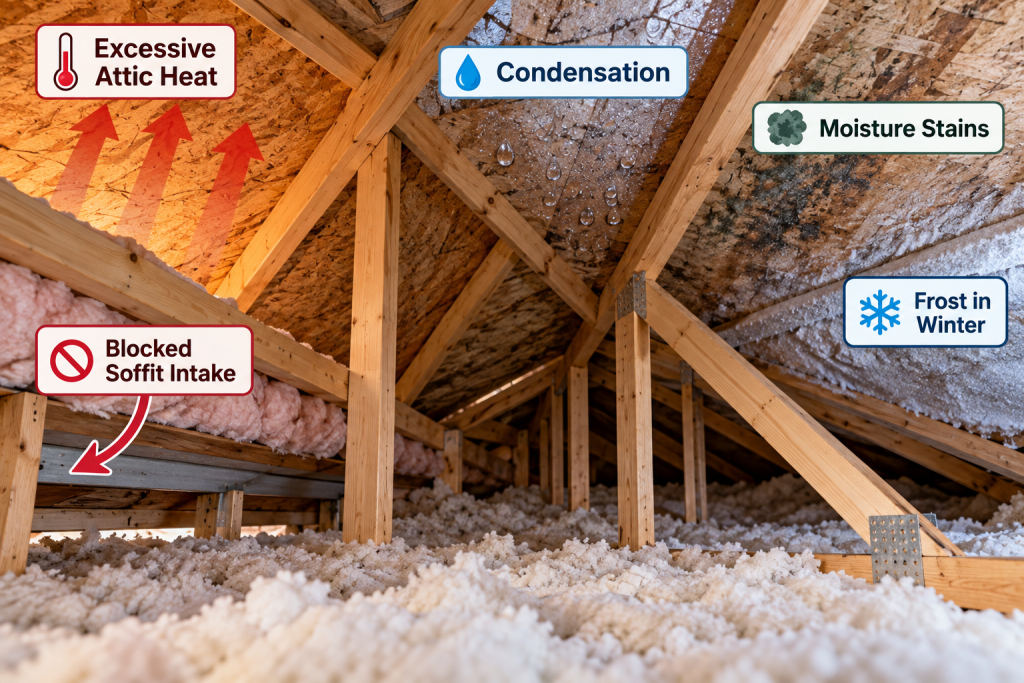
| What You Notice | What It May Suggest | What to Check Next |
|---|---|---|
| Excessive attic heat | Weak airflow or solar heat gain | Intake and exhaust pathways |
| Condensation or frost | Moisture reaching cold surfaces | Air leaks, exhaust ducts, ventilation |
| Damp or darkened sheathing | Repeated moisture exposure | Leak patterns and condensation clues |
| Blocked soffit vents | Reduced intake airflow | Insulation and baffle position |
| Exhaust vents but little intake | Unbalanced ventilation | Usable soffit or eave intake |
Treat these as diagnostic clues rather than proof of a ventilation failure.
What Poor Attic Ventilation Actually Means
A conventional vented attic depends on a continuous path for outside air to enter through lower intake vents and leave through higher exhaust vents.
Problems can develop when either side is restricted. A house may have several roof vents but still have weak ventilation if insulation blocks the soffits. Likewise, adequate intake cannot work as intended without sufficient, properly positioned exhaust.
Adding more exhaust is not an automatic solution. Without enough intake, extra exhaust may change pressure relationships without fixing the restricted airflow.
The main questions are whether usable intake and exhaust are present, whether air can move between them, and whether another source is adding excess heat or moisture.
Common Signs of Poor Attic Ventilation
No single symptom confirms a ventilation problem. Look for patterns involving heat, moisture, and restricted airflow.
Unusually hot attic or roof-deck conditions
Attics and roof decks naturally become hot in sunny weather, so temperature alone does not prove poor ventilation. More useful clues include persistent heat combined with blocked intake, limited exhaust, or noticeable differences between attic sections.
An isolated section of the attic may behave differently if it does not share the same airflow path. Premature-looking roofing or roof-deck heat stress can also be a clue, but it has other possible causes and should not be treated as proof.
Condensation on roof sheathing or fasteners
Water droplets on roof sheathing, nails, or other cold surfaces indicate that moist air is reaching a surface cool enough for condensation.
Ventilation may contribute, but the moisture source matters. Indoor air leakage, bathroom or dryer exhaust, plumbing leaks, and other moisture pathways can create the same condition.
Frost during cold weather
Moisture entering a cold attic can freeze on roof sheathing, fasteners, or other surfaces.
Frost is an important moisture warning, but it does not automatically mean more vents are needed. Indoor humidity and air leakage can also be major contributors, especially when frost returns repeatedly.
Damp or darkened roof sheathing
Damp, stained, or darkened roof sheathing deserves closer attention.
Localized staining below a roof penetration may suggest a leak, while broader moisture patterns may be consistent with condensation. Appearance alone may not distinguish the two, particularly after the wood has dried.
Musty odors or visible mold-like growth
A persistent musty odor can indicate a current or previous moisture problem. Visible spotting or growth on attic wood should also be treated as a moisture warning rather than identified by appearance alone.
The priority is finding why the material is becoming or remaining damp. If growth is widespread, damage appears extensive, or the area cannot be inspected safely, professional evaluation is appropriate.
Blocked Intake Is One of the Most Useful Clues
Poor intake is often easier to recognize from inside an accessible attic than inadequate exhaust.
Soffit vents may be visible outside yet provide little useful airflow if insulation blocks the openings or the path into the attic.
From stable attic flooring or a safe platform, look toward the eaves for:
- Insulation packed against the roof deck
- Soffit openings buried beneath insulation
- Compressed or displaced insulation near the eaves
- Missing airflow channels where the assembly requires them
- Baffles that are crushed, displaced, or blocked
- Intake paths that are open in one area but closed in another
In some attics, daylight may be visible near open soffit areas. Its absence does not prove a blockage because vent designs differ, but a clearly open pathway can help confirm that intake communicates with the attic.
Do not crawl onto unsupported ceiling drywall to inspect the eaves. If an area cannot be reached from stable framing, flooring, or an appropriate platform, leave that portion of the inspection to a professional.
If insulation is restricting soffit airflow, our soffit baffles guide explains how baffles help preserve a clear intake path at the eaves.
Why Moisture Problems Can Mimic Poor Ventilation
Ventilation is only one part of attic moisture control. Before assuming more ventilation is needed, check for other sources.
Air leakage from the living space
Warm indoor air can leak through ceiling penetrations and other gaps into the attic. When that moisture-containing air reaches cold surfaces, condensation or frost may form even when vents are present.
Ventilation and air sealing therefore address different problems: ventilation manages attic airflow, while air sealing limits unwanted air movement from the house.
Bathroom and dryer exhaust
Bathroom exhaust ducts and clothes-dryer ducts should not dump moist air into the attic.
During a safe visual inspection, look for ductwork that appears disconnected, damaged, or terminating in the attic. Do not dismantle ducts or work around energized equipment.
Roof leaks
Roof leaks can wet insulation, darken sheathing, and create odors that resemble condensation problems.
Localized staining around penetrations, flashing areas, or one roof section may point toward water entry rather than general airflow. Do not climb onto a steep roof or modify flashing to investigate.
If warm indoor air is leaking into the attic, our attic air sealing guide explains the common ceiling-plane gaps that can contribute to moisture problems.
Summer and Winter Clues Can Look Different
During hot weather, ventilation concerns may show up as intense heat or noticeable differences between attic sections. In cold weather, condensation and frost may make moisture problems easier to see.
Seasonal timing helps narrow the possibilities, but it does not establish the cause. Summer heat can result from normal solar gain, while winter moisture can be driven by indoor humidity, air leakage, or other sources.
What to Inspect Before Adding More Vents
Before changing the ventilation system, look for a complete intake-and-exhaust path rather than simply counting vents.
Check whether soffit or eave intake appears open, whether insulation blocks it, and whether baffles or other airflow channels remain properly positioned.
Then look for:
- Damp areas or water droplets
- Frost
- Staining or darkened sheathing
- Rust or moisture on exposed fasteners
- Visible mold-like growth
- Ducts that appear to terminate in the attic
- Obvious openings that may allow indoor air into the attic
Do not disturb vermiculite insulation or suspected asbestos-containing material. Avoid exposed or questionable electrical wiring, and never step between framing members when the only surface below is ceiling drywall. If the attic does not provide a safe walking or viewing area, stop the inspection.
When a Ventilation Calculation Helps
If the airflow paths appear open but the attic may have too little ventilation area, a ventilation calculation can provide a useful planning check. It compares attic floor area with the usable intake and exhaust capacity of the system.
The calculation does not replace an inspection. An attic can have enough vent area on paper and still perform poorly because soffits are blocked, attic sections are isolated, or airflow is uneven.
When Professional Evaluation Makes Sense
Consider a qualified roofing, building-envelope, or attic professional when the cause is unclear or correcting it would require roof modifications.
Professional evaluation is especially useful when:
- Condensation or frost repeatedly returns.
- Sheathing remains damp or shows widespread deterioration.
- Mold-like growth is extensive.
- Multiple attic sections do not communicate well.
- Intake cannot be inspected safely.
- Existing vent combinations create an unclear airflow pattern.
- A roof leak and condensation are difficult to distinguish.
- New roof openings or vent changes are being considered.
- Unsafe access or suspect hazardous insulation is present.
A professional can evaluate the complete attic system rather than assuming one symptom means more ventilation is required.
Frequently Asked Questions
What are the most common signs of poor attic ventilation?
Possible signs include trapped heat, condensation, frost, damp sheathing, blocked soffit vents, musty odors, weak intake, and uneven conditions between attic sections. Each can have causes other than ventilation.
Does a very hot attic mean the ventilation is bad?
Not necessarily. Solar heating can make an attic very hot even when ventilation is functioning. Heat becomes more useful diagnostically when it appears with blocked intake, limited exhaust, or uneven airflow.
Can blocked soffit vents cause attic ventilation problems?
Yes. If insulation or another obstruction prevents outside air from entering through the soffits, the attic may have inadequate usable intake even though exterior vents are visible.
Will adding more roof vents fix poor attic ventilation?
Not automatically. More exhaust does not correct blocked or inadequate intake, and adding vents without considering the existing airflow path may not solve the problem.
Final Thoughts
Good attic ventilation depends on a clear path from intake to exhaust, not simply on having a certain number of vents. Heat, condensation, frost, damp sheathing, and blocked soffits are clues, not proof of a ventilation failure.
If the attic shows heat or moisture problems, first look for blocked intake, missing airflow channels, air leakage, roof leaks, and other moisture sources before assuming the solution is simply adding more vents.