
siding repair cost: what homeowners can expect to pay
Siding repair cost can range from a few hundred dollars for a small, accessible repair to several thousand dollars when damage covers a larger area or extends behind the siding. Material type, labor rates, house height, matching difficulty, flashing and trim work, and hidden moisture damage all affect the final bill. For planning purposes, many professional siding repairs fall roughly between $350 and $1,500, but larger repairs can cost considerably more.
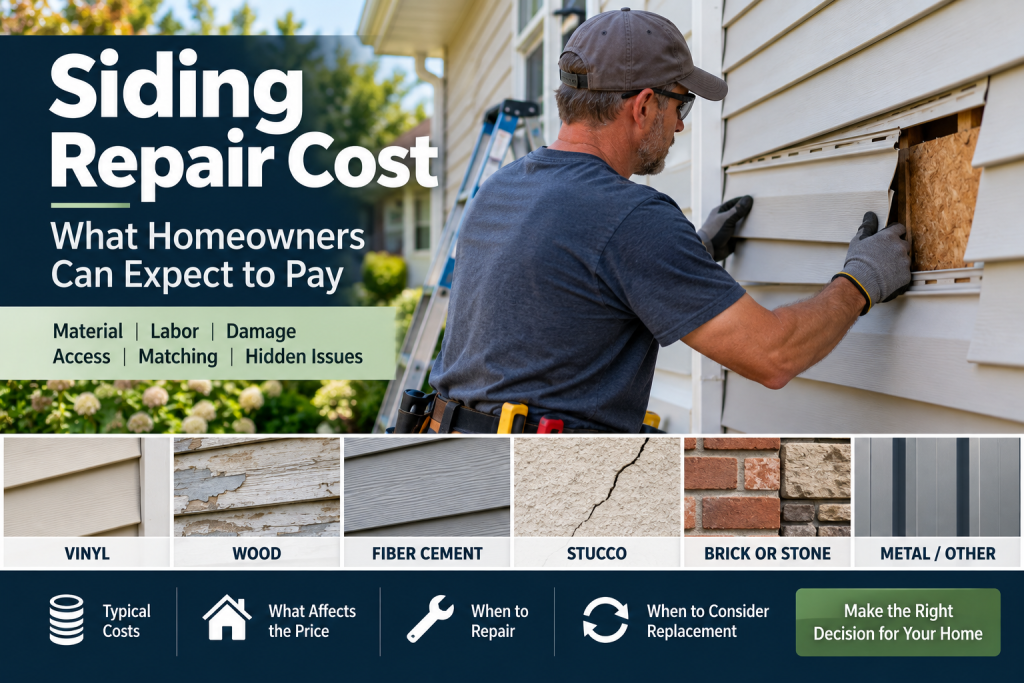
Average Siding Repair Cost
A useful national planning range for many professional siding repairs is about $350 to $1,500, with recent cost data placing the average near $900. Treat those figures as budgeting guidance rather than a quote.
Small isolated repairs may remain in the hundreds of dollars. Moderate repairs involving several boards or panels, difficult access, or finish matching can move into the low thousands. Once contractors uncover wet sheathing, rot, failed flashing, or damage across a large wall area, costs can rise well beyond a typical service call.
| Repair Type | Typical Cost Level | Main Cost Driver |
|---|---|---|
| Replacing a few vinyl panels | Low–Moderate | Matching material and minimum labor charge |
| Small crack or hole repair | Low | Access and service-call minimum |
| Damaged wood siding boards | Moderate | Rot extent, wood type, and finishing |
| Fiber cement board replacement | Moderate | Labor, handling, cutting, and finish matching |
| Stucco patching | Moderate–High | Patch depth, texture, and color matching |
| Brick or stone veneer repair | Moderate–High | Masonry labor and material matching |
| Widespread storm damage | High | Area affected and access |
| Repair with sheathing or water damage | High | Hidden damage and wall reconstruction |
A square-foot price can be useful on larger repairs, but it often does a poor job of predicting a tiny job. Contractors still have travel, setup, material sourcing, and minimum labor costs even when only one or two pieces of siding need attention.
Siding Repair Cost by Material
The siding material changes both the cost of the replacement pieces and the labor needed to make a convincing repair.
Vinyl Siding
Vinyl is generally among the less expensive siding materials to repair. An accessible area with a few damaged panels may stay relatively affordable when compatible replacements are readily available.
Matching is often the complication. Older vinyl can fade, and manufacturers may discontinue colors or profiles. A new panel may technically fit but stand out sharply from the surrounding siding.
Older siding can also become more brittle, making it harder to work around one damaged section without affecting neighboring panels.
If the damage is limited to vinyl siding, our guide on how to repair vinyl siding explains which common problems may be repairable and when a damaged panel should be replaced.
Wood Siding
Wood repairs vary widely because the visible damaged board may not represent the full problem.
A split board damaged by a single impact may be a relatively limited job. Wood affected by prolonged moisture can involve multiple boards, trim, paint or stain, and potentially deteriorated material underneath.
Wood species also influences cost. Matching an older cedar or specialty profile can be more expensive than obtaining a common siding board.
Finishing matters as well. Replacement wood usually needs an appropriate exterior finish, and blending that finish with weathered surrounding siding can add labor.
Fiber Cement Siding
Fiber cement repairs tend to cost more than comparable vinyl work because the boards are heavier and less flexible to handle.
Replacing damaged sections can involve careful removal, fastening, and finish matching. Cutting fiber cement can also create respirable crystalline silica dust, so professional work should use appropriate cutting methods and dust controls rather than uncontrolled dry cutting.
A factory-finished replacement board may not perfectly match material that has weathered for years. Painted siding can sometimes be easier to blend, although that adds finish work to the repair.
Stucco
Stucco repair cost depends heavily on what caused the visible defect.
A limited surface crack is different from an area that is loose, bulging, or deteriorated because water has entered the wall assembly. Larger patches also make texture and color matching more difficult.
Stucco is particularly sensitive to repair quality because an otherwise sound patch can remain conspicuous if its texture differs from the surrounding wall.
When cracking or deterioration is associated with moisture problems, investigation and correction of the underlying cause can cost substantially more than the visible patch.
Brick and Stone Veneer
Brick and stone veneer repairs typically involve specialized masonry labor, which tends to place them above simpler vinyl repairs.
Cost depends on the number of damaged units, mortar work, access, and whether replacement brick or stone can be matched closely enough.
Damage near windows, doors, ledges, or other transitions may also involve flashing and water-management details. Those repairs are more complex than replacing one visibly cracked masonry unit.
Natural or manufactured stone can be especially challenging to match because color, texture, shape, and pattern all contribute to the finished appearance.
Metal and Engineered Wood
Metal siding repair costs depend on the type of metal, profile, coating, and extent of denting or deformation. Older aluminum and steel profiles may be difficult to source, making matching a major cost factor.
Engineered wood is generally repaired by replacing damaged boards or panels and restoring the required finish. Costs rise when moisture damage extends beyond the visible siding or when replacement profiles are difficult to obtain.
What Affects Siding Repair Cost?
Two houses with similar-looking damage can receive very different estimates because the scope around that damage may be different.
Extent of Damage
Replacing one damaged section is usually far less expensive than repairing siding across several walls.
The total can rise quickly after hail, wind, falling branches, or prolonged water exposure because many pieces may need attention at once. Labor also becomes a larger portion of the project as removal and replacement expand.
Labor and Local Rates
Siding repair is labor-sensitive. Regional wages and contractor availability can therefore change the price substantially.
Specialty materials such as stucco, masonry, and some metal systems may require contractors with more specific experience, which can further affect local pricing.
House Height and Access
Easy first-story access generally costs less than work high on a multi-story wall.
Tight side yards, decks, large shrubs, roof intersections, steep grades, and other obstacles can slow setup and require additional access equipment.
Homeowners should not try to reduce a quote by taking on unsafe ladder or roof-edge work themselves. High or awkward siding damage is an appropriate place for professional access.
Matching Existing Siding
Material matching can turn a physically small repair into a frustrating project.
Vinyl colors fade. Wood grain and stain change with weathering. Stucco texture varies. Brick production runs differ. Some profiles simply disappear from the market.
When an exact replacement cannot be found, the choices may include accepting a visible repair, using material from a less-visible area when appropriate, refinishing a larger section, or replacing more siding to create a consistent appearance.
Trim, Flashing, and Penetrations
Damage in an open section of wall is often simpler than damage around building details.
Repairs near windows, doors, outside corners, utility penetrations, and roof-to-wall intersections may require trim removal, flashing work, additional cuts, or careful integration with the water-resistive barrier.
A quote that includes those details can reasonably be higher than one for the same amount of siding on a simple wall.
Hidden Damage
Hidden damage is one of the biggest reasons an exterior repair can exceed an initial estimate.
Removing damaged siding may expose:
- Wet or deteriorated sheathing
- Wood rot
- Failed or damaged flashing
- Torn water-resistive barrier
- Insect damage
- Deterioration around windows or doors
These conditions should not simply be covered with new siding. The source of the moisture or other damage needs to be corrected before the wall is closed again.
How Storm Damage Changes Repair Cost
Storms can produce anything from one punctured panel to damage across several elevations.
Hail may leave cracks, dents, chips, or broken sections depending on the siding material and storm intensity. High winds can loosen or remove siding, while branches and other flying debris can cause concentrated impact damage.
The cost depends largely on how widespread the damage is. An isolated first-floor impact may remain a small repair. Wind or hail affecting multiple sides of a two-story house can become a much larger project.
After a storm, photograph visible damage from safe locations if practical and review your homeowners policy if the event may be covered. Avoid climbing onto roofs or using unstable ladders to document inaccessible areas.
Why Small Repairs Sometimes Cost More Than Expected
One broken panel does not necessarily produce a tiny bill.
A contractor still has to travel to the property, assess the problem, obtain compatible material, set up safely, perform the work, and clean up. Many businesses therefore have minimum service or trip charges.
Older or uncommon siding can add sourcing time. Difficult second-story access can add setup. A replacement piece may need painting, staining, or special ordering.
These fixed costs are why the price per square foot can look unusually high on a very small repair compared with a larger project.
When Repair Is Usually the Better Choice
Repair generally makes sense when the problem is isolated, and the rest of the exterior is in good condition.
Good repair candidates usually have several things in common:
- Damage is confined to a small area.
- Surrounding siding remains sound.
- Compatible replacement material is available.
- The siding is not broadly brittle, rotten, or deteriorated.
- There is no unresolved water intrusion behind the wall.
- The repair can be made without dismantling a large portion of the exterior.
In these situations, replacing otherwise serviceable siding across an entire wall may offer little practical benefit.
When Replacement May Be Worth Comparing
Replacement deserves consideration when the repair scope keeps expanding.
Examples include widespread storm damage, chronic failures across multiple walls, extensive rot, brittle aging siding, or a discontinued product that is nearly impossible to match.
It can also make sense to compare replacement when contractors must remove large areas anyway to correct water damage or failed wall details.
That does not mean a particular dollar figure automatically triggers replacement. Compare the extent of the work, condition of the remaining siding, likelihood of future repairs, and availability of compatible material before deciding.
If repair costs are starting to approach a larger project, our siding replacement cost guide explains the main factors that affect the total price of replacing siding.
Can You Reduce Siding Repair Cost?
The safest ways to control costs involve preventing small problems from expanding and making estimates easier to compare.
Useful steps include:
- Address damaged or loose siding before repeated water exposure worsens the area.
- Keep leftover siding and records of manufacturer, profile, and color after installation.
- Avoid emergency scheduling when the condition is stable and can safely wait for normal service.
- Request written estimates for larger repairs.
- Ask whether the quote includes disposal, finishing, trim, and flashing work.
- Ask how hidden damage will be priced if contractors uncover it.
- Compare the work included in each estimate, not only the bottom-line number.
A lower estimate may not actually be less expensive if it excludes necessary wall or water-management work.
What Should a Siding Repair Estimate Include?
A clear estimate makes it easier to understand why one contractor’s price differs from another’s.
For a meaningful repair, look for information covering:
- Labor and siding materials
- Removal and disposal of damaged material
- Trim or flashing work included in the scope
- Wall or surface preparation
- Painting, staining, or other finishing when required
- Access or equipment charges when applicable
- How unexpected hidden damage will be handled
- Product and workmanship warranty information
For larger projects, ask the contractor to explain assumptions about the existing wall rather than relying on a single lump-sum number with little detail.
When to Call a Professional
Professional evaluation is appropriate when damage is high on the house, involves multiple stories, or requires work near roof edges or difficult access.
Call a qualified professional when water intrusion, extensive stucco or masonry deterioration, structural wall damage, or damaged siding around electrical equipment is suspected.
Older materials also require caution. Some cementitious siding products may contain asbestos. Suspected asbestos-containing siding should not be cut, sanded, drilled, ground, broken, removed, or otherwise disturbed; have it evaluated by an appropriately qualified asbestos professional.
Paint on older homes may contain lead as well. Work that disturbs painted surfaces on pre-1978 housing requires appropriate lead-safe practices rather than casual sanding or scraping.
Final Thoughts
Siding repair cost depends more on the true scope of the job than on any single national average. A small accessible repair with readily available material may remain in the hundreds of dollars, while difficult access, masonry work, widespread damage, or deterioration behind the siding can push the total into the thousands.
Before comparing estimates, identify the siding material, approximate extent of visible damage, access conditions, matching difficulty, and whether water may have reached the wall behind it. Those factors provide a much clearer picture of the likely repair than the number of damaged panels alone.