
how to repair vinyl siding: methods for common damage
Learning how to repair vinyl siding starts with identifying the type and extent of damage. A loose panel may only need to be re-locked, while small holes or cracks may be patchable. Severely cracked, warped, melted, or broken panels usually need replacement. If the damage exposes wet sheathing, rot, missing flashing, or other hidden problems, the repair should go beyond a cosmetic siding fix.
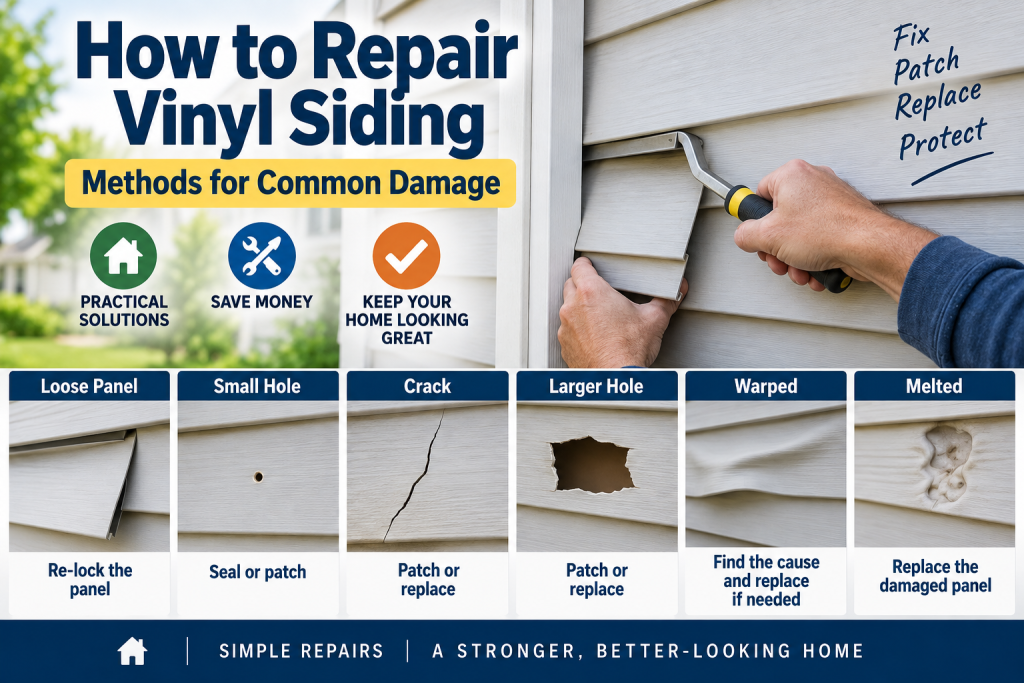
| Damage | Typical repair approach | DIY level | Replace panel? |
|---|---|---|---|
| Loose panel | Re-engage locking edge | Beginner-friendly at safe height | Usually no |
| Tiny hole | Exterior-compatible sealant | Simple | Usually no |
| Small crack | Limited patch | Moderate | Sometimes |
| Larger hole | Patch or replace panel | Moderate | Often |
| Warped panel | Correct cause, then replace if needed | Limited DIY | Often |
| Melted panel | Replace damaged piece | Moderate | Usually |
| Broken panel | Replace individual panel | Moderate | Yes |
Before You Repair Vinyl Siding
Inspect the area before deciding on a repair method. A damaged panel can sometimes hide a larger problem behind it.
Check:
- How large the damaged area is
- Whether one panel or several are affected
- Whether the panel is securely attached
- Whether you see staining, moisture, or deterioration behind the siding
- Whether nearby trim, flashing, or channels appear damaged
- Whether electrical service equipment is nearby
- Whether you can reach the area safely without risky ladder or roof-edge work
If removing or lifting a small section reveals rot, wet sheathing, mold, insect damage, missing flashing, structural deterioration, or electrical components, stop and have the area evaluated rather than expanding the DIY repair.
Vinyl siding can also cover much older exterior materials. Do not cut, drill, sand, grind, break, or remove older cementitious siding if asbestos is suspected. Older painted siding or trim may also contain lead.
Tools and Materials You May Need
The exact supplies depend on the repair, but common items include:
- Vinyl siding zip tool
- Matching replacement siding
- Utility knife
- Tin snips or an appropriate siding-cutting tool
- Tape measure
- Straightedge
- Exterior sealant compatible with vinyl
- Suitable patch material
- Work gloves
- Eye protection
Do not cut or disturb unknown older materials exposed behind the vinyl.
How to Fix Loose Vinyl Siding
A loose vinyl panel often means its lower locking edge has disengaged from the course beneath it. If the panel itself is intact and the area is safely accessible, it may simply need to be re-locked.
Step 1: Inspect the loose panel
Look for cracks, a broken locking lip, missing material, or obvious distortion.
If the locking edge is damaged, re-engaging it may not last, and panel replacement may be more appropriate.
Step 2: Hook the lower edge with a siding zip tool
Slip the zip tool beneath the lower edge of the loose panel and engage the locking lip.
Work only from a safe position. Do not attempt upper-story siding repair from an unstable ladder.
Step 3: Re-engage the locking lip
Pull the edge down slightly with the tool and press it back into the receiving lock on the siding below.
Work along the loose section until the panel is fully engaged.
Step 4: Check movement and alignment
The panel should sit straight but still have some ability to move side to side.
Vinyl siding should not be clamped tightly against the wall. Restricting normal movement can contribute to buckling as temperatures change.
How to Repair a Small Hole in Vinyl Siding
Very small punctures can sometimes be sealed without replacing the panel.
For a tiny hole, clean the surrounding surface and use a small amount of exterior sealant that is compatible with vinyl. Keep the repair no larger than necessary and use a color that blends with the siding when possible.
A larger visible hole should not simply be filled with a large blob of caulk. Once material is missing over a noticeable area, a proper patch or panel replacement generally produces a better and more durable result.
How to Repair a Larger Hole in Vinyl Siding
A larger opening may sometimes be covered with a piece of matching vinyl, but the repair should not interfere with the way the siding drains and moves.
A simple patch concept uses a piece of matching siding large enough to cover the damaged area cleanly. The patch needs to sit securely without rigidly fastening together parts of the siding that are designed to move.
This approach is best for limited cosmetic damage where the wall behind the siding is dry and intact.
If the opening exposes wet sheathing, rot, missing water-management details, insect damage, or other deterioration, do not cover it with a patch. The underlying problem should be evaluated first.
How to Repair Cracked Vinyl Siding
A short, stable crack may sometimes be patched if the panel remains secure and otherwise intact.
Long cracks, spreading cracks, or panels split completely through are better candidates for replacement. A crack near the locking edge is especially likely to affect the panel’s ability to remain engaged.
Cold vinyl can also become more brittle. Avoid forcing or sharply bending siding when temperatures make the material stiff.
No patch should be expected to make a significant crack completely invisible, especially on older siding that has faded.
If cracking is part of broader aging or deterioration, our guide on how long vinyl siding lasts explains which signs suggest the material may be nearing the end of its useful life.
When a Vinyl Siding Panel Should Be Replaced
Replacement is usually more reliable than patching when the panel is:
- Badly cracked
- Split through
- Missing a large section
- Severely punctured
- Warped or buckled beyond its original shape
- Melted by heat
- Broken along the locking edge
- Unable to remain engaged
- Repeatedly coming loose because the panel itself is damaged
Replacing one panel does not require replacing the entire wall when the surrounding siding remains serviceable.
If damage is widespread enough that individual panel repairs no longer make sense, our siding replacement cost guide explains the major factors that affect a larger replacement project.
How to Replace One Damaged Vinyl Siding Panel
Replacing a single panel can be reasonable when the work is safely reachable and does not require extensive siding removal.
Step 1: Confirm you have a matching replacement piece
Compare the profile, thickness, locking shape, and color before opening the wall.
Older siding often fades, so even an original matching color may look different when new.
Step 2: Unlock the siding above the damaged panel
Use a siding zip tool to release the lower edge of the course directly above the damaged piece.
Work carefully so you do not crack brittle siding or unnecessarily disturb adjacent panels.
Step 3: Remove the damaged panel carefully
Release the damaged piece from its fasteners and locking edge without expanding the opening farther than necessary.
Stop if removal exposes wet or deteriorated wall materials, damaged flashing, electrical components, or other hidden conditions.
Step 4: Install the replacement panel
Fit the new piece into the same location and engage its lower locking edge.
Vinyl needs room to expand and contract. It should not be nailed tightly against the wall or forced rigidly into place.
Step 5: Re-lock the siding above
Re-engage the upper panel using the zip tool and check that the repaired area sits straight.
Make sure the siding can still move normally, and that drainage or expansion openings have not been sealed.
How to Deal With Warped or Buckled Vinyl Siding
Warped siding usually needs more than being pushed flat.
Possible causes include siding fastened too tightly, insufficient expansion room, excessive heat exposure, an uneven wall surface, or installation problems.
If only one panel is distorted and surrounding siding remains flat, replacing that panel may solve the visible problem once the cause is corrected.
When several panels buckle or repeatedly distort, have the siding evaluated. Replacing individual pieces without addressing the reason they are moving is unlikely to provide a lasting repair.
Can Melted Vinyl Siding Be Repaired?
Heat-deformed vinyl usually cannot be reshaped reliably. Once the panel has melted, rippled, or permanently distorted, replacement is generally the practical repair.
Possible heat sources include grills, fires, high-temperature equipment, and concentrated reflected sunlight from some windows.
Address the heat source before installing new siding so the replacement is not damaged in the same way.
What About Dents in Vinyl Siding?
Vinyl does not typically dent like metal siding. Impact is more likely to leave a crease, deformation, crack, or puncture.
Minor deformation that does not affect the panel’s lock or create an opening may remain mostly cosmetic. Creased, split, or cracked panels are usually better replaced than repeatedly manipulated in an attempt to reshape them.
What If the Damage Is Near a Window, Door, Corner, or Utility Penetration?
These locations deserve extra caution because siding may interact with J-channel, corner trim, flashing, sealant, and other water-management details.
A simple patch may not solve damage if the surrounding trim or water-control components are also compromised.
Do not reconstruct flashing or remove large siding areas as part of a basic vinyl repair. Persistent leaks or damage around openings should be evaluated before the siding is closed again.
What If You Cannot Find Matching Vinyl Siding?
Matching older siding can be difficult because colors fade and manufacturers discontinue profiles.
A professional may sometimes obtain a donor piece from an inconspicuous part of the house and move the new, slightly mismatched piece to the less-visible location.
That approach avoids leaving an obvious color difference in a prominent area, but it may require more disassembly than a simple homeowner repair.
Sometimes an exact match is not possible. In that case, the practical goal is usually the closest compatible profile and the least noticeable color difference.
Common Vinyl Siding Repair Mistakes
Several mistakes can create new problems even when the original damage is small:
- Nailing vinyl siding tightly against the wall
- Caulking weep holes or drainage openings
- Sealing expansion paths that should remain free
- Using excessive sealant on larger holes
- Ignoring moisture damage behind the siding
- Forcing cold or brittle panels
- Using patch material that interferes with panel movement
- Replacing damaged siding without checking why it failed
- Attempting repairs too high on an unsafe ladder
A siding repair should restore the exterior without defeating the drainage and movement built into the system.
When to Call a Professional
Professional repair is appropriate when damage is high on the house, several panels are affected, or the job requires removing a large siding area.
Call for evaluation if you find wet or rotten sheathing, suspected flashing problems, repeated buckling, significant pest or mold damage, or deterioration behind the siding.
Professional help is also appropriate when the damaged area is near electrical service conductors or equipment. Do not position ladders, tools, siding panels, or removed materials near energized service components.
Final Thoughts
For many common problems, the repair path is straightforward: re-lock an intact loose panel, patch only very small damage, and replace panels that are badly cracked, warped, melted, split, or broken.
The goal is not only to hide the damaged spot. A sound vinyl siding repair preserves normal expansion, drainage, and water management while identifying hidden moisture or wall damage that needs attention before the exterior is closed again.