
how long does vinyl siding last: signs it may be time to replace
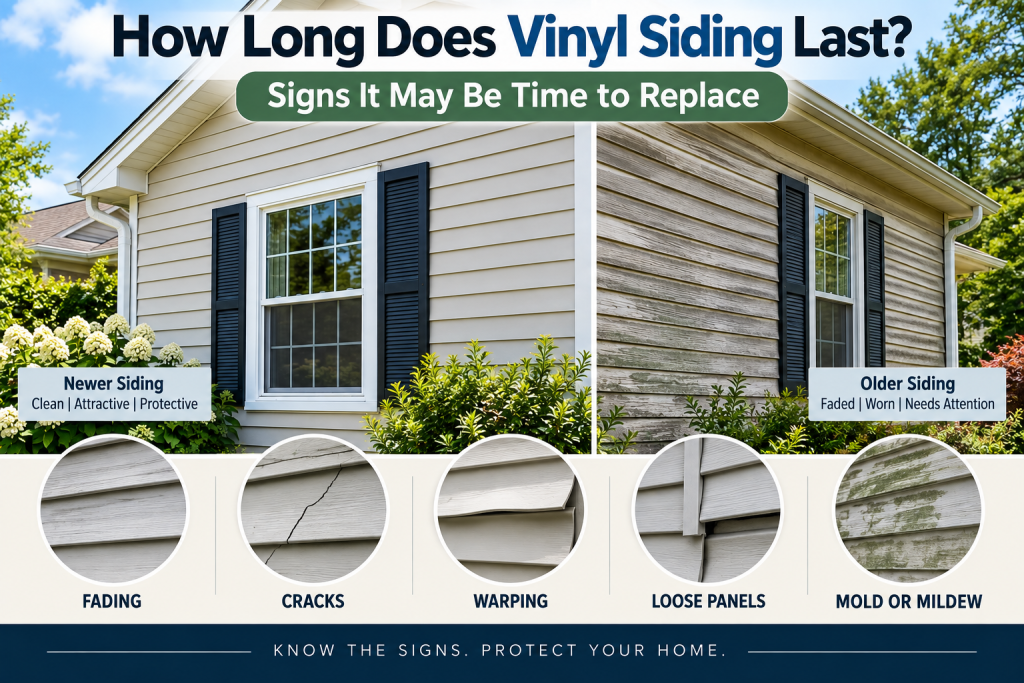
If you are wondering how long does vinyl siding last, a practical planning range is roughly 25 to 50 years, although there is no fixed expiration date. Product quality, installation, sun and heat, storms, impacts, and moisture management can shorten or extend its useful life. Physical condition matters more than age alone when deciding whether to keep, repair, or replace it.
How Long Does Vinyl Siding Usually Last?
Vinyl siding can remain serviceable for several decades. Roughly 25 to 50 years is a useful planning range, but an individual installation may fall outside it.
Age also means different things depending on what you are evaluating. Older siding may still protect the wall adequately even after its color has faded. Another house may have younger siding that needs substantial work because of storm damage, heat distortion, or installation problems.
It helps to separate four conditions:
- Still functional: Panels remain secure and generally intact, with no evidence of persistent water problems.
- Functionally sound but visibly aged: Fading or minor cosmetic wear is noticeable, but deterioration is limited.
- Increasingly difficult to repair: Damage is appearing in multiple places or matching panels are difficult to obtain.
- Replacement deserves consideration: Brittleness, widespread cracking, repeated failures, or underlying moisture problems affect significant areas.
The installation date is useful context, but the siding’s actual condition should drive the decision.
What Affects Vinyl Siding Lifespan?
Vinyl siding ages outdoors under constant exposure to temperature changes, sunlight, wind, rain, and physical impacts. Several factors determine how well it handles those conditions.
Product Quality
Vinyl siding products differ in thickness, profile design, formulation, color technology, and manufacturing quality.
Those differences can affect rigidity, impact performance, color retention, and how well panels retain their shape over time. A broad material label such as “vinyl siding” does not mean every product will age identically.
Installation Quality
Vinyl naturally expands and contracts as temperatures change. It needs to be installed so panels can move rather than being clamped tightly to the wall.
Incorrect fastening or insufficient room for movement can contribute to buckling, distortion, or gaps. Wind performance also depends on using the correct product and fastening pattern for the home’s exposure.
The wall behind the siding matters just as much. Vinyl siding is exterior cladding, not the wall’s water-resistive layer. Flashing and the water-management system behind it must direct penetrating rain back outside.
Sun and Heat Exposure
Years of ultraviolet exposure can gradually change vinyl’s appearance. Some fading is a normal part of exterior weathering and does not automatically mean the siding has failed.
Heat creates a different concern. Vinyl moves as temperatures rise and fall, and excessive or concentrated heat can distort it. In unusual situations, reflected sunlight from nearby glazing or another concentrated heat source can produce localized warping.
A distorted area that keeps returning or affects many panels deserves evaluation rather than being treated as simple cosmetic aging.
Cold Weather and Impacts
Cold temperatures can make some vinyl siding more vulnerable to impact damage.
A strike that might leave little damage during warmer conditions can crack a panel when it is very cold. Lawn equipment, falling branches, hail, and other impacts can therefore affect service life independently of the siding’s age.
One damaged panel does not mean the entire exterior has reached the end of its life. Repeated cracking across many panels is more significant.
Wind and Storm Exposure
High winds place stress on panel locks and fasteners. Hail and wind-driven debris can also crack, puncture, or loosen siding.
After a significant storm, inspect safely from the ground for missing pieces, open seams, cracks, or visibly loose sections. Do not use unsafe ladder setups to inspect upper walls; inaccessible damage can be assessed by a qualified siding or exterior contractor.
Repeated wind failures in the same area may point to installation, fastening, or exposure issues rather than ordinary aging alone.
Maintenance
Vinyl requires relatively little routine maintenance, but neglect can allow minor issues to become larger ones.
Keeping the surface reasonably clean and addressing damaged or loose sections promptly helps preserve the exterior. Cleaning should follow the siding manufacturer’s recommendations; aggressive methods that force water behind the cladding can create new problems.
Maintenance cannot make damaged siding last indefinitely. Its main value is helping you spot problems while they are still limited.
Signs Vinyl Siding Is Aging
Normal aging is not the same as failure.
Gradual fading is one of the most obvious changes. A wall with strong afternoon sun may age visually faster than a shaded elevation, which can leave different sides of the house looking slightly different.
You may also notice minor surface wear or an occasional damaged panel from an old impact. Older profiles and colors can become harder to match as product lines change.
Those conditions alone do not necessarily justify replacing an otherwise sound exterior. Cosmetic age becomes more important when it is accompanied by physical deterioration or makes necessary repairs increasingly impractical.
Signs It May Be Time to Replace Vinyl Siding
Replacement deserves closer consideration when problems are widespread rather than isolated.
Important warning signs include:
- Cracks appearing across numerous panels
- Siding that has become noticeably brittle and fails easily
- Multiple punctured, chipped, or otherwise damaged sections
- Widespread buckling, warping, or heat distortion
- Panels that repeatedly loosen or disengage
- Large areas damaged by hail, wind, or flying debris
- Repeated repairs on several walls
- Water intrusion or deterioration behind the siding
- Recurring trouble around windows, doors, or other penetrations
- Difficulty obtaining compatible replacement panels
- Numerous mismatched patches from previous repairs
The pattern matters. One cracked panel after an impact is different from cracks appearing throughout an aging exterior with no single recent cause.
When Is Repair Still Reasonable?
Repair usually remains practical when the problem is confined to a small area, and the rest of the siding is sound.
A limited repair is more promising when compatible replacement material is available, surrounding panels are intact and secure, and there is no evidence of an unresolved leak or widespread deterioration.
Color matching can complicate an otherwise straightforward repair. Even when the original color is still sold, a new panel may look different beside siding that has weathered for many years.
Repair becomes less attractive when every new problem reveals another fragile or damaged area nearby. At that point, the issue is no longer one isolated defect.
If the damage is still localized, our guide on how to repair vinyl siding explains which problems may be patchable or repairable and when replacing a damaged panel makes more sense.
When Replacement Makes More Sense Than Repair
Replacement becomes easier to justify when repairs are solving individual symptoms but the exterior continues to deteriorate as a whole.
That can occur after a major storm damages multiple walls, when siding has become broadly brittle, or when repeated wind failures affect large portions of the house.
Replacement may also become practical when the existing siding has faded enough that every repaired section is conspicuous and the original profile is no longer available.
Water problems deserve separate attention. If inspection finds damaged sheathing, incorrect flashing, or another source of persistent moisture, those conditions need to be corrected rather than covered with new siding.
Major remodeling can also change the calculation. Work involving many windows, doors, wall penetrations, or other exterior changes may make retaining heavily aged siding increasingly difficult.
Does Faded Vinyl Siding Need to Be Replaced?
No. Fading by itself is usually a cosmetic reason to consider replacement, not proof that the siding has stopped functioning.
Look at the physical condition along with the color. Siding that remains intact, secure, properly shaped, and free of significant moisture-related problems may still be serviceable despite visible fading.
Fading does create a practical repair problem. A brand-new replacement panel can stand out against decades of weathered siding, even when the nominal color is correct.
If the house has both substantial fading and widespread physical damage, replacing a larger area may produce a more consistent result than accumulating visible patches.
Can Vinyl Siding Last Longer Than Expected?
Yes. A planning range is not a deadline.
Good-quality siding can remain useful longer when it was installed correctly, has moderate exposure, avoids major impacts, and continues to work with a dry, properly detailed wall assembly.
A homeowner therefore does not need to replace siding simply because it reaches a certain birthday. An older installation that remains intact and performs well may have useful service life left.
Continue monitoring it for changes rather than treating age alone as a failure test.
Can Vinyl Siding Fail Early?
Vinyl siding can develop serious problems well before its expected service life when conditions are unfavorable.
Premature problems can result from improper fastening, inadequate allowance for expansion and contraction, severe wind or hail, repeated impacts, excessive heat, or product defects.
Problems behind the cladding can also make an apparently young siding installation part of a larger repair. Poor window flashing or another source of water intrusion, for example, can damage sheathing even though the vinyl itself does not rot.
Early failure should therefore prompt an evaluation of the cause rather than an assumption that replacing a few panels will solve it.
Check the Wall Behind the Siding
The condition of the vinyl is only part of the decision. The wall it covers also needs to remain dry and sound.
Possible warning signs of a problem behind the cladding include interior water staining, recurring dampness near openings, deteriorated sheathing discovered during professional evaluation, rot around windows or doors, and persistent musty odors associated with a particular exterior wall.
Do not cover unresolved water intrusion with replacement siding. The leak path, damaged materials, and flashing or drainage problem should be addressed first.
Older houses can also have previous siding layers or nearby materials that require special caution. Some older cementitious siding may contain asbestos. Do not cut, drill, sand, grind, break, remove, or otherwise disturb suspected asbestos-containing material.
Painted exterior surfaces in older homes may contain lead as well. Work that disturbs those coatings requires appropriate lead-safe practices rather than casual sanding or scraping.
How to Decide Whether to Keep, Repair, or Replace
The most useful decision is based on the extent of deterioration, not age alone.
Keep the existing siding when damage is minor, panels remain secure and intact, the appearance is acceptable, and there are no signs of persistent water problems.
Repair limited damage when only a small number of panels are affected, compatible material is available, and the surrounding siding remains healthy.
Consider replacement when deterioration extends across multiple walls, panels are increasingly brittle, storm or heat damage is extensive, repairs keep recurring, matching material is unavailable, or moisture problems require broader wall work.
When several of those replacement conditions appear together, continuing to patch individual areas can become less practical even though some original panels remain usable.
If replacement is becoming the more practical choice, our siding replacement cost guide explains the major factors that affect the total project price.
Final Thoughts
Vinyl siding does not have one expiration date. A practical answer to how long does vinyl siding last is several decades, with roughly 25 to 50 years serving as a broad planning range rather than a guarantee.
The better measure is condition. Isolated damage can often remain a repair issue, while widespread brittleness, cracking, distortion, repeated failures, difficult material matching, or moisture behind the siding can shift the decision toward replacement.