
how to get rid of carpet beetles: find the source and stop the infestation
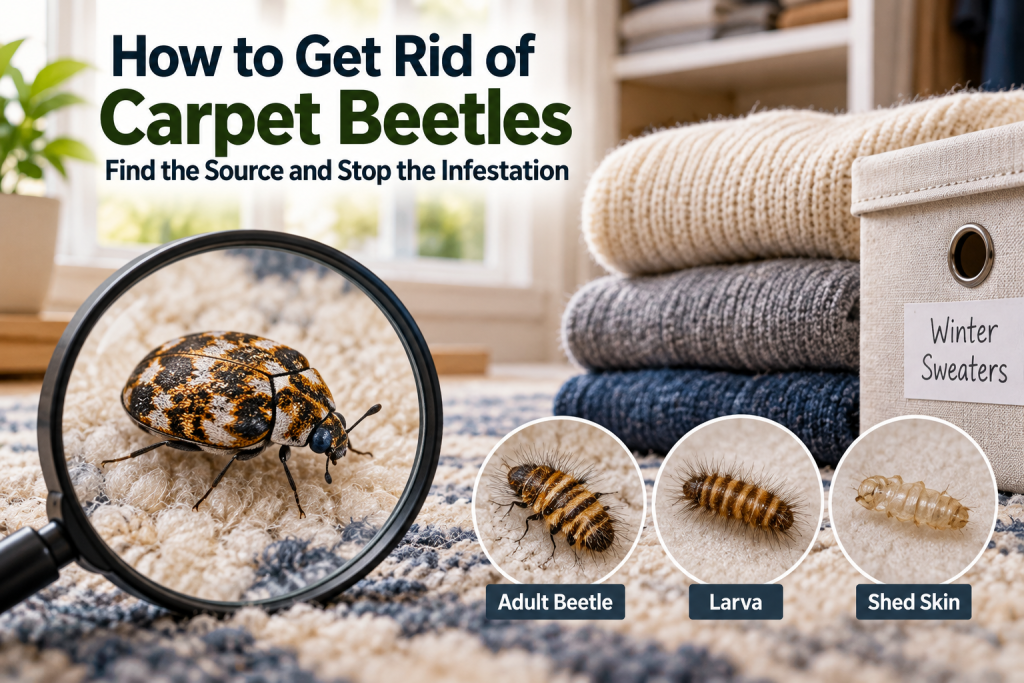
How to get rid of carpet beetles starts with finding what the larvae are feeding on, then removing or cleaning that source. Adult beetles may be the insects you notice near windows, but the fuzzy larvae cause most household material damage. Inspect vulnerable fabrics and quiet storage areas, vacuum lint and debris thoroughly, clean affected items appropriately, and protect clean belongings from renewed activity.
| What you notice | What it may mean | What to do |
|---|---|---|
| Small beetles near windows | Adult carpet beetle activity | Check nearby rooms and stored materials for larvae |
| Fuzzy or bristly larvae | Active larval stage | Inspect fabrics, lint, pet hair, and other possible food sources |
| Shed skins along baseboards | Larvae have been developing nearby | Vacuum and inspect surrounding areas |
| Irregular fabric damage | Possible larval feeding | Check natural-fiber items, seams, folds, and storage areas |
| Repeated activity after cleaning | A source may remain | Reinspect overlooked rooms, stored goods, and debris |
What Carpet Beetles Are
Carpet beetles are small beetles that may be rounded or oval as adults. Some common species have mottled patterns, while others are darker and less distinctive.
The larvae look very different. They are usually brownish and fuzzy or bristly, and this larval stage causes most damage to household materials.
Adult carpet beetles may be attracted to light and are often noticed near windows. Finding one adult beetle does not automatically mean the home has a serious infestation, but repeated sightings or the presence of larvae deserve a closer look.
Common Signs of Carpet Beetles
Carpet beetle activity can show up in several ways.
Watch for:
- Small adult beetles near windows or window tracks
- Fuzzy or bristly larvae
- Shed larval skins
- Irregular holes or thinning in natural-fiber fabrics
- Damage along rug edges or beneath furniture
- Larvae in closets, storage boxes, or quiet corners
- Activity along baseboards
- Repeated beetle sightings in the same area
Damage is often easier to spot on items that remain undisturbed for long periods. Stored blankets, seasonal clothing, rugs beneath furniture, and materials at the back of closets deserve particular attention.
Carpet Beetles vs. Clothes Moths
Carpet beetles and clothes moths can both damage natural-fiber materials, but they are different pests.
| Feature | Carpet beetles | Clothes moths |
|---|---|---|
| Adult form | Beetle | Moth |
| Larvae | Usually fuzzy or bristly | Caterpillar-like |
| Damage | Often irregular patches or thinning | May occur with webbing or cases, depending on species |
| Movement | Larvae may wander away from food | Larvae often remain close to suitable materials |
This comparison is useful for a first look, but damaged or very small insects can be difficult to identify confidently.
Where Carpet Beetles Come From
Carpet beetle larvae can feed on a range of animal-derived materials and accumulated household debris.
Possible sources include:
- Wool rugs and clothing
- Fur
- Feathers
- Felt
- Silk
- Leather or other animal-derived materials
- Stored natural-fiber fabrics
- Lint and pet hair
- Dead insects
- Insect remains in window tracks
- Bird or rodent nesting material
- Taxidermy or natural-material collections
Synthetic carpet by itself is not necessarily the food source. The problem may instead be lint, hair, dead insects, or natural-fiber material collected along carpet edges or beneath furniture.
For broader pest prevention beyond carpet beetles, see our whole-home guide on how to keep bugs out by reducing food sources, shelter, moisture, and common entry points.
How to Get Rid of Carpet Beetles by Finding the Source
Killing the adult beetles you see near a window will not solve an infestation if larvae are still feeding elsewhere.
Start where activity is most concentrated, then inspect nearby rooms and storage areas methodically.
Check likely hiding and feeding areas
Inspect:
- Closets
- Rug edges
- Beneath furniture
- Baseboards
- Window tracks
- Storage boxes
- Linen storage
- Pet resting areas
- Rarely disturbed corners
- Stored wool or natural-fiber items
- Floor vents that can be checked safely
- Attic or storage areas that are safely accessible
Look for larvae, shed skins, fabric damage, lint, pet hair, dead insects, and concentrated debris.
A cluster of evidence in one location is more useful than a single adult beetle found elsewhere.
Inspect Rugs, Clothing, and Stored Fabrics
Natural-fiber materials deserve careful inspection when carpet beetles are suspected.
Check items made with or containing:
- Wool
- Silk
- Fur
- Feathers
- Felt
- Natural-fiber rug materials
- Stored blankets
- Seasonal clothing
- Upholstery containing vulnerable natural fibers
Look along seams, folds, edges, undersides, and areas that remain dark and undisturbed.
Do not cut into furniture, pull apart rug backing, or otherwise damage an item just to search for larvae. A careful visual inspection is enough for the homeowner stage.
What should be discarded?
Throwing away everything nearby is unnecessary.
Discard material when it is heavily infested, badly damaged, contaminated beyond practical cleaning, or a low-value item is clearly acting as an ongoing source.
Valuable rugs, clothing, furniture, heirlooms, or collections deserve a more conservative approach. Professional cleaning, textile care, or conservation help may be more appropriate than aggressive home treatment.
Vacuum Thoroughly
Vacuuming is one of the most useful low-risk control steps because it can remove larvae, shed skins, lint, hair, dead insects, and other debris that may support continued activity.
Focus on:
- Rug and carpet edges
- Baseboards
- Under furniture
- Closet floors
- Window tracks
- Accessible floor vents
- Upholstered furniture seams
- Pet resting areas
- Quiet corners where debris collects
Move accessible furniture when practical so you can clean areas that are normally undisturbed.
After vacuuming an active infestation area, dispose of the vacuum contents promptly. For a bagless vacuum, empty the container outside the living area where practical. For a bagged vacuum, remove and discard the bag according to the vacuum manufacturer’s directions.
Vacuuming is important, but it does not guarantee elimination if an infested item or other food source remains.
Wash or Clean Affected Items Appropriately
Washable clothing, blankets, and other fabrics can be cleaned according to their care labels.
Laundering or professional cleaning can help remove insects, shed skins, and debris from suitable items. Avoid using a universal water temperature or drying method because some wool, silk, and other delicate materials can shrink or be damaged.
For valuable, fragile, or difficult-to-clean items, professional cleaning is the safer choice.
Do not apply heat, chemicals, or other aggressive treatments to valuable textiles unless the item’s care requirements specifically allow it.
Clean Lint, Hair, and Dead Insects
This step is easy to overlook.
Carpet beetle larvae may feed on pet hair, lint, dead insects, feathers, and other animal-derived material that accumulates in quiet places. The infestation source does not always turn out to be an obvious wool garment or rug.
Clean carefully:
- Beneath beds, sofas, and cabinets
- Along baseboards
- Around heat registers
- In window tracks
- Inside closet corners
- Around pet beds
- Beneath stored boxes
- In other rarely cleaned storage areas
Removing these materials reduces potential food sources and makes future larvae easier to notice.
Check Bird and Rodent Nesting Material Safely
Old bird nests, rodent nesting material, feathers, or animal debris near the structure can sometimes support carpet beetle larvae.
Homeowners can visually inspect safe, accessible areas and note any suspicious nesting material near where beetles are appearing.
Do not climb onto roofs, enter unsafe attics, disturb active bird or rodent nests, or handle accumulated animal waste without appropriate precautions.
If a suspected nest or debris source is high, inaccessible, active, or potentially hazardous, contact an appropriate pest, wildlife, or building professional.
Protect Clean and Unaffected Items
Once an area and its belongings have been cleaned, make it harder for new activity to go unnoticed.
Practical steps include:
- Clean clothing before long-term storage
- Avoid storing soiled wool or other natural-fiber garments
- Use durable storage containers with secure lids
- Keep stored materials away from lint and pet-hair buildup
- Inspect seasonal items periodically
- Keep storage areas clean and dry
These measures are especially useful for woolens, blankets, felt items, feathers, and other materials that may remain untouched for months.
Do Sticky Traps Help?
Sticky traps can help monitor adult beetles or general insect activity in a room.
They may show whether beetles continue appearing or whether activity is stronger in one area than another. However, traps do not remove larvae hidden in fabrics, lint, dead insects, or other feeding material.
Use traps as a monitoring aid rather than the main control method.
What About Insecticides?
Insecticides should not be the first or only response to carpet beetles. Finding the larval food source and cleaning affected areas are more important.
If you use a pest-control product, it should be specifically labeled for the pest and location. Follow the label exactly, keep products away from children and pets, and avoid food-contact areas.
Do not spray clothing, rugs, furniture, or other fabrics unless the product label specifically permits that use. Avoid broad indoor spraying, foggers, homemade pesticide mixtures, and improvised applications.
A pesticide cannot compensate for an overlooked source of larvae.
Why Carpet Beetles Keep Coming Back
Recurring activity usually means larvae still have access to food somewhere.
Common reasons include:
- An infested item was missed
- Lint or pet hair remains beneath furniture
- Dead insects remain in window tracks or hidden edges
- Stored wool or natural-fiber items were overlooked
- Old bird or rodent nesting material is nearby
- Activity is occurring in another room
- Only adult beetles were removed
When beetles or larvae continue appearing, return to source identification rather than simply treating the insects you can see.
If recurring activity seems tied to stored dry food rather than fabrics, lint, or animal-derived materials, see how to get rid of pantry moths by finding and removing the infested food source.
A Practical Carpet Beetle Control Sequence
Step 1: Confirm the insect or larva
Look for adult beetles, fuzzy larvae, shed skins, or characteristic material damage.
Step 2: Find where activity is concentrated
Note the rooms, closets, rugs, or storage areas with the most evidence.
Step 3: Inspect vulnerable materials
Check natural-fiber rugs, clothing, blankets, upholstery, and stored items.
Step 4: Remove or isolate infested material
Discard low-value material that is badly infested or separate valuable items for appropriate cleaning.
Step 5: Vacuum thoroughly
Remove larvae, shed skins, lint, hair, dead insects, and debris from accessible areas.
Step 6: Clean appropriate fabrics
Follow care labels or use professional cleaning for delicate or valuable items.
Step 7: Check overlooked debris sources
Inspect window tracks, pet areas, baseboards, and other quiet locations.
Step 8: Look for nesting material
Visually inspect safe, accessible areas for bird or rodent material without disturbing active or hazardous nests.
Step 9: Protect cleaned belongings
Use clean, secure storage for vulnerable fabrics and periodically reinspect them.
Step 10: Reinspect if activity continues
Repeated larvae or beetles suggest that another source remains.
When Professional Help May Be Useful
Professional pest evaluation may be worthwhile when larvae continue appearing after repeated cleaning, activity occurs in several rooms, or the source cannot be located.
Seek additional help when valuable rugs, fabrics, furniture, or collections are being damaged, when inaccessible nesting material may be involved, or when you cannot confidently identify the insect.
Extensive infestations may also benefit from professional assessment so the source can be located without unnecessary pesticide use or damage to belongings.
Final Thoughts
The most effective approach to how to get rid of carpet beetles is to focus on the larvae and what they are feeding on. Inspect vulnerable natural-fiber materials, remove or appropriately clean infested sources, and vacuum lint, pet hair, shed skins, dead insects, and other debris thoroughly.
Protect cleaned belongings in secure storage and monitor for renewed activity. If larvae continue appearing or the source remains hidden, a pest professional can help determine what was missed.