AC Making Grinding Noise? Causes and what to Do
AC making grinding noise is not a normal operating sound. Turn cooling off at the thermostat and avoid restarting the system simply to hear the noise again. Grinding, scraping, or metal-on-metal sounds commonly involve a fan blade contacting something, worn motor bearings, a damaged blower wheel, or possible compressor trouble. Continued operation can worsen mechanical damage.
You can make basic observations from outside the equipment, but do not remove panels, reach through a fan guard, or reach into the indoor air handler.
AC Making Grinding Noise: What to Do First
A genuine grinding sound is a shut-it-off symptom. Focus on where and when the noise occurred rather than trying to identify the exact failed part.
- Turn the cooling system off at the thermostat.
- Do not restart it merely to reproduce the sound.
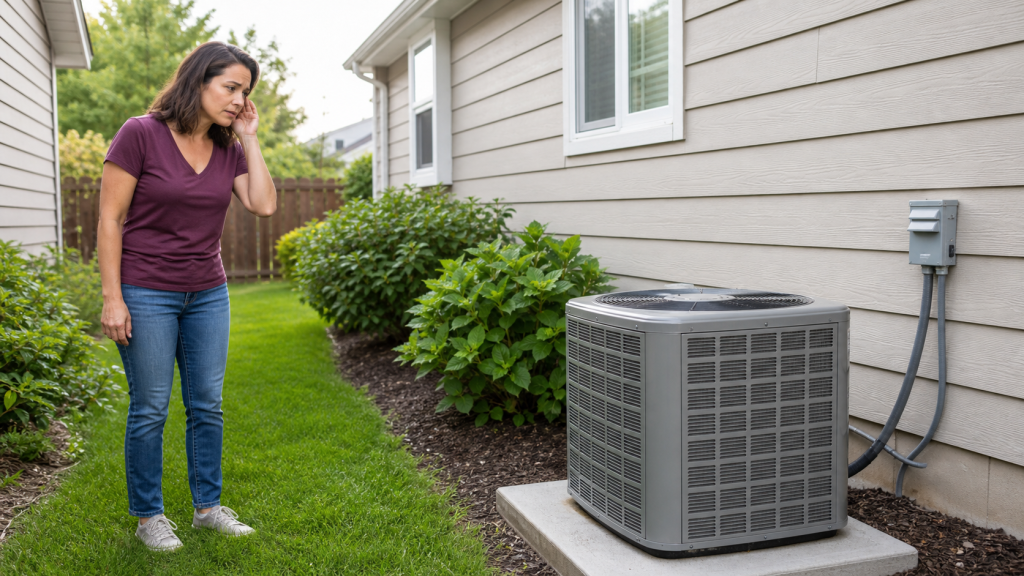
- Determine whether the noise came from the outdoor condenser or indoor air handler. Do this from a safe distance.
- Note when it happened. Was it during startup, continuously while running, during shutdown, or only while a fan was operating?
- Look for additional warning signs. From a safe position, note smoke, a burning odor, severe vibration, or visible cabinet damage.
- Leave the system off and arrange professional diagnosis for a genuine grinding sound.
- Move away and call emergency services for smoke, fire, visible arcing, or another immediate electrical or fire hazard.
Do not reach into either unit or remove an access panel to investigate.
Quick AC Grinding-Noise Diagnosis Table
| Where or When You Hear It | Possible Cause | Other Clues | Immediate Action |
|---|---|---|---|
| Outdoor unit while fan runs | Fan motor, blade, or debris contact | Wobbling, scraping, fan slowing | Turn AC off |
| Outdoor unit during startup | Motor, fan, or compressor problem | Hard start, vibration, repeated noise | Leave system off |
| Deep grinding low in outdoor cabinet | Possible compressor trouble | Poor cooling, harsh vibration, starting trouble | Call HVAC professional |
| Indoor air handler while airflow is present | Blower motor or wheel problem | Noise starts with indoor fan | Turn AC off |
| Grinding with weak airflow | Blower problem or other airflow issue | Reduced air from vents | Leave system off |
| Grinding with severe vibration | Loose or damaged mechanical part | Cabinet shaking | Turn AC off |
| Grinding followed by fan stopping | Motor, fan, or mechanical failure | Airflow or outdoor fan stops | Call for service |
| Grinding with burning smell | Motor or electrical problem | Heat, smoke, shutdown | Turn off; urgent service |
| Brief scraping at startup or shutdown | Moving part rubbing as speed changes | Sound follows fan or motor speed | Keep system off if truly scraping |
| Noise continues after cooling is off | Another fan, appliance, or building component | AC equipment no longer operating | Identify location safely |
These patterns help narrow the possibilities, but they do not confirm which component has failed.
Why an AC Makes a Grinding Noise
Fans, motors, blower wheels, and the compressor should operate without harsh metal-on-metal contact. A true grinding noise usually means a moving component is worn, damaged, loose, obstructed, or no longer aligned correctly.
Possible causes include:
- Worn or failing motor bearings
- A bent, loose, or damaged fan blade
- A fan blade rubbing the housing or guard
- A loose or damaged blower wheel
- A foreign object contacting a moving part
- Compressor trouble
- A loose motor or mounting assembly
- Another mechanical component shifting out of alignment
A dirty air filter does not normally create a true grinding sound by itself. Restricted airflow can cause other operating problems and place additional strain on the system, so the filter is still worth checking if it is safely accessible.
Grinding Noise From the Outdoor AC Unit
An outside AC unit making a grinding noise usually directs attention toward one of the major moving components in the condenser.
The outdoor unit contains the condenser fan motor and fan blade as well as the compressor. Sound location and timing can help an HVAC technician decide where to begin testing.
For example, grinding that appears only while the outdoor fan turns may point toward the fan assembly. A deeper harsh noise that seems to come from lower inside the cabinet may involve the compressor or another internal component.
The sound alone is not enough to diagnose either one.
The outdoor condenser also contains high-voltage electrical components, and its fan can start unexpectedly under some conditions. Keep all inspections external.
If your outdoor condenser has stopped running altogether, our guide to an outside AC unit not turning on explains the safe checks for thermostat settings, visible power conditions, airflow, and possible safety shutdowns. Do not restart an AC that has been making a grinding noise.
AC Fan Making a Grinding Noise
An AC fan making a grinding noise may have a mechanical problem involving the motor, blade, mounting, or something contacting the rotating fan.
Possible causes include:
- Worn fan-motor bearings
- A bent or damaged fan blade
- A loose motor or fan assembly
- A blade rubbing the guard or cabinet
- Debris contacting a blade
You may be able to see obvious cabinet damage or debris resting against the outside of the unit without touching anything. That is as far as the inspection should go.
Do not:
- Remove the condenser top or fan guard
- Reach through the guard
- Spin the fan blade by hand
- Insert a stick, screwdriver, or other tool
- Continue running the AC if the fan is not rotating normally
Grinding or clanking followed by a fan stopping is a strong reason to leave the equipment off and call for service.
AC Compressor Grinding Noise
The compressor circulates refrigerant through the cooling system so heat can be moved from inside the home to outdoors.
An AC compressor grinding noise, banging, or other harsh mechanical sound can indicate an internal compressor problem. Other symptoms may include:
- Reduced or lost cooling
- Difficulty starting
- Severe vibration
- Overheating or unexpected shutdowns
- Repeated breaker trips
These symptoms can have more than one cause, so a noisy compressor should not be diagnosed from sound alone.
Compressor testing involves electrical and refrigeration-system diagnosis. Refrigerant handling also requires proper equipment and qualifications. Leave the system off and have a qualified HVAC professional determine the cause.
Continuing to operate a compressor that is mechanically deteriorating may cause additional damage.
Grinding Noise From the Indoor Air Handler
A grinding noise from an indoor AC unit often begins when the blower starts.
The blower wheel and motor move household air through the evaporator section and duct system. Problems that can create an air handler grinding noise include:
- Worn blower-motor bearings
- A loose or damaged blower wheel
- A blower wheel rubbing its housing
- A shifted motor or mounting assembly
- Debris contacting the blower
- Another mechanical failure
Possible clues include weak or uneven airflow, vibration near the air handler, grinding that starts with the indoor fan, or airflow that stops shortly after the noise begins.
An AC blower making grinding noise requires professional inspection. Do not open the blower compartment, reach inside, or attempt to rotate or tighten internal parts.
Grinding Noise During Startup, Operation, or Shutdown
The timing of the sound is valuable information for the technician.
Grinding When the AC Starts
An AC grinding noise when starting may involve a fan motor, blower motor, compressor, or another component having difficulty as it begins rotating.
A short sound does not make it harmless. If it is genuinely grinding or scraping, keep the system off rather than cycling it again.
Grinding While the AC Runs
Continuous grinding may indicate ongoing contact between moving parts, deteriorated bearings, fan damage, blower trouble, or compressor problems.
A sound that changes with fan speed can be another useful clue, but it still does not identify the exact failed component.
Grinding When the AC Shuts Off
An AC grinding noise when shutting off can occur as a moving component slows and rubs against another part. A loose fan, blower assembly, or other mechanical component may also shift as rotational speed falls.
Report the shutdown timing to the technician rather than restarting the AC to test it again.
Grinding vs Other Common AC Noises
Noise descriptions can overlap, especially when heard through walls or ductwork.
- Grinding or scraping: Harsh rubbing or metal-contact sound
- Rattling: Loose panel, fastener, debris, or another moving object
- Buzzing: Electrical or motor-related issue, though causes vary
- Humming: Can be normal at low levels or abnormal if new or unusually loud
- Squealing: Often associated with rotating motor or blower components
- Clicking: Controls may click normally, but repeated abnormal clicking needs diagnosis
- Hissing: May involve airflow or a refrigeration-system problem
- Duct popping: Sheet metal can move as pressure and temperature change
You do not need to identify the sound perfectly. Avoid repeatedly restarting the equipment just to decide whether it is grinding, scraping, or squealing.
What Homeowners Can Safely Check
Once cooling is off, keep checks simple and external.
- Confirm that the thermostat is no longer calling for cooling.
- Note whether the sound came from indoors or outdoors.
- Check a normally accessible air filter and replace it if it is dirty.
- Make sure ordinary supply vents and return grilles are unobstructed.
- Look around the condenser for leaves, branches, or objects resting against the outside of the cabinet.
- Note visible cabinet damage without touching internal parts.
- Recall whether airflow or cooling became weaker before the grinding began.
- Write down whether the noise occurred at startup, during operation, or at shutdown.
- Record a short sound or video only if you can do it safely without restarting the equipment or moving close to a hazard.
Replacing a dirty filter may correct an airflow restriction, but it should not be treated as a repair for a true AC making scraping noise or metal-on-metal sound.
What Not to Do
- Do not keep running the AC.
- Do not repeatedly restart it.
- Do not remove condenser or air-handler panels.
- Do not reach through a fan guard.
- Do not manually spin a fan blade.
- Do not test capacitors, wiring, motors, or the compressor.
- Do not reset a breaker that repeatedly trips.
- Do not handle refrigerant or open the refrigeration system.
- Do not attempt to lubricate sealed motor bearings.
- Do not assume the system is safe because it is still cooling.
A system can continue producing cool air for a time even while a mechanical part is deteriorating.
When to Call an HVAC Professional
Any genuine grinding or metal-on-metal AC noise deserves professional diagnosis, especially when you also notice:
- Weak or lost cooling
- Weak airflow
- Severe vibration
- An outdoor fan that is not spinning normally
- A burning odor
- Visible smoke
- Repeated breaker trips
- Difficulty starting
- Unexpected shutdowns
- Noise that is worsening rapidly
An HVAC technician may inspect the condenser fan blade and motor, indoor blower wheel and motor, compressor, mounting hardware, electrical components, and overall system operation.
The diagnosis does not automatically mean the entire air conditioner needs replacement. The needed repair depends on which component is actually causing the sound and the condition of the rest of the system.
Can You Run an AC That Is Making a Grinding Noise?
No. A genuine grinding sound is a reason to turn cooling off until the cause has been diagnosed.
An AC grinding noise but still cooling can be misleading. A worn motor bearing, damaged fan, rubbing blower wheel, or failing compressor may continue operating temporarily before deteriorating further.
Do not run the system for a few more minutes to see whether the noise clears up. Leaving it off reduces the chance of turning an existing mechanical problem into additional damage.
How to Reduce the Risk of Future AC Noise Problems
Routine care cannot prevent every motor, fan, or compressor failure, but it can help catch abnormal operation earlier.
- Schedule periodic professional HVAC maintenance.
- Inspect and replace the air filter as appropriate for your system and household conditions.
- Keep normal supply and return openings unobstructed.
- Keep leaves, branches, and stored items away from the outdoor condenser.
- Pay attention to new sounds before they become severe.
- Avoid pressure washing the condenser or inserting tools into it.
- Schedule service when vibration, airflow, startup behavior, or cooling performance changes noticeably.
The goal is not to make the system silent. It is to recognize when its normal operating sound changes into a mechanical warning.
For a practical schedule of filter inspections, outdoor equipment checks, and seasonal professional servicing, follow our preventive HVAC maintenance guide to help identify developing problems before they become more serious.
Frequently Asked Questions
Why is my AC making a grinding noise?
Possible causes include worn motor bearings, a damaged or rubbing fan blade, a loose blower wheel, debris contacting a moving component, a mounting problem, or compressor trouble. Sound alone cannot identify the failed part.
Should I turn off an AC that is grinding?
Yes. Turn cooling off at the thermostat and leave the system off until the cause is diagnosed. Do not repeatedly restart it.
Can a bad AC compressor make a grinding noise?
Yes. Internal compressor problems can produce grinding, banging, or other harsh mechanical noises, but a technician must confirm the cause.
Can a bad fan motor make a grinding noise?
Yes. Worn bearings or other fan-motor problems can create rough grinding or scraping sounds. Blade damage or contact can produce similar noise.
Why is my outside AC unit making a grinding noise?
The condenser fan, fan motor, compressor, debris contact, or another mechanical problem may be involved. Keep the system off and have it inspected.
Why is my indoor AC unit making a grinding noise?
A grinding noise from the indoor AC unit may involve the blower motor, blower wheel, mounting assembly, or something rubbing inside the air handler.
Can a dirty air filter cause a grinding noise?
A dirty filter does not normally create a true metal-on-metal grinding sound. It can restrict airflow and contribute to other system problems, so replace it if needed without assuming that the grinding issue is repaired.
Why does my AC grind only when it starts?
Startup grinding can involve a motor, fan, blower, compressor, or another moving component as it begins operating. Timing helps with diagnosis but does not prove the cause.
Can I keep using the AC if it is still cooling?
No. Continued cooling does not mean the system is mechanically sound. Leave it off until the grinding noise has been diagnosed.
Is an AC grinding noise expensive to repair?
The cost depends on the actual failed component, equipment design, labor required, and system condition. A grinding sound alone cannot determine the repair cost.
Can debris cause the outdoor fan to grind?
Debris contacting a fan blade can create scraping or grinding sounds. Do not reach through the guard or remove the condenser top to retrieve an object.
What information should I give the HVAC technician?
Tell the technician whether the noise came from the indoor or outdoor unit, when it occurred, whether airflow or cooling changed, and whether you noticed vibration, burning odors, smoke, breaker trips, or fan problems.
Final Recommendation
Treat AC making grinding noise as a reason to stop operation, not as a sound to monitor while the equipment continues running. The likely problem involves a moving mechanical component such as a fan motor, fan blade, blower assembly, mounting part, or possibly the compressor.
Limit homeowner troubleshooting to simple external observations. Keep panels closed, stay away from moving and electrical parts, and leave the system off for professional diagnosis.