
attic insulation cost: what affects the price?
Attic insulation cost depends on attic size, insulation type, target R-value, existing insulation, access, labor, air sealing, removal needs, moisture or contamination problems, and regional pricing. A simple top-up in a clean, accessible attic can cost much less than a project involving removal, repairs, difficult access, extensive preparation, or a change from attic-floor insulation to a specialized roof-deck assembly.
Because those variables differ so much from house to house, one national average is less useful than understanding what is included in a particular estimate.
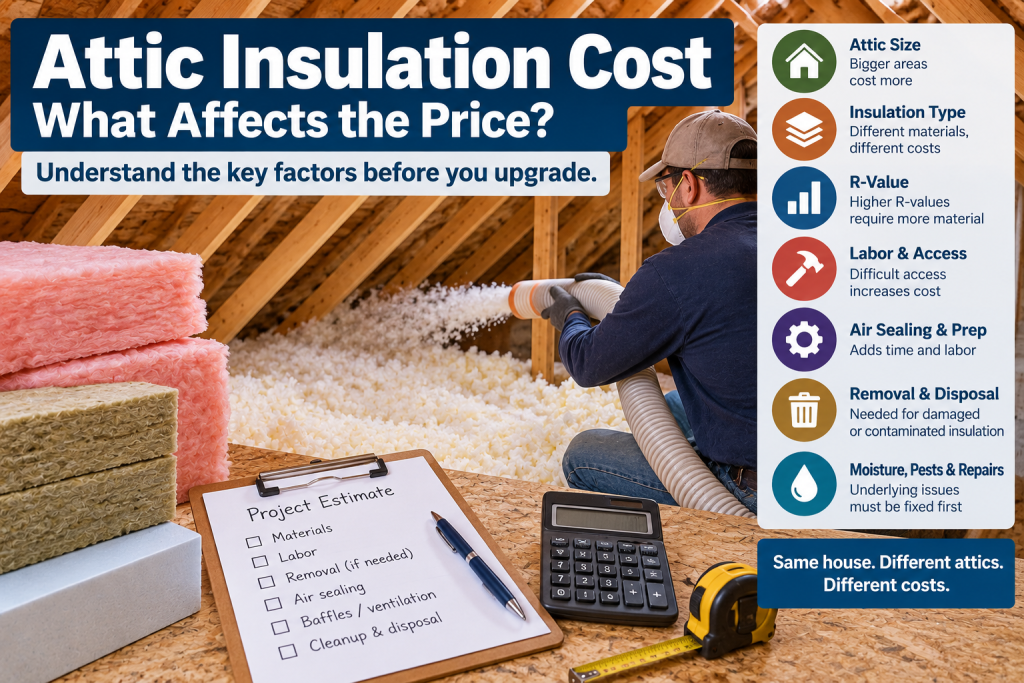
| Cost factor | Lower-cost situation | Higher-cost situation | Why it matters |
|---|---|---|---|
| Existing insulation | Dry and serviceable | Damaged or contaminated | May determine whether removal is needed |
| Access | Large, easy-to-reach attic | Small hatch or low clearance | Difficult access increases labor |
| Material | Common batt or loose-fill systems | Mineral wool, spray foam, specialized assemblies | Material and installation methods differ |
| R-value target | Small top-up | Major increase from little insulation | More material and labor are required |
| Preparation | Attic ready for insulation | Air sealing, baffles, or repairs needed | Adds work before insulation goes in |
| Removal | Existing material stays | Removal, bagging, hauling, disposal | Can become a major project expense |
| Moisture or contamination | None present | Leaks, mold, pests, hazardous material | Underlying problems must be addressed first |
What Affects Attic Insulation Cost?
The insulation itself is only one part of the total.
Two similar-size homes can receive very different estimates because one attic needs only additional loose fill while the other requires insulation removal, air sealing, ventilation baffles, moisture repairs, or extensive labor in confined spaces.
The main price drivers are:
- attic area
- amount of insulation needed
- insulation material and installation method
- condition of existing insulation
- labor and regional rates
- attic accessibility
- removal and disposal
- air sealing and ventilation preparation
- moisture, pests, contamination, or repair needs
The best way to budget is to define the project scope first and compare estimates that cover the same work.
Attic Size and Required R-Value
Attic square footage is one of the basic cost drivers because a larger area requires more insulation and more installation time.
Do not automatically use the home’s total square footage as the attic measurement. A two-story house, finished attic, addition, or unusual roofline may have a different insulation area than the home’s advertised living area.
The required R-value also changes how much material is needed. A house already reasonably close to its appropriate insulation level may need only a top-up. A poorly insulated or nearly bare attic can require substantially more material.
Material matters because different insulation types need different installed depths to reach the same target. That is why comparing estimates only by the number of inches being added can be misleading.
If you are still determining how much insulation your attic may need, our attic insulation R-value guide explains how climate and insulation depth affect the target.
How Insulation Type Changes the Price
Material choice affects both product cost and labor.
Fiberglass batts are commonly positioned toward the lower end of attic-insulation options, especially when framing is open, regular, and easy to access. Complicated fitting can increase labor.
Blown-in fiberglass is also commonly used for attic floors and top-ups. Equipment and labor affect the final price, but it can be efficient for covering broad or irregular areas.
Cellulose is another relatively economical loose-fill option frequently used for attic top-ups and retrofit work.
Mineral wool generally carries a higher material cost than common fiberglass or cellulose products. Its use may be justified in assemblies where its specific characteristics are valuable.
Spray foam is usually a higher-cost professional installation. Roof-deck spray foam can also represent a fundamentally different attic assembly rather than a simple replacement for loose-fill insulation.
Rigid foam is typically used in specialized roof, knee-wall, or enclosure details rather than as a default open-attic-floor material. Those projects should be priced as complete assemblies, not compared only by board cost.
The cheapest bag or batt does not necessarily produce the cheapest finished project. Ease of installation, preparation, required depth, and labor all affect the total.
Top-Up vs. Insulation Removal and Replacement
Whether existing insulation can remain is one of the biggest cost questions.
A top-up is generally simpler when the existing material is dry, reasonably clean, serviceable, and compatible with the new insulation. In that situation, the project may involve preparation followed by additional insulation rather than removing everything first.
Old insulation does not automatically need replacement simply because of its age.
Removal can become appropriate when insulation has significant water damage, mold, pest contamination, major physical damage, or another condition that prevents it from remaining safely in place. Repairs may also require the attic floor to be exposed.
Removal adds labor for collecting or vacuuming material, containment, bagging, hauling, disposal, and cleanup before new insulation can be installed.
If pebble-like vermiculite insulation is present or suspected, do not treat it as an ordinary removal job. Do not disturb, vacuum, or remove it yourself. Have it professionally evaluated before any work that could disturb the material. This does not mean that all older insulation contains asbestos.
Why Attic Access and Layout Affect Labor Cost
An easy-to-enter attic with good working clearance generally requires less labor than a confined attic where every movement is difficult.
Costs may increase when installers must work around:
- small access openings
- very low roof areas
- complicated framing
- HVAC equipment or ducts
- wiring and plumbing
- difficult-to-reach eaves
- finished attic sections
- numerous obstructions
Access can also affect removal costs because old material must be transported out of the attic safely.
Do not use a low contractor estimate as a reason to attempt unsafe access yourself. Walking on ceiling drywall, balancing on exposed joists, or working around energized wiring can turn an insulation project into a serious hazard.
Air Sealing, Baffles, and Preparation Costs
A quality insulation project may include work that is not technically insulation.
Air sealing addresses uncontrolled air movement through openings in the ceiling plane. If accessible leaks need attention, completing that work before adding insulation can improve the value of the overall upgrade and prevent those locations from being buried.
The amount of preparation depends on how many penetrations, framing gaps, utility chases, and other leakage points require attention.
Vented attics may also need baffles or ventilation chutes near the eaves so additional insulation does not block soffit airflow. Existing blocked openings may require correction before the insulation layer is increased.
These items add cost, but omitting necessary preparation simply to reduce the estimate can leave the attic with avoidable performance or moisture problems.
Before pricing a top-up, it is worth checking whether ceiling-plane leakage needs attention first; our attic air sealing guide explains what to look for.
Before pricing a top-up, it is worth checking whether ceiling-plane leakage needs attention first; our attic air sealing guide explains what to look for.
Moisture, Mold, Pests, and Other Problems That Increase Cost
Unexpected attic conditions can move a project well beyond the cost of insulation alone.
An active roof leak needs repair before new insulation covers the affected area. Recurring condensation or unexplained moisture may require further diagnosis.
Pest activity can add costs for exclusion, contaminated-insulation removal, cleaning, and related repairs. Significant mold may require professional evaluation and remediation rather than ordinary insulation work.
Damaged wiring or uncertain clearances around recessed lights, flues, or other heat-producing components can also require the appropriate professional before insulation is added.
These problems should be treated as separate work rather than hidden inside a cheap insulation quote.
DIY vs. Professional Attic Insulation Cost
DIY installation can reduce direct labor charges on certain simple projects, but labor is not the only expense.
A homeowner installing insulation may still need to pay for:
- insulation material
- blower rental for loose-fill products
- protective equipment
- baffles or ventilation protection
- appropriate air-sealing materials
- transportation
- cleanup and disposal
- additional material needed to achieve the planned coverage
Professional estimates may bundle material, labor, equipment, preparation, cleanup, and disposal. Some contractors may also provide workmanship coverage or warranties, depending on the company and project.
DIY is therefore not automatically cheaper once access, equipment, preparation, and safety are considered. Spray foam, suspected hazardous materials, major contamination, serious moisture problems, and difficult attic conditions belong in professional scope.
How to Compare Attic Insulation Estimates
Compare the work being proposed, not only the final dollar amount.
Two estimates that appear far apart may actually describe different projects. Before comparing totals, confirm that each contractor is pricing the same basic scope.
Ask what the estimate includes for:
- attic area
- insulation type
- target R-value or installed specification
- existing insulation
- air sealing
- ventilation baffles or eave protection
- removal and disposal
- cleanup
- access limitations
- repairs specifically excluded
- final insulation depth or coverage
A lower estimate that omits needed removal, air sealing, or ventilation preparation is not directly comparable with one that includes those services.
Likewise, confirm whether a quote is for adding insulation at the attic floor or creating a substantially different roof-deck or conditioned-attic assembly.
Ways to Control Cost Without Cutting Corners
The most useful savings come from controlling scope intelligently rather than eliminating necessary work.
Preserve existing insulation when it is dry, serviceable, compatible, and does not need removal for repairs. Correct leaks before paying to install material that could become wet again.
Address accessible air-leakage issues before another insulation layer makes them harder to reach. If other attic work is planned—such as electrical, duct, or roof-related repairs—coordinate it before the final insulation layer when practical.
Get comparable estimates using the same target R-value and preparation requirements. This makes differences in labor and material easier to understand.
Finally, avoid choosing insulation solely by the lowest upfront material price. A product that costs less but is difficult to install correctly in a particular attic may not produce the least expensive or most effective completed project.
Frequently Asked Questions
How much does attic insulation cost?
There is no single dependable figure for every attic. Area, material, required R-value, labor, access, preparation, existing insulation, and removal needs can change the total substantially. Local estimates based on the same project scope provide a more useful comparison than a national average alone.
Is it cheaper to add insulation over existing insulation?
Usually, when the existing insulation is dry, serviceable, and suitable to remain, avoiding unnecessary removal can save labor and disposal costs.
Does old attic insulation need to be removed first?
Not simply because it is old; removal is more likely when insulation is wet, contaminated, badly damaged, pest-affected, or must be moved for necessary repairs.
Does air sealing increase attic insulation cost?
Yes, when additional air-sealing work is needed. However, doing it before the attic is covered with more insulation can make the overall upgrade more complete and avoid burying accessible leakage points.
Final Thoughts
Attic insulation cost is driven by far more than the price of insulation. Attic area, required R-value, material, existing conditions, access, preparation, removal, air sealing, ventilation protection, and labor can all change the final project.
For budgeting, first determine whether the attic needs a straightforward top-up or a larger repair-and-insulation project. Then compare estimates with matching scopes. Preserving serviceable insulation and correcting problems before new material goes in can control cost without sacrificing the quality of the upgrade.