
battery backup sump Pump buying guide: how to choose the right backup
A battery backup sump pump gives a primary sump system a second way to remove water when the main pump cannot keep up or loses power. The right backup depends on more than pump size. Your sump basin, discharge piping, required pumping height, battery arrangement, outage risk, alarms, and maintenance access all affect which system makes sense.
Before buying, confirm that the backup pump physically fits the existing sump setup and can move enough water under the conditions in your home. Installation requirements differ by system, and plumbing or electrical modifications may call for professional help.
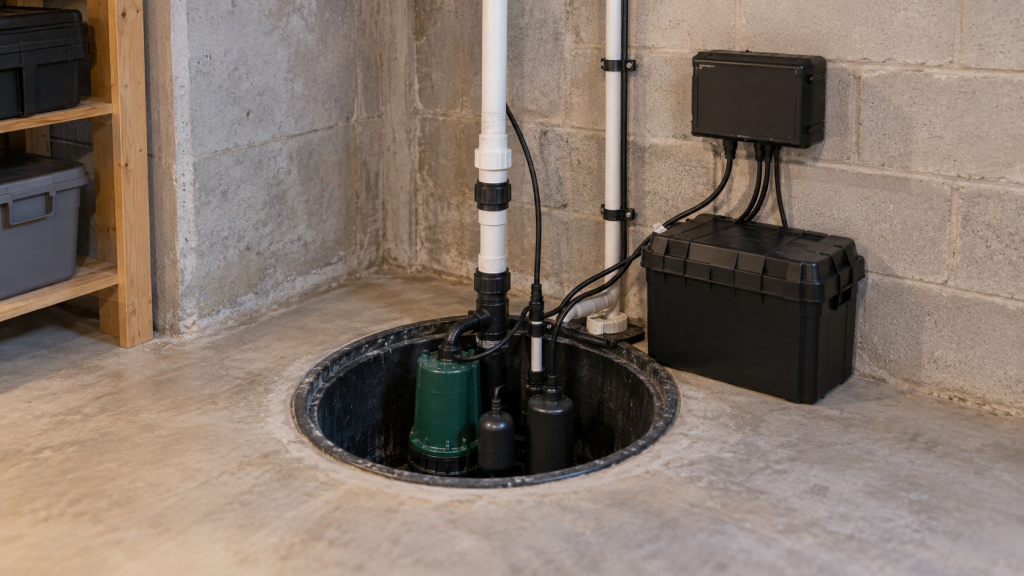
What a Battery Backup Sump Pump Does
Most primary residential sump pumps operate on household AC power. A battery backup system adds a separate pump powered by a standby battery so it can respond when water rises beyond the primary pump’s normal operating level.
Depending on the system, the backup may activate because:
- Utility power has failed.
- The primary pump has stopped working.
- Water is entering faster than the primary pump can remove it.
- The water level rises high enough to activate the backup float.
A backup pump is not meant to make an undersized or failing primary system acceptable. It is an additional layer of protection for abnormal conditions.
Manufacturers commonly design battery backup systems specifically to work alongside an AC primary pump rather than replace it.
A backup pump is only one part of a basement water-management system, so homeowners dealing with recurring water entry may also want to compare the broader basement waterproofing options available.
Dedicated Backup Pump or Integrated System?
The first buying decision is whether you want to add a backup to the existing sump system or replace more of the system at once.
| Backup type | Best suited for | Main advantage | Main consideration |
|---|---|---|---|
| Add-on backup pump | Existing primary pump is suitable | Keeps the current primary pump | Must fit the existing basin and piping |
| Primary/backup combination | Replacing or upgrading both pumps | Components are designed as a system | Higher initial scope and cost |
| Water-powered backup | Suitable municipal-water homes | Does not depend on a standby battery | Water-supply and plumbing requirements apply |
Add-on battery backup
A dedicated backup pump is installed alongside the existing primary pump and has its own float, controls, battery connection, and charger.
This can be a practical choice when the primary pump is in good condition, and the basin has enough room for another pump and float assembly.
Compatibility is the key issue. The backup needs enough space to operate without interfering with the primary pump, floats, check valves, piping, or pit cover.
Integrated primary and backup systems
Combination systems pair a primary AC pump with a battery-powered backup as a coordinated assembly. Current manufacturer product lines include systems sold with both primary and backup equipment together.
An integrated system may make sense when the primary pump also needs replacement or when you want to reduce the uncertainty involved in combining components from different setups.
It does not eliminate the need to verify basin size, discharge arrangement, battery requirements, and installation conditions.
Choose the Battery for the System, Not Just by Voltage
The battery is part of the backup system rather than a generic accessory.
Backup pumps may call for a particular type of 12-volt standby, deep-cycle, AGM, or other manufacturer-approved battery. Some systems are designed around specific battery models or battery characteristics. Liberty, for example, specifies a deep-cycle battery for one current backup line, while Basement Watchdog identifies an AGM standby battery for certain systems.
Do not assume that any battery with the correct nominal voltage is appropriate. The pump, charger, controls, and battery need to be compatible.
Battery capacity affects available backup time
Higher available battery capacity can generally provide more reserve energy, but advertised runtime needs context.
A backup pump rarely runs continuously under normal sump conditions. It may run for a short period, shut off as the water drops, and restart later. Manufacturers may therefore describe runtime using assumptions about cycling or duty cycle rather than uninterrupted pumping. One current manufacturer manual, for example, explicitly bases its stated standby-battery runtime on a defined duty cycle.
Actual backup duration can change with:
- How frequently the pump runs
- How much water it moves during each cycle
- Pumping height
- Battery condition and age
- System efficiency
- Incoming water volume
Compare runtime claims only after understanding the manufacturer’s test assumptions.
Pump Capacity Must Be Considered at the Actual Head Height
A backup pump must be able to remove water quickly enough to prevent the sump basin from overflowing.
Do not compare pumps using only a prominent maximum-flow number. Pumping performance changes as the pump has to lift water higher through the discharge system.
The relevant measurement is often described in terms of head or total dynamic head. At a basic level, the important point is that a pump moving water upward to a higher discharge point may deliver less flow than it does under easier test conditions.
Manufacturer documentation should include a performance chart or capacity information at different pumping heights. A current Liberty backup-pump manual specifically identifies excessive discharge height or length as a reason a pump may deliver too little water.
Compare the backup’s rated performance under conditions reasonably close to your home’s discharge setup instead of relying on a single headline capacity figure.
Check Basin and Discharge Compatibility Before Buying
A powerful backup pump is not useful if it cannot fit or operate correctly in the existing sump basin.
Before purchasing, inspect or document:
- Basin diameter and depth
- Primary pump location
- Existing float movement
- Available space for a second pump and float
- Discharge-pipe arrangement
- Location of existing check valves
- Vertical rise to the discharge point
- Whether the backup would use a shared or separate discharge route
The backup float must be able to move freely without hitting the pump, pipe, basin wall, or another float.
Manufacturer requirements can differ significantly, so check the installation drawing for the exact system under consideration before assuming it will fit.
Shared versus independent discharge
Some battery backup systems can be incorporated into a discharge arrangement that joins the primary system, while manufacturers may recommend or support separate discharge configurations for other installations.
A separate route can reduce interaction between the primary and backup discharge paths, but it may also require additional plumbing and a suitable exterior termination.
For example, a current Liberty battery-backup manual describes a separate backup discharge as its preferred fail-safe arrangement while also documenting system-specific plumbing requirements.
Treat discharge configuration as a compatibility issue, not as a universal installation rule.
If accommodating the backup requires cutting and rerouting substantial piping, creating a new discharge path, or making other significant plumbing changes, professional installation is usually the better choice.
Check Valves Are Part of the System Decision
A check valve helps prevent discharged water from flowing backward when a pump stops.
That matters because water returning to the basin can increase cycling and reduce effective pumping.
The correct valve arrangement depends on how the primary and backup pumps are connected. Manufacturer documentation may require particular check-valve locations for a given system. Liberty’s current backup instructions, for example, specify a check valve in the primary-pump discharge as part of the documented installation arrangement.
Before buying, determine whether the backup package includes required valves or whether compatible components need to be purchased separately.
Do not improvise the valve arrangement based on another pump’s installation diagram.
Alarm and Monitoring Features Can Be Worth Paying For
A backup system provides more value when it tells you that something unusual has happened.
Depending on the model, monitoring may include alerts for conditions such as:
- Backup-pump activation
- Power loss
- Battery problems
- Charging problems
- High water
- System faults
Some current backup systems also offer connected monitoring or smartphone notifications.
Remote alerts can be particularly useful if the basement is rarely visited or the house is sometimes unoccupied.
However, connectivity should come after pumping capability, battery compatibility, drainage configuration, and reliability. An app cannot compensate for a backup that does not fit the basin or cannot handle the expected flow.
Automatic Charging and Battery Maintenance Matter
A battery backup sump pump normally includes a charging or control system intended to maintain the standby battery while household power is available.
Confirm what the charger monitors and which batteries it supports. Do not substitute an unrelated charger unless the manufacturer specifically allows it.
Maintenance requirements also depend on battery type. Some approved batteries are designed to be maintenance-free, while other battery arrangements can require different inspection routines.
At minimum, follow the backup-system and battery manufacturers’ schedules for testing, inspection, cleaning, and replacement.
A backup system that sits untouched for years should not be assumed to work simply because its indicator light is on.
Regularly use the manufacturer’s recommended test procedure so you can verify the float, pump, alarms, battery, and controls before an actual outage.
The primary pump should also be checked periodically, and our guide on how to test a sump pump explains a simple water test that can confirm basic automatic operation before heavy rain.
If Your Home Loses Power Frequently, Plan for the Outage You Actually Have
Backup requirements are different for a house that experiences occasional short interruptions and one that regularly loses power during long storms.
If extended outages are a realistic concern, look closely at:
- Expected pump cycling during wet weather
- Approved battery capacity
- Whether the system supports additional battery capacity
- Battery charging and monitoring
- Alarm or remote-notification options
- Your ability to inspect the system during an outage
- An alternative backup strategy if prolonged pumping is common
Some systems permit specific multiple-battery arrangements, but this is manufacturer-dependent. Do not connect additional batteries merely to increase runtime unless the system documentation specifically supports that configuration.
If the sump runs very frequently during storms, the amount of incoming water deserves attention too. A backup pump provides protection against pump or power failure; it does not correct drainage conditions that unnecessarily overload the sump system.
When a Water-Powered Backup May Be Worth Considering
A battery system is not the only backup option.
Water-powered backup pumps use pressure from a municipal water supply to move sump water and do not rely on a standby battery for pumping. Current systems from manufacturers such as Liberty and Zoeller are specifically designed around municipal water pressure.
They can be worth considering where:
- Municipal water remains available during electrical outages.
- Long power failures are a significant concern.
- The home’s plumbing conditions meet the system requirements.
- Local backflow and plumbing requirements can be satisfied.
They are generally not an equivalent option for a home whose water supply depends on an electric well pump, because the water supply itself may stop during the outage. Liberty specifically notes this limitation for its current water-powered system.
Water-powered systems can also require specific water-supply connections and backflow protection. Those requirements make professional installation appropriate in many homes.
When Professional Installation Is the Better Choice
Some backup installations are straightforward replacements within an already compatible system. Others involve enough plumbing or electrical complexity that professional help is the safer choice.
Consider a plumber, sump-pump specialist, or other qualified professional when:
- The existing basin is crowded or undersized for the proposed system.
- The discharge piping needs significant modification.
- A new independent discharge route is required.
- You are uncertain about check-valve placement.
- The system requires plumbing into the potable water supply.
- Installation involves backflow-prevention requirements.
- Electrical circuit changes would be needed.
- The existing pump or piping arrangement is difficult to identify.
- The sump handles unusually heavy inflow, and pump sizing is uncertain.
Do not work on energized wiring, alter household electrical circuits for the pump, or handle electrical equipment while standing in water.
Battery Backup Sump Pump Pre-Purchase Checklist
Before ordering a system, confirm:
- The backup fits the existing sump basin.
- Its float has room to operate independently.
- Pump performance is adequate at your home’s expected pumping height.
- The discharge configuration works with the existing plumbing.
- Required check valves are identified.
- The manufacturer-approved battery type is readily available.
- Battery capacity fits the expected outage conditions.
- The charger is designed for the selected battery.
- Alarms provide the level of warning you want.
- Remote monitoring is included if it has practical value.
- Routine battery and pump maintenance will be accessible.
- Replacement batteries and system support are available.
- Any required plumbing or electrical work has been identified before purchase.
Final Thoughts
Choosing a battery backup sump pump starts with the existing sump system, not with the biggest capacity or longest advertised runtime. Make sure the pump fits the basin, performs adequately at the required head height, works with an appropriate battery, and can be connected to a suitable discharge arrangement.
For homes with frequent or extended outages, battery capacity, monitoring, and alternative backup options deserve extra attention. If installation requires major discharge changes, potable-water plumbing, electrical modifications, or an uncertain pump configuration, have the system evaluated and installed by the appropriate professional.