
best cleaner for vinyl siding: what to use for dirt, mildew, and stains
The best cleaner for vinyl siding depends on what you are trying to remove. Routine dirt and pollen usually need only a mild vinyl-compatible detergent, while mildew, algae, rust, and oily residue may require more specialized chemistry. Start with the mildest suitable cleaner, confirm that it is approved for vinyl, and move to a stronger product only when the stain actually requires it.
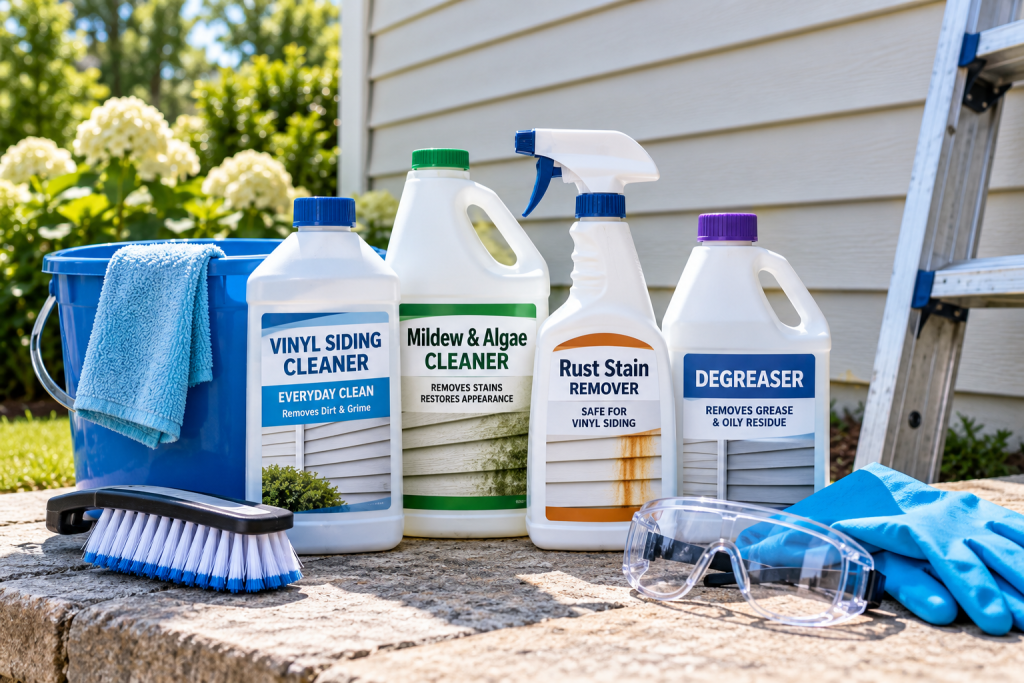
Best Vinyl Siding Cleaners at a Glance
Matching the cleaner to the problem is safer than reaching immediately for the strongest product available.
| Cleaning Problem | Best Cleaner Type | Strength Level | Main Caution |
|---|---|---|---|
| General dirt and dust | Mild vinyl-safe detergent | Mild | Avoid abrasive scrubbing |
| Pollen and light grime | Mild detergent or soap | Mild | Rinse before cleaner dries |
| Mildew or algae | Vinyl-safe biological-growth cleaner | Moderate | Protect plants and follow label |
| Heavy organic buildup | Exterior cleaner approved for vinyl | Moderate | Test before treating large areas |
| Rust stains | Vinyl-safe rust remover | Specialized | Acids may damage incompatible surfaces |
| Grease or oily residue | Mild vinyl-compatible degreaser | Moderate | Avoid strong solvents |
| Unknown stain | Mild cleaner first | Mild | Test in an inconspicuous spot |
No cleaner is automatically appropriate for every vinyl product. The siding manufacturer’s care instructions and the cleaner label should take priority over generic cleaning recipes.
Best Cleaner for General Dirt and Grime
Ordinary dirt usually does not require aggressive chemicals.
A mild exterior cleaner labeled as suitable for vinyl siding is a straightforward choice. Depending on the siding manufacturer’s guidance, ordinary mild detergent or a small amount of uncomplicated dish soap may also work for dust, atmospheric grime, and similar buildup.
These cleaners work mainly by loosening dirt so it can be gently brushed and rinsed away. A soft-bristle brush or nonabrasive cloth is preferable to trying to compensate for a mild cleaner with aggressive scrubbing.
Avoid assuming that a stronger concentrate will clean better. Excessive cleaner strength can discolor siding, affect the surface appearance, damage nearby materials, or increase risks to landscaping without providing a meaningful benefit on ordinary dirt.
Best Cleaner for Mildew and Algae
Dark spots or green growth on shaded siding may be mildew, algae, or another type of biological buildup. These conditions are more common where walls stay damp or receive little direct sun and rainfall.
A cleaner labeled for mildew or algae removal and approved for vinyl siding is usually the most direct choice.
Oxygen-based cleaners can be useful for some organic staining. Bleach-based products are another option when both the cleaner instructions and the siding manufacturer permit their use.
Bleach requires more care around landscaping, clothing, metals, painted surfaces, and other materials. Follow the product’s dilution and application directions rather than improvising a stronger mixture.
Do not assume that every black or green stain is biological growth. Dirt, corrosion runoff, pollution, and stains from other building materials can sometimes look similar.
Best Cleaner for Heavy Organic Buildup
Walls near trees, shaded landscaping, or other sources of organic debris can develop more persistent films than ordinary household soap removes easily.
Heavy pollen, tree residue, green buildup, and environmental grime may justify a stronger exterior cleaner specifically labeled for use on vinyl siding.
Before increasing chemical strength, make sure the problem is actually a stain rather than dirt that simply needs more contact time or gentle agitation. Follow the cleaner label for any required dwell time, and do not allow the product to dry on the siding unless its instructions specifically permit it.
Test stronger cleaners on a small, inconspicuous area first. A product can remove a stain effectively and still be a poor choice if it changes the siding’s color or sheen.
Best Cleaner for Rust Stains
Rust usually calls for a stain-specific cleaner rather than more scrubbing.
Look for a rust-removal product that explicitly lists vinyl or the applicable plastic surface as compatible. Rust removers may use acidic chemistry, so a product that is safe for masonry or another hard surface is not automatically appropriate for vinyl siding.
Spot-test the cleaner and follow its stated contact time. Keep it off nearby materials that the label identifies as incompatible.
Avoid steel wool, abrasive powders, or aggressive pads. Scratching the siding to remove a stain can leave permanent surface damage that is more noticeable than the original discoloration.
Recurring rust also deserves investigation. Water running over a corroding fastener, railing, gutter component, or other metal surface can repeatedly restain otherwise clean siding.
Best Cleaner for Grease or Oily Residue
Grease, oily residue, tar-like marks, and similar contamination can require a cleaner capable of breaking down oils.
Start with a mild vinyl-compatible degreaser. Give it the label-recommended contact time and use gentle agitation rather than reaching immediately for a powerful solvent.
Strong solvents can discolor, soften, dull, or otherwise damage some vinyl surfaces. A solvent that works well on metal, concrete, or tools should not be assumed safe for siding.
If the siding manufacturer recommends a particular treatment for oily or tar-like contamination, follow that guidance rather than experimenting with household solvents.
Can You Use Dish Soap on Vinyl Siding?
Yes, mild dish soap can be reasonable for routine dirt when the siding manufacturer’s care guidance allows it.
A small amount of basic detergent can help loosen dust, light grime, pollen, and similar surface contamination without introducing unnecessarily strong chemistry.
Choose a simple product rather than assuming a detergent containing extra additives is preferable. Manufacturer guidance may differ, so check it before cleaning a large area.
Dish soap is not the answer to every stain. It may do little for established mildew, rust, or stubborn oily contamination. When a mild wash does not work, identify the stain and select a cleaner intended for that problem.
Can You Use Bleach on Vinyl Siding?
Bleach-based cleaners can be appropriate for some vinyl siding, particularly for mildew and other biological growth, but they should be used only when permitted by the siding and cleaning-product manufacturers.
Do not make a stronger solution in an attempt to speed up the work. Excessive concentrations can damage siding or nearby materials.
Bleach also requires careful handling around plants and other exterior surfaces. Wear the protective equipment specified on the product label and follow its directions for dilution, application, rinsing, and landscaping protection.
Most importantly, never mix bleach with ammonia, vinegar, acids, or other cleaning products. Dangerous gases can be produced. Use one cleaner at a time and follow its label.
Are Oxygen-Based Cleaners Safer?
Oxygen-based cleaners are often considered when homeowners want an alternative for organic staining or general exterior buildup.
These products typically use oxygen-releasing compounds to help break down stains. Depending on the formulation, they may be suitable for mildew-like staining, algae, dirt, or other organic residue.
However, “oxygen-based” does not mean universally harmless. Concentration, additional ingredients, nearby surfaces, landscaping, and the specific vinyl product still matter.
Treat an oxygen cleaner like any other chemical product: confirm that vinyl is an approved surface, follow the stated dilution and dwell time, protect yourself as directed, and test a small area before broad use.
Can You Use Vinegar on Vinyl Siding?
Vinegar is often suggested as a household cleaner, but its suitability depends on the siding manufacturer’s instructions and what you are attempting to remove.
Because vinegar is acidic, do not assume that a homemade vinegar mixture is preferable to a cleaner specifically labeled for vinyl. A manufacturer-approved siding cleaner offers clearer compatibility and use instructions.
If your siding manufacturer permits a mild vinegar solution for a particular purpose, follow that guidance rather than increasing the concentration.
Never combine vinegar with bleach. Acidifying bleach can release dangerous chlorine gas.
What Cleaners Should You Avoid on Vinyl Siding?
Stronger does not mean better, and some cleaning products can create permanent cosmetic or physical damage.
Unless specifically approved for your siding, avoid:
- Abrasive powders and scouring compounds
- Aggressive paint or coating removers
- Strong solvents
- Highly caustic cleaners
- Undiluted concentrated chemicals
- Products that do not list vinyl as a compatible surface
- Homemade mixtures of multiple cleaning chemicals
Also avoid trying to overcome the wrong chemistry with aggressive scrubbing. Even a safe cleaner can be paired with an unsafe tool.
If the product label and the siding manufacturer’s guidance conflict, choose another cleaner or contact the siding manufacturer for direction.
How to Choose a Cleaner for Your Siding
The simplest selection method is to identify the contamination first and use the least aggressive chemistry suited to it.
For routine dirt
Choose a mild vinyl-compatible exterior cleaner or another mild detergent allowed by the siding manufacturer.
For mildew or algae
Choose a vinyl-safe cleaner labeled for biological growth. Oxygen-based or bleach-based formulations may be options depending on manufacturer guidance.
For rust
Use a stain-specific rust remover that explicitly indicates compatibility with vinyl. Do not substitute harder scrubbing.
For oily residue
Choose a mild compatible degreaser before considering stronger chemistry.
For an unknown stain
Begin with mild soap or a general vinyl cleaner in a small test area. If that does not work, identify the stain as closely as possible before choosing a specialty product.
Once you have the right cleaner, our step-by-step guide on how to clean vinyl siding explains the safest way to apply it, scrub stained areas, and rinse without damaging the siding.
What to Check on the Product Label
A good cleaner should provide more information than a marketing claim that it is “heavy duty.”
Before buying or applying a product, check for:
- Surfaces the cleaner is approved for
- Required dilution
- Application instructions
- Dwell or contact time
- Rinsing requirements
- Gloves, eye protection, or other PPE
- Landscaping and runoff precautions
- Pressure-washer compatibility, if relevant
- Explicit chemical-mixing warnings
Pay particular attention to dwell time. Leaving a cleaner on longer than directed is not necessarily more effective and may increase the risk of discoloration or damage.
Do You Need a Pressure-Washer Cleaner?
Not necessarily.
A pressure-washer concentrate makes sense only when the cleaner is designed for that equipment and the siding manufacturer permits pressure washing. Some siding manufacturers discourage pressure washing because forceful water can cause damage or enter behind the cladding.
Chemical strength and water pressure are separate decisions. A pressure washer does not make an incompatible cleaner safe, and a stronger chemical does not require high pressure to work.
If pressure washing is not recommended for your siding, choose a cleaner that can be applied and rinsed using the manufacturer’s approved method instead.
Protect Plants and Nearby Surfaces
Cleaning products that are safe for vinyl may still affect vegetation, metals, paint, glass, or other surfaces.
Follow the product label’s landscaping instructions. Depending on the cleaner, that may include pre-wetting plants, covering sensitive areas temporarily, controlling concentrated runoff, and rinsing vegetation afterward.
Keep cleaner off surfaces identified as incompatible on the label.
If extensive chemical use would be difficult to contain around valuable landscaping or sensitive exterior materials, professional cleaning may be a safer option.
When a Cleaner Is Not the Solution
Repeated staining sometimes points to a source that cleaning cannot correct.
Green growth that quickly returns may indicate persistent shade or moisture. Rust streaks may originate from a corroding metal component. Dirty bands can result from roof or gutter runoff, and recurring wet areas may be associated with irrigation overspray or drainage problems.
Leaks around windows, roofs, or other exterior details require evaluation rather than repeated chemical cleaning.
Addressing the source often does more for the siding’s appearance than continually escalating to stronger cleaners.
If discoloration is actually tied to aging, cracking, warping, or other material deterioration, our guide on how long vinyl siding lasts explains when cleaning is no longer the real issue.
Final Thoughts
The best cleaner for vinyl siding is the mildest product that safely addresses the specific dirt or stain in front of you. Routine grime usually needs only a mild vinyl-compatible cleaner, while mildew, algae, rust, and grease may justify specialized formulations.
Check both the cleaner label and the siding manufacturer’s instructions, test unfamiliar products first, and reserve stronger chemistry for problems that actually require it. Above all, never mix cleaning chemicals—especially bleach with ammonia, vinegar, acids, or other cleaners.