best weeding tools
The best weeding tools depend on the weed, where it is growing, and how you prefer to work. A forked weeder may be ideal for a dandelion in the lawn, while a hoe works better on many small weeds in open soil. The right tool should remove weeds efficiently without making the job harder than necessary.
Most homeowners do not need a collection of specialized weeders. Start with the tool that solves your most common problem, then add another only when differences in root type, working space, or comfort justify it.
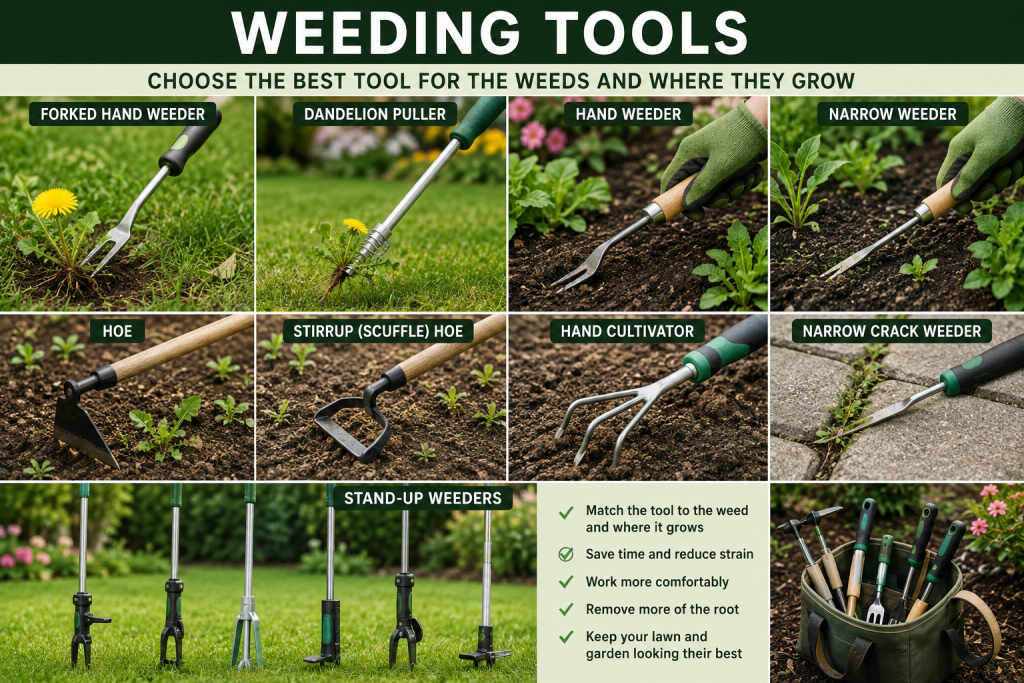
| Weeding situation | Best tool type | Why |
|---|---|---|
| Dandelions in lawn | Forked weeder or dandelion puller | Reaches below the crown to loosen the taproot |
| Shallow weeds in flower beds | Hand weeder or small hoe | Provides control around desirable plants |
| Weeds between closely spaced plants | Narrow hand weeder | Fits into tight spaces with less soil disturbance |
| Weeds in compacted soil | Sturdy forked weeder | Adds leverage for loosening stubborn roots |
| Larger open garden bed | Stirrup or scuffle hoe | Covers many small weeds efficiently |
| Weeds in cracks | Narrow crack weeder | Reaches confined joints and edges |
| Homeowner who wants to avoid kneeling | Stand-up weeder | Allows more work from an upright position |
What Makes a Weeding Tool a Good Fit?
Start with the weed and its location rather than the tool’s appearance.
A useful weeding tool should match four basic factors:
- Root type: Deep taproots need a different approach from shallow seedlings.
- Working space: Open garden soil allows broader tools than a crowded flower bed.
- Soil condition: Dry, compacted ground requires more leverage than loose soil.
- Working position: Handle length, weight, grip, and leverage affect how comfortable the job is.
The amount of ground also matters. Pulling six weeds from a lawn is different from clearing hundreds of small seedlings from an open vegetable bed.
Avoid buying several tools that perform essentially the same job. A basic hand weeder, for example, may handle most isolated lawn and flower-bed weeds without requiring multiple specialty versions.
For a broader homeowner tool setup beyond weeding, see the HRA guide to the best garden tools for homeowners.
Best Weeding Tool for Dandelions and Taproots
For dandelions and similar taproot weeds, a forked or V-notch hand weeder is a practical choice.
The narrow shaft slides into the soil beside the plant, while the forked end helps loosen the root below the crown. This provides more leverage than grabbing the leaves and pulling from the surface.
The goal is to remove as much of the root as practical. Simply tearing off the foliage may leave enough root behind for the plant to grow again.
A longer dandelion puller performs a similar job while reducing how much you need to bend or kneel. Some stand-up designs use claws or jaws that enter the soil around the weed and release it after removal.
Soil condition makes a noticeable difference. Roots usually release more easily from soil that is moderately moist than from ground that is extremely dry and hard. Avoid turning the lawn into mud, however, because saturated soil is unpleasant to work in and can be easily disturbed.
If dandelions are a recurring lawn problem rather than a few isolated plants, see how to get rid of dandelions in a lawn for the broader control decision.
Best Weeding Tools for Flower Beds
Flower beds require more precision because desirable plants may be only inches away from the weeds.
A narrow hand weeder is often the best basic tool here. It lets you work close to stems and roots without disturbing a wide area.
A hand cultivator can also be useful where the soil is relatively loose and weeds are small. Its short tines loosen the soil surface and can dislodge shallow weeds while breaking up lightly crusted soil.
Do not expect a hand cultivator to replace a taproot weeder. Its broader action is useful for small weeds but is less suited to extracting a deep individual root.
Small hoes can work in beds with enough open space, but use them carefully around established plants. A broad sweeping motion that is efficient in an empty row can damage nearby flowers or shallow roots.
Preventive bed maintenance also reduces how much weeding equipment you need. Maintaining suitable mulch can suppress many weed seedlings and leave fewer weeds to remove manually. The HRA guide to choosing the best mulch for flower beds explains where different mulch types make sense.
Best Weeding Tools for Larger Garden Areas
When weeds are small and spread across an open garden bed, removing them individually can become unnecessarily slow.
A hoe is usually more efficient for this type of work.
Traditional hoes cut or disturb weeds as the blade moves through the upper soil. They work best where there is enough open space to operate without striking desirable plants.
A stirrup hoe, sometimes called a scuffle hoe, uses a loop-shaped blade that moves back and forth just below or along the soil surface. It is particularly useful for disrupting many small, shallow-rooted weeds in open areas.
This type of tool makes the most sense when:
- Weeds are still small.
- The ground is reasonably workable.
- Plants are arranged with enough space between them.
- You have more area to cover than a hand tool can handle efficiently.
A hoe is generally a poor choice for weeds embedded in dense lawn turf because the blade can damage desirable grass along with the weed.
It is also not the ideal tool for deeply rooted perennial weeds that can regrow from substantial roots left underground.
Best Stand-Up Weeding Tools
A stand-up weeder can be a good choice for anyone who wants to reduce repeated bending, crouching, or kneeling.
These tools use a long handle and a root-gripping or forked mechanism near the ground. The homeowner works from a more upright position and uses leverage to loosen the weed.
That can be useful for older homeowners, but age alone does not determine which tool is best. The same design may help anyone with limited mobility, knee discomfort, back discomfort, or a preference for standing work.
When comparing stand-up weeders, pay attention to:
- Overall tool weight
- Handle length
- Grip diameter and comfort
- Amount of force needed to operate the mechanism
- Balance when the tool is positioned over a weed
- How easily the weed releases from the tool afterward
A longer handle can reduce bending but may sacrifice some precision. In tightly planted beds, a short hand tool may still provide better control.
For more specific ergonomic considerations, see the HRA guide to weeding tools for older homeowners.
Best Tools for Weeds in Cracks and Tight Spaces
Weeds growing between pavers or in pavement joints require a narrow tool rather than a general-purpose garden hoe.
A crack weeder typically has a thin, rigid blade or hooked end designed to enter confined gaps. It allows you to scrape or loosen weeds without trying to force a wide tool into the joint.
These tools can also be useful along some edging and other narrow hardscape gaps.
Use controlled force. Hard surfaces can cause metal tools to slip unexpectedly, and sharp edges should be kept away from hands and feet.
Also be cautious around areas where irrigation tubing, shallow landscape wiring, or other hidden components may be present. Do not drive a pointed weeding tool forcefully into ground when you do not know what is beneath it.
For an isolated weed growing in loose soil, however, a crack weeder is usually unnecessary. Use the simpler tool that already fits the job.
Hand Weeder vs Hoe vs Cultivator
These three common tools overlap, but each has a different strength.
Choose a hand weeder when:
- You are removing individual weeds.
- A weed has a substantial root.
- You need precision around lawn grass or desirable plants.
- The job is small enough to work weed by weed.
Choose a hoe when:
- Many small weeds cover an open area.
- The weeds are shallow or young.
- There is room to work without hitting garden plants.
- Covering ground efficiently matters more than individual root extraction.
Choose a hand cultivator when:
- You are loosening surface soil around plants.
- Weeds are small and shallow.
- You want one tool for light cultivation and minor weeding.
- Deep taproots are not the main problem.
For many homeowners, a hand weeder and a hoe cover more situations than owning several slightly different specialty tools.
What to Look for Before Buying a Weeding Tool
Once you know the tool type you need, choose one that fits your body and working conditions.
Handle length
Short handles provide control but require you to work closer to the ground. Longer handles reduce bending and extend reach but can be less precise.
Choose based on where you normally weed rather than assuming longer is always better.
Grip comfort
A handle should be comfortable enough to hold and control repeatedly. Larger or cushioned grips may be easier for some homeowners, particularly when hand strength or joint comfort is a concern.
The grip should not make the tool difficult to control.
Weight
Heavy does not automatically mean durable or effective.
Extra weight can become tiring during repetitive work and may make precise movements harder. Look for enough strength for the intended job without buying more tool than you need.
Leverage
For stubborn taproots and firmer soil, leverage can reduce the amount of pulling force required. Forked weeders and stand-up designs use leverage differently, so choose a design that works with a comfortable body position.
Working conditions
Think about your usual soil. Loose garden soil is relatively easy to work with, while dry clay or heavily compacted soil can make manual weed removal considerably harder.
Slightly moist soil may make root removal easier. If the ground is extremely hard, changing the timing of the job can be more effective than applying excessive force to the tool.
Wear gloves where appropriate, watch for sharp edges, maintain stable footing when using long-handled tools, and follow the tool manufacturer’s instructions.
Which Weeding Tools Are Worth Buying First?
For most homeowners, a small collection is enough.
A sensible order is:
- Basic hand weeder: The most versatile choice for individual lawn and garden weeds.
- Hoe: Worth adding if you regularly maintain open garden or flower-bed areas.
- Stand-up weeder: Useful when lawn weeds are frequent and reducing bending or kneeling is important.
- Crack weeder: Add one only if pavement joints or other narrow gaps are a recurring problem.
- Hand cultivator: Useful when you also need light soil cultivation around plants.
Do not buy a specialized tool because you encountered one difficult weed once. Buy for problems that return often enough to justify another tool taking up storage space.
Hand pulling may be all you need when weeds are young, the soil is workable, and only a few plants are present.
When a Tool Is Not the Best Fix
A weeding tool removes weeds, but it does not necessarily address why they keep returning.
Repeated heavy weed pressure may point to a larger maintenance issue.
In lawns, weeds can take advantage of thin turf and bare areas. Improving mowing practices, watering, and turf density may reduce the open space available for unwanted plants. Clover can require its own broader lawn-care decisions, which are covered in HRA’s guide to controlling clover in a lawn.
In flower and garden beds, exposed soil or inadequate mulch can allow new weed seedlings to appear repeatedly.
Large infestations of spreading perennial weeds may also be impractical to solve one plant at a time. At that point, identify the weed and determine the broader management strategy before buying more manual tools.
Final Thoughts
For most homeowners, the best starting point is a sturdy hand weeder for individual weeds and a hoe if you maintain larger open beds. Add a stand-up weeder when reducing bending is important, or a narrow crack tool when confined spaces are a recurring problem.
Match the tool to the root, location, soil, and way you want to work. A comfortable, controllable tool that solves a frequent problem is usually a better purchase than several specialized weeders that rarely leave the shed.