
window well cover buying guide: fit, materials, and drainage considerations
The best window well cover is the one that fits the actual well, suits the conditions around it, and does not interfere with drainage or emergency escape. Generic size labels are only a starting point. Measure the well, identify its shape, decide how much rain and debris protection you need, and confirm that the cover can be safely opened or removed if the window serves as an emergency exit.
A cover can reduce direct rain, snow, leaves, and debris entering a window well. It cannot correct a clogged drain, saturated soil, poor grading, runoff directed toward the well, or a failed foundation drainage system.
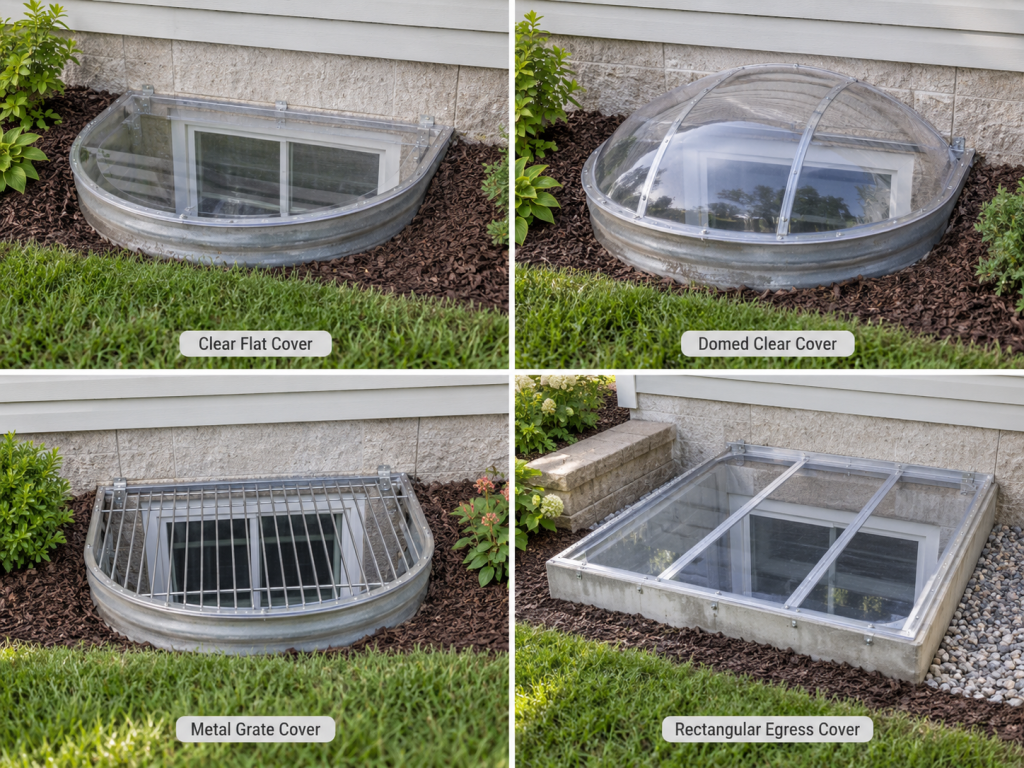
| Cover type | Main advantage | Main tradeoff |
|---|---|---|
| Clear plastic-style cover | Light and rain protection | Strength and durability vary |
| Metal grate | Airflow and open appearance | Allows more rain and debris through |
| Reinforced clear or hybrid | Weather protection plus added support | Fit and hardware matter more |
| Custom cover | Better fit for unusual wells | Requires precise measurements |
What a Window Well Cover Does
A window well cover sits over the opening created by a below-grade or partially below-grade basement window well. Its main jobs are to reduce direct precipitation and debris, limit snow accumulation, and provide some protection over the opening.
Those benefits have limits. A cover does not create a drainage path below the well. If water already pools because the drain is clogged or the surrounding soil stays saturated, covering the top may reduce some incoming water without correcting the underlying problem.
Treat the cover as one part of a functioning window-well system, not a replacement for drainage.
Fit Matters More Than Generic Size Labels
Two window wells sold under the same nominal size may not have identical dimensions or shapes. Measure the actual well before buying rather than relying on the basement window size or an old product label.
Measure the width
Measure the well from side to side where it meets the foundation wall.
If the well is irregular, measure at more than one point near the top opening. That upper opening is generally what the cover needs to span.
Measure the projection
Projection is the distance the well extends outward from the foundation wall.
Measure from the wall to the farthest outer edge. A cover that is wide enough but too shallow may leave part of the well exposed.
Identify the shape
Common shapes include:
- Semicircular or rounded wells
- Rectangular wells
- Squared wells with rounded corners
- Irregular or custom shapes
Do not assume a rectangular cover will work on a strongly curved well just because the maximum width and projection seem close. The cover should sit securely in the position intended by its manufacturer without large gaps, unstable overhangs, or interference with the foundation wall.
Choosing the Best Window Well Cover Material
Material affects light, airflow, weather protection, appearance, and potential strength. There is no single material that is best for every well.
Clear polycarbonate or acrylic-style covers
Clear covers are a practical choice when you want to preserve natural light while reducing direct rain, snow, leaves, and debris.
Do not assume all clear covers have the same strength or durability. Material type alone does not establish load capacity. Panel thickness, framing, reinforcement, and overall design can differ substantially.
If strength matters, rely on the specific manufacturer’s published performance information rather than the material name.
Metal grate-style covers
A metal grate provides a more open cover and generally allows more airflow than a solid design.
That openness also means rain, snow, small leaves, and other debris can pass through more easily. A grate may suit a well where the main goal is guarding the opening and drainage already works reliably.
Strength varies by product. Never assume a metal grate is safe to stand on unless the manufacturer specifically provides an appropriate load rating.
Hybrid and reinforced clear covers
Some covers combine a clear panel with a frame, grate, brace, or other reinforcement.
These designs can provide more weather protection than an open grate while adding support compared with a simple unsupported clear panel.
They can be useful on larger wells or where both daylight and strength are important, but actual performance depends on the specific product and attachment method.
Flat, Sloped, and Domed Covers
Cover shape affects how rain, snow, and debris behave on the surface.
A flat cover can provide a simple, low-profile appearance. Depending on its design and location, however, leaves, snow, or water may remain more noticeable on the surface.
A sloped or domed cover is shaped to encourage water and debris to move away from the center.
That does not mean runoff should be directed against the foundation. Before buying, consider where water will go after leaving the cover.
Domed covers may also project higher above the surrounding surface, which can matter near walkways, landscaping, or other obstructions.
Choose the shape based on both the well and the surrounding area.
Drainage Still Matters Under the Cover
A window well cover can reduce the amount of water entering from above, but the well still needs functioning drainage.
A cover will not fix:
- A clogged window-well drain
- Saturated soil
- Ground that directs runoff toward the well
- A downspout discharging nearby
- Heavy surface runoff reaching the foundation
- A failed or inadequate foundation drainage system
If the well already fills with water during storms, diagnose that problem before assuming a cover will solve it.
A cover may reduce direct rainfall entering the well, but water can still arrive from the surrounding ground or flow beneath the edges. The cover should complement proper drainage, not replace it.
If the window well already holds water or drains slowly, see our window well drainage guide for the common causes of pooling and the checks that can help identify the problem.
Consider Debris, Snow, Light, and Ventilation
The conditions around the well can help determine which design makes sense.
If leaves and mulch regularly collect in the well, a mostly solid cover can reduce debris and help keep the drainage area clearer.
If snow accumulation is a concern, check whether the manufacturer provides relevant load guidance for the specific cover. Do not assume a product can support accumulated snow, a person, or other loads unless its documentation says so.
For rooms that rely on the basement window for daylight, a clear cover generally preserves more light than an opaque design or dense grate.
Ventilation creates a tradeoff. An open grate usually permits more airflow than a solid cover. If airflow around the window matters, consider that along with weather protection.
Strength and Load Ratings Need Verification
Window well covers range from lightweight weather shields to products designed with substantial structural support.
That difference matters if the well is near a lawn, walkway, patio, driveway edge, or other area where someone could accidentally put weight on the cover.
Do not judge strength by appearance.
Check the manufacturer’s published load rating or other relevant performance information for the exact model you are considering. A thick-looking clear panel or metal grate is not automatically safe to walk or stand on.
If people are likely to step near the well, strength should be a major buying criterion.
Hardware, Attachment, and Removability
The attachment system helps keep the cover positioned during normal weather while allowing access when needed.
Depending on the product, the cover may use clips, brackets, hinges, pins, or another attachment method.
Use the hardware intended for that product rather than improvising a different attachment that could affect stability or removability.
Also consider how easily the cover can be removed for cleaning, inspection, window maintenance, or emergency escape.
A cover that is difficult to remove may be inconvenient on an ordinary well and unsafe on an egress well.
Egress Windows Need Special Attention
If a basement window is intended for emergency escape, the cover must preserve that function.
Do not install a permanently fixed cover that cannot be opened or removed from inside the window well.
The cover and attachment method must allow safe emergency egress and must not obstruct:
- Window operation
- Well ladders
- Steps
- The path needed to climb out
Do not invent or assume universal code dimensions or opening-force requirements. Local rules can vary, so check applicable requirements for your home along with the cover manufacturer’s instructions.
Before buying, think through the entire escape path. A cover may fit the top of the well yet still interfere with the window sash, ladder, steps, or room needed to exit.
For an egress window, openability and removability are safety requirements, not optional features.
When a Custom Window Well Cover Makes Sense
Standard covers work best when the well closely matches a common shape and dimension.
Custom fabrication may be appropriate when the well is unusually large, asymmetrical, deeply curved, rectangular with uncommon proportions, or located around obstructions that prevent a standard cover from fitting correctly.
It can also make sense when a standard product would leave large gaps or interfere with the window or egress hardware.
A custom cover still needs accurate measurements and safe access. Measure carefully and make sure the design accounts for the window, well shape, drainage, and any emergency-egress requirements.
Practical Pre-Purchase Checklist
Before choosing the best window well cover for your home, confirm:
- The actual width of the well
- How far the well projects from the foundation
- Whether the well is rounded, rectangular, or irregular
- Whether natural light is important
- Whether you prefer maximum weather protection or more airflow
- How much rain, snow, leaves, and debris normally reach the well
- Whether the existing window well drainage works properly
- Whether the manufacturer provides the strength or load information you need
- How the cover attaches to the well
- Whether it can be removed easily for cleaning and inspection
- Whether the window is part of an emergency escape route
- Whether the cover can be opened or removed from inside an egress well
- Whether it interferes with window operation, ladders, or steps
- Whether a standard product fits correctly or custom fabrication is more appropriate
Taking these measurements and decisions before shopping is more reliable than buying from a generic size label and trying to make the cover fit afterward.
Before installing a new cover, it is also worth making sure the well itself is clean and unobstructed, and our guide on how to clean a window well explains the routine maintenance homeowners can safely handle.
Final Thoughts
The best window well cover is not necessarily the thickest, clearest, or most expensive option. It is the cover that fits the well, provides the level of debris and weather protection you need, and works safely with the window and existing drainage conditions.
Measure width, projection, and shape before buying. Compare material, strength information, light, ventilation, attachment, and removability. If the well already fills with water, address the drainage or runoff problem rather than expecting a cover to replace functioning drainage. For an egress window, safe opening and removal from inside the well should remain non-negotiable.