
window well drainage problems: why water pools and what to check
Good window well drainage should keep rain and runoff from building up against a basement window. When water pools in a well, the cause may be as simple as leaves blocking the bottom, but it can also involve concentrated roof runoff, poor surface drainage, saturated soil, or a drain that is clogged or no longer functioning.
Start by observing when the well fills and where the water seems to enter. Do not climb into a deep, flooded, or unstable window well to investigate it.
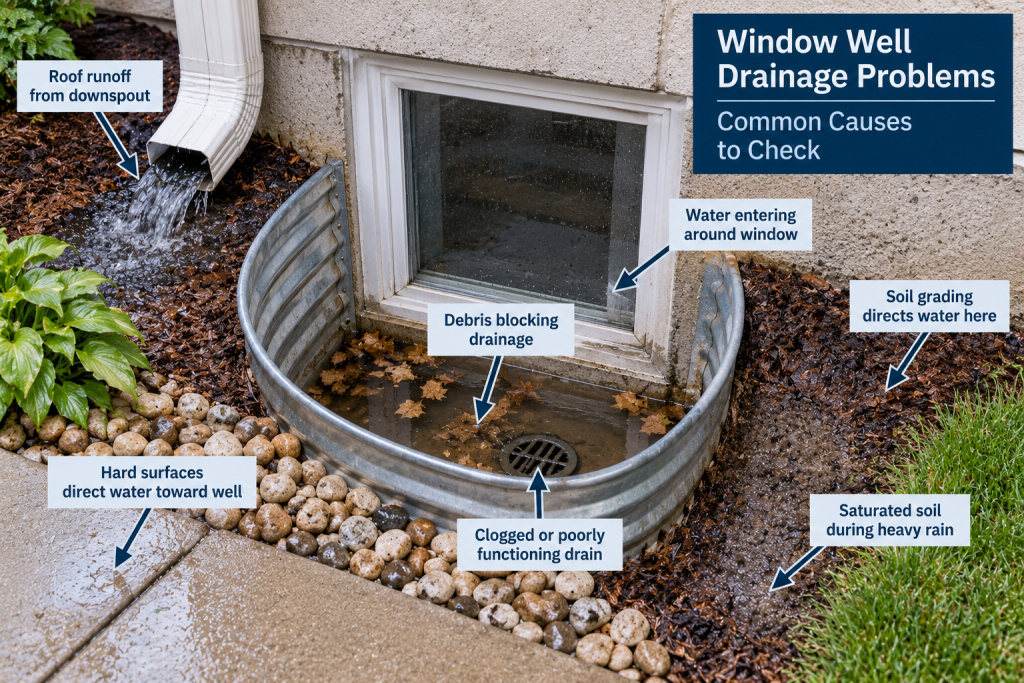
| What you observe | Possible cause | What to check |
|---|---|---|
| Water pools over leaves or soil | Debris blocking drainage | Bottom of well from ground level |
| Well fills quickly during rain | Surface or roof runoff | Water flowing toward the well |
| Pooling starts after long rain | Saturated soil or slow drainage | Whether water drains after rain stops |
| Water remains long after the storm | Clogged or inadequate drainage | Visible drain condition, if accessible |
| Only one well repeatedly floods | Localized runoff or drain problem | Conditions around that well |
| Water reaches window before well looks full | Window or opening problem | Frame, sill, and foundation opening |
If water has already entered the basement, stay out of standing water when electrical outlets, wiring, appliances, or other energized equipment may be involved. Have electrical hazards addressed before entering an unsafe flooded area.
How Window Well Drainage Is Supposed to Work
A window well creates an open space outside a below-grade basement window. Because that space is lower than the surrounding yard, rainwater has to be kept from collecting there.
Depending on the house and well design, water may drain through free-draining material below the well, into a dedicated window-well drain, or into a drainage system serving the foundation. Some systems are specifically designed to connect window-well drainage with a perimeter foundation drain.
The important point is not that every well must look the same. It is that water reaching the well needs a reliable path away before the water level rises against the window.
A small amount of rain reaching a well is not necessarily a problem if it drains promptly. Repeated standing water, rising water during storms, or water reaching the basement window indicates that the system is not keeping up with the amount of water entering.
Why Water Pools in a Window Well
Several problems can produce the same puddle. Look for the simplest visible explanation first before assuming the well needs to be excavated or rebuilt.
Leaves, soil, and debris are blocking drainage
Leaves, mulch, grass clippings, soil, and other debris can collect in an uncovered well. Over time, that material can cover the drainage area or reduce how easily water reaches the material or drain below.
From ground level, look for a layer of organic debris, sediment, or soil accumulation at the bottom.
If the well is shallow and safely accessible without climbing into it, loose surface debris may be removable. Do not enter a deep well or one with unstable sides simply to investigate the bottom.
Debris is particularly suspicious when a well used to drain normally but has gradually begun holding water.
Roof runoff or a downspout is sending too much water toward the well
A window well may drain adequately under ordinary rainfall and still flood if a concentrated source delivers a large volume of water directly to it.
During safe rainy conditions, look from ground level for water flowing toward the well. A nearby downspout discharge, overflowing gutter, roof valley discharge, or concentrated stream across the ground can overwhelm a well much faster than direct rainfall alone.
The appropriate repair belongs at the source of that runoff rather than inside the window well. This article does not cover gutter or downspout repair in detail, but the relationship is important diagnostically.
If moving runoff away from the area stops the well from flooding, you have learned more than you would by adding another layer of gravel to the bottom.
Grading or hard surfaces direct water toward the well
The surrounding ground should not act like a funnel feeding the window well.
Look for low areas beside the well or visible runoff moving from the yard toward the foundation. Driveways, walks, patios, landscape edging, and other hard surfaces can also influence where stormwater travels.
One well flooding while nearby wells remain dry can be a strong clue that the issue is localized to the surrounding surface conditions.
Do not turn this inspection into a major grading project. If the ground or paving is clearly directing significant runoff toward the foundation, that drainage issue deserves its own focused repair.
The window-well drain may be clogged or performing poorly
Some wells have a visible drain opening or a designed connection to another foundation drainage component. If that drain becomes blocked by sediment, debris, or other material, water may drain slowly or stop draining altogether.
A common pattern is water that enters the well normally but remains there long after the rain has ended.
From ground level, you may be able to see whether an accessible drain opening is covered with debris. That does not tell you whether a buried line farther below is open.
Do not start digging beside the foundation simply to find out where a window-well drain goes. Drain connections may be buried and may interact with other foundation drainage components. Excavation can also involve unstable soil and buried utilities.
Persistent drainage failure is a reasonable point to involve a waterproofing or drainage professional.
There may be no dedicated window-well drain
Not every window well has a visible drain at the bottom.
Some installations depend on free-draining material and the drainage conditions around the foundation. Others are designed with a connection to a perimeter system. What is appropriate depends on the well, foundation, soil, and overall drainage design.
A missing visible drain therefore does not automatically mean something was installed incorrectly.
However, if the well repeatedly holds water because the surrounding soil cannot accept it or because the existing drainage approach is inadequate, the system may need professional evaluation. Determining whether a new drain or another drainage strategy is appropriate can require excavation and knowledge of the existing foundation system.
Saturated soil slows drainage during prolonged rain
A well that drains quickly after a short shower may behave very differently after several days of rain.
As the surrounding soil becomes saturated, water has fewer places to go. Drainage through soil can slow, groundwater conditions can change, and an otherwise marginal window well may begin filling.
Timing is the clue here. If pooling appears only after long storms, repeated storms, or rapid snowmelt, soil saturation may be contributing.
That does not prove the well needs a larger drain. It means the amount of water reaching and surrounding the well during those conditions should be considered before choosing a repair.
Water may be entering around the window or foundation opening
Sometimes the problem is not only what happens at the bottom of the well.
If water reaches the basement around the window frame, sill, or edges of the foundation opening, inspect those areas visually from both sides when safe.
Staining concentrated around one edge of the window may point toward a localized window or opening problem. Water may also enter once a poorly draining well fills high enough to reach parts of the window that are not intended to remain submerged.
A window repair professional may be appropriate if the well drains normally but water consistently enters around the window assembly itself.
Why Timing and Location Matter
A useful window well diagnosis answers two questions: When does the water begin pooling, and where is it coming from?
Water that rushes into the well immediately when rain begins often points toward surface runoff or concentrated roof drainage.
Water that appears gradually after hours of rain may suggest slower drainage or increasingly saturated soil.
Water that remains long after rainfall stops raises more concern about a blocked or inadequate drain path.
Compare multiple wells when your house has them. If only one floods, concentrate on conditions unique to that location. If several wells fill during the same prolonged storms, the problem may involve broader soil or foundation drainage conditions.
One storm may not tell the whole story. Photos taken during several rain events can help show whether the pattern depends on rainfall intensity, duration, or how wet the ground was beforehand.
How to Inspect a Window Well Safely
Most useful observations can be made from ground level.
During or shortly after rain, look for:
- Water visibly flowing across the ground toward the well
- A downspout or roof runoff source nearby
- Leaves, mulch, soil, or sediment accumulated at the bottom
- Standing water and whether its level is rising or falling
- A visible drain opening covered by debris
- Water staining around the window frame or foundation opening
- Soil that appears washed out or unstable around the well
- A cover that is damaged, poorly positioned, or collecting water
Take photos so you can compare conditions later.
Avoid leaning deeply into a well or climbing inside for a closer look. Deep wells can present fall and exit hazards, and saturated soil around the sides may be unstable.
If the window is intended for emergency egress, do not add materials, fasten improvised coverings, or make alterations that could interfere with opening the window or using the well as an exit.
Routine debris removal and seasonal upkeep can prevent simple maintenance issues from becoming drainage problems, and our guide on how to clean a window well explains what homeowners can safely handle.
Why Adding Gravel Alone May Not Fix Window Well Drainage
Gravel is often associated with window wells because free-draining material can allow water to move more readily than compacted soil.
But adding gravel to the top of an existing problem does not create a drainage destination.
If a drain below is clogged, the surrounding soil is saturated, or runoff is pouring into the well faster than water can leave, additional gravel may simply hide standing water below the surface.
It can also make diagnosis harder because the visible puddle disappears while the underlying drainage problem remains.
Before adding material, determine whether debris is obstructing an existing drainage path or whether the well has a larger runoff or drainage problem.
A Window Well Cover Helps With Some Water, Not Every Problem
A properly selected cover can reduce the amount of direct precipitation, leaves, snow, and debris entering a window well.
That can be useful, especially where debris repeatedly accumulates.
A cover does not correct a clogged drain, saturated soil, poor grading, or a downspout sending concentrated runoff toward the foundation. Water can still reach the well from the surrounding ground even when the top is covered.
Treat a cover as a way to limit surface entry and debris, not as a substitute for functioning drainage.
For an egress window, the cover also needs to preserve safe window and well use. Do not improvise a permanently fastened cover that could obstruct emergency escape.
If a cover makes sense for your situation, see our guide to the best window well cover for help comparing fit, materials, drainage considerations, strength, and egress compatibility.
When Professional Evaluation Is Appropriate
The next professional depends on the pattern you find.
A basement waterproofing or drainage professional is appropriate when a well repeatedly fills despite being clear of debris, water remains for long periods, the drain appears nonfunctional, several wells are affected, or the problem seems connected to broader foundation drainage conditions.
A window professional may be the better choice when the well drains but water still enters around the window frame, sill, or installation opening.
More extensive surface-drainage problems may require a contractor familiar with grading or site drainage, particularly when large amounts of runoff consistently reach the foundation.
Professional help is also appropriate if diagnosis would require deep excavation, work near buried utilities, entry into an unsafe well, or disturbance of unstable soil. Do not excavate around the foundation as a casual test to find a buried drain.
Final Thoughts
Diagnosing window well drainage starts with watching how water reaches the well and how quickly it leaves. Debris, concentrated runoff, surface grading, a poorly functioning drain, saturated soil, and window-opening problems can all create pooling, but they do not require the same solution.
Inspect from ground level during and after rain, compare affected and unaffected wells, and document the pattern. If the well repeatedly fills despite simple visible causes being ruled out, move to professional drainage, waterproofing, or window evaluation rather than relying on more gravel or a cover to hide the underlying problem.