
how to clean and maintain a basement window well
To clean window well areas safely, focus on routine debris removal, light sediment cleanup, and visual inspection from ground level whenever possible. Leaves, mulch, soil, sticks, and snow can cover drainage areas or block access around the basement window. Regular seasonal checks also make it easier to spot standing water, corrosion, damaged covers, or loose well components before they become larger problems.
Do not climb into a deep, flooded, unstable, or damaged window well for routine cleaning. If standing water is near electrical equipment, wiring, outlets, or appliances inside the basement, avoid the area until electrical conditions are safe.
How Often to Inspect a Window Well
There is no single maintenance interval that fits every home. A well beneath large trees may collect debris much faster than one in an open area, and local weather can change how often attention is needed.
A practical approach is to inspect window wells:
- Seasonally
- After major storms
- After heavy leaf fall
- After significant snowmelt
- Whenever the well appears to drain more slowly than normal
Spring and fall are especially useful times for a thorough check. Spring reveals damage or debris left by winter, while fall maintenance can remove leaves before snow and ice cover them.
A quick inspection after unusually heavy rain can also tell you whether water is draining normally or remaining in the well.
What You Need for Routine Cleaning
Most basic window-well maintenance requires only simple tools.
Depending on how safely you can reach the well, useful items may include:
- Work gloves
- A bucket or trash bag
- A small hand scoop
- A long-handled grabber
- A small hand brush for accessible surfaces
- A flashlight for visual inspection
Choose tools that let you work from ground level when possible.
Do not lean deeply over an unstable edge or climb into a deep well just to reach debris. If routine cleaning cannot be done safely from above, the well may need professional maintenance or a safer access arrangement.
How to Clean a Window Well
The goal is to remove loose material without disturbing buried drainage components or turning a maintenance task into excavation.
Step 1: Check the well before reaching inside
Look into the well from ground level before removing anything.
Check for standing water, unstable soil, broken metal, sharp edges, damaged covers, animals, or loose well components. If the well is flooded, structurally damaged, or difficult to access safely, stop rather than climbing in.
For an egress well, also confirm that the ladder, steps, and window area are visible and unobstructed.
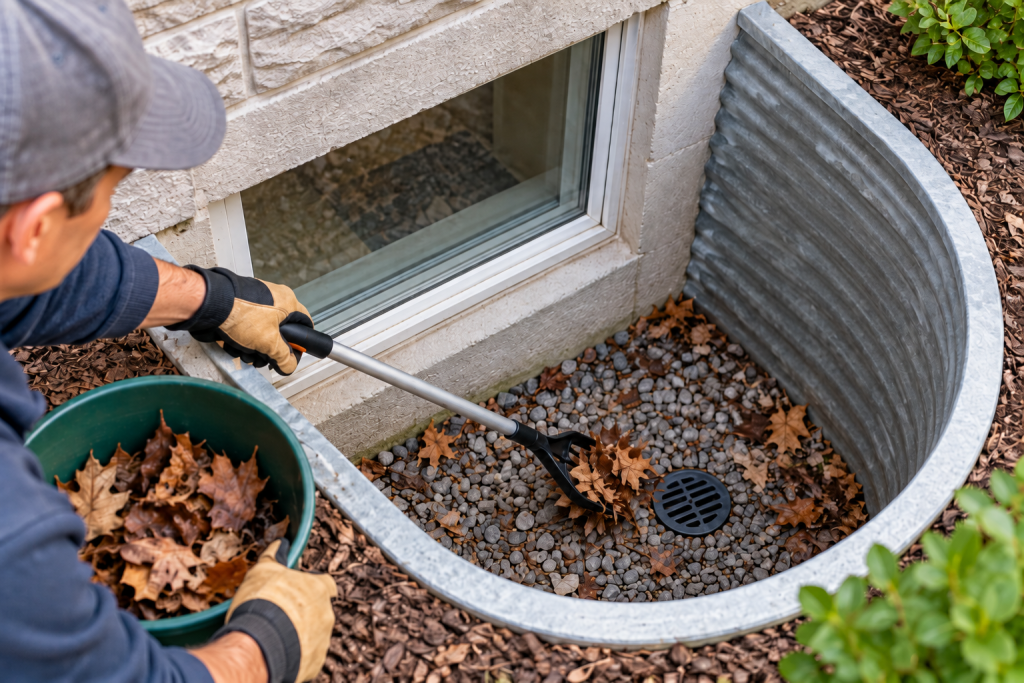
Step 2: Remove leaves, mulch, sticks, and loose debris
Remove loose material that can be safely reached by hand or with a grabber.
Leaves and mulch can form a dense layer over the bottom of the well, trapping additional sediment and covering a visible drain opening. Sticks and other debris may also interfere with a window or egress ladder.
Place the material in a bucket or bag rather than pushing it deeper into the well.
Pay attention to mulch and loose landscaping material around the top edge. If it repeatedly spills into the well, move it back far enough that normal rain does not wash it inside.
Step 3: Remove light surface sediment
After loose debris is gone, inspect the bottom for accumulated soil or fine sediment.
Light surface buildup that is safely accessible can usually be removed with a small hand scoop. Work only with loose material at the surface.
Do not dig down through gravel, remove large amounts of soil, or excavate beside the foundation in an attempt to locate a drain. Buried window-well drainage can be connected to other foundation systems, and excavation may involve unstable soil or buried utilities.
If substantial sediment repeatedly returns, that may indicate runoff or erosion that needs diagnosis rather than more cleaning.
Step 4: Check visible drainage areas
If the well has an accessible drain opening, make sure loose leaves, mulch, or surface debris are not covering it.
Also look at the gravel or drainage material at the bottom of the well. It should not be buried beneath a thick layer of organic debris or sediment.
Routine maintenance can keep an accessible drainage area clear, but it cannot clean a clogged buried drain line.
Do not insert tools deeply into an unknown drain or dismantle drainage components. If water continues to pool after visible debris is removed, the problem has moved beyond routine cleaning.
Step 5: Inspect the window and well
With the well clear enough to see, look for obvious signs of deterioration.
Check the window frame and the foundation opening for visible gaps, staining, deterioration, or damage. Inspect the well itself for:
- Rust or corrosion
- Loose fasteners
- Bent or damaged well walls
- Components pulling away from the foundation
- Washed-out or unstable soil
- Shifted sections of the well
Routine cleaning does not correct these conditions. Significant corrosion, looseness, movement, or deterioration deserves repair before the well worsens.
Step 6: Inspect the cover
If a window well cover is installed, check that it remains positioned correctly and is not cracked, badly deformed, loose, or obstructing the window.
Remove accumulated leaves and other loose debris where it can be done safely.
A cover can reduce direct rain, snow, and debris entering the well, but it should not hide a drainage problem underneath. Look below the cover periodically rather than assuming the well is clean because the top appears protected.
For an egress window, make sure the cover can still be opened or removed as intended from inside the well and that its attachment does not interfere with emergency escape.
If the existing cover is damaged or poorly matched to the well, our guide to the best window well cover explains how to compare fit, materials, drainage considerations, and egress compatibility.
Step 7: Check drainage after the next rain
After cleaning, observe the well during or after a normal rain event when conditions are safe.
A small amount of water reaching the bottom is not necessarily a problem if it drains away. Persistent pooling is more important.
Note whether:
- Water drains normally after the storm
- The water level continues rising
- Runoff is visibly flowing into the well
- One well remains wet while others drain
- Water reaches the window frame
If standing water remains after visible debris has been cleared, additional cleaning may not help. The well may have a clogged buried drain, saturated surrounding soil, surface-runoff problem, or another drainage issue requiring diagnosis.
If the well still holds water after visible debris has been cleared, see our window well drainage guide for the common causes of persistent pooling and what to check next.
Keep Vegetation and Landscaping Out of the Well
Plants around a basement window can make the area attractive, but vegetation should not obstruct the well.
Trim back branches or foliage that repeatedly drop material into the opening. Keep vines from growing across covers, ladders, steps, or window hardware.
Mulch and loose soil also deserve attention. Material piled close to the edge can wash into the well during heavy rain and gradually bury drainage material.
Routine maintenance should focus on preventing material from spilling inside. Correcting larger grading or runoff problems is a separate drainage task.
Watch for Snow and Ice
Winter conditions can obstruct a window well even when leaves and sediment are not a problem.
After significant snowfall or drifting, visually check whether snow has accumulated over the well or blocked an egress route. Snowmelt can also carry debris into the well and reveal drainage problems that were not visible while conditions were frozen.
Avoid striking or prying aggressively at frozen covers, windows, ladders, or well components. Damage from ice or shifting soil may not be obvious until temperatures rise.
After snowmelt, inspect again for standing water, shifted components, sediment, or debris.
Keep Egress Windows Clear
If a basement window is intended for emergency escape, maintenance has an additional safety purpose.
Do not allow leaves, stored objects, vegetation, snow, or other material to obstruct the window, ladder, steps, or path out of the well.
Do not remove a fixed egress ladder simply because it makes cleaning less convenient.
For deeper wells designed for access, use only the intended safe access arrangement and only when conditions are stable. Routine maintenance should not require climbing into a well that is difficult to exit.
If damage to the cover, ladder, well, or window could interfere with emergency escape, address that problem promptly.
What Routine Window Well Maintenance Cannot Fix
A clean well can still have a drainage problem.
Removing debris may help when leaves or sediment are covering an accessible drain opening, but maintenance does not correct:
- A clogged buried drain line
- Saturated surrounding soil
- Poor grading
- Persistent runoff toward the well
- Foundation drainage failure
- A damaged window installation
- Significant well movement or deterioration
Adding more gravel is also not a substitute for diagnosing persistent standing water. Gravel can hide water below the surface without creating a path for it to drain.
If a well continues filling after routine cleaning, the next step is drainage diagnosis rather than repeated debris removal.
A drainage or waterproofing professional may be appropriate when pooling is persistent, a buried drain is suspected of failing, several wells are affected, or investigation would require excavation.
A window professional may be more appropriate when drainage appears normal but water enters around the window frame or foundation opening.
Simple Seasonal Window Well Maintenance Checklist
Use this quick check during seasonal inspections and after severe weather:
- Remove leaves, sticks, mulch, and loose debris
- Scoop out light surface sediment when safely reachable
- Make sure visible drain openings are not covered
- Check that gravel or drainage material is not buried under debris
- Look for standing water after rain
- Inspect the window frame and edges of the foundation opening
- Check for rust, corrosion, loose fasteners, or damaged well walls
- Inspect the cover for damage or poor positioning
- Keep vegetation and mulch from spilling into the well
- Check for snow or ice obstruction in winter
- Keep egress ladders, steps, windows, and escape paths unobstructed
- Note any drainage that appears slower than it was previously
A few minutes of observation can often reveal whether the well simply needs cleaning or has developed a problem that routine maintenance will not solve.
Final Thoughts
The best way to clean window well areas is to keep the task simple: remove loose debris and light sediment, keep visible drainage areas uncovered, inspect the well and window, and check how the area behaves after rain.
Seasonal maintenance can prevent leaves, mulch, snow, and sediment from creating avoidable problems, but it cannot repair failed drainage or persistent water entry. If a clean well continues to hold water, becomes unstable or damaged, or no longer provides clear egress, move from routine maintenance to the appropriate drainage, waterproofing, or window repair evaluation.