
dishwasher soap dispenser not opening: causes and fixes
Dishwasher soap dispenser not opening can be caused by something as simple as a dish blocking the dispenser or detergent residue around the latch, but an internal actuator, wiring, or control problem is also possible. Start with loading, visible buildup, and detergent condition. Then check the lid manually with the dishwasher off before deciding whether appliance service is needed.
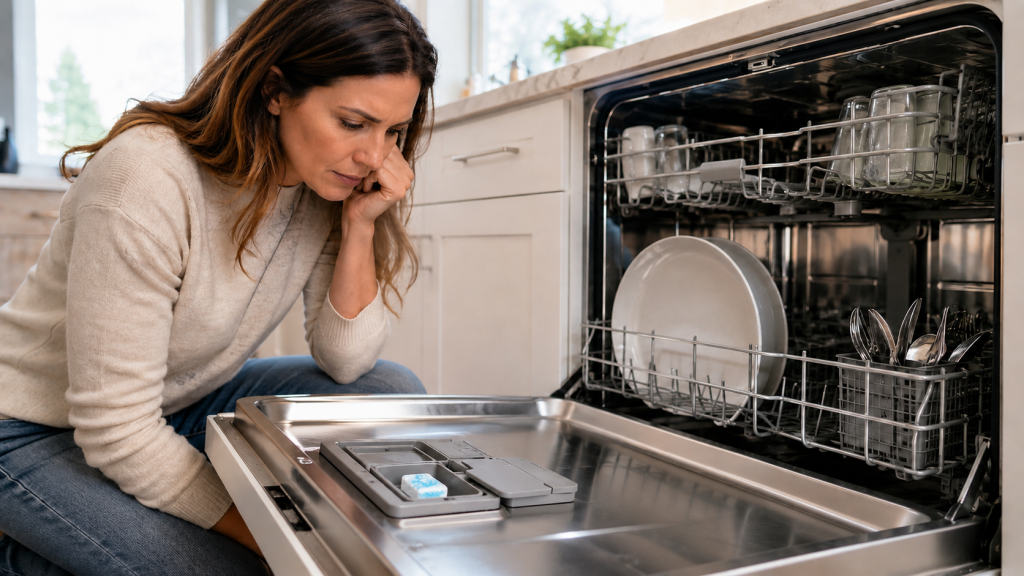
Dishwasher soap dispenser not opening? Start with these checks
Use the symptom you see to narrow the problem before assuming the dispenser needs replacement.
| What to Check | What You May Notice | Safe First Step |
|---|---|---|
| Dish blocking dispenser | Lid stays closed after cycle | Reload large items away from dispenser |
| Utensil interference | Failure changes with different loads | Move tall utensils or handles |
| Detergent residue | Sticky or crusted lid and latch | Clean accessible buildup |
| Wet or clumped detergent | Pod sticks or powder cakes | Dry dispenser and use fresh detergent |
| Lid not latching | Door will not stay closed | Check lid movement with dishwasher off |
| Damaged latch | Loose, cracked, or distorted parts | Stop forcing it; consider service |
| Cycle selection | Problem occurs on certain settings | Confirm a normal wash cycle |
| Dispenser opens, detergent remains | Door is open after cycle | Check detergent and water access |
| Internal problem | Lid works by hand but not in cycles | Arrange appliance service |
Before doing more than normal loading checks or surface cleaning, stop the dishwasher and let hot water and surfaces cool. Do not remove the inner door, service panels, wiring covers, or other components.
If troubleshooting would require access near electrical or moving parts, disconnect power first. Unplug the dishwasher only when the plug and surrounding area are safely accessible and dry. For a hardwired machine, or whenever power cannot be safely isolated, use the appropriate breaker shutoff or leave the work to an appliance technician.
Check Whether a Dish Is Blocking the Dispenser
Loading interference is one of the easiest problems to overlook. A large plate, cutting board, pan, tall utensil, or oversized item can physically prevent the dispenser door from swinging open.
The exact dispenser location and required clearance vary by dishwasher design. Look at how the racks and loaded items sit when the dishwasher door closes rather than assuming every model needs the same arrangement.
Try these checks:
- Remove large items positioned near the dispenser.
- Make sure pan handles and tall utensils cannot move into its path.
- Avoid crowding the rack directly in front of the dispenser.
- Confirm that adjustable racks are seated normally.
- Follow the loading arrangement shown in your owner’s manual.
Run a normal wash cycle after reloading. If the problem disappears, the dispenser itself may be working normally.
Check the Dispenser for Detergent Residue
Detergent can accumulate around the dispenser cup, lid edges, hinge, and latch. As buildup dries, it may make the lid harder to close or prevent the latch from releasing smoothly.
With the dishwasher stopped and cool, inspect only the accessible dispenser surfaces. Wipe away loose or softened residue with warm water and a soft cloth. A soft brush can help around accessible edges if it does not require prying or disassembly.
Do not scrape the dispenser aggressively with screwdrivers, knives, or other metal tools. Plastic hinges and latch parts can be damaged by excessive force.
After cleaning, wipe the cup and lid area dry. The lid should move normally without needing to be pushed, twisted, or forced.
For routine cleaning around dispensers, filters, racks, and other appliance surfaces, choose appliance cleaning tools that will not scratch finishes or damage plastic components.
Check Whether the Detergent Is Wet, Swollen, or Clumped
Detergent left inside the dispenser does not always prove that the dispenser door failed.
Powder can absorb moisture and form hard clumps. Some detergent pods or packets can become sticky or swollen after exposure to humidity or moisture. Detergent may also adhere to a damp dispenser cup, especially if it is loaded well before the wash begins.
Check the detergent itself if:
- Powder is lumpy instead of free-flowing.
- A pod feels sticky or appears misshapen.
- Detergent is stuck to the cup even though the door opened.
- The dispenser is wet when detergent is added.
Use fresh detergent that has been stored as directed on its packaging. When appropriate for your detergent and dishwasher, dry the dispenser before filling it and add detergent shortly before starting the cycle.
Detergent formulations vary, so follow both the detergent packaging and dishwasher manufacturer’s instructions.
Test the Dispenser Lid With the Dishwasher Off
A simple manual check can help distinguish a mechanical problem from a problem that happens only during operation.
With the dishwasher off and cool:
- Open and close the dispenser lid normally.
- Check whether it moves smoothly through its normal range.
- Close it and see whether the latch holds.
- Look for cracks, deformation, or obvious damage.
- Check the hinge and latch area for remaining residue.
Do not force a lid that is jammed or pry it open with a metal tool.
If the lid will not latch, immediately springs open, binds badly, or has visible broken parts, the dispenser may need repair or replacement. Depending on the dishwasher design, the dispenser may be serviced as an assembly rather than as individual small parts.
Does the Dispenser Door Open by Hand but Not During a Cycle?
This symptom is an important dividing line.
If the lid closes, latches, and opens normally by hand when the dishwasher is off, but repeatedly stays closed during proper wash cycles, an internal problem becomes more likely. Possible causes can include:
- A dispenser actuator that is not operating correctly.
- A wiring or connection problem.
- A control-related fault.
- A cycle or timing problem.
These possibilities should not be tested by powering the dishwasher while accessing the dispenser mechanism.
Do not bypass the door interlock, probe wiring, take voltage measurements, test the actuator while energized, or remove the dishwasher door to reach controls. Once loading, residue, detergent condition, and obvious mechanical problems have been ruled out, professional appliance diagnosis is the appropriate next step.
Check the Cycle Selection
Dishwasher cycles do not all behave the same way. Detergent use and dispenser operation can vary depending on the model and selected program.
For troubleshooting, confirm that you are running a normal wash cycle intended to clean a full load. A rinse-only or similar short program may not use detergent in the same way as a normal cleaning cycle.
Also check whether the cycle was interrupted or canceled before completion.
Do not rely on a supposed universal time when the detergent door should open. Consult your dishwasher manual for the behavior of its specific cycles.
What If the Dispenser Opens but the Detergent Does Not Dissolve?
An open dispenser at the end of the cycle changes the diagnosis. The door may have released correctly even though some or all of the detergent remained.
Possible reasons include:
- Detergent became wet or clumped before release.
- A dish blocked water from reaching the dispenser area.
- Spray-arm movement was obstructed.
- The wash cycle was interrupted.
- Water movement was inadequate.
- Water temperature was not appropriate for effective cleaning.
- The detergent was not well suited to the dishwasher or conditions.
Start with loading and detergent condition rather than assuming the dispenser is defective.
If the dishwasher also has broad washing-performance problems, such as consistently dirty dishes or little apparent water movement, the issue may extend beyond the dispenser. Avoid progressing into pump, heater, inlet-valve, or electrical diagnosis as part of this check.
Check for Rack or Spray-Arm Interference
Loading can affect more than the dispenser door itself. Large items may also interfere with the water pattern needed to carry released detergent through the dishwasher.
With the dishwasher off:
- Make sure racks are installed and seated normally.
- Look for pans, boards, or utensils extending into spray-arm paths.
- Rotate an easily accessible spray arm gently by hand if your manufacturer’s instructions permit it.
- Rearrange anything that obviously restricts its movement.
The spray arm should not need to be removed for this check. Stop at visible, accessible interference rather than dismantling the pump or internal spray system.
Could the Dispenser Latch Be Damaged?
A damaged latch or lid usually produces a mechanical symptom you can see or feel without taking the dishwasher apart.
Watch for:
- A lid that will not remain latched.
- A latch that feels unusually loose.
- Cracked or missing plastic.
- A distorted hinge.
- A lid that springs open as soon as you close it.
- A dispenser that remains firmly stuck after accessible residue is removed.
A normal visual and manual inspection is enough for a homeowner diagnosis. Do not take apart the latch mechanism or inner dishwasher door to investigate further.
If the mechanism is visibly damaged, appliance service or dispenser replacement may be required. The repair method depends on the model.
Could Moisture Inside the Dispenser Be the Problem?
Moisture matters most when the dispenser door opens but detergent remains stuck inside.
A wet dispenser cup can cause some powders to cake or some pods to begin softening before the wash cycle reaches the detergent-release stage. Humid storage can cause similar problems before the detergent even enters the dishwasher.
To reduce this possibility:
- Wipe excess moisture from the dispenser before adding detergent when appropriate.
- Keep detergent containers properly closed.
- Store pods or powder in suitable dry conditions.
- Follow storage and loading directions for the detergent you use.
If the dispenser door itself consistently remains latched shut, however, moisture alone is unlikely to explain the entire problem.
What If the Dispenser Only Fails Sometimes?
An intermittent failure can be useful diagnostically because something may be changing from one load to another.
Compare failed cycles with successful ones. Look for differences in:
- Placement of large dishes.
- Utensil positions.
- Rack adjustment.
- Detergent condition.
- Moisture inside the dispenser.
- Residue around the latch.
- Cycle selection.
Consistent loading can help isolate the cause. If failures stop after moving a particular pan or keeping the dispenser clean and dry, you have a practical explanation.
If the dispenser becomes increasingly unreliable even with consistent loading, fresh detergent, and a clean mechanism that works smoothly by hand, a developing latch, actuator, or control problem may require service.
When a Dishwasher Soap Dispenser Not Opening Needs Professional Service
Arrange appliance service when accessible checks do not solve the problem or when diagnosis would require opening the dishwasher door or working around electrical components.
Professional service is appropriate when:
- The dispenser is visibly damaged.
- The lid will not latch normally.
- The lid works manually but repeatedly fails during wash cycles.
- Correct loading does not prevent recurring failures.
- Accessible cleaning makes no difference.
- An actuator, wiring connection, or control problem is suspected.
- Reaching the suspected fault requires door disassembly or service-panel removal.
Stop using the dishwasher and have the problem evaluated if you notice a burning odor, sparking, arcing, unusual overheating, visible damaged wiring, or repeated breaker trips.
Do not continue by performing energized tests or control-board diagnostics.
If the dishwasher is older and dispenser trouble is part of a growing pattern of repairs, consider the appliance’s overall condition when deciding whether another repair makes sense.
Common Dishwasher Soap Dispenser Troubleshooting Mistakes
Avoiding a few common mistakes can make the diagnosis faster and prevent damage.
- Assuming the dispenser is broken before checking dish placement.
- Overloading racks and blocking the dispenser’s path.
- Forcing a lid that does not move normally.
- Prying dispenser parts with metal tools.
- Ignoring dried detergent around the latch or hinge.
- Putting moisture-sensitive detergent into a wet cup against its instructions.
- Assuming undissolved detergent means the door never opened.
- Repeating identical wash cycles without changing the suspected loading problem.
- Taking apart the dishwasher door before completing accessible checks.
- Attempting live actuator, wiring, or control testing.
Dishwasher Soap Dispenser Not Opening FAQ
Why is my dishwasher soap dispenser not opening?
A dishwasher soap dispenser not opening is often caused by a dish or utensil blocking the door, detergent residue around the latch, a mechanical lid problem, or an unsuitable cycle. If the lid works normally by hand but repeatedly stays closed during proper cycles, an internal actuator, wiring, or control problem may need professional diagnosis.
Can dishes block the detergent dispenser?
Yes. Depending on the dishwasher layout, large plates, cutting boards, pans, utensils, or improperly positioned racks can interfere with the dispenser. Rearrange the load so the dispenser has clear space to open, following your model’s loading instructions.
Why is detergent still in the dispenser after the cycle?
The door may not have opened, but that is not the only possibility. Detergent can remain because it became wet or clumped, stuck to the cup, received inadequate water spray, or was left after an interrupted cycle. Check whether the dispenser door is open before deciding where to troubleshoot next.
Can a wet dispenser stop a dishwasher pod from releasing?
Moisture can make some pods or other detergents sticky before release, depending on the product. Keeping the detergent properly stored and drying the dispenser when recommended can help. A wet cup does not usually explain a lid that is mechanically stuck closed.
When should I replace or service the dishwasher detergent dispenser?
Service is appropriate when the lid or latch is visibly damaged, the lid cannot latch normally, or the dispenser repeatedly works by hand but not during wash cycles. Replacement depends on the dishwasher’s design and should not require a homeowner to perform energized testing or internal door disassembly.
Final Thoughts
For a dishwasher soap dispenser not opening, work from the simplest explanation toward the more complex ones: check dish placement, remove accessible detergent residue, inspect the detergent, test the lid and latch manually with the dishwasher off, confirm the cycle selection, and look for obvious rack or spray-arm interference.
If those checks do not explain the failure, stop before investigating the actuator, wiring, control board, or components inside the dishwasher door. A dispenser that works mechanically but consistently fails during operation is a good reason to move from homeowner troubleshooting to professional appliance service.