
fascia board rot: causes, warning signs, and repair options
Fascia board rot is usually a moisture problem. Wood fascia can decay when it repeatedly gets wet and does not dry properly because of failed finishes, roof-edge water problems, gutter leaks, or hidden moisture behind the board. The lasting fix is not simply covering or repainting damaged wood—it is finding the moisture source, determining how far the decay extends, and repairing or replacing the affected material.
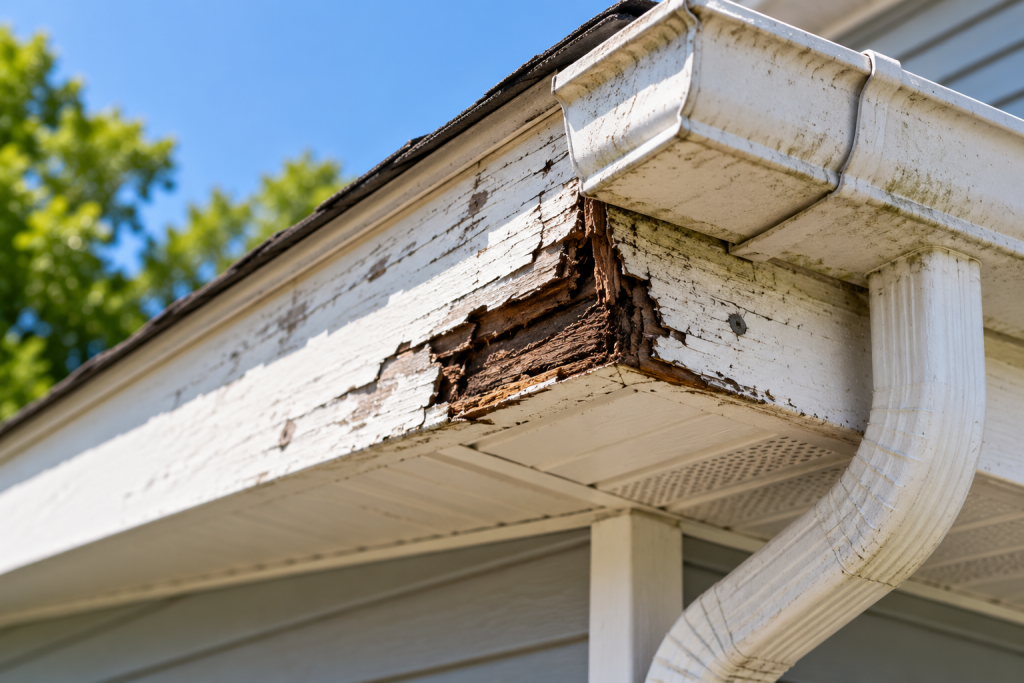
What Is Fascia Board Rot?
Fascia is the finished board running along the lower edge of many sloped roofs. It covers the ends of the roof framing, creates a finished roof edge, meets the soffit below, and often provides the mounting surface for gutters.
Because fascia sits directly at the roof edge, it is exposed to rain, snow, overflowing water, and repeated wetting from roof runoff. Painted or otherwise protected wood can perform well, but persistent moisture eventually creates conditions where decay can develop.
Rot is different from ordinary weathering. Faded paint or minor surface checking does not automatically mean the wood is structurally deteriorated. Rot involves actual breakdown of the wood fibers, which can leave the board soft, weak, crumbly, or unable to hold fasteners.
What Causes Fascia Board Rot?
Rot rarely begins simply because a fascia board is old. More often, moisture repeatedly reaches the wood through a failed finish or another defect at the roof edge.
Failed Paint or Finish
Paint and other exterior finishes help limit direct moisture exposure.
As coatings age, they can crack, peel, blister, or separate from the wood. Bare end grain, joints, nail holes, and exposed board edges can absorb water more readily than a maintained finished surface.
Repeated paint failure in the same location deserves attention. Repainting may improve appearance, but it will not solve a leak or drainage problem that continually wets the wood.
Roof-Edge Water Problems
Roof-edge details are intended to move water off the roof without allowing it to curl back onto the fascia or reach vulnerable wood behind the roof covering.
Damaged, missing, or poorly configured drip-edge flashing can contribute to repeated fascia wetting. Problems with roofing near the eave can have a similar effect.
Signs such as staining concentrated just below the roof edge, recurring rot along the top of the fascia, or deterioration that returns after previous repairs can point toward a water-management problem rather than simple finish failure.
Roof-edge repairs can involve fall hazards and roofing-system details, so homeowners should limit inspection to safe observations from the ground and leave work at the roof edge to an appropriate professional.
Gutter Leaks or Overflow
Gutters are another possible source of repeated moisture.
Water can reach wood fascia when a gutter leaks at a joint, overflows, pulls away from the roof edge, or otherwise fails to carry runoff as intended. A persistent wet streak or localized deterioration near a gutter connection may provide a clue.
The important point is identifying whether gutter water is contributing to the rot. Detailed gutter drainage troubleshooting is a separate task, particularly when work would require climbing or removing heavy gutter sections.
Snow and Ice Exposure
Cold climates can expose the roof edge to prolonged periods of snow, ice, and meltwater.
The fascia may remain damp longer than it would after an ordinary rainstorm, particularly where drainage or roof-edge details are already imperfect. Repeated freezing and thawing can also stress coatings, joints, and nearby materials.
Snow and ice do not automatically cause fascia rot. The concern is repeated or trapped moisture that keeps wood wet instead of allowing it to dry.
Moisture Trapped Behind the Fascia
Some fascia deterioration begins where it cannot be seen easily.
Water entering at the roof edge can reach the back or top of a fascia board while the painted face still appears relatively normal. Moisture may also come from failed flashing or deterioration in adjacent roof-edge components.
This is why surface appearance does not always reveal the full extent of decay. A small soft area on the visible face can sometimes be associated with deeper deterioration behind it.
Signs of Fascia Board Rot
Some warning signs appear before the wood is obviously falling apart. Early recognition can help limit how much material eventually needs repair.
Common signs include:
- Peeling, blistering, or repeatedly failing paint
- Dark stains or persistent discoloration
- Visible cracks or splits
- Swollen or distorted areas
- Soft or spongy-looking wood
- Crumbling or missing wood fibers
- Holes or visibly deteriorated sections
- Fasteners beginning to pull out
- Gutters sagging or separating from the fascia
- Repeated deterioration in the same location
One peeling patch does not prove that the board is rotten. Paint can fail for several reasons. The concern increases when coating failure appears alongside softness, swelling, crumbling wood, loose fasteners, or recurring moisture.
Visible deterioration can also underestimate the problem. Rot may extend farther along the board or into material behind it than the exposed damage suggests.
How Serious Is Fascia Rot?
The seriousness of fascia rot depends on how much wood is affected and whether deterioration extends into surrounding components.
A small localized area may involve only a short section of fascia. If most of the board remains solid and the moisture source is corrected, the repair may stay relatively limited.
A board that is soft through a large area is a different situation. It may no longer provide a dependable attachment surface for gutters or adjacent trim.
More extensive warning signs include several rotten sections along the same roof edge, deterioration on multiple sides of the house, or damage involving nearby soffit, roof sheathing, or rafter tails.
Widespread rot does not automatically mean the roof structure has been damaged. It does mean the moisture source and surrounding materials deserve a more careful professional evaluation.
Can Rotten Fascia Be Repaired?
Sometimes. Limited deterioration may be repairable when the affected area is small, the remaining board is solid, and the source of the moisture has been identified and corrected.
The appropriate repair depends on the depth and location of the decay. A cosmetic surface defect is not the same as wood that has lost much of its strength.
A repair is less likely to be durable when significant rotten material remains or when water continues to reach the same location.
Avoid treating repair compounds, new trim, or fresh paint as substitutes for diagnosing the cause. They may improve the surface temporarily while deterioration continues underneath.
For a broader look at repair options beyond rot-specific damage, our fascia repair guide explains common damage types, repair costs, and when replacement makes more sense.
When Should a Fascia Board Be Replaced?
Replacement becomes more appropriate as deterioration affects more of the board or compromises its ability to stay securely attached.
Replacement is more likely when:
- Wood is deeply soft, crumbly, or missing
- Rot extends through a significant portion of the board
- Fasteners no longer hold securely
- Several areas of the same board are deteriorated
- Gutters can no longer be securely supported
- Previous localized repairs have failed repeatedly
- Access to adjacent materials is necessary to correct the moisture source
A damaged fascia section may sometimes be replaced without rebuilding the entire roof edge. More extensive deterioration involving soffit, sheathing, framing, or multiple fascia boards requires a broader assessment.
Why Fixing the Moisture Source Comes First
Rotten fascia is the result of a moisture problem, not merely a damaged-looking board.
Possible sources include failed exterior coatings, roof-edge water intrusion, gutter leakage or overflow, damaged flashing, persistent runoff, or another defect that keeps the wood wet.
Replacing deteriorated wood without correcting that condition can allow the new fascia to develop the same problem.
Likewise, covering rotten wood with metal, PVC trim, or another exterior material does not restore strength to the damaged board or stop water that is entering from behind.
A durable repair should address the problem in this order: identify the source, correct the water-management defect, determine how much material has deteriorated, and then repair or replace damaged components.
Can You Paint Over Rotten Fascia?
No. Paint does not restore decayed wood.
If the fascia is merely weathered and still solid, maintaining the protective finish can help prevent additional moisture exposure. But paint cannot make soft, crumbling, or structurally weakened wood sound again.
Repeatedly painting the same failing area can also hide a moisture problem temporarily without correcting it.
Older painted fascia requires additional caution. Homes built before 1978 may have lead-containing exterior coatings. Work that disturbs those coatings requires appropriate lead-safe practices rather than casual sanding or scraping.
What If the Gutter Is Attached to Rotten Fascia?
Rotten fascia can become a gutter-support problem because many gutters are fastened directly to the fascia or supporting material at the roof edge.
Possible warning signs include:
- A gutter section that visibly sags
- Fasteners pulling out
- A widening gap between the gutter and fascia
- Soft or missing wood near gutter attachments
A sagging gutter can become heavy when it contains water, ice, or debris. Do not attempt to detach or support large gutter sections while balancing on a ladder.
If the fascia can no longer hold the gutter securely, professional evaluation is appropriate. The deteriorated attachment surface and the moisture source both need attention.
Can Fascia Rot Spread to the Soffit or Roof Edge?
Persistent moisture that damages fascia can also affect nearby materials.
Depending on where water is entering, deterioration may involve the soffit, roof sheathing, rafter tails, trim, or gutter attachment points. Rot does not literally have to “spread” from one board to another; the same damp conditions can damage several adjacent wood components.
That is why extensive fascia decay deserves more attention than a surface patch.
Not every rotten fascia board means structural framing is damaged. The extent has to be evaluated based on the actual conditions.
If deterioration is affecting both parts of the roof edge, our soffit and fascia replacement guide explains when combined replacement may be more practical than repairing each component separately.
How to Check Fascia Safely
Homeowners can learn a surprising amount through a visual inspection from the ground.
Walk around the house and look for peeling paint, dark staining, holes, distorted boards, sagging gutters, missing wood, or areas that remain visibly wet longer than the surrounding fascia.
Accessible first-story fascia may also be inspected from a safe ground-level position when no climbing is required.
Do not climb onto the roof or lean from a ladder to probe fascia. Avoid pulling on questionable gutters or deteriorated boards, which may not be securely attached.
Binoculars or a camera with zoom can help with an initial look at higher areas. If the damage cannot be evaluated safely from the ground, have a qualified professional inspect it.
Repair vs. Replacement: A Simple Decision Guide
| Condition | Likely Direction |
|---|---|
| Small, localized deterioration with solid surrounding wood | Repair may be reasonable |
| Moisture source corrected and board remains mostly sound | Limited repair may be appropriate |
| Deep softness or crumbling through much of the board | Replacement is more appropriate |
| Fasteners no longer hold securely | Replacement likely |
| Multiple rotten sections | Broader replacement should be evaluated |
| Soffit, sheathing, or roof-edge damage suspected | Professional evaluation |
The moisture problem still has to be corrected regardless of whether the final solution is a localized repair or board replacement.
How to Help Prevent Fascia Rot
Prevention centers on keeping wood protected and preventing chronic wetting.
Maintain painted or otherwise finished wood before large areas of coating fail. Address gutters that visibly leak or overflow, and have roof-edge water problems or damaged flashing corrected rather than repeatedly repainting the resulting stains.
After major wind, snow, or rain events, a ground-level visual check can also reveal displaced gutters, damaged roof edges, or fresh staining before deterioration becomes extensive.
The goal is not to keep fascia completely dry during every storm. Exterior components are designed for weather exposure. The goal is to prevent repeated moisture from becoming trapped or continually soaking vulnerable wood.
When to Call a Professional
Professional evaluation is appropriate when fascia damage is high on the house, requires roof-edge access, or involves gutters that are sagging or pulling away.
A professional should also evaluate large areas of rot, suspected damage to roof sheathing or rafter tails, deterioration involving several exterior components, or situations where the source of the moisture is unclear.
Avoid opening roof-edge assemblies or removing large fascia sections simply to investigate. What appears to be a trim problem can sometimes involve roofing, flashing, gutter support, or framing that needs to be evaluated together.
Final Thoughts
Fascia board rot is fundamentally a moisture problem. Peeling paint, soft wood, swelling, loose fasteners, and sagging gutters can all signal deterioration, but the visible damage may be only part of the issue.
The durable approach is to identify and correct the moisture source, determine how much wood has lost its integrity, repair or replace the deteriorated fascia, and restore the protective finish and water-management details. Addressing only the rotten surface leaves the condition that caused it ready to start the cycle again.