Flooring Types for Homes: how to chose the right floor
Choosing among the many flooring types for homes comes down to matching the material to the room, moisture exposure, traffic, maintenance needs, comfort, appearance, and budget. Luxury vinyl plank, laminate, hardwood, engineered hardwood, ceramic tile, and porcelain tile can all be good choices, but each handles water, wear, repairs, and installation differently.
Start with the conditions the floor must handle rather than appearance alone. A beautiful floor that does not suit the room, subfloor, or moisture conditions can become an expensive problem.
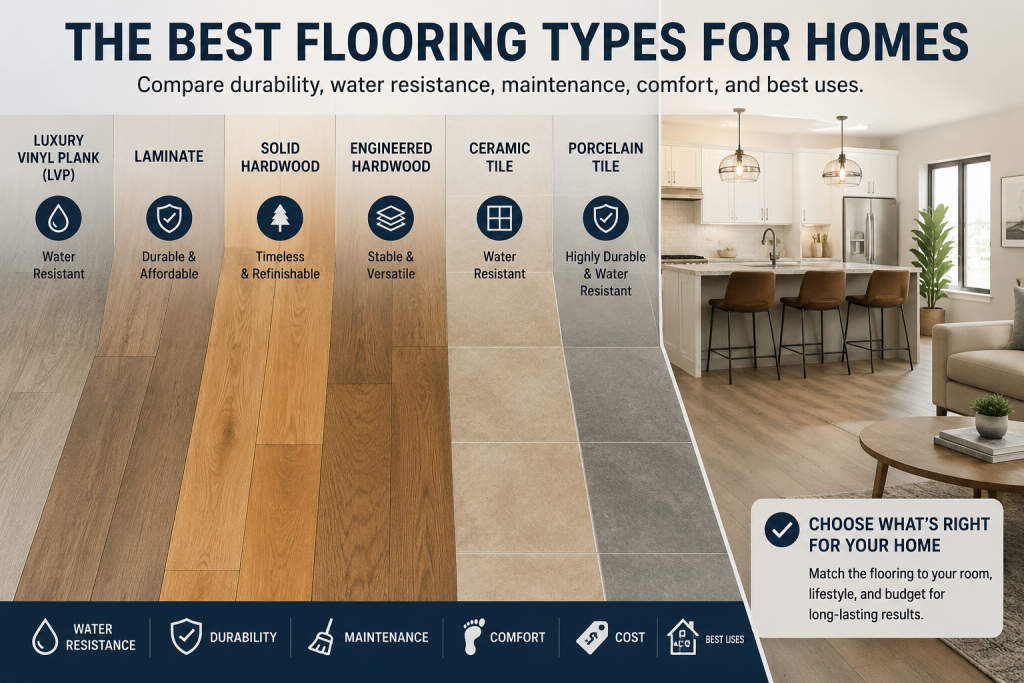
| Flooring type | Water resistance | Durability | Maintenance | Comfort | Typical cost level | Best suited for |
|---|---|---|---|---|---|---|
| Luxury vinyl plank / vinyl | High for appropriate products | Good for everyday household use | Easy routine cleaning | Softer than tile | Low to moderate | Kitchens, living areas, basements |
| Laminate | Varies; prolonged moisture can damage the core | Durable wear surface | Easy in dry areas | Moderately comfortable | Low to moderate | Bedrooms, living rooms, dry family spaces |
| Solid hardwood | Limited | Long-lasting but can scratch and dent | Requires moisture-conscious care | Warm and comfortable | Moderate to high | Living rooms, bedrooms, dining rooms |
| Engineered hardwood | Better stability than solid wood, but not waterproof | Good with proper care | Similar to other wood floors | Warm and comfortable | Moderate to high | Living areas and suitable concrete installations |
| Ceramic tile | High at the tile surface | Very durable | Easy surface cleaning; grout needs care | Hard and cool | Moderate | Bathrooms, kitchens, entries |
| Porcelain tile | Very high at the tile surface | Very durable | Easy surface cleaning; grout needs care | Hard and cool | Moderate to high | Bathrooms, entries, mudrooms, high-wear areas |
Flooring work can involve heavy materials, cutting tools, dust, adhesives, and hidden problems below the existing surface. If older flooring, sheet goods, tiles, mastics, or adhesives could contain asbestos, do not sand, grind, scrape, cut, or remove them until the material has been appropriately evaluated.
how to choose between flooring types for homes
No flooring type is best in every category. The right choice depends on which tradeoffs matter most in a particular room.
If durability is one of your highest priorities, see our guide to the most durable flooring options for busy homes.
Consider these factors before narrowing your options:
- Moisture exposure: Bathrooms, basements, mudrooms, and some kitchens need materials that tolerate water better than dry bedrooms.
- Durability: High-traffic spaces need flooring that can handle repeated foot traffic without premature wear.
- Scratch and dent resistance: Pets, furniture, dropped objects, and children can be harder on some surfaces than others.
- Comfort underfoot: Tile is hard and cool, while many floating floors feel somewhat softer.
- Maintenance: Some floors need little more than routine cleaning, while others may eventually need refinishing, grout care, or more cautious cleaning.
- Appearance: Natural wood, wood-look planks, and tile create very different visual effects.
- Installation difficulty: Material weight, cutting requirements, subfloor preparation, and fastening or adhesive methods can affect project difficulty.
- Subfloor condition: Flatness, stiffness, moisture, damage, and existing floor layers can determine what is practical.
- Cost level: Compare the complete project, including preparation, underlayment, trim, transitions, labor, and repairs.
- Expected service life: A longer-lasting material can make sense when the structure beneath it is sound and the style suits the home.
- Repairability: Some floors can be sanded, refinished, or repaired locally more easily than others.
- Pets and children: Spills, claws, toys, noise, and traction may deserve more weight in a busy household.
Product quality and installation conditions also matter. Two floors made from the same broad material category can perform very differently.
Luxury Vinyl Plank Flooring
Luxury vinyl plank, usually called LVP, is a layered resilient flooring designed to resemble wood planks. Many products use a rigid or flexible core, a printed design layer, and a protective wear surface.
Homeowners often choose LVP because it combines convincing wood-look designs with relatively easy maintenance. It is also more forgiving underfoot than ceramic or porcelain tile.
Water performance varies by product. Some LVP is marketed as waterproof because the planks themselves resist water penetration. Others provide strong water resistance but have limitations involving seams, perimeter gaps, exposure duration, or installation conditions. A waterproof plank does not make the subfloor or room waterproof.
Scratches and dents are another consideration. A tough wear surface can resist everyday abrasion, but sharp grit, pet claws, dragged furniture, or heavy point loads can still leave marks.
LVP also depends on a properly prepared base. A subfloor that is uneven, damaged, or excessively flexible can cause movement, visible imperfections, joint stress, or premature failure. Concrete slabs also deserve attention because moisture vapor from below can affect some flooring systems.
Underlayment requirements vary. Some planks include an attached pad, while others require an approved separate layer. Adding extra underlayment when it is not permitted can make a floating floor too flexible.
LVP is commonly considered for:
- Kitchens
- Living rooms
- Family rooms
- Bedrooms
- Finished basements
- Hallways
Its main drawbacks are the possibility of scratching or denting, sensitivity to poor subfloor preparation, and limited repair options compared with refinishable hardwood.
Laminate Flooring
Laminate flooring uses a manufactured core topped with a decorative image layer and a durable transparent wear surface. Modern products can closely imitate hardwood, stone, or other materials.
One of laminate’s main strengths is surface durability. Its wear layer can handle regular foot traffic, furniture movement, and routine household use well when the flooring is matched to the space.
Water performance deserves careful attention. Some laminate products are labeled water-resistant, while others make stronger waterproof claims. These descriptions should not be treated as interchangeable.
The core of traditional laminate can swell when water reaches vulnerable joints or remains in contact with the material for too long. Prolonged moisture exposure may lead to raised seams, swelling, or bubbling that does not return to its original shape after drying.
Subfloor preparation and underlayment are also important. Laminate generally performs best over a flat, stable surface with the underlayment specified for that flooring system.
Laminate can work well in:
- Bedrooms
- Living rooms
- Dining rooms
- Hallways
- Dry family spaces
Its main limitation is moisture sensitivity. Laundry leaks, repeated wet mopping, plumbing problems, and standing water can create more serious damage than an ordinary cleaned-up spill.
Solid Hardwood Flooring
Solid hardwood is milled from solid pieces of wood. Its natural grain, warmth, and ability to age gracefully make it appealing for living spaces where appearance is a priority.
A major advantage is repairability. Depending on plank thickness and condition, many solid hardwood floors can be sanded and refinished multiple times over their service life.
Wood is softer than tile and many laminate surfaces, so dents and scratches are normal considerations. Pet claws, chair legs, grit, and dropped objects can leave visible marks.
Solid wood also changes dimension as indoor humidity changes. Seasonal gaps or movement can occur as the material gains and loses moisture. Large or persistent changes can signal humidity or moisture conditions that deserve attention.
Because solid hardwood reacts to moisture, it requires more caution in bathrooms, basements, and other damp locations. Kitchens are possible in many homes, but leaks, dishwasher failures, sink spills, and repeated moisture exposure increase the risk.
Solid hardwood is often a strong fit for:
- Living rooms
- Dining rooms
- Bedrooms
- Offices
- Hallways in dry areas
Its strengths are natural appearance, long-term repairability, and refinishing potential. Its tradeoffs include humidity sensitivity, denting, scratching, and more limited suitability for moisture-prone spaces.
Engineered Hardwood Flooring
Engineered hardwood combines a real wood wear layer with a layered or composite core. That construction makes it different from solid hardwood even though the visible surface is genuine wood.
The layered construction generally improves dimensional stability, which can make engineered hardwood suitable for situations where solid wood would be more sensitive to environmental changes. It is still a wood product, however, and should not be treated as waterproof.
If you are choosing between these two popular options, compare vinyl plank vs engineered hardwood before deciding.
Installation options can be more flexible than with traditional solid wood. Depending on the product and subfloor, engineered flooring may be installed using floating, glue-down, or fastening methods.
Refinishing potential depends heavily on the thickness of the real wood wear layer. A thicker wear layer may allow future sanding or refinishing, while a thin veneer may allow little or none.
Engineered hardwood can be a good choice for:
- Living rooms
- Bedrooms
- Dining rooms
- Offices
- Some installations over concrete when approved
Its main tradeoff is that homeowners get a real wood surface and improved stability, but not necessarily the same refinishing potential or moisture tolerance they might expect from the word “engineered.”
Ceramic Floor Tile
Ceramic floor tile is a hard, fired material that performs well in areas where durability and easy surface cleaning matter. It is frequently used in kitchens, bathrooms, entries, and other areas exposed to shoes or occasional water.
Tile itself handles moisture well, but the complete floor depends on more than the tile surface. Grout, transitions, joints, and the underlying floor system all affect performance.
Ceramic tile is hard underfoot and can feel cool compared with wood or resilient flooring. Dropped glasses or dishes are also more likely to break on it.
Grout requires periodic cleaning and may need maintenance as it ages. Cracks in grout or tile can sometimes reflect movement in the floor beneath rather than a problem with the tile alone.
Subfloor stiffness and preparation are especially important. Tile does not tolerate movement as well as many floating floors. An unsuitable substrate can contribute to cracking or loose areas.
Ceramic floor tile is commonly used in:
- Bathrooms
- Kitchens
- Entryways
- Mudrooms
- Laundry areas
Its main drawbacks are hardness, grout maintenance, demanding substrate preparation, and the possibility of cracks when the supporting floor moves.
Porcelain Floor Tile
Porcelain is a type of ceramic tile made to be denser and less water-absorbent than many standard ceramic tiles. That can make it particularly useful where moisture exposure, wear, or heavy traffic are major concerns.
Its density can also make porcelain more durable in demanding applications, but it does not automatically make porcelain the best flooring for every house.
Porcelain is heavier and usually more difficult to cut than standard ceramic tile. Those characteristics can increase installation effort and make proper tools and substrate preparation more important.
Like ceramic tile, porcelain needs a stable supporting surface. A cracked, flexible, or poorly prepared substrate can undermine even a high-quality tile installation.
Porcelain is often considered for:
- Bathrooms
- Entryways
- Mudrooms
- Kitchens
- High-traffic areas
Its main tradeoffs are weight, installation difficulty, hardness underfoot, and the need for careful substrate preparation.
Best Flooring Types for Different Rooms
Room conditions often make the decision easier than comparing materials in the abstract.
Kitchens
Kitchen floors need to handle spills, frequent cleaning, foot traffic, and dropped objects.
LVP can be appealing for its water tolerance and softer feel. Tile handles spills and wear well but is hard underfoot and on dropped dishes. Engineered or solid hardwood can provide a warm appearance, but water exposure around sinks, refrigerators, and dishwashers deserves extra consideration.
Bathrooms
Moisture exposure is the main concern in bathrooms. Ceramic and porcelain tile are common choices, while suitably rated LVP may also work well.
Surface texture matters because a wet, smooth floor can be slippery. Flooring selection does not replace proper control of plumbing leaks or water escaping from tubs and fixtures.
Basements
Basements require special attention to slab moisture, humidity, and vapor movement.
LVP is often considered because many products tolerate moisture better than wood-based flooring. Engineered hardwood may be suitable when specifically approved for the installation conditions. Traditional laminate and solid hardwood generally require more caution around moisture.
Do not install a finished floor over an unresolved wet slab, active leak, or dampness problem.
Laundry Rooms
Laundry room floors should account for routine moisture as well as the possibility of a leaking supply hose, drain problem, or appliance failure. Easy cleaning also matters because detergents, dirt, and water can reach the floor.
Appropriate LVP, ceramic tile, and porcelain tile are common options because they can tolerate surface moisture well when properly selected and installed. A waterproof flooring product does not prevent water from reaching or damaging the subfloor, walls, or nearby rooms during a significant leak.
Bedrooms
Bedrooms place less demand on water resistance and more emphasis on comfort, appearance, noise, and easy cleaning.
Hardwood, engineered hardwood, laminate, and LVP can all work well. The choice often comes down to desired appearance, budget, maintenance, and how the floor feels underfoot.
Living Rooms
Living rooms combine appearance with everyday durability. Homes with children, pets, or frequent visitors may need more resistance to scratches, spills, and traffic.
Hardwood and engineered hardwood offer natural wood surfaces and repairability. LVP and laminate can provide easier routine maintenance and strong wear resistance, depending on the product.
Entryways and Mudrooms
Entry areas deal with wet footwear, grit, mud, road salt, and frequent cleaning.
Porcelain and ceramic tile are strong candidates where a hard floor is acceptable. Moisture-tolerant LVP can also work well. Whatever the material, controlling grit with entry mats helps reduce surface wear.
Best Flooring for Homes With Pets
Pet-friendly flooring depends on the animal and household rather than one universal material.
Important factors include:
- Scratch resistance: Harder surfaces and durable wear layers may show fewer claw marks.
- Traction: Extremely smooth floors can be difficult for some pets to walk on confidently.
- Water accidents: Flooring that handles short-term moisture is easier to manage around bowls and accidents.
- Cleaning: Smooth surfaces are generally easier to remove hair and tracked dirt from.
- Noise: Hard tile and some floating floors can make claws sound louder.
- Comfort: Older pets may prefer surfaces that are less hard and slippery.
LVP, laminate, tile, engineered hardwood, and solid hardwood can all work in pet households when their tradeoffs match the owner’s priorities.
Best Flooring for Busy Families
Busy households usually benefit from flooring that tolerates repeated traffic, spills, frequent cleaning, and occasional accidents.
LVP and laminate can offer practical maintenance and durable surfaces. Tile handles heavy use well but may feel hard and unforgiving. Hardwood can show wear sooner, yet its long-term repairability can be an advantage.
Also consider replacement difficulty. A floor that is easy to clean today may be difficult to repair later if individual planks or tiles become damaged or matching material is no longer available.
What Flooring Holds Up Best to Water?
Water resistance is not a single standard that applies equally to every floor.
A useful way to compare flooring is to separate four levels of performance:
- Waterproof flooring products: The flooring material itself is designed to resist water penetration under specified conditions.
- Water-resistant flooring: It can tolerate spills for a limited period but still has exposure limits.
- Spill-tolerant flooring: Occasional moisture is usually manageable when cleaned promptly.
- Moisture-sensitive flooring: Prolonged water exposure can cause swelling, staining, movement, or permanent damage.
Porcelain and ceramic tile handle surface water well. Many LVP products also provide strong water protection. Laminate varies considerably by product, while hardwood and engineered wood require more caution.
For a deeper comparison of moisture-resistant choices, see our guide to the best waterproof flooring for your home.
A waterproof flooring product does not make the subfloor, wall base, seams, or entire room waterproof. Plumbing leaks and moisture coming from below still need to be corrected.
Underlayment and Moisture Barriers
Underlayment can provide cushioning, sound control, separation, or other functions depending on the flooring system.
There is no universal underlayment that should be added beneath every floor. Some products require a particular material, some prohibit certain underlayments, and some include an attached pad.
Adding an extra layer beneath a flooring system that was not designed for it can allow too much movement and contribute to joint problems.
Concrete slabs also need special attention. Moisture vapor can move through concrete even when the surface appears dry, and some flooring systems require specific moisture-control measures.
Follow the flooring manufacturer’s requirements for underlayment, slab preparation, moisture testing, and vapor-control compatibility rather than assuming that more layers provide more protection.
Check the Existing Floor and Subfloor First
Before choosing a new floor, find out what condition exists underneath it.
Check for:
- Uneven or damaged subfloors
- Moisture or staining
- Rot or soft areas
- Loose materials
- Significant cracks
- Old adhesive
- Multiple existing flooring layers
Installing a new surface over unresolved damage can hide the problem without fixing it. Moisture, structural movement, rot, or large slab cracks need to be evaluated before the finish floor goes down.
Older flooring, tiles, sheet flooring, mastics, or adhesives may contain asbestos. If suspect materials may be present, do not sand, grind, scrape, cut, or remove them until they have been appropriately evaluated. Do not proceed with demolition based only on appearance.
Flooring Types by Priority
Different materials rise to the top depending on what the homeowner values most.
| Priority | Flooring types worth considering | Main caution |
|---|---|---|
| Water resistance | Porcelain, ceramic, suitable LVP | Subfloor still needs moisture protection |
| Durability | Porcelain, ceramic, quality laminate, quality LVP | Performance varies by product and installation |
| Natural wood appearance | Solid hardwood, engineered hardwood | More sensitive to scratches and moisture |
| Easier maintenance | LVP, laminate, tile | Grout and surface damage still need attention |
| Long-term repairability | Solid hardwood, some engineered hardwood | Refinishing depends on thickness and condition |
| Lower installation complexity | Some floating LVP and laminate | Subfloor preparation still matters |
| Pets | LVP, laminate, tile, suitable wood floors | Balance scratches, traction, noise, comfort |
| Busy households | LVP, laminate, tile, repairable hardwood | Consider spills, repairs, and future replacement |
These are starting points rather than absolute rankings. Material quality, room conditions, installation, and maintenance can change the outcome.
Lowest Maintenance
If low maintenance is the priority, LVP, laminate in suitable dry locations, and tile are useful places to start. Compare routine cleaning needs with longer-term issues such as grout care, surface scratches, damaged planks, or replacement of individual pieces.
Long-Term Appearance
Solid hardwood and some engineered hardwood floors appeal to homeowners who value natural materials and the ability to renew the surface later. Tile can also retain its appearance for a long time, but grout and cracked or chipped pieces may eventually need attention.
Consider how gracefully a floor ages, not only how it looks when new.
Budget
Compare the complete installed project rather than the flooring price alone. Preparation, old-floor removal, underlayment or moisture-control requirements, trim, transitions, and professional labor where needed can change the total cost substantially.
A lower-cost material may not produce the lowest-cost project if the existing floor requires significant preparation.
Questions to Answer Before Buying Flooring
Before ordering flooring, work through a few practical questions:
- Will the floor receive regular water exposure, wet footwear, spills, or plumbing-related moisture?
- Is the room above grade or below grade?
- Is the existing subfloor or concrete slab suitable for the flooring you are considering?
- Will pets or children increase scratches, spills, noise, or cleaning needs?
- How much routine and long-term maintenance are you willing to handle?
- Are you prioritizing lower initial cost or a longer potential service life?
- How important is the ability to repair, refinish, or replace a damaged area later?
- What does the manufacturer require for installation, underlayment, expansion space, subfloor preparation, and moisture control?
If you cannot answer the subfloor or moisture questions confidently, resolve those conditions before purchasing a large quantity of flooring.
Common Flooring Selection Mistakes
Many flooring problems begin before installation.
Common mistakes include:
- Choosing primarily by appearance
- Ignoring room moisture exposure
- Assuming “waterproof” means the entire floor system is waterproof
- Ignoring subfloor flatness
- Adding incompatible underlayment
- Choosing glossy or very smooth surfaces without considering traction
- Overlooking pets, children, and traffic patterns
- Assuming a higher purchase price guarantees a longer service life
- Failing to consider how damaged areas could be repaired
- Installing new flooring over unresolved moisture or structural problems
A flooring choice is only as sound as the surface supporting it and the conditions surrounding it.
When to Get Professional Help
Professional evaluation is appropriate when the floor system has problems beyond normal finish-material selection.
Get qualified help when you find:
- Significant subfloor damage
- Structural movement or noticeable deflection
- Persistent or unexplained moisture
- Mold or rot
- Large slab cracks, vertical displacement, or ongoing movement
- Floor leveling beyond minor surface preparation
- Suspected asbestos-containing flooring, mastic, or adhesive
- Extensive demolition
- An installation method beyond your tools or skill level
A flooring installer can help with material and installation requirements. Structural movement, chronic moisture, hazardous materials, or extensive rot may require a different specialist before the flooring work begins.
Final Thoughts
The best flooring types for homes are the ones that fit the conditions of each room rather than winning on a single specification. Compare moisture exposure, durability, maintenance, comfort, appearance, repairability, budget, and the condition of the existing floor system before deciding.
Once you narrow the material choices, verify the specific product’s installation, moisture, underlayment, expansion, and subfloor requirements. That final compatibility check can prevent many of the problems that shorten the life of a new floor.