hollow sounding tile: what it means and when to repair it
A hollow sounding tile does not automatically mean the tile has failed. Some ceramic or porcelain floor tiles sound different when tapped because of variations in mortar contact or the floor assembly and can remain stable for years.
The sound becomes more important when it appears with movement, cracking, lifting, loose grout, or a spreading pattern. Physical symptoms matter more than the tap sound alone when deciding whether a tile needs repair.
| What you notice | What it may mean | How concerning? | What to do |
|---|---|---|---|
| One tile sounds hollow but is solid | Local support or bond variation | Usually low | Monitor for movement or damage |
| Several neighboring tiles sound hollow | Broader installation or bond condition | Moderate | Check for developing symptoms |
| Hollow sound near tile edge | Reduced support near edge | Sometimes | Watch for chipping, grout cracks, or movement |
| Hollow tile rocks underfoot | Bond or support failure | Concerning | Avoid repeated loading and evaluate |
| Hollow sound plus cracked tile | Support, movement, or other stress | More concerning | Check surrounding floor for a pattern |
| Hollow sound plus lifting | Physical failure is present | Concerning | Determine why the tile is lifting |
| Hollow sound plus cracked grout | Movement may be occurring | Moderate to high | Check whether tile moves |
| Hollow sound after a leak | Moisture may have affected supporting materials | Moderate | Correct moisture and check the floor assembly |
| Hollow area appears to be expanding | Broader bond or substrate issue | More concerning | Consider professional evaluation |
A loose, lifted, or broken tile can create sharp edges or a trip hazard. Avoid repeatedly walking on unstable tile.
If older tile, sheet flooring, mastic, adhesive, or underlayment may contain asbestos, do not sand, grind, scrape, cut, drill, or demolish suspect material before appropriate evaluation or testing.
What Does a Hollow Sounding Tile Mean?
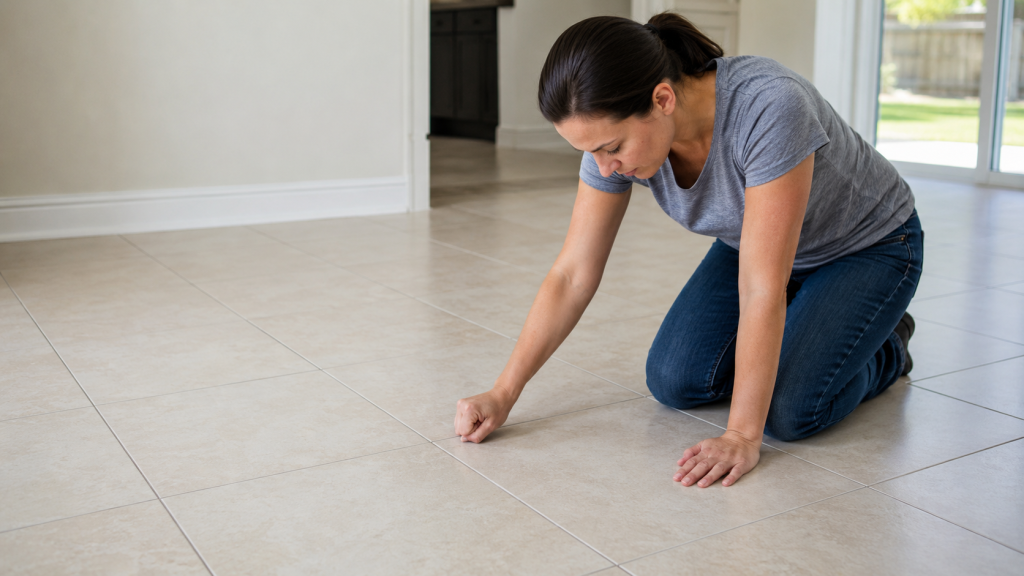
Tapping a tile creates sound based on how the tile and the materials beneath it respond.
The sound can be affected by:
- How fully the tile is supported
- Mortar or adhesive contact
- Substrate construction
- Tile size and thickness
- Voids beneath the tile
- Nearby framing or spaces within the floor assembly
A tile that sounds different from its neighbors may have less support or a different bond condition beneath part of its surface.
That difference does not prove the tile is loose or defective.
The more useful question is whether the tile also moves, cracks, lifts, or shows other signs that its support is failing.
Why Some Tiles Sound Hollow
Several conditions can change the sound of a floor tile.
Possible causes include:
- Incomplete mortar contact
- Localized voids
- Partial bond loss
- Differences in the substrate
- Normal installation variation
- Movement beneath the tile
- Moisture-related deterioration
- Separation between layers in the floor assembly
Not all of these conditions require immediate repair.
A stable tile with a localized hollow sound is different from a hollow tile that rocks underfoot or sits beside several other loose tiles.
Diagnosis should be based on the complete pattern rather than sound alone.
Hollow Sound vs Loose Tile
This distinction is one of the most important parts of the diagnosis.
Hollow but stable
A tile may sound hollow yet still:
- Remain firmly attached
- Stay completely still underfoot
- Have intact grout
- Show no cracking
- Show no lifting
In that situation, monitoring may be more appropriate than immediate repair.
Loose tile
A loose tile may:
- Rock
- Shift
- Move vertically
- Separate from surrounding grout
- Lift at an edge
Movement is stronger evidence of physical failure than a hollow sound by itself.
If the tile moves, the problem is no longer only about acoustics. Its bond or support should be evaluated.
One Hollow Sounding Tile
One isolated hollow tile can result from a small variation beneath that particular tile.
Possible causes include:
- A localized mortar void
- Installation variation
- A small bond difference
- A local substrate condition
If the tile remains solid and undamaged, immediate repair may not be necessary.
Monitor it for:
- New movement
- Cracking
- Grout separation
- Edge lifting
- A change in the hollow-sounding area
A tile that remains unchanged for a long period is less concerning than one that gradually becomes loose.
Several Hollow-Sounding Tiles
A cluster of neighboring hollow tiles deserves more attention than one isolated tile.
Possible causes include:
- A broader mortar-contact issue
- Bond problems
- Underlayment or substrate conditions
- Floor movement
- Moisture
- An installation pattern affecting several tiles
A large hollow-sounding area does not automatically mean every tile must be removed.
Look for physical symptoms. If the tiles remain stable, grout is intact, and the condition is not spreading, monitoring may still be reasonable.
If several tiles begin moving, cracking, or lifting, the likelihood of a broader failure increases.
Hollow Sound Near the Edge of a Tile
A hollow sound concentrated near a tile edge can indicate reduced support or bond in that area.
Edges may experience concentrated loads when someone steps near them or when furniture loads are applied.
Watch for:
- Edge chipping
- Grout cracking
- Movement
- A crack beginning near the edge
An edge that sounds hollow but remains stable is not automatically failing.
Movement or damage at that edge is the more important warning sign.
Hollow Tile That Rocks or Moves
A hollow tile that also rocks or moves deserves closer attention.
Possible causes include:
- Bond failure
- Inadequate support
- Substrate movement
- Deterioration in a supporting layer
Repeated movement can stress grout, tile edges, and neighboring tiles.
A moving tile is therefore more likely to need repair than one that merely sounds different when tapped.
Do not try to stabilize it with improvised adhesive or by placing heavy objects on top. The cause should be understood before a repair method is chosen.
Hollow Sound Plus Cracking
When a hollow-sounding tile is also cracked, inadequate support or bond becomes more relevant to the diagnosis.
However, the crack may also result from:
- Substrate movement
- Impact
- Concrete cracking
- Floor flexing
Do not assume the hollow sound itself caused the crack.
Look at whether adjacent tiles or grout show a similar pattern. A crack crossing several tiles suggests a different problem from one isolated damaged tile.
If the tile is also cracked, see our guide to floor tile cracking for help interpreting the crack pattern and whether movement or substrate conditions may be involved.
Hollow Sound Plus Lifting
A hollow tile that is also lifting or tenting is already showing physical failure.
Possible contributors include:
- Bond loss
- Movement
- Expansion stress
- Moisture-related changes below the tile
This is more concerning than a stable hollow tile because the tile has changed position.
If several tiles are lifting, the problem may extend beyond one localized bond issue.
Hollow Sound Plus Cracked Grout
Cracked grout around a hollow tile may indicate movement.
The combination becomes more significant if:
- Grout repeatedly separates
- The tile rocks
- The tile shifts vertically
- Nearby tiles show similar symptoms
Repairing the grout alone is unlikely to last if the tile continues moving underneath it.
The movement should be addressed before treating grout failure as the primary problem.
If the grout repeatedly fails around the same tile, our guide to why grout keeps cracking explains when movement is more important than the grout itself.
Can Moisture Cause Hollow-Sounding Tile?
Moisture can contribute indirectly.
Ceramic and porcelain tile themselves are not usually the main problem. Moisture can affect materials underneath the tile, including:
- Wood subflooring
- Underlayment
- Bonding materials
- Other supporting layers
Possible clues include:
- A recent plumbing leak
- Damp baseboards
- A soft floor
- New tile movement
- Lifting
- A hollow-sounding area that is expanding
Correct ongoing moisture before making cosmetic tile repairs.
Hollow Tile Over a Wood Subfloor
A wood-framed floor introduces several possible sources of movement.
A hollow sound may be associated with:
- Floor flexing
- Plywood or OSB movement
- Moisture
- Underlayment problems
- Bond loss
Sound alone still does not prove the floor assembly is failing.
However, hollow tile combined with bounce, softness, cracking, or lifting makes the supporting floor more important to the diagnosis.
Significant sagging, softness, or structural movement should be professionally evaluated rather than treated as a tile-only problem.
Hollow Tile Over Concrete
A hollow sound over concrete may result from:
- Mortar-contact variation
- Bond failure
- Surface contamination
- Slab conditions
- Moisture
- Cracking beneath the tile
One hollow tile over a concrete floor does not mean the slab or foundation has failed.
If hollow areas follow cracks, continue spreading, or appear with lifting or movement, closer evaluation of the tile assembly may be appropriate.
Can a Hollow Tile Stay in Place?
Yes, sometimes.
A hollow-sounding tile may remain serviceable when:
- It is firmly attached
- It does not rock or move
- The tile is not cracked
- Grout remains intact
- No edge is lifting
- No moisture problem is developing
- The condition remains stable
This is why tapping alone is not a good reason to automatically replace tile.
Monitoring a stable tile avoids creating unnecessary demolition and repair work when there is no evidence of active failure.
When a Hollow Tile Should Be Repaired
Repair becomes more reasonable when physical symptoms appear.
Examples include:
- Tile rocking or moving
- Tile lifting
- Cracking
- Grout repeatedly separating
- A hollow area spreading
- Several tiles becoming loose
- Moisture or substrate damage
- A trip hazard developing
The repair should address the reason the tile became unstable, not just the sound it makes.
A stable hollow tile and a moving hollow tile should not be treated as the same problem.
Should You Inject Adhesive Under a Hollow Tile?
Adhesive injection should not be treated as a universal homeowner fix.
A hollow sound can have several causes, and injecting material beneath the tile may not correct:
- Substrate movement
- Moisture
- Underlayment damage
- Expansion stress
- Broader bond failure
Repair methods also depend on the tile assembly and material compatibility.
Do not drill into a tile or inject adhesive simply because tapping produces a hollow sound. Identify the failure condition first.
What Homeowners Can Check Safely
Use observation before considering destructive inspection.
Check:
- Is one tile affected or many?
- Does the tile rock?
- Does it move vertically?
- Is the grout cracked?
- Is the tile cracked?
- Is an edge lifting?
- Was there a recent leak?
- Does the floor feel soft or bouncy?
- Is the hollow area changing?
- Is the floor over concrete or wood framing?
These physical clues are more useful than repeatedly tapping the tile alone.
Signs the Problem May Be More Serious
Pay closer attention when there is:
- Tile movement
- Lifting
- Cracking
- Repeated grout failure
- Several loose tiles
- An expanding hollow area
- A soft or sagging floor
- Persistent moisture
- Structural movement
- A large affected area
These symptoms suggest the problem may extend beyond a harmless difference in sound.
Common Mistakes
Avoid these common responses:
- Assuming every hollow tile must be replaced
- Ignoring movement because the tile has not cracked yet
- Repairing grout around a moving tile
- Injecting adhesive without understanding the cause
- Assuming a hollow sound proves structural failure
- Ignoring moisture
- Using destructive testing unnecessarily
- Demolishing older flooring without considering asbestos
Sound is a clue. Movement and damage are stronger evidence.
When Professional Evaluation Makes Sense
One stable hollow tile does not automatically need professional repair.
Qualified evaluation makes more sense when there is:
- A tile that rocks or shifts
- Several hollow tiles that are also loose
- Lifting or tenting
- Repeated grout or tile cracking
- Soft or damaged supporting material
- Significant floor movement
- Persistent moisture
- A large area with suspected bond failure
- An unclear cause before widespread repair
- Suspected structural movement
- Suspected asbestos-containing flooring, mastic, adhesive, or underlayment
A flooring professional can assess the tile assembly. Structural movement, persistent moisture, or hazardous-material concerns may require another appropriate specialist.
Final Thoughts
A hollow sounding tile is not automatically a failed tile. If it remains firmly attached, does not move, has intact grout, and shows no cracking or lifting, monitoring may be all that is needed.
Repair becomes more appropriate when hollow sound is accompanied by movement, cracking, lifting, grout separation, moisture, or a spreading pattern. Judge the tile by its physical condition and how the surrounding floor is behaving, not by sound alone.