
floor tile cracking: causes and when to worry
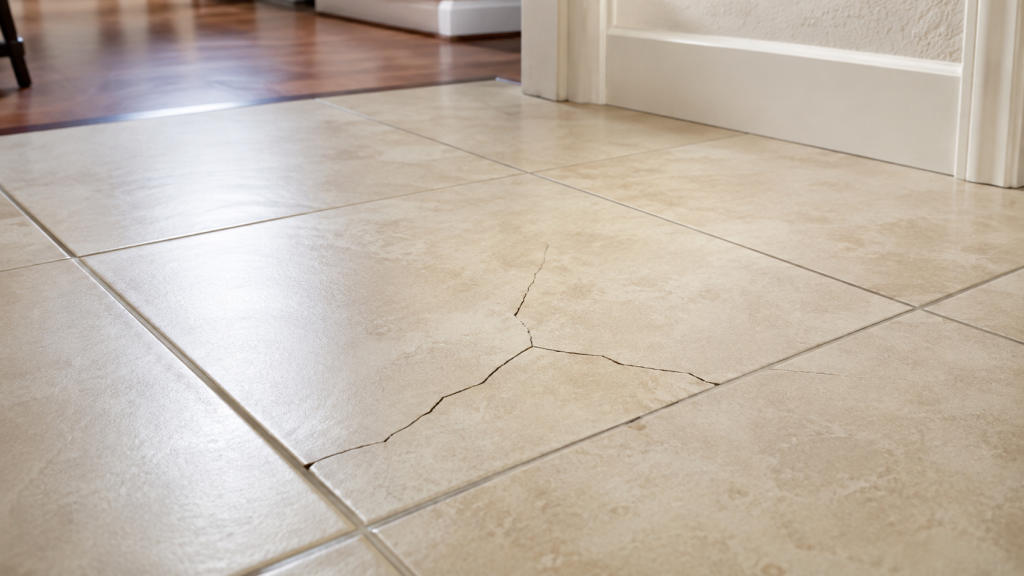
Floor tile cracking can result from something as simple as a dropped object or from movement beneath the finished surface. One cracked tile may be a localized problem, but cracks that recur, cross several tiles, follow the same line, or appear with floor movement can point to a problem below.
Replacing a damaged tile without understanding why it cracked can lead to the replacement failing again. Start by looking at the crack pattern, location, surrounding grout, floor movement, moisture history, and whether nearby tiles are loose or lifting.
| What you notice | Possible cause | How concerning? | What to check |
|---|---|---|---|
| One chipped or cracked tile after impact | Dropped object | Usually localized | Whether surrounding tiles remain stable |
| Hairline crack in one tile | Minor defect, impact, or local stress | Often low | Whether the crack grows or tile moves |
| Several tiles cracked in a straight line | Substrate or slab movement | More concerning | Whether cracks follow the same path |
| Tile keeps cracking in the same spot | Unresolved movement or support problem | Concerning | Substrate and surrounding movement |
| Cracks near doorway or transition | Concentrated stress or movement | Sometimes | Nearby grout and floor movement |
| Cracked tile plus hollow sound | Support or bond issue may be involved | More concerning | Whether the tile moves |
| Cracked tile plus lifting | Movement or bond failure | Concerning | Whether nearby tiles are also loosening |
| Cracks over concrete slab | Slab crack may be transferring upward | Depends on pattern | Whether damage follows a continuous line |
| Cracks plus noticeable floor movement | Subfloor or structural movement | High concern | Softness, sagging, or bounce |
Sharp cracked edges can cut bare feet, so keep people away from badly broken areas. If older flooring, mastics, adhesives, or underlayments may contain asbestos, do not sand, grind, scrape, cut, drill, or demolish them before appropriate evaluation or testing.
What Floor Tile Cracking Can Mean
Ceramic and porcelain floor tile are hard and durable, but they are also relatively brittle.
Tile handles direct compression well. It is much less tolerant of bending, flexing, or movement beneath it.
Cracks can result from:
- Direct impact
- Material defects
- Inadequate support
- Substrate movement
- Concrete cracking
- Installation problems
- Inadequate movement accommodation
- Moisture-related damage below the tile
- Structural movement
A crack is therefore a symptom rather than a diagnosis.
One isolated crack in an otherwise stable floor may have a very different cause from a straight crack crossing several tiles and the grout joints between them.
One Cracked Tile vs Several Cracked Tiles
The number and pattern of cracked tiles can help narrow the cause.
One cracked tile
A single damaged tile may result from:
- A dropped heavy object
- A local unsupported area
- A defective tile
- A small localized substrate problem
If surrounding tiles remain firmly attached, nearby grout is intact, and the floor does not move, the problem may be limited.
Several cracked tiles
Multiple cracks deserve more investigation, especially when they form a line or recurring pattern.
Possible causes include:
- Movement beneath the tile
- Substrate cracking
- Installation problems
- Expansion stress
- Larger support issues
A straight line of damage is particularly useful because it may reflect movement in the floor below.
Impact Damage
Impact cracks are often easier to recognize than movement-related cracks.
Clues include:
- A visible chip where the crack begins
- Star-shaped cracking
- A known dropped object
- Damage isolated to one tile
If a heavy pan, tool, or other object struck the tile shortly before the crack appeared, impact is a reasonable explanation.
An isolated impact-damaged tile may be replaceable without a larger repair if nearby tiles and the supporting surface remain stable.
If the same location has cracked repeatedly, however, impact becomes a less convincing explanation.
Inadequate Support Beneath the Tile
Floor tile needs continuous, appropriate support.
If part of a tile bridges an unsupported area, normal loads from walking or furniture can place bending stress on the tile.
Possible contributing conditions include:
- Voids beneath the tile
- Poor bond
- A flexible substrate
- Unsuitable underlayment
- Deteriorated supporting materials
A cracked tile that also sounds noticeably hollow or moves slightly may make inadequate support more relevant to the diagnosis.
Replacing only the visible tile will not correct a support problem underneath it.
Floor Movement and Deflection
A floor that bends or moves under load can repeatedly stress brittle tile.
Possible clues include:
- Cracks returning in traffic areas
- Tile cracking near panel or framing transitions
- Noticeable bounce underfoot
- Several tiles cracking along a similar path
- Grout cracking beside damaged tiles
A small amount of normal building vibration does not mean the structure is failing. Noticeable sagging, softness, or repeated movement-related cracking deserves qualified evaluation.
Do not attempt structural floor modifications based only on cracked tile.
Tile Cracking Over a Wood Subfloor
Wood-framed floors can move as plywood, OSB, framing, and other components respond to loads and moisture.
Possible contributing conditions include:
- Plywood or OSB movement
- Panel seams
- Inadequate floor stiffness
- Moisture-damaged subflooring
- An unsuitable underlayment or installation assembly
Tile cannot compensate for a floor that flexes excessively beneath it.
If cracking follows a repeatable line or occurs with bounce, loose tiles, or soft areas, investigate the supporting floor before replacing more tile.
Tile Cracking Over Concrete
Concrete slabs can develop cracks from shrinkage, settlement, movement, temperature changes, and other conditions.
In some cases, a slab crack can transfer through tile installed above it.
A common clue is a line of cracked tiles following the same path across the room.
That pattern does not automatically mean the foundation has failed. Concrete can crack without creating a structural emergency.
However, recurring tile cracks along the same line suggest the slab or supporting assembly deserves closer evaluation before another cosmetic repair.
Tile Keeps Cracking in the Same Spot
Repeated failure in the same location strongly suggests the tile itself may not be the entire problem.
Possible causes include:
- A substrate crack
- Local floor movement
- Unsupported tile
- A plywood or OSB panel seam
- A transition between materials
- Expansion stress
- Repeated point loading
If a replacement tile cracks again in the same spot, stop treating replacement as the complete solution.
Investigate the supporting surface and movement conditions first. Otherwise, another replacement may simply fail in the same way.
Cracks Near Doorways and Transitions
Doorways and transitions can concentrate stress because several conditions meet in a relatively small area.
These locations may involve:
- Heavy foot traffic
- Changes in floor construction
- Different flooring materials
- Movement between adjoining rooms
- Transition strips or thresholds
- Layout-related stress
One impact crack near a doorway may still be localized.
Repeated cracks, straight-line damage, or cracking that continues into neighboring grout deserves more attention.
Movement Joints and Expansion Stress
Tile installations need to accommodate normal movement in the building and flooring materials.
Problems can develop when movement is restrained over large areas or at transitions and perimeters.
Possible symptoms include:
- Cracked tile
- Cracked grout
- Recurring stress lines
- Tenting
- Lifting
Do not assume expansion stress is behind every crack. It becomes more relevant when cracking appears across a broad area, near fixed boundaries, or alongside lifting.
Specific movement-joint design depends on the installation and should not be guessed from a universal rule.
Moisture and Substrate Damage
Moisture does not normally crack sound ceramic or porcelain tile directly.
It can damage the materials supporting the tile.
Moisture may contribute to:
- Swollen wood subflooring
- Deteriorated underlayment
- Loss of bond
- Movement
- Settlement or deformation
Look for supporting clues such as:
- Recent plumbing leaks
- Damp baseboards
- Staining
- Soft areas
- Loose tiles
- Hollow-sounding tiles
- Changes after repeated moisture exposure
Correct ongoing moisture before repairing the tile surface.
Cracked Tile With a Hollow Sound
A hollow sound can suggest differences in support or bond beneath a tile, but hollow sound alone does not prove failure.
When a tile is both cracked and noticeably hollow compared with surrounding tiles, localized support or bond problems become more relevant.
Pay closer attention if the tile also moves or sits beside other damaged tiles.
If the tile sounds different from surrounding tiles but does not move, our guide to hollow sounding tile explains when that sound matters and when monitoring may be enough.
Cracked Tile That Is Also Lifting
Cracking combined with lifting is more concerning than a stable surface crack.
Lifting, tenting, or debonding may involve:
- Movement
- Loss of bond
- Moisture-related substrate changes
- Expansion stress
If several tiles are lifting or the affected area is spreading, the problem likely extends beyond one tile.
Do not simply press lifted tile back down without understanding why it moved.
If the tile is rising, tenting, or separating from the surface below, see our guide to floor tile lifting for the likely causes and what to check next.
Cracks Through Both Tile and Grout
A continuous crack crossing tile and grout can indicate movement beneath the finished surface.
Patterns worth noting include:
- A straight line across several tiles
- Repeated cracking along the same path
- Damage aligned with a substrate joint
- A line that appears to follow a slab crack
This does not prove structural failure.
It does make an isolated tile defect less likely, especially when the same path continues across several tiles.
Is a Hairline Crack a Problem?
Sometimes a hairline crack is mainly cosmetic.
A stable hairline crack in one tile may not require urgent repair when:
- The tile remains firmly attached
- The floor does not move
- The crack is not widening
- No moisture problem is present
- Surrounding tile and grout remain intact
Monitoring is reasonable in that situation.
Closer evaluation makes sense if the crack grows, spreads, returns after repair, or becomes part of a wider pattern.
Can You Replace Just One Cracked Tile?
Often, yes, when the damage is genuinely localized, and the supporting surface remains sound.
Single-tile replacement is more reasonable when:
- A clear impact caused the damage
- Nearby tile remains stable
- The floor does not move
- No recurring crack pattern is present
- Moisture is not involved
Replacement is less likely to solve the problem when:
- The same location keeps cracking
- Adjacent tiles are damaged
- The floor moves or feels soft
- The substrate is deteriorated
- Tile is lifting
- Moisture remains unresolved
The cause matters more than the number of replacement tiles available.
What Homeowners Can Check Safely
Use observation rather than destructive inspection.
Check:
- Whether one tile or several are affected
- Whether the crack is straight, random, or impact-shaped
- Whether the same location has failed before
- Whether the floor moves or feels soft
- Whether nearby grout is cracked
- Whether the tile sounds different from nearby tiles
- Whether any tile is lifting
- Whether there was a recent leak
- Whether the floor is over concrete or wood framing
- Whether the crack follows a doorway or transition
- Whether the crack is widening
These observations can help separate a localized defect from a broader floor-system problem.
Signs the Problem May Be More Serious
Further evaluation makes sense when you see:
- Cracks spreading across several tiles
- A long straight crack
- Repeated cracking in the same location
- Noticeable floor movement
- Sagging
- Soft supporting material
- Multiple loose tiles
- Lifting or tenting
- Persistent moisture
- Widespread grout cracking
- Other signs of structural movement
These conditions suggest that something below the finished tile may be contributing to the damage.
Common Mistakes
Avoid these common responses to floor tile cracking:
- Replacing the same tile repeatedly without finding the cause
- Assuming every crack means structural failure
- Assuming every crack is purely cosmetic
- Filling a moving crack and expecting it to stay repaired
- Ignoring floor movement
- Ignoring moisture or subfloor softness
- Treating cracked grout and cracked tile as unrelated when both follow the same line
- Demolishing old flooring without considering hazardous materials
Diagnosis before repair reduces the chance of repeating the same failure.
When Professional Evaluation Makes Sense
One small isolated crack does not automatically require professional work.
Qualified evaluation is more appropriate when there is:
- Repeated cracking in the same location
- Multiple cracked tiles
- Significant movement or sagging
- Cracks extending across a large area
- Suspected slab movement
- Soft or damaged subflooring
- Widespread loose or lifting tile
- Ongoing moisture
- An unclear cause before a larger repair
- Other signs of structural movement
- Suspected asbestos-containing flooring, mastic, adhesive, or underlayment
A flooring professional can assess the tile assembly. Significant structural movement, slab concerns, moisture problems, or hazardous materials may require other specialists.
Final Thoughts
Floor tile cracking can be a minor isolated problem or a sign that movement, support, moisture, or substrate conditions need attention. One impact-damaged tile may be straightforward, while recurring cracks, straight-line patterns, loose tiles, or noticeable floor movement deserve broader investigation.
Before replacing cracked tile, look at the pattern and what is happening around it. If the same area keeps failing or several tiles are affected, investigate the supporting floor rather than treating the visible tile as the entire problem.