home appliance maintenance: complete checklist by appliance
Home appliance maintenance is mostly about cleaning accessible surfaces and filters, inspecting for wear or leaks, keeping airflow and drainage paths clear, and noticing developing problems before they become larger ones. These routine tasks can help appliances operate as intended and may reduce avoidable problems, but maintenance cannot prevent every failure.
Stay within tasks the appliance manufacturer intends homeowners to perform. When maintenance would require major disassembly, live electrical work, refrigerant handling, gas-system repair, or access to sealed components, stop and use qualified service instead.
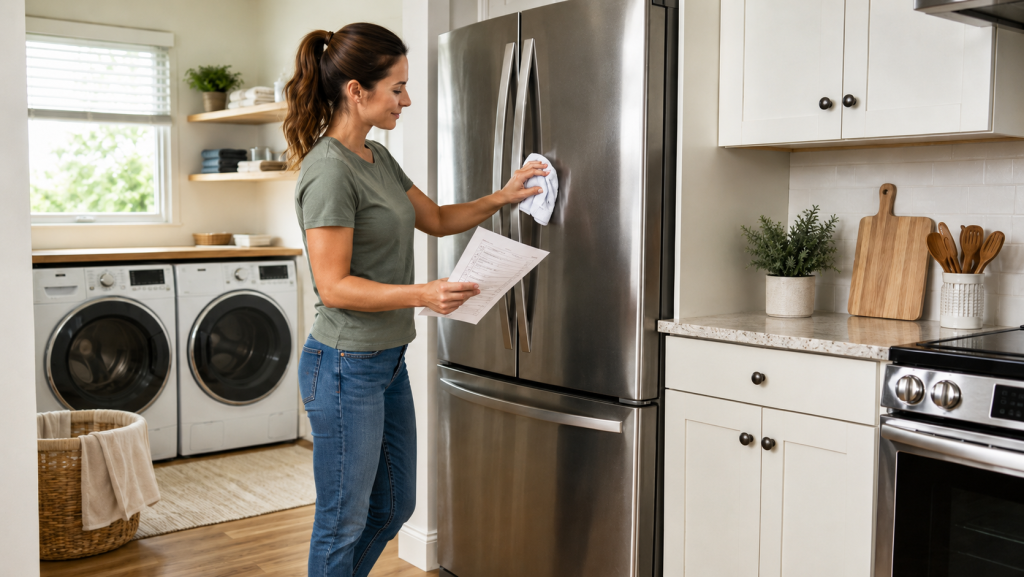
Home Appliance Maintenance Checklist at a Glance
This checklist gives you a practical starting point. Exact maintenance needs vary by appliance design, household use, and manufacturer instructions.
| Appliance | Regular Maintenance | Typical Frequency | Stop and Investigate If |
|---|---|---|---|
| Refrigerator | Clean seals, remove spills, check airflow and accessible vents | Monthly or periodically | Cooling declines, water leaks, electrical symptoms |
| Freezer | Clean seals, keep vents clear, watch for abnormal frost | Monthly or periodically | Food will not stay frozen, heavy unexplained frost |
| Ice maker | Clean accessible bin parts, replace applicable filters | Periodically | Ice production stops, water leaks appear |
| Dishwasher | Clean filter, inspect spray arms, wipe seals | Monthly or as needed | Water remains, leaking continues, electrical symptoms appear |
| Washing machine | Clean dispensers and seals, inspect hoses, run cleaning cycle | Monthly to periodically | Persistent leaking, severe vibration, repeated fill problems |
| Dryer | Clean lint screen, inspect duct and exterior vent | Every load plus periodic checks | Burning smell, overheating, drying time keeps increasing |
| Oven/range | Clean spills and cooking surfaces, inspect controls | As needed and periodically | Gas odor, sparking, unusual overheating, heating problems |
| Garbage disposal | Clean splash guard, use adequate water, check for moisture | Regularly | Leaking, humming, abnormal grinding, electrical problems |
Use this table as a recurring reminder rather than a rigid schedule. Your appliance manual takes priority when it specifies different procedures or intervals.
Basic Appliance Maintenance Safety
Routine maintenance should involve components you can safely reach without substantial appliance disassembly.
Before beginning:
- Read the appliance manual when available, especially before removing filters, panels specifically intended for homeowner access, burner parts, or other removable components.
- Unplug an appliance when the maintenance task requires access near moving or electrical components, provided the plug and surrounding area are safely accessible and dry.
- Keep water away from plugs, receptacles, controls, wiring, and other electrical components.
- Do not perform live electrical troubleshooting.
- Never bypass a safety switch, lid switch, door interlock, or other protective device.
- Do not open sealed refrigeration systems, handle refrigerant, or attempt compressor repairs.
- Do not repair gas lines or internal appliance gas valves.
If an appliance is wet around electrical components, stop using it. Do not reach through water or touch wet electrical equipment. Unplug it only when the plug and surrounding area are dry and safely accessible; otherwise, use an appropriate safe shutoff or contact a qualified professional.
Stop appliance use if you notice active burning, arcing, sparking, unusual overheating, damaged wiring, or a gas odor. Those conditions have moved beyond routine maintenance.
Refrigerator Maintenance Checklist
A refrigerator needs clear airflow, clean sealing surfaces, and periodic inspection of accessible areas.
- Wipe up food and liquid spills promptly.
- Clean door gaskets gently so crumbs and sticky residue do not interfere with sealing.
- Check that each door closes completely without food containers, shelves, or drawers interfering.
- Avoid packing food so tightly that internal air vents are blocked.
- Remove dust from ventilation openings you can reach without disassembly.
- Inspect accessible water-line connections and the floor around the refrigerator for visible moisture.
- Replace the refrigerator water filter according to the appliance or filter manufacturer’s instructions when one is installed.
- Keep the refrigerator stable so it does not rock during normal use and the doors operate properly.
Some refrigerators have condenser coils or condenser areas that manufacturers expect homeowners to clean periodically. Others use designs that are enclosed or are not intended for routine homeowner cleaning.
If your manual calls for condenser cleaning, follow its access and cleaning instructions. Do not remove sealed or service-only panels merely to find the condenser.
Drain openings are similar. Clean an accessible drain area only when the manufacturer identifies it as a homeowner-maintenance location.
If the refrigerator develops persistent cooling problems or an active water leak, further cleaning is not necessarily the answer. The appliance may need diagnosis rather than additional routine maintenance.
Freezer and Ice Maker Maintenance Checklist
Freezers and ice makers share several refrigerator maintenance priorities, particularly airflow, clean door seals, and water-system awareness.
For the freezer:
- Keep packages from blocking internal air vents.
- Wipe the door gasket so debris does not interfere with closure.
- Check that bins or food packages are not preventing the door from closing completely.
- Watch for unusual or excessive frost in a freezer designed for frost-free operation.
- Remove accessible dust from ventilation areas without opening service panels.
- Inspect the surrounding floor for moisture or signs of an accessible water leak.
For an ice maker:
- Keep the ice bin reasonably clean.
- Wash removable ice-bin components when the manufacturer permits it.
- Discard old, contaminated, or noticeably stale ice when necessary.
- Replace compatible water filters according to the applicable instructions.
- Look for visible moisture around accessible water connections.
Heavy unexplained frost, persistent loss of freezing performance, an ice maker that stops working, or continuing water leakage deserves diagnosis. Avoid attempting repairs involving internal water valves, refrigerant systems, compressors, or energized electrical components.
Dishwasher Maintenance Checklist
Dishwasher maintenance centers on keeping food debris under control, maintaining water circulation and drainage paths, and watching for leaks.
- Remove excessive food debris from dishes as appropriate for your dishwasher.
- Clean the removable filter if your machine has a homeowner-serviceable filter.
- Check accessible spray-arm openings for debris that may interfere with water flow.
- Wipe residue from door edges and gasket areas.
- Inspect racks, wheels, and stops for obvious damage or binding.
- Keep detergent and rinse-aid areas clean so their covers and openings can operate normally.
- Check the floor and cabinet area around the dishwasher periodically for visible moisture.
- Run a dishwasher cleaning cycle when the manufacturer recommends one.
Use cleaning products intended for the appliance and avoid improvising with harsh household chemicals that may damage internal surfaces, seals, or components.
A small amount of water in a location the manufacturer identifies as normal is different from persistent standing water or a dishwasher that repeatedly fails to drain. Continuing leaks, drainage trouble, burning odors, sparking, or other electrical symptoms call for further diagnosis or professional service.
Washing Machine Maintenance Checklist
Both top-load and front-load washers benefit from proper detergent use, clean dispensing areas, routine leak checks, and stable installation.
- Use the detergent type recommended for your machine.
- Avoid regularly using more detergent than the load and product instructions call for.
- Do not routinely overload the washer.
- Clean detergent, bleach, and fabric-softener dispensers as the manufacturer directs.
- Run the manufacturer’s recommended washer-cleaning cycle when needed.
- Clean homeowner-serviceable filters when your model includes them.
- Inspect accessible water-supply hoses and connections for bulging, cracking, corrosion, or moisture.
- Look behind and beneath the washer periodically for signs of leakage.
- Check that the machine remains stable and does not rock during ordinary use.
For front-load washers, wipe moisture and residue from the accessible door gasket. Pay particular attention to folds where detergent residue, lint, or small objects may collect.
Allowing a washer to ventilate after use may help moisture escape on models where the manufacturer recommends leaving the door or lid open or partly open. Follow the instructions for your specific machine, especially in homes where an open appliance could create a safety concern for children or pets.
Persistent leaking, repeated failure to fill, severe vibration, electrical symptoms, or a problem that remains after basic maintenance calls for diagnosis. Avoid invasive work on pumps, internal valves, wiring, or control components.
Dryer Maintenance Checklist
Dryer maintenance deserves special attention because restricted airflow and accumulated lint can contribute to overheating and unsafe operating conditions.
Clean the lint screen after every load, or at the interval specified by the manufacturer. A damaged lint screen should be replaced with a compatible part rather than operated indefinitely.
Also:
- Remove lint from the lint-screen housing where it is safely accessible without disassembling the dryer.
- Check the transition duct behind the dryer for crushing, excessive bends, or sharp kinks.
- Make sure moving the dryer has not damaged or disconnected the duct.
- Inspect the exterior vent termination for obvious blockage and confirm that it can open properly during dryer operation.
- Keep combustible clutter away from the dryer.
- Have lint buildup removed from the vent system periodically when needed.
There is no single vent-cleaning interval that fits every home. Vent length, routing, duct construction, dryer use, pets, laundry volume, and other household conditions can change how quickly lint accumulates.
Increasing drying time can be an early sign that airflow deserves attention. If basic accessible checks do not restore normal performance, further diagnosis may be needed.
For accessible exhaust systems, a properly chosen dryer vent cleaning kit can help homeowners remove lint beyond the basic lint-screen area.
If the dryer produces an active burning smell, visible smoke, sparking, or unusual overheating, stop using it. Do not run another test load while the condition remains. A qualified appliance technician or other appropriate professional should determine the cause before the dryer returns to service.
Oven and Range Maintenance Checklist
Regular cleaning helps keep food residue from interfering with normal cooking surfaces and removable components.
For electric and gas appliances:
- Clean spills after the cooking surface or oven has cooled.
- Keep cooktop surfaces free of heavy grease and food buildup.
- Clean removable burner components only as the manufacturer permits.
- Keep control knobs reasonably clean and confirm they operate normally.
- Wipe the oven door and accessible sealing surfaces carefully.
- Clean oven racks using methods approved for the appliance.
- Avoid placing foil, liners, or other materials where the manufacturer prohibits them.
- Watch for unusual heating behavior, damaged components, or controls that stop operating normally.
Self-cleaning ovens should be used according to their specific instructions. Do not assume every rack, liner, accessory, or removable component can remain inside during a self-cleaning cycle.
Gas appliances require an additional boundary. If you smell gas, stop using the appliance. Do not operate electrical switches, create flames, or attempt to locate or repair the leak yourself. Leave the affected area and follow your gas utility or local emergency guidance from a safe location.
Internal gas valves, gas piping, combustion adjustments, and similar work are not routine homeowner maintenance.
If an oven stops heating normally, basic cleaning and visual inspection may still be worthwhile, but detailed diagnosis belongs outside a routine maintenance checklist.
Garbage Disposal Maintenance Checklist
Good disposal maintenance begins with using the appliance appropriately rather than treating it as a way to process any kitchen waste.
- Run adequate water during normal disposal operation.
- Avoid items the disposal manufacturer identifies as unsuitable.
- Clean residue from the sink flange and accessible splash guard.
- Use routine cleaning methods compatible with the disposal to address food residue and odors.
- Check the cabinet below the sink for visible moisture.
- Pay attention to new grinding noises, humming, vibration, or leakage.
Never put your hand into a garbage disposal chamber, even when the disposal appears to be off.
If inspection requires access to the grinding chamber or underside of the unit, disconnect power conservatively first. Unplug the disposal when the plug is dry, visible, and safely accessible. When it is hardwired or you cannot positively isolate it safely, stop rather than reaching into or beneath the unit.
Persistent leaks, humming without normal operation, damaged wiring, repeated breaker trips, or abnormal mechanical noises call for further diagnosis rather than repeated operation.
Simple Monthly, Quarterly, and Annual Appliance Maintenance Schedule
A maintenance calendar makes appliance care easier to remember, but treat these intervals as planning reminders rather than universal requirements.
Monthly or frequent tasks
- Clean the dryer lint screen with every load or as directed.
- Wipe refrigerator and freezer door seals when dirty.
- Check refrigerator, dishwasher, and washing-machine areas for visible moisture.
- Clean dishwasher and washer filters when inspection shows they need it.
- Wipe front-load washer door gaskets and dispensers.
- Keep appliance vents and airflow openings unobstructed.
- Clean food and grease spills before they become heavy buildup.
Every few months
- Inspect accessible washing-machine hoses and connections.
- Check the dryer transition duct for crushing or kinking.
- Inspect the exterior dryer vent termination.
- Clean dishwasher spray-arm openings when accessible debris is present.
- Check refrigerator and freezer ventilation areas for dust.
- Run appliance cleaning cycles when called for by the manufacturer.
- Inspect the garbage-disposal cabinet area for moisture.
Annual or periodic tasks
- Assess the dryer vent system for accumulated lint and arrange cleaning when needed.
- Inspect appliance cords and accessible plugs for visible damage.
- Check behind appliances where safely practical for leaks, damaged hoses, or restricted ventilation.
- Confirm large appliances remain stable in their installed positions.
- Review maintenance tasks that may have been overlooked during the year.
Manufacturer-specific tasks
Water filters, specialty filters, condenser cleaning, drain access, self-cleaning cycles, and serviceable internal filters vary considerably between appliances.
Follow the manufacturer’s schedule and procedure when it differs from a general maintenance calendar.
Signs Maintenance Is No Longer Enough
Maintenance has reached its limit when cleaning, inspection, or another ordinary homeowner task no longer matches the problem.
Stop routine maintenance and move to diagnosis, repair evaluation, or professional service when you find:
- Persistent or recurring water leaks
- Water around electrical components
- Repeated breaker trips
- Damaged cords or plugs
- Burning odors
- Sparking or arcing
- Gas odors
- Unusual overheating
- Persistent loss of refrigerator or freezer cooling
- A dishwasher that repeatedly will not drain
- A washing machine that repeatedly fails to fill
- Severe or worsening washer vibration
- A dryer that continues taking unusually long to dry after accessible airflow checks
- Persistent grinding, humming, or other abnormal mechanical sounds
- Appliance performance that remains poor after appropriate basic maintenance
The important distinction is whether you are maintaining an accessible component or trying to diagnose and repair a failure.
Electrical faults, refrigerant problems, internal gas-system defects, hidden leaks, and failures requiring major disassembly are appropriate points for professional service.
Common Home Appliance Maintenance Mistakes
A few habits can undermine otherwise good maintenance routines.
- Ignoring the manual. Access points, filters, cleaning methods, and maintenance schedules differ among models.
- Using excessive detergent. More detergent is not automatically better and can contribute to residue in washers and dishwashers.
- Forgetting filters. Dishwasher, washing-machine, refrigerator, and other filters may need periodic attention when the appliance includes a homeowner-serviceable design.
- Allowing lint to accumulate. Dryer lint screens, ducts, and vent systems need appropriate attention.
- Blocking airflow. Overpacked refrigerators, blocked freezer vents, and crushed dryer ducts can interfere with intended operation.
- Using unsuitable chemicals. Strong or incompatible cleaners can damage finishes, seals, and appliance components.
- Ignoring small leaks. Moisture beneath or behind an appliance deserves investigation before damage spreads.
- Continuing to operate an unsafe appliance. Burning smells, sparking, gas odors, or serious overheating are reasons to stop use.
- Turning maintenance into repair work. Major disassembly and internal electrical, gas, or refrigerant work exceed normal homeowner maintenance.
Using the right appliance cleaning tools can also make routine maintenance easier while reducing the chance of scratching finishes or damaging sensitive surfaces.
Home Appliance Maintenance FAQ
What home appliance maintenance should homeowners do regularly?
Most home appliance maintenance involves cleaning accessible filters and surfaces, checking seals and hoses, keeping vents and drainage paths clear, and inspecting surrounding areas for moisture or other developing problems.
The exact checklist varies by appliance and model, so manufacturer instructions should remain the primary guide for specialized tasks.
How often should appliances be maintained?
Some tasks are frequent, such as cleaning a dryer’s lint screen. Others may be monthly, seasonal, annual, or based on appliance use and condition.
Instead of applying one interval to every appliance, build a recurring schedule and adjust it to the manufacturer’s recommendations and your household’s usage.
Can regular maintenance make appliances last longer?
Appropriate maintenance can help an appliance operate under the conditions its manufacturer intended and may reduce avoidable problems caused by buildup, blocked airflow, neglected filters, or unnoticed leaks.
It cannot guarantee a specific lifespan or prevent failures caused by normal component wear, defects, electrical problems, or other internal faults.
Which appliance maintenance tasks are most important for safety?
Dryer lint and airflow maintenance deserves particular attention. Homeowners should also watch for damaged electrical cords, active leaks near electrical equipment, excessive heat, burning odors, and gas odors.
Any of those warning signs may require appliance shutdown and professional evaluation rather than additional cleaning.
When should I stop DIY maintenance and call a professional?
Stop when the job requires live electrical testing, major appliance disassembly, refrigerant handling, compressor work, gas-line or internal gas-valve repair, or access to components that are not intended for homeowner service.
Professional help is also appropriate when leaks, electrical symptoms, overheating, loss of cooling, drainage failures, or other performance problems continue after safe basic maintenance.
Final Thoughts
A practical home appliance maintenance routine does not need to be complicated. Keep appliances clean, protect airflow and drainage paths, check accessible filters, seals, hoses, vents, and surrounding areas, and respond when you notice a developing problem.
The goal is not to repair every appliance yourself. Routine maintenance ends when the work crosses into electrical, gas, refrigerant, sealed-system, or invasive repair territory. At that point, stop using the appliance when safety requires it and move to proper diagnosis or qualified professional service.