
how to clean a bathtub without damaging the finish
If you want to know how to clean a bathtub without damaging it, start with the finish rather than the strongest cleaner you can find. Remove loose debris, use a cleaner and soft tool approved for the surface, allow only the permitted working time, rinse as directed, and dry the tub when appropriate.
Bathtubs can look similar while requiring different care. Acrylic, fiberglass, porcelain enamel, and refinished coatings may tolerate different products, so identifying the surface is the safest first step.
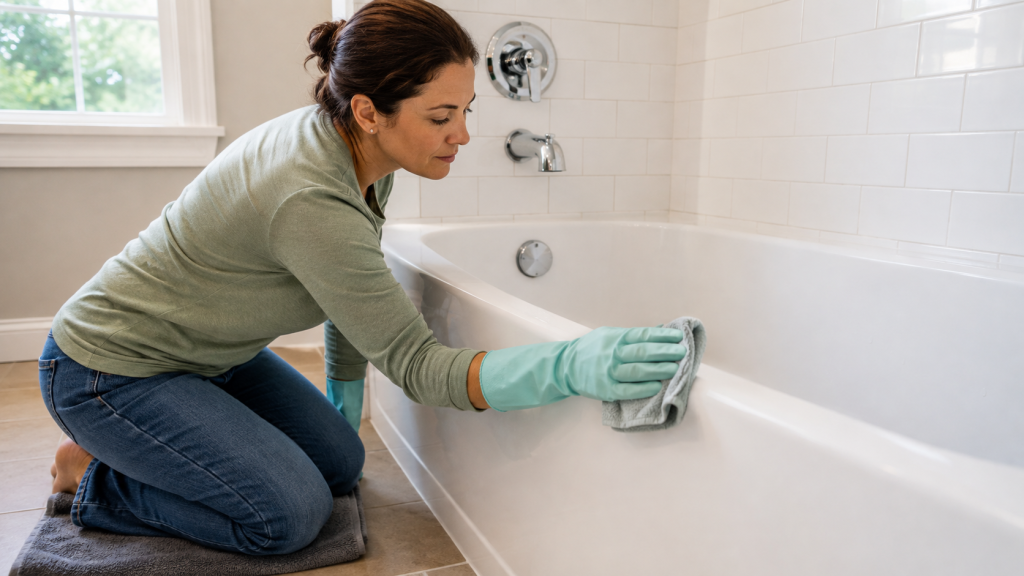
Cleaning safety: Never mix cleaning products. Never mix bleach with ammonia or acids, including vinegar, and never mix drain cleaners with other products. Use one product at a time, follow its directions for ventilation and protective equipment, and keep cleaning water away from outlets and electrical equipment.
Check the Tub Material and Finish First
If you know the tub manufacturer and model, use its care instructions as your starting point. A model label, purchase paperwork, builder records, or manufacturer documentation may identify the surface.
Appearance alone is not always enough. Several tub materials can have a smooth white finish.
- Acrylic: A plastic-based surface common on modern tubs. Manufacturers commonly call for nonabrasive cleaners and soft cloths or sponges, but the approved chemicals vary by product.
- Fiberglass or gel-coated composite: These tubs can also be vulnerable to scratching and dulling. Follow the care guide for the exact unit rather than assuming an acrylic cleaner is automatically suitable.
- Porcelain enamel over steel or cast iron: The glossy surface is a glass-like enamel over metal. It can be durable, but abrasives, aggressive chemicals, and damaged enamel still require caution.
- Refinished or reglazed tubs: A newer coating has been applied over the original tub. The refinisher’s care instructions take priority over guidance for the material underneath.
- Less-common materials: Solid-surface, stone, specialty composites, and other finishes need their own care instructions.
If a tub has been refinished, do not clean it as though the original porcelain, fiberglass, or other substrate were still exposed. Products tolerated by the original tub may damage the newer coating.
When the finish is unknown, use a conservative approach. Avoid abrasive pads, scouring powders, strong acids, strong alkalis, solvents, and other aggressive cleaners until you can determine what the surface allows.
A hidden-area test can sometimes reveal an obvious compatibility problem, but it does not override a manufacturer’s restriction.
Supplies and Finish-Compatibility Guide
For routine cleaning, you generally need only:
- A soft cloth or manufacturer-approved nonabrasive sponge.
- A cleaner approved for the exact tub surface.
- Clean water and a rinsing container if needed.
- Gloves, eye protection, or other protection required by the cleaner label.
- A soft cloth for drying when the surface-care instructions recommend it.
Do not assume dish soap is universally safe simply because it is mild. Some tub manufacturers approve mild detergents for specific surfaces, but the exact product and rinsing instructions still matter.
Likewise, words such as natural, non-scratch, or bathroom cleaner on the front of a bottle do not prove that the product is compatible with your tub.
| Tub surface | Routine-cleaning approach | Main caution |
|---|---|---|
| Acrylic | Approved nonabrasive cleaner with a soft cloth or sponge | Some chemicals can dull, crack, or otherwise damage certain acrylic products |
| Fiberglass or gel-coated composite | Follow the unit’s approved cleaner list and use a soft tool | Abrasives can scratch or dull the finish; chemical restrictions vary |
| Porcelain enamel | Use products approved for the particular enameled fixture | Avoid assuming every acid, abrasive, or toilet cleaner is safe because the surface feels hard |
| Refinished or reglazed coating | Follow the refinisher’s cleaner and tool restrictions | Abrasives, harsh acids, bleach, and suction-cup accessories may be restricted |
| Unknown or specialty finish | Use only clearly verified care guidance | Do not experiment with aggressive stain treatments while the finish is uncertain |
Toilet-bowl cleaner is not a general bathtub cleaner. Its chemistry may be inappropriate for a tub finish even when both fixtures appear to be porcelain.
How to Clean a Bathtub Step by Step
This sequence works as a framework for routine body oils, ordinary dirt, and light soap residue. The cleaner and exact directions still need to match the tub.
- Ventilate and read both sets of directions.
Use the bathroom exhaust fan or other ventilation as appropriate. Read the cleaner label and the tub’s care instructions before applying anything. Check surface compatibility, protective-equipment requirements, rinsing directions, and any permitted working time. - Remove toiletries and loose debris.
Move bottles, toys, mats, and other accessories out of the tub. Pick up loose hair and debris without dismantling the drain. Clean accessories separately according to their own care requirements. - Prepare the tub as directed.
Some cleaning products are used on a wet surface and others on a dry one. Rinse or prepare the tub only as the product and surface instructions direct. - Apply a compatible cleaner.
Apply only enough product to clean the intended area. Do not casually layer different cleaners or use a stronger product because routine soil is not disappearing immediately. - Allow only the permitted working time.
Follow the cleaner label rather than using a universal dwell time. Do not leave a cleaner sitting on the finish longer than allowed, and do not let it dry on the surface unless the directions specifically permit that. - Wipe gently with the approved tool.
Use a soft cloth or nonabrasive sponge that the tub manufacturer or refinisher permits. Give the cleaner a chance to do its job instead of compensating with harder scrubbing.Work from outside the tub where practical. Do not balance on the rim, stand on a wet tub floor, or lean into an unstable position to reach the far side. - Rinse thoroughly when required.
Remove cleaner residue according to the product directions. Pay particular attention to residue on the tub floor, where remaining cleaner can create a slippery surface. - Dry when appropriate.
If the care instructions recommend drying, wipe the surface with a clean soft cloth. Let bath mats, toys, bottles, and other wet accessories dry separately before returning them.
Do not switch cleaners over residue
Never apply a new cleaner directly over another product’s residue.
If you need to use products sequentially, follow both products’ instructions for completely removing residue and preparing the surface. If those directions do not make safe sequential use clear, stop rather than experimenting and consult the cleaner or tub manufacturer.
This is especially important with bleach, ammonia, acids such as vinegar, and drain-opening chemicals. Hazardous gases or reactions can result from incompatible products.
Routine bathtub cleaning also does not automatically require disinfection. If disinfection is appropriate, first make sure the disinfectant is approved for the tub surface, clean the surface as directed, and follow the disinfectant label for preparation and the full labeled contact time.
If a Stain or Deposit Remains
A mark that survives normal cleaning is a reason to identify the problem, not immediately scrub harder.
Start with these decisions:
- Repeat the approved routine only if permitted. A second normal cleaning may remove residue that has had time to build up.
- Identify the likely type of mark. Mineral deposits, rust-colored staining, soap buildup, and surface damage may look similar but call for different responses.
- Check for a surface-specific treatment. Consult the tub’s care instructions for a cleaner or method approved for that particular material and finish.
- Stop if the finish changes. Dulling, roughness, peeling, blistering, color transfer, or visible coating damage means harder scrubbing is not the answer.
Do not default to vinegar, bleach, baking-soda paste, abrasive powder, solvents, or melamine-foam pads. Any of those may be permitted for particular products and prohibited for others.
Stubborn soap scum may require a compatible treatment beyond routine cleaning, but it should still be matched to the surface. Visible mold likewise has its own cleaning and moisture considerations and should not trigger improvised combinations of strong chemicals.
A stain may also not be a stain at all. Etching, worn enamel, scratches, chips, exposed metal, and failing refinishing coatings cannot be restored by using more cleaner.
If the remaining buildup is soap scum, see our guide on how to remove soap scum for cleaning options matched to the surface.
How Often Should You Clean a Bathtub?
For a regularly used tub, a light routine cleaning about weekly is a practical starting point. Adjust that schedule for household use, the speed of buildup, the tub manufacturer’s instructions, and how quickly the area dries.
Between full cleanings:
- Rinse away ordinary bath residue when the tub’s care guidance allows it.
- Remove loose hair and debris before they accumulate.
- Let the tub and accessories dry after use.
- Clean light buildup before it requires prolonged scrubbing.
Some refinished surfaces restrict suction-cup bath mats and similar accessories because they can affect the coating. Check the refinisher’s instructions before using one. Do not assume an accessory that is harmless on one tub is suitable for another.
The goal is not to scrub the tub constantly. Routine gentle cleaning before deposits become heavy is usually easier on the finish than repeatedly attacking established buildup.
Use our bathroom cleaning checklist to fit bathtub care into your routine for the rest of the room.
When to Stop Cleaning and Get Help
Stop treating the problem as ordinary dirt when you find signs that the tub or surrounding area is damaged.
Get appropriate repair or professional assessment for:
- Peeling, bubbling, or blistering refinished coatings.
- Cracks, significant chips, sharp damaged edges, or exposed rusting metal.
- Soft, flexing, or unstable areas that appear damaged.
- Water escaping around the tub or signs of leakage into walls, floors, ceilings, or nearby rooms.
- Recurring or widespread mold rather than a small isolated surface spot.
- Swollen, soft, stained, or deteriorating material around the tub that suggests significant moisture damage.
Do not try to solve a failing coating, damaged tub structure, hidden leak, failed waterproofing, or deteriorated substrate by increasing the strength of the cleaner.
Bathtub Cleaning FAQs
Can you use vinegar to clean a bathtub?
Only if the care instructions for that exact tub or finish allow it. Some manufacturers approve vinegar for particular surfaces or deposits, while other products and refinished coatings restrict acids.
Vinegar is therefore not a universal bathtub cleaner. Never mix it with bleach because the combination can release hazardous chlorine gas.
Can you use a melamine-foam cleaning pad on a tub?
It depends on the surface. Some manufacturers permit melamine-foam pads on certain fiberglass products, while other tub and refinishing guidance calls for specific nonabrasive cloths or sponges.
Do not assume a product marketed as a cleaning eraser is safe for acrylic, enamel, fiberglass, or refinished coatings. Check the exact care instructions first.
Why does my bathtub still look dirty after cleaning?
The remaining mark may be mineral buildup, soap deposits, rust staining, scratching, etching, worn enamel, or a damaged refinished coating rather than ordinary dirt.
If an approved routine cleaner does not remove it, identify the surface and the type of mark before trying a targeted treatment. Stop scrubbing if the finish becomes dull, rough, chipped, or otherwise damaged.
Final Thoughts
The safest bathtub-cleaning routine is usually the least complicated one: identify the finish, use a compatible cleaner and soft tool, follow the permitted working time, rinse properly, and avoid unnecessary abrasion.
When ordinary cleaning stops improving the appearance, determine whether you are dealing with a specific deposit or a damaged finish. More aggressive scrubbing cannot repair a surface that is already failing.