how to remove rust stains from concrete
To remove rust stains from concrete, first identify and stop the source, then start with the mildest cleaning method likely to work. Light recent stains may respond to gentle cleaning, while older or darker marks often need a concrete-safe rust remover and possibly more than one treatment.
Avoid jumping straight to strong acids or aggressive scrubbing. Concrete can be etched or discolored by harsh cleaners, and sealed or coated surfaces require extra care because the cleaner can damage the finish.
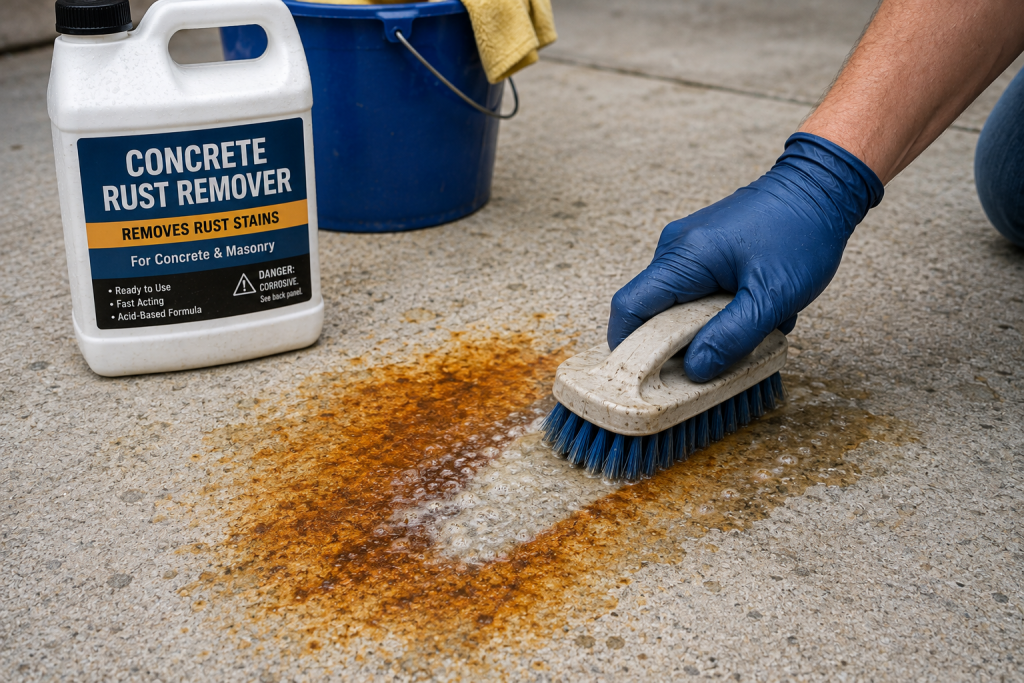
Safety note: Read and follow the cleaner label. Wear gloves and eye protection as directed, avoid skin and eye contact, and ventilate enclosed garages. Never mix rust removers with bleach or other cleaners unless the labels specifically permit it. Keep people and pets away from wet treated surfaces, and control residue and runoff.
| Stain situation | Best first step | What to expect |
|---|---|---|
| Light recent stain | Mild concrete-safe cleaning | May improve quickly |
| Older dark rust stain | Concrete-safe rust remover | May need repeated treatment |
| Rust under metal furniture | Remove the metal source, then clean | Can return if wet metal contact continues |
| Irrigation rust | Clean stain and address water source | Likely to recur if irrigation continues |
| Fertilizer-related orange stain | Remove remaining granules, then treat appropriately | Iron-containing residue may leave staining |
| Sealed or coated concrete | Confirm cleaner compatibility first | Strong cleaners may damage the finish |
What Causes Rust Stains on Concrete?
Rust-colored staining usually involves iron or other metallic material contacting the concrete and reacting in the presence of moisture.
Common sources include:
- Metal patio furniture
- Tools or equipment left on wet concrete
- Steel containers or decorative objects
- Irrigation water containing iron
- Metal fasteners or hardware
- Fertilizer or lawn products containing iron
- Rusty vehicle or equipment components
Finding the source matters because cleaning alone may only provide temporary improvement. A chair leg that repeatedly sits wet on a patio or a sprinkler that continually sprays iron-containing water onto a driveway can recreate the stain after you remove it.
Some orange or brown marks may also come from materials other than rust. If the source is uncertain, avoid assuming that a stronger rust remover is automatically the solution.
Step 1: Identify the Source
Look directly above, beside, and around the stain before applying cleaner.
For rust beneath metal furniture or tools, move the object and inspect its underside. If rusty metal repeatedly contacts damp concrete, isolate it from the surface before cleaning so the problem does not immediately return.
For staining along a regular spray pattern, irrigation water may be the source. Iron in the water can leave recurring orange-brown deposits as droplets repeatedly wet the concrete.
Cleaning can improve the concrete, but the stains may return if the irrigation pattern or water source stays the same.
Fertilizer can create another recognizable pattern. Some fertilizers and lawn products contain iron, and stray granules or runoff can leave rust-colored spots on damp concrete. Sweep spilled granules off paved surfaces promptly rather than allowing them to dissolve during watering or rain.
Step 2: Start With the Mildest Practical Cleaning Method
Fresh or light staining does not always require a specialized rust remover immediately.
First remove loose dirt, debris, fertilizer granules, or other material from the area. For a light stain, use a mild cleaning method that is appropriate for concrete and for any existing sealer or coating.
A suitable stiff-bristle brush can help loosen surface residue without resorting to harsh chemicals.
Keep the cleaning area controlled. Protect nearby:
- Plants and lawn edges
- Painted siding and trim
- Garage doors
- Metal fixtures
- Vehicles
- Decorative surfaces
Avoid using a metal brush as your default scrubber. Metal bristles can scratch some finished surfaces, leave particles behind, and potentially create additional rust marks.
If mild cleaning does not produce enough improvement after the concrete dries, move to a product specifically intended for rust staining.
Step 3: Use a Concrete-Safe Rust Remover if Needed
Rust stains often respond better to a cleaner formulated to react with or remove mineral and metallic staining than to an ordinary detergent.
Choose a rust remover whose label specifically permits use on concrete. Products use different chemistries, so do not assume they have interchangeable instructions.
Before using the product, confirm:
- It is suitable for exterior or interior concrete as applicable.
- It is compatible with the surface finish.
- You understand the required protective equipment.
- You can follow the specified dwell time.
- You know whether and how the product must be rinsed.
- Nearby materials can be protected from contact.
If the directions call for testing in an inconspicuous location, do so before treating the main stain.
Do not increase the concentration, extend the dwell time, or combine the remover with another chemical in an attempt to make it stronger. More aggressive treatment can etch or discolor the concrete without producing a proportionally better result.
Muriatic acid is not a routine homeowner solution for rust-stain removal. Strong acidic cleaning can damage the surface and create additional handling concerns.
Step 4: Scrub Carefully
When the product instructions call for agitation, use a suitable stiff-bristle brush.
Work the stained area with controlled pressure. The goal is to help the approved cleaner contact the stain, not to mechanically wear away the concrete surface.
Watch for signs that the cleaning method is affecting more than the stain, such as:
- A change in surface texture
- Unexpected lightening or darkening
- Loss of sheen on sealed concrete
- Softening or damage to a coating
- Surface material beginning to loosen
If any of these occur, stop and reassess the cleaner and surface compatibility.
Repeated moderate treatments may be safer than trying to eliminate an older stain in one aggressive session.
Step 5: Rinse and Let the Concrete Dry
Remove the cleaner and residue exactly as the product instructions require.
If rinsing is specified, control the water instead of allowing chemical residue to run freely toward storm drains, soil, landscaping, or neighboring surfaces. Follow local requirements for disposing of contaminated wash water and cleanup material.
Pressure washing can sometimes assist with rinsing or removing loosened material, but pressure alone is not a reliable treatment for a chemically bonded rust stain.
Excessive pressure can also damage concrete that is scaling, weak, or otherwise deteriorated.
After cleaning, allow the surface to dry completely before judging the result. Wet concrete usually appears darker and can make remaining discoloration look more severe than it will when dry.
How to Treat Older Rust Stains
An older rust stain may have penetrated farther into porous concrete and can take more than one treatment to improve.
Use the same least-aggressive sequence rather than immediately moving to harsher chemistry:
- Remove loose surface material.
- Clean the area using an appropriate mild method.
- Apply a concrete-safe rust remover if needed.
- Allow it to work only as directed.
- Scrub with a suitable nonmetallic stiff-bristle brush when permitted.
- Rinse or remove residue as specified.
- Let the concrete dry completely.
- Repeat if the product allows and further improvement seems reasonable.
An older stain may become much lighter without disappearing completely. Concrete can retain discoloration within its pores even after the readily removable contamination is gone.
Do not sacrifice the surface texture or finish trying to make an old stain invisible.
Removing Rust From Sealed or Coated Concrete
Sealed concrete and coated garage floors need a compatibility check before rust treatment.
Penetrating sealers, acrylic sealers, epoxy coatings, polyurea systems, and other finishes do not all have the same chemical resistance. A rust remover that is suitable for bare concrete may dull, soften, discolor, or damage another finish.
Identify the sealer or coating when possible and follow its cleaning requirements.
If you need help distinguishing common sealer categories, Best Concrete Driveway Sealer explains the major differences between penetrating and film-forming products.
Avoid strong acidic cleaners on an unknown coating. Also avoid aggressive scraping or scrubbing that could turn a small stain into a damaged finish.
If you plan to reseal bare concrete after stain removal, wait until cleaning is complete and the surface meets the product requirements in How to Apply Concrete Sealer.
Common Rust-Stain Cleaning Mistakes
Rust removal can cause unnecessary damage when homeowners assume the strongest cleaner will produce the best result.
Avoid these mistakes:
- Cleaning the stain without correcting its source
- Starting with a highly aggressive acidic treatment
- Using a rust remover not approved for concrete
- Ignoring an existing sealer or coating
- Leaving the cleaner on longer than directed
- Mixing different cleaners
- Mixing rust remover with bleach
- Scrubbing with a metal brush that can damage the surface
- Using excessive water pressure on weak concrete
- Letting residue flow into landscaping or storm drains
- Judging results before the concrete has dried
Different stains also require different methods. Oil contamination should be treated as an oil problem, not simply as another dark concrete stain. See How to Remove Oil Stains From Concrete for that process.
Likewise, removing paint from concrete requires a different approach when the discoloration is actually paint or overspray.
When the Stain Will Not Come Out Completely
Complete removal is not always realistic, particularly when staining is old or has penetrated deeply.
You may reach a point where another treatment offers little improvement while increasing the risk of etching, discoloring, or roughening the surface. A faint remaining stain can be preferable to permanent cleaner damage.
Also check whether the apparent staining is accompanied by actual concrete deterioration. Cleaning cannot correct scaling, spalling, deep pitting, cracking, or movement.
If the surface itself is failing, Concrete Driveway Repair: What Homeowners Should Know can help separate a cosmetic stain from a repair problem.
When to Call a Professional
Professional cleaning may make sense when:
- Rust staining covers a large area.
- Repeated appropriate treatments produce little improvement.
- The concrete has a decorative or valuable finish.
- You cannot identify an existing coating.
- The surface is already weak or deteriorated.
- Removal appears to require aggressive acid treatment.
- Contaminated runoff will be difficult to contain.
- You are concerned about damaging adjacent metal, landscaping, or finished surfaces.
A professional may also be helpful for widespread recurring irrigation stains when ordinary spot cleaning no longer makes practical sense.
Final Thoughts
Start rust-stain removal by finding the source, then use the mildest suitable treatment before moving to a concrete-safe rust remover. Follow the product label for compatibility, dwell time, protective equipment, and cleanup, and let the concrete dry before deciding whether another treatment is needed.
Older stains may lighten without disappearing completely. Correct recurring sources such as wet metal contact, irrigation spray, or fertilizer residue, and avoid increasingly aggressive treatments when they risk doing more damage to the concrete than the remaining stain.