
Why does my shower drain keep clogging?
A shower drain keeps clogging when hair, soap residue, and other buildup continue collecting in the drain or when an earlier clearing attempt removed only part of the restriction. If the drain improves but slows again soon afterward, some material may still be deeper in the drain, where it can quickly catch more hair and residue.
| What Keeps Happening | What It May Suggest | First Safe Check |
|---|---|---|
| Drain slows every few weeks | Recurring hair and residue buildup | Inspect drain cover and visible opening |
| Drain clears, then slows again | Restriction may be only partly removed | Check for remaining accessible hair |
| Water pools only during long showers | Drain flow is restricted but not blocked | Watch how quickly water clears afterward |
| Hair collects around drain cover | Too much hair is reaching the drain | Clean cover and consider a hair catcher |
| Drain gurgles or smells bad | Buildup or a deeper drainage issue | Check for other drainage symptoms |
| Other drains are also slow | Problem may extend beyond the shower | Stop treating it as a shower-only clog |
Why a Shower Drain Keeps Clogging
A recurring shower drain clog is different from a one-time obstruction.
If you remove visible hair and the shower drains normally for months, the problem may simply have been routine accumulation. If the shower drain clogs again within a short period, however, the earlier clearing may have removed only the easiest material to reach.
A partial restriction can still pass water. Plunging, pulling out some hair, using a simple hair tool, or even partial action from a chemical cleaner may temporarily improve drainage without completely removing the buildup.
The material left behind creates a convenient place for new hair and residue to collect. The drain improves, then gradually—or sometimes quickly—slows again.
Understanding that pattern is more useful than repeatedly applying the same temporary fix.
Hair and Shower Residue Often Build Up Together
Hair is one of the most common contributors to recurring shower drainage problems.
Individual strands can wrap around drain components, catch on existing buildup, or become tangled together farther inside the drain. Removing the visible portion does not guarantee that all of the hair has been removed.
Hair also rarely accumulates by itself.
Shampoo, conditioner, soap, body wash, skin oils, and other shower residue can create sticky buildup along drain surfaces. Hair catches in that material, and the combined mass can trap even more debris.
This cycle helps explain why a shower drain keeps getting clogged even when you routinely pull visible hair from the opening.
Cleaning the material you can safely reach is worthwhile. But if drainage improves for only a short time, assume the remaining restriction may extend beyond what you can see.
Mineral Buildup Can Contribute to Recurring Problems
Mineral deposits from water can also contribute to slow drainage in some homes.
Deposits may gradually narrow surfaces or create rough areas where hair and residue can collect more easily.
Mineral accumulation is not automatically the main cause of a recurring shower clog. Hair and product residue are often more immediately relevant.
However, visible mineral deposits combined with repeated buildup can be one part of the overall problem.
Avoid assuming that stronger cleaners are the answer. Drain materials, finishes, and cleaner compatibility vary, and a recurring obstruction still needs to be identified rather than repeatedly treated with chemicals.
Check the Drain Cover and Visible Opening First
Begin with the easiest accessible area rather than assuming the clog is deep.
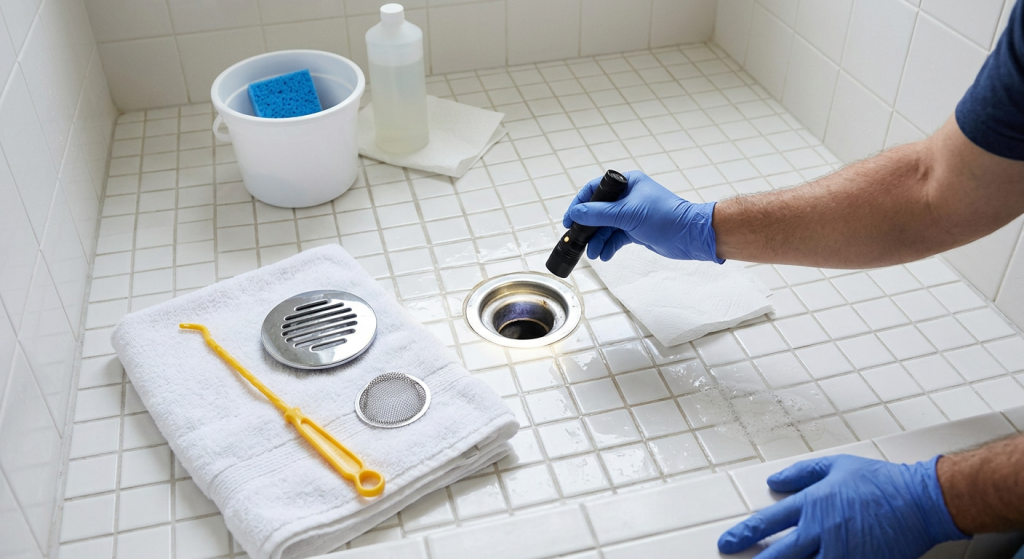
Put on gloves and use a flashlight to inspect the drain cover and opening. Look for visible hair, soap residue, and other debris.
If the drain cover can be removed normally without forcing stuck hardware, inspect the accessible area beneath it.
Remove visible hair and clean accessible residue.
A simple plastic hair-removal tool can be useful when hair is close to the drain opening. Insert it gently and use it only as intended.
Do not aggressively probe the drain with improvised wire, screwdrivers, sharp objects, or other tools. You can push debris deeper or damage drain components.
If drain-cover screws are rusted, corroded, or will not turn with reasonable effort, do not force them. Damaging the screw heads or drain assembly will make the job more difficult without necessarily getting you closer to the clog.
After accessible cleaning, observe how the shower drains during normal use.
A Better Hair Catcher May Reduce Recurrence
If you regularly find substantial hair beneath the drain cover, reducing how much enters the drain can help.
A properly fitting hair catcher or drain cover designed to capture loose hair can reduce accumulation farther into the drainage path.
It still requires routine cleaning. A hair catcher packed with hair and soap residue can itself restrict drainage.
The goal is not to create another blockage at the surface. It is to intercept hair where it can be removed easily rather than allowing it to collect farther down the drain.
Choose something appropriate for the drain design that does not interfere with normal drainage.
Short-Lived Improvement Suggests Buildup Remains
How long the drain stays clear after cleaning is an important clue.
Suppose you remove a large amount of visible hair and normal drainage returns for a long time. That suggests the accessible buildup was probably a major part of the restriction.
If the shower improves for only a day or two before slowing again, the problem is different.
Material may remain farther into the drain, or the original restriction may never have been completely removed. The remaining buildup quickly catches new hair and residue.
Repeatedly cleaning only the drain opening may produce the same short-lived result.
At that point, the next step should be determining whether an appropriate mechanical clearing method can safely reach the restriction—not simply repeating the surface cleaning more often.
What if the Shower Has Standing Water?
A slowly draining shower and a shower that will barely drain or has substantial standing water are related problems, but they require different priorities.
This article focuses on why the clog keeps returning.
If water is standing in the shower because the drain is effectively blocked, switch to a clearing approach appropriate for that condition. See How to Unclog a Shower Drain With Standing Water for that troubleshooting sequence.
Be especially cautious if any chemical drain cleaner has already been added. Do not put your hands into chemically contaminated standing water.
When to Consider a Plunger or Small Manual Snake
If you have removed accessible hair and residue but drainage remains slow, a simple mechanical drain tool may be appropriate.
A plunger may help with some localized soft restrictions when it can form an effective seal.
A small manual hand snake may be useful for reachable buildup farther into an appropriate shower drain.
The right choice depends on the drain configuration and likely location of the restriction. Drain Snake vs Plunger: Which Should Homeowners Use? explains the differences without assuming one tool is right for every clog.
Keep mechanical clearing conservative.
Do not force a snake that meets persistent hard resistance, and do not escalate to a powered drain machine as a beginner homeowner step.
If the cable does not advance normally, stop. More force can damage plumbing, lodge the cable, or indicate that the problem requires a different approach.
Why Liquid Drain Cleaner May Not Stop the Clog From Returning
Liquid chemical drain cleaner should not be the automatic response to a shower drain that repeatedly clogs.
Hair-heavy buildup may not be completely removed. A product might create enough of an opening for water to move again while leaving material that continues collecting hair and residue.
That can produce temporary improvement without solving the recurring problem.
Chemical cleaner also creates an important safety concern when it remains in standing water or a restricted drain.
Never mix drain cleaner with:
- Bleach
- Vinegar
- Ammonia-based cleaners
- Another drain cleaner
- Other household cleaning products
If drain cleaner is already present in standing water, do not plunge the drain, insert a snake, or put your hands into the water.
Do not add another chemical because the first treatment did not work.
If professional service becomes necessary, tell the plumber that a chemical drain product was used and identify it if you know which product it was.
Gurgling and Odors Can Be Additional Clues
A shower drain that repeatedly slows may also begin gurgling or developing an unpleasant odor.
Gurgling can indicate unusual air and water movement through the drainage system, but it does not identify the cause by itself.
An odor associated with accumulated hair and organic residue may improve when accessible buildup is removed.
A sewage-like odor deserves more attention, particularly if it appears along with slow drainage in other fixtures, backups, or unusual water movement elsewhere.
Do not keep treating a shower drain as an isolated hair clog when multiple drainage symptoms are developing around the home.
Signs the Problem May Be Deeper Than the Shower
A recurring shower drain problem becomes more concerning when the symptoms extend beyond ordinary hair and surface buildup.
Watch for:
- The clog returning within a day or two
- Several household fixtures draining slowly
- Water backing up into another fixture
- Dark or dirty water returning through the drain
- Sewage odor combined with drainage problems
- A manual snake repeatedly meeting hard resistance
- Water leaking below the bathroom
These symptoms can point toward a restriction farther into the branch drain or another shared portion of the drainage system.
A shower drain that improves briefly after cleaning but repeatedly slows again may also have buildup beyond the reach of simple surface tools.
Do not respond by applying progressively more force, stronger chemical treatments, or powered drain-cleaning equipment.
If sewage backs up, avoid contact with the water and keep people and pets away from the affected area.
When to Call a Plumber
Qualified plumbing help is appropriate when a recurring clog returns almost immediately after accessible cleaning, especially when reasonable beginner-level methods do not produce lasting improvement.
Stop DIY drain clearing if a hand snake repeatedly meets hard resistance, water leaks below the bathroom, or dark or sewage-contaminated water backs up through the drain.
Professional diagnosis is also appropriate when multiple fixtures are slow, or water backs up somewhere other than the shower. Those symptoms suggest the problem may extend beyond the individual shower drain.
Final Thoughts
If your shower drain keeps clogging, focus on why the improvement does not last. Repeated problems often mean some hair and residue remain farther into the drain, allowing new buildup to collect quickly.
Remove accessible hair safely, keep the drain cover or hair catcher clean, and pay attention to how long the improvement lasts. When the clog quickly returns, other fixtures become slow, a snake meets hard resistance, or sewage or leaking appears, stop repeating temporary treatments and have the deeper drainage problem diagnosed.