
Smart Light Switch vs Smart Bulb: Which Is Better for Homeowners?
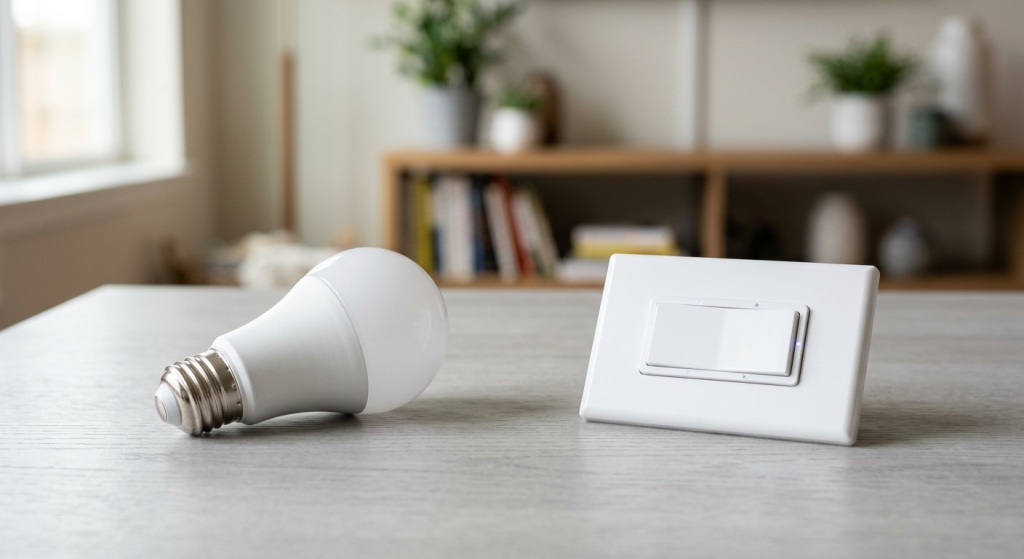
A smart light switch vs smart bulb decision depends on how you want people to control the lights, how many bulbs are involved, and which smart features matter most. A smart switch is usually better when normal wall control should remain intuitive for one or more fixtures. A smart bulb is often easier when you want color changing, individual bulb control, or renter-friendly installation. Neither option is universally better.
| Feature | Smart Switch | Smart Bulb |
|---|---|---|
| Installation difficulty | Usually higher | Usually lower |
| Wall-switch usability | Normal wall control remains useful | Wall switch must usually stay on |
| Color changing | Usually no | Common on compatible models |
| Dimming | Available on smart dimmers | Often built into bulb controls |
| Multiple bulbs | Can control several on one circuit | Usually requires one smart bulb per socket |
| Renter friendliness | May require approval or wiring changes | Usually easier |
| Cost per room | Can be efficient for several bulbs | Can add up with multiple bulbs |
| Power-off behavior | Smart control remains at the wall | Bulb may go offline if wall switch is off |
| Smart-home compatibility | Product-dependent | Product-dependent |
| Best use case | Permanent room or circuit control | Lamps, color lighting, individual control |
1. What Is a Smart Light Switch?
A smart light switch replaces or supplements the normal wall control for a lighting circuit and adds features such as app control, schedules, automation, and voice commands.
Depending on the installation, one smart switch may control:
- One ceiling fixture
- Several recessed lights
- Multiple bulbs in one fixture
- A group of lights on the same switched circuit
That can make a smart switch practical when several lights should always operate together.
Compatibility matters, however. Some smart switches require a neutral conductor, certain load types, minimum loads, compatible dimmable bulbs, or specific switch configurations.
Do not assume that every smart switch works with every home or lighting circuit. Product requirements should be checked before purchase, and installation may require a qualified electrician.
2. What Is a Smart Bulb?
A smart bulb contains its own wireless and electronic controls.
Depending on the model, it may offer:
- On/off control
- Dimming
- Scheduling
- Adjustable white color temperature
- RGB color changing
- Scenes
- App and voice integration
Installation is often as simple as replacing a compatible conventional bulb and completing the manufacturer’s setup process.
The main limitation is power.
A smart bulb generally needs continuous electrical power to remain connected. If someone turns off the wall switch supplying it, the bulb may no longer respond to the app, voice assistant, schedules, or automations until power is restored.
That difference is central to the smart bulb vs smart switch decision.
3. Smart Light Switch vs Smart Bulb: Main Differences
A smart switch makes the wall control itself part of the smart-lighting system. A smart bulb makes each individual bulb smart.
That leads to several practical differences.
Smart switches often work better when:
- Several bulbs should turn on together.
- Family members expect to use a normal wall control.
- You want a permanent room-level solution.
- Individual bulb colors are not important.
Smart bulbs often work better when:
- You want color-changing light.
- Individual bulbs need separate control.
- You want minimal installation work.
- You are automating a lamp rather than a switched ceiling fixture.
Cost can also shift depending on scale. One smart switch controlling six compatible ordinary bulbs may be more economical than buying six smart bulbs, while a single smart bulb can be the simpler solution for one lamp.
4. Which Is Easier to Install?
Smart bulbs are generally easier to install.
In many cases, you replace an existing compatible bulb, turn the light on, and follow the manufacturer’s app setup process.
A smart switch can require changes to the wall control and must be compatible with the existing electrical system.
Requirements may include:
- A neutral conductor
- A compatible lighting load
- Proper dimmable bulbs for a smart dimmer
- A supported single-pole or multi-location configuration
Those requirements should remain a product-selection consideration rather than a DIY wiring project.
If you do not know the wiring configuration or the installation requires opening an electrical box, professional installation is the safer approach.
5. Which Is Better for Multiple Bulbs?
A smart switch can be especially useful when one wall control already operates several lights together.
Examples include:
- Recessed ceiling lights
- Multi-bulb ceiling fixtures
- Vanity lighting
- Groups of overhead lights
Instead of buying a separate smart bulb for every socket, one compatible smart switch may provide app, schedule, and voice control for the entire switched group.
Smart bulbs may still be preferable when each bulb needs different settings.
For example, individual smart bulbs make more sense when you want separate colors, separate dimming levels, or different scenes within the same room.
Do not assume that every group of bulbs works with every smart switch. Load type, bulb compatibility, and the switch manufacturer’s requirements still matter.
6. Which Is Better for Color-Changing Light?
Smart bulbs are generally the more practical choice for color-changing lighting.
They can offer features such as:
- RGB colors
- Tunable white
- Warm-to-cool white adjustment
- Scene-based color changes
- Independent colors for different bulbs
Most smart switches control power or dimming rather than producing different colors themselves.
If color is a major reason you want smart lighting, smart bulbs usually offer more flexibility without requiring a specialized lighting system.
For simple on/off automation or whole-room dimming, however, a smart switch may be enough.
7. What Happens if Someone Turns the Wall Switch Off?
This is one of the biggest everyday differences between the two options.
With a smart bulb, turning the normal wall switch off usually cuts electrical power to the bulb. Once that happens, app commands, voice control, schedules, and remote access may stop working until someone turns the switch back on.
That can be frustrating in homes where people naturally use wall switches.
A smart switch generally avoids that problem because the wall control itself is part of the smart system. People can still operate the light in the familiar way without disabling the smart control.
That can make a smart switch especially practical in:
- Kitchens
- Hallways
- Guest rooms
- Family rooms
- Frequently used shared spaces
8. Smart Switch vs Smart Bulb for Renters
Smart bulbs are often easier for renters because they usually require no permanent changes to wall wiring.
You can often install them, configure the app, and remove them later when you move.
Smart switches may involve permanent electrical work and may require property-owner approval.
That does not make smart bulbs the best choice in every rental. Their continuous-power requirement can still be inconvenient if roommates, guests, or family members frequently turn off the wall switch.
But for renters who want simple smart control without changing electrical hardware, bulbs are generally the easier starting point.
9. Smart Switch vs Smart Bulb for Homeowners
Homeowners have more flexibility because a permanent wall-control upgrade may make sense over the long term.
A smart switch may fit better when:
- One switch controls several lights.
- Normal wall operation matters.
- The setup is intended to remain in place.
- Color-changing features are unnecessary.
A smart bulb may fit better when:
- Color or tunable white is important.
- One lamp or fixture needs automation.
- Individual bulb control matters.
- You want to avoid changing the wall control.
Some homes use both approaches in different rooms rather than choosing one technology everywhere.
10. Dimming Compatibility
Smart bulbs usually handle dimming through their own electronics, app, automation, or compatible smart controls.
Do not assume a smart bulb will work correctly with a traditional wall dimmer unless the bulb manufacturer specifically says it is compatible.
A conventional dimmer can interfere with the power a smart bulb expects and may cause unreliable operation.
Smart switches and smart dimmers have their own load requirements as well. A smart dimmer should be compatible with the connected LED bulbs and the total lighting load.
Compatibility should be confirmed through manufacturer information rather than trial-and-error replacement.
11. Neutral Wire and Wiring Requirements
Some smart switches require a neutral conductor to power their internal electronics.
Other products are designed for installations where a neutral conductor is not available at the switch location.
Whether a particular product will work depends on factors such as:
- Smart-switch design
- Existing wiring
- Lighting load
- Switch configuration
- Number of control locations
Do not open the electrical box merely to determine whether a neutral is present if you are not equipped to work safely around electrical wiring.
If the existing configuration is unknown, confirm compatibility with the product documentation or have a qualified electrician evaluate it.
12. Smart-Home Platform and Hub Compatibility
Before buying either option, make sure it works with the smart-home system you intend to use.
Depending on the product, compatibility may include systems such as:
- Alexa
- Google Home
- Apple Home
- Matter
- Manufacturer-specific hubs
Different devices may communicate through Wi-Fi, Bluetooth, a dedicated hub, Matter, Thread, or another protocol.
You do not need to choose a whole smart-home ecosystem just to compare a switch and bulb, but compatibility matters if you want everything controlled from the same app or voice assistant.
Check the manufacturer’s current compatibility list before purchase.
13. What Happens if Wi-Fi or Internet Goes Down?
Product behavior varies, but a smart switch will generally continue functioning as a physical wall control even when network features are unavailable, assuming the electrical system itself is operating normally.
A smart bulb can usually still be turned on and off with the wall switch, but remote control, schedules, or app functions may be limited if connectivity is lost.
Some smart-home systems support local control and can continue certain automations without an internet connection.
Do not assume every product behaves the same way. If offline operation matters to you, check that feature before choosing a device.
14. Cost: One Switch vs Multiple Smart Bulbs
The lower-cost option depends on how many lights you want to control.
A smart switch may cost more than one smart bulb but can potentially control several ordinary compatible bulbs at once.
That can make switches attractive for rooms with:
- Multiple recessed lights
- Large ceiling fixtures
- Several bulbs controlled together
Smart bulbs can become more expensive when every socket needs its own smart device.
However, those additional bulbs may provide capabilities a single smart switch cannot, including individual control, color changing, tunable white, and per-bulb scenes.
Compare the cost of the whole room rather than only one device.
15. Which Is Better for Different Rooms?
In a living room, a smart switch can make sense when several fixtures should respond together and normal wall control matters. Smart bulbs may be more appealing when color scenes are part of the goal.
In a bedroom, either can work. A smart bulb is convenient for a bedside lamp, while a smart switch can automate the primary ceiling fixture.
In a kitchen, a smart switch is often practical for groups of overhead lights that everyone needs to operate easily.
In a hallway, normal wall control usually matters more than individual bulb features, making a compatible smart switch a practical option.
In a home office, a smart bulb may be useful when tunable white or color control matters.
In a rental, smart bulbs are often the easier choice because they can usually be installed and removed without permanent electrical changes.
16. Which One Should You Choose?
Choose a smart switch when:
- One wall switch controls one or more fixtures.
- Everyone should be able to use the wall normally.
- You want a more permanent whole-room solution.
- Color-changing light is not important.
Choose a smart bulb when:
- You want color or tunable white.
- You need individual bulb control.
- Simple installation matters.
- You are renting.
- You want to automate a lamp or single fixture.
For many homeowners, the best answer is a mix: smart switches in shared rooms and smart bulbs where individual color or fixture control adds useful flexibility.
17. Safety and Compatibility
Before buying, verify:
- Fixture type
- Bulb base
- Fixture wattage limits
- Enclosed-fixture rating when applicable
- Dimmer compatibility
- Smart-switch load compatibility
- Manufacturer wiring requirements
- Smart-home platform compatibility
For covered fixtures, see the guide to the best LED bulbs for enclosed fixtures before choosing a smart bulb.
If an existing wall control is behaving abnormally rather than simply lacking smart features, troubleshoot the light switch not working problem separately instead of assuming a smart-switch upgrade is the fix.
Do not treat smart-switch installation as a diagnostic experiment for an existing electrical problem.
Final Thoughts
The smart light switch vs smart bulb choice depends on how the room is used. Smart switches generally suit shared spaces, multi-bulb circuits, and households that want familiar wall control. Smart bulbs are often better for color changing, individual control, lamps, renters, and simpler installation.
Before buying, consider wiring compatibility, fixture requirements, number of bulbs, desired features, smart-home platform support, and how everyone in the household actually turns the lights on and off.