soft-close drawer not working: causes and what to check
If your soft-close drawer not working problem shows up as slamming, stopping short, rebounding, or uneven closing, first determine whether the drawer moves freely before it reaches the soft-close stage. A drawer that binds throughout its travel usually has a general slide problem. If it moves normally but stops slowing near the end, focus on engagement, locking devices, alignment, and the damping mechanism.
| Symptom | Possible cause | First check |
|---|---|---|
| Drawer slams shut | Damper not engaging or failed | Confirm drawer is fully seated on both slides |
| Stops before closing | Misalignment, obstruction, damaged mechanism | Test empty and watch where it stops |
| Rebounds or opens slightly | Catch not completing its cycle, misalignment | Check engagement and visible hardware |
| One side closes first | One runner or locking device not engaged | Compare both sides |
| Needs a hard push | Alignment, load, runner interference | Test the empty drawer |
| Works only sometimes | Intermittent engagement or damaged hardware | Inspect catches and mounting points |
Start With the Exact Soft-Close Symptom
“Soft close is not working” can describe several different problems.
A drawer that travels smoothly almost all the way closed and then slams is behaving differently from one that scrapes or binds from the moment you move it. Likewise, a drawer that reaches the soft-close point but rebounds needs a different inspection from one that never reaches that point.
Empty the drawer and operate it several times. Notice:
- whether movement is smooth through most of the travel
- where resistance begins
- whether both sides move together
- whether you hear scraping, clicking, or an unusual impact
- whether the soft-close system catches consistently
- whether the problem disappears when the drawer is empty
If the drawer is difficult to move throughout its entire travel, ordinary slide cleaning, mounting, or alignment may be the real problem rather than the damper itself. General sticking and binding belong to normal drawer-slide troubleshooting.
Identify the Soft-Close Slide System
Soft-close drawers can use several hardware arrangements. Common examples include concealed undermount runners, side-mount ball-bearing slides with integrated damping, and systems that add a separate closing device to compatible hardware.
These systems do not share one universal release, reset, or adjustment procedure.
Undermount runners may connect to the drawer with front locking devices or catches while also using hooks or other engagement points farther back. Other systems use different clips, levers, brackets, or disconnects.
Before forcing a drawer off its slides, look for a manufacturer name, series marking, or recognizable locking device. Manufacturer instructions are particularly useful here because a release method that works for one system may damage another.
Support a large or heavy drawer when removing it. Do not work underneath an unsupported drawer.
If the drawer is sticking, binding, or coming loose during normal travel rather than only at the soft-close stage, see our guide to how to fix drawer slides for those broader hardware checks.
What to Check When a Soft Close Drawer Is Not Working
Step 1: Test the drawer empty
Remove everything from the drawer and open and close it several times.
If soft close works when empty but fails when loaded, weight may be exposing another problem such as loose mounting, misalignment, worn hardware, or a runner that is not appropriate for the load. Do not assume a universal drawer weight limit; limits depend on the specific runner system.
If the drawer behaves exactly the same when empty, continue checking the hardware.
Step 2: Confirm the drawer is fully engaged
This is one of the most important checks on undermount systems.
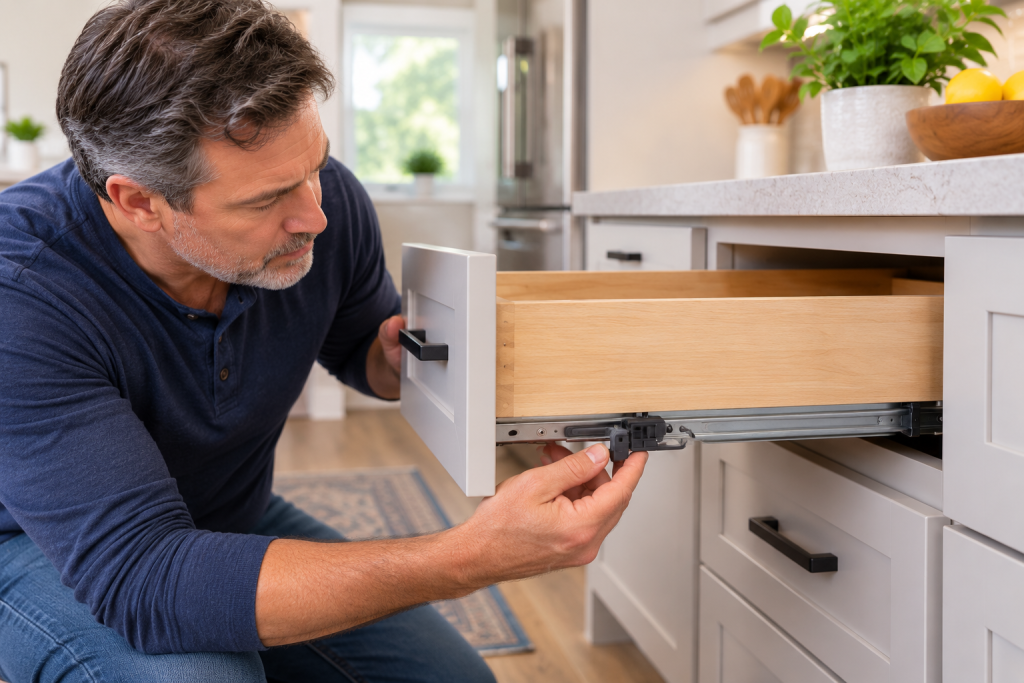
Some runners use front locking devices, catches, or clips that secure the drawer to the slides. They may also depend on rear hooks or other engagement points. If one side is not fully seated, the drawer can close unevenly or fail to enter the soft-close mechanism correctly.
Compare the left and right sides. Look for one locking device that appears loose, cracked, or positioned differently from the other.
Do not use a universal “snap it back in” procedure. Re-engage the drawer only according to the hardware manufacturer’s design.
Step 3: Check visible mounting hardware
Inspect accessible slide screws, locking devices, clips, brackets, and cabinet-side mounting points.
Snug hardware that is clearly loose, but do not overtighten it. A screw that spins without becoming secure indicates a mounting problem rather than something that will be corrected with more tightening.
Keep the inspection focused on what affects the drawer entering the closing position correctly. Extensive stripped-hole repair or cabinet reconstruction is a separate job.
Step 4: Look for obvious misalignment
Soft-close hardware depends on the drawer reaching the final part of its travel in the correct position.
Look for signs that one side sits higher or lower, the drawer is skewed, one runner has shifted, or one side begins closing before the other.
Some concealed runner systems provide built-in height, side, depth, or tilt adjustment, but the available adjustments and their controls vary by model. Do not change several adjustments at once without knowing what each one does.
If the drawer binds long before it approaches the soft-close mechanism, treat that as an ordinary slide-alignment or binding problem instead.
Step 5: Inspect the soft-close mechanism
With the drawer removed only if the manufacturer’s method allows it, inspect the accessible damping and catching components.
Possible signs of actual hardware failure include:
- a catch or trigger that is visibly broken
- cracked plastic parts
- a damper that remains stuck
- a mechanism that does not return to its normal starting position
- obvious physical damage to a runner
- one side operating normally while the corresponding side does not
- leakage from a damping component where that design contains a fluid damper
Do not dismantle a sealed damping unit to investigate its internal parts. Once an integrated mechanism is physically broken, replacement of the appropriate component or runner is generally more practical than attempting to rebuild the damper.
Step 6: Re-engage and test the drawer
If the hardware appears intact, reinstall the drawer according to the manufacturer’s procedure and make sure both sides engage correctly.
Test it several times while empty before adding the contents back.
Some systems can resume normal operation after the drawer is removed and correctly re-engaged or after a manufacturer-specified mechanism is returned to its starting position. That does not mean every soft-close drawer has a homeowner-accessible reset.
If the manufacturer does not provide a reset procedure, do not invent one by forcing catches, dampers, or runners into a different position.
Why a Soft-Close Drawer Slams Shut
A drawer that moves freely but closes at full speed is a stronger sign of a soft-close engagement problem than a drawer that sticks throughout its travel.
Possible causes include:
- the damper is not being triggered
- the drawer is not seated correctly on the runners
- a locking device is loose or damaged
- an adjustable part is out of position on a system that provides that adjustment
- the damping unit has failed
- a runner is damaged
- incompatible hardware has previously been installed
Start with drawer engagement and visible hardware before concluding that the damper is defective.
If the mechanism catches on one attempt but not another, watch whether the drawer approaches the closing position evenly on both sides.
Why the Drawer Stops Before It Fully Closes
A soft-close drawer that stops short may have an obstruction, a drawer-engagement problem, or hardware that is no longer entering the closing cycle correctly.
Remove the contents and check for anything physically blocking the drawer. Then watch whether resistance begins only near the closing point or much earlier.
Resistance through most of the drawer’s travel suggests a general runner problem rather than soft-close failure.
If movement remains smooth until the final portion, check for a partially disengaged locking device, shifted runner, damaged catch, or soft-close mechanism that is not completing its travel.
Do not force the drawer closed. Extra force can damage catches, plastic locking components, or already-misaligned runners.
Why a Drawer Rebounds or Will Not Stay Closed
A drawer that appears to close but then moves outward again may not be completing the intended closing cycle.
Possible causes include misalignment, incomplete engagement between the drawer and runners, a damaged catch or damper, or a runner that has shifted at its mounting point.
Cabinet position can matter as well. If the cabinet is substantially out of level or the drawer box itself is warped, the hardware may not operate in the position for which it was designed.
Do not start changing several adjustment points randomly. First confirm that the drawer is seated correctly and the visible hardware is secure.
What If Soft Close Works on Only One Side?
Uneven closing often points to an engagement or hardware difference between the two sides.
One runner may not be connected correctly, one locking device may be loose or broken, or one damping component may have failed. Uneven runner mounting can produce similar behavior.
Compare the left and right attachment points closely. If the system uses matched runners and one side is damaged, follow the manufacturer’s replacement guidance rather than permanently operating the drawer with one side disconnected or defeated.
Does Lubricating a Soft-Close Drawer Fix It?
Lubrication is not a general repair for a failed soft-close mechanism.
Ordinary drawer slides may have manufacturer-specific cleaning or lubrication requirements, but damping units should not be sprayed with lubricant unless the hardware manufacturer explicitly instructs you to do so.
Adding spray lubricant to a damper can contaminate the mechanism without correcting a broken catch, failed damping unit, or engagement problem.
If the drawer itself is rough throughout its travel, address normal slide maintenance separately.
When Soft-Close Hardware Needs Replacement
Replacement becomes more likely when inspection reveals actual physical failure rather than an engagement or adjustment problem.
Examples include:
- broken or nonfunctioning damper
- cracked locking device
- broken catch or trigger
- bent runner
- mechanism that no longer resets as designed
- one side that repeatedly fails despite correct engagement
- drawer that will not remain securely attached to the runner
- soft-close mechanism that no longer catches after correct installation and alignment
- manufacturer guidance that specifies replacing the failed component
Do not buy replacement runners based only on appearance. Matching, measuring, selecting, and installing replacement drawer slides is a separate project.
If the damping hardware or runner itself has failed, use our drawer slide replacement guide to identify, measure, and install compatible replacement slides.
Common Mistakes to Avoid
Avoid making the problem harder to diagnose by:
- assuming every closing problem means a failed damper
- forcing a drawer that will not close
- spraying lubricant into a soft-close unit
- opening or dismantling a sealed damper
- changing several adjustments at once
- overlooking a drawer that is only partially engaged
- ignoring loose clips or mounting hardware
- following reset instructions for a different slide system
- ordering replacement slides before identifying the existing hardware
Start with the simplest observable problem and change one thing at a time.
When to Call a Cabinet Professional or Handyman
Routine inspection, re-engagement, and tightening accessible hardware are reasonable homeowner tasks.
Professional help makes sense when the mounting surface is damaged, the drawer box is warped, the cabinet appears out of square, or several drawers develop similar alignment problems at the same time.
A cabinet professional or experienced handyman can also help when specialty hardware cannot be identified or correcting the problem would require modifying the cabinet or drawer rather than servicing the existing soft-close system.
Frequently Asked Questions
Why is my soft-close drawer slamming shut?
The damper may not be engaging, the drawer may not be fully seated on its runners, a locking device may be loose, or the damping mechanism may have failed. Confirm engagement and alignment before assuming the soft-close unit needs replacement.
Why does my soft-close drawer stop before closing?
An obstruction, misalignment, partially engaged drawer, damaged catch, or failing damping mechanism can stop the drawer short. If it binds throughout its travel rather than only near the closing stage, investigate the ordinary slide movement first.
Can a soft-close drawer mechanism be reset?
Some systems can be re-engaged or returned to their starting position using a manufacturer-specified procedure. Others have no universal homeowner reset. If you have a soft-close drawer not working, identify the runner system before attempting any reset.
Should I lubricate soft-close drawer slides?
Do not lubricate the damping mechanism unless the manufacturer specifically allows it. Lubrication requirements for the slide itself vary by model and are separate from repairing a failed soft-close unit.
How do I know if the soft-close mechanism is broken?
Physical damage, a cracked catch, a damper that will not operate or return normally, or repeated failure after the drawer is correctly engaged and aligned all point toward hardware failure. Sealed damping mechanisms generally should not be dismantled for repair.
Final Thoughts
Start with the exact symptom. Make sure the drawer moves normally before the soft-close stage, confirm both sides are fully engaged, and check accessible locking devices, mounting hardware, and basic alignment.
Do not force the drawer, spray lubricant into the damper, or dismantle a sealed mechanism. If the drawer is correctly installed and aligned but the damping hardware is visibly damaged or still will not engage, replacement of the failed hardware is the appropriate next step.