
types of shower heads: which style fits your bathroom?
Types of shower heads include fixed wall-mounted heads, handheld models, rain-style heads, and combination designs that pair two functions in one setup. The right choice depends less on the style name than on where the water comes from, how much reach and coverage you want, who uses the shower, and whether the new fixture works with the existing plumbing without a larger renovation.
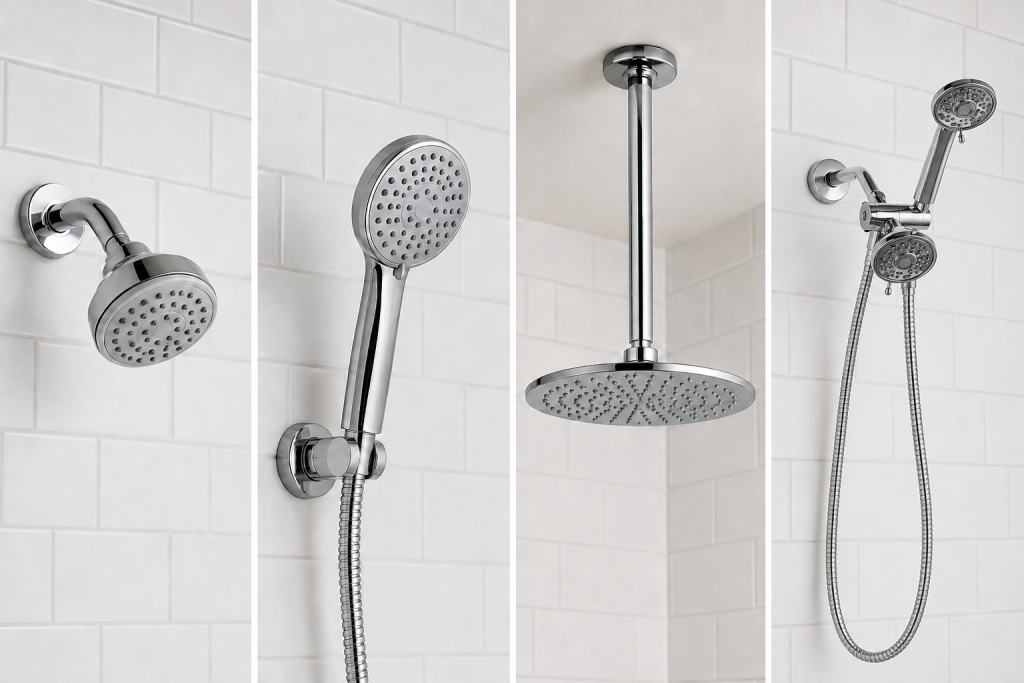
What Makes One Shower Head Type Different From Another?
Shower-head categories can overlap. A handheld head can have multiple spray settings and carry a water-efficiency label. A rain-style head might attach to a wall-mounted arm or hang from a ceiling supply. A combination unit can include both a broad fixed head and a removable handheld spray.
It helps to separate five characteristics:
- Mounting: Whether the head attaches to a wall arm, ceiling arm, bracket, slide bar, or another shower component.
- Mobility: Whether the spray stays fixed or can be removed from a holder and directed by hand.
- Spray-face size and coverage: How broadly the water is distributed around the user.
- Spray settings: Whether the head provides one pattern or selectable sprays such as full coverage, massage, concentrated rinse, or pause.
- Efficiency features: Whether the model carries a verified efficiency label or uses other flow-management features.
Pressure, flow rate, coverage, and spray force are also different. Household water pressure exists in the plumbing system. Flow rate describes how much water passes through the shower head over time. Coverage describes where that water lands, while spray force affects how the stream feels.
A shower head can change the character of the spray, but it does not increase the water pressure available from the home’s supply system.
Types of Shower Heads Compared
| Style | Best-fit use | Main advantage | Main limitation | Installation consideration |
|---|---|---|---|---|
| Fixed wall-mounted | Simple everyday showering | Compact and straightforward | Limited reach | Often a head-only swap if compatible |
| Handheld | Directed rinsing and flexible reach | Spray can move where needed | Hose and docking require space | Bracket style varies |
| Rain-style | Broad overhead-oriented coverage | Larger spray area | Position and height matter | Some fit wall arms; others require ceiling plumbing |
| Combination or dual | Users wanting fixed and handheld functions | Multiple ways to direct water | More components and controls | Exposed retrofit or larger system, depending on design |
The table is a starting point. Within each style, spray patterns, dimensions, flow rates, docking methods, and installation requirements can differ substantially.
Fixed Wall-Mounted Shower Heads
A fixed head stays attached to the shower arm and directs water from one position. Many models pivot at the connection so the spray angle can be adjusted within a limited range.
This style suits homeowners who want a straightforward shower without a hose or separate docking point. It can also be one of the simplest choices when replacing an existing conventional head because a compatible model may attach to the sound shower arm already in place.
Compatibility still needs verification. Do not assume every shower head and arm use interchangeable fittings simply because both are conventional-looking products.
A fixed head is less flexible when you need to rinse the enclosure, wash a pet, bathe a child, or direct water toward a particular part of the body. Its usefulness also depends heavily on the height and angle of the existing arm.
Changing the head does not automatically solve poor placement. Raising, lowering, or relocating the water outlet may require a different arm or changes to plumbing, which turns the project into something larger than a head replacement.
If the existing arm moves at the wall, is heavily corroded, or leaks around its wall connection, address that problem before installing a new head.
Handheld Shower Heads
A handheld shower head connects to a flexible hose and rests in a bracket or dock when it is not being held. The movable spray makes it easier to direct water exactly where you want it.
That flexibility can be useful for:
- Rinsing shampoo from long or thick hair.
- Bathing children.
- Washing pets.
- Rinsing the shower enclosure.
- Serving household members with different heights or reach needs.
- Directing spray while seated when the complete shower setup is appropriate for that use.
Do not assume that every handheld model creates an accessible shower. Consider whether the intended user can reach the holder, remove and replace the head, operate its controls, and manage the hose comfortably.
Holder location matters as much as hose length. A shower-arm-mounted bracket may place the handheld relatively high. A slide bar can provide adjustable docking height, but installing one may require wall mounting and drilling rather than a simple shower-head swap.
An ordinary handshower slide bar is also not automatically a grab bar. Use it for body-weight support only when that specific product is designed, rated, and installed for that purpose.
Look at how the head docks, too. Traditional brackets rely on a mechanical cradle, while some products use magnetic docking. Either can work well, but ease of removal and secure replacement can matter for someone with limited reach or hand strength.
Keep all supplied washers, screens, vacuum breakers, and other required components in the system. Do not remove a backflow or flow-control component in an attempt to change spray performance.
Rain-Style Shower Heads
Rain-style heads generally use a broad spray face to distribute water across a larger area. Their defining characteristic is the coverage and water-delivery pattern rather than one particular mounting arrangement.
Some rain heads can attach to an appropriate wall-mounted arm. Others are intended to hang overhead from a ceiling-mounted arm. Certain models may support either orientation when used with the correct arm and plumbing.
That distinction can make the difference between a straightforward fixture change and a remodeling project. For example, a compatible wall-mounted rain head may replace an existing head on a stable arm. A true ceiling-fed installation that does not already have an overhead supply can require new plumbing and ceiling work, which is outside a simple shower-head upgrade.
Consider four practical factors before choosing a large rain head:
- Height: Make sure the spray face will sit high enough for the users of the shower.
- Position: Check where the spray will actually land relative to the person and enclosure.
- Space: A large head can feel crowded in a small stall or interfere with doors and other fixtures.
- Support and compatibility: Confirm that the specified arm and connection can support the chosen head.
Do not use diameter alone to predict performance. A larger spray face can distribute water over a wider area, but that does not mean it creates greater household pressure or stronger spray.
If an overhead arrangement would require adding or relocating a supply line, treat it as a plumbing project rather than assuming the rain head itself is a simple retrofit.
Combination and Dual Shower Heads
Combination designs pair a fixed or rain-style head with a handheld spray. They suit households that want broad hands-free coverage during ordinary showering plus a movable sprayer for directed rinsing.
Some combination products mount entirely at the existing shower arm. Delta’s In2ition Two-in-One Shower is one current example: its detachable hand shower docks within the fixed shower head, and the exposed unit can replace a conventional head without opening the wall when the existing connection is suitable.
Its diverter lets the user select the fixed head, handheld spray, or both together. That illustrates another important buying point: simultaneous operation is product-specific.
Do not assume every dual shower head works the same way. Some diverters select only one outlet at a time, while others allow shared operation. When both operate simultaneously, do not assume that each outlet will feel exactly as it does when running alone or that using two outlets doubles the total water flow.
Also distinguish an exposed combination head from a built-in multi-outlet shower system. A system with separate wall or ceiling supplies, body sprays, concealed diverter valves, or additional controls can require in-wall plumbing and is a different project.
Combination heads have more parts to consider than fixed heads: hose routing, diverter access, docking effort, spray controls, clearance, and the weight placed on the existing assembly.
Features That Can Appear Across Shower-Head Styles
The main types of shower heads describe the overall configuration, but several features can appear in more than one category.
Multiple spray modes let you change the spray pattern without changing the plumbing. Consider whether you actually want several settings and whether the controls are easy to operate with wet hands.
WaterSense certification is available for fixed shower heads, rain showers, and handheld showers. In the United States, WaterSense-labeled showerheads have a maximum flow rate of 2.0 gallons per minute and are independently certified against program requirements that include spray force, spray coverage, and performance across a range of water pressures. The label evaluates efficiency and defined performance characteristics; it does not mean a shower head increases household supply pressure.
Magnetic docking can make a handheld head easier to return to its holder. Delta’s current In2ition models with MagnaTite docking are an example. Magnetic docking is a convenience feature, not a substitute for checking holder position, user reach, and secure installation.
Pause settings can reduce water flow while lathering or performing another short task. On products such as Delta In2ition, the pause function reduces flow to a trickle rather than providing a positive shutoff. Use the shower valve when you are finished showering.
Do not remove flow restrictors or other factory components to alter performance.
Ease of maintenance is another worthwhile comparison point. Look at spray-hole design, access to screens or serviceable parts, finish-care requirements, and whether the handheld hose or docking components can be cleaned without complicated disassembly.
If weak spray is a concern, our guide to choosing the best shower head for low water pressure compares documented performance and explains when a replacement may help.
Choose the Style for the Actual Bathroom
When comparing types of shower heads, work through the bathroom and household needs rather than choosing from appearance alone.
- Check the existing connection. Verify that the intended model is compatible with the existing shower arm or system already installed.
- Look at spray position. Consider the arm height, ceiling height, user height, enclosure size, and where a larger spray pattern will land.
- Consider reach. A handheld can add flexibility, but only if users can comfortably reach the head, dock, and controls.
- Check the existing arm’s role. Do not load an unstable arm with a heavier or more complicated assembly. Stop for movement, damage, or leakage at the wall.
- Identify installation changes before buying. A head-only replacement is very different from adding a slide bar, drilling through tile, moving a supply, or installing a concealed diverter.
- Review operating options. For combination designs, confirm whether the outlets operate separately, simultaneously, or both, and how the diverter works.
- Compare maintenance. More spray faces, hoses, docks, and controls mean more components to clean and inspect.
- Budget for the complete setup. Include any compatible arm, bracket, hose, diverter, mounting hardware, or professional work the chosen style requires.
If the shower arm is unstable, fittings are damaged, water leaks at the wall, or the desired design requires new concealed plumbing, stop treating the project as a simple shower-head change.
Once you have chosen a compatible model, see our guide on how to replace a shower head for the steps and limits of a straightforward replacement.
FAQs
Can a rain shower head fit an existing shower arm?
Some can. Certain rain heads are designed for compatible wall-mounted arms, while others require a specific extended or ceiling-mounted arm. Check the head’s mounting instructions, dimensions, weight, and required connection before buying. Do not assume every large rain head is suitable for the existing arm.
Is a handheld or fixed shower head better?
Neither is universally better. A fixed head is simpler and keeps the shower uncluttered. A handheld provides more directed reach for rinsing, cleaning, pets, children, and different users. A combination design may suit a household that wants both functions without choosing one exclusively.
Can a dual shower head run both outlets at once?
Some can and some cannot. The Delta In2ition system, for example, has models that allow the fixed head and handheld spray to operate separately or together. Other systems use diverters that select only one outlet. Check the exact model rather than assuming all dual heads offer simultaneous operation.
Final Thoughts
The most useful way to compare types of shower heads is to match the style to the people using the shower and the plumbing that is already there. Fixed heads favor simplicity, handhelds add directed reach, rain heads emphasize broad coverage, and combination designs provide multiple functions at the cost of additional components.
Choose the configuration first, then compare spray settings, efficiency, controls, dimensions, and maintenance. If the style you want requires an unstable arm, drilling, new supply lines, or concealed plumbing changes, plan for the larger installation rather than treating it as a head-only upgrade.