
vinyl siding vs fiber cement: cost, durability, and maintenance
When comparing vinyl siding vs fiber cement, both can be strong choices, but they suit different priorities. Vinyl usually costs less and requires less routine maintenance, while fiber cement offers a more rigid, painted-board appearance along with strong fire, rot, and pest resistance. The better fit depends on your budget, climate, appearance goals, and willingness to handle future finish maintenance.
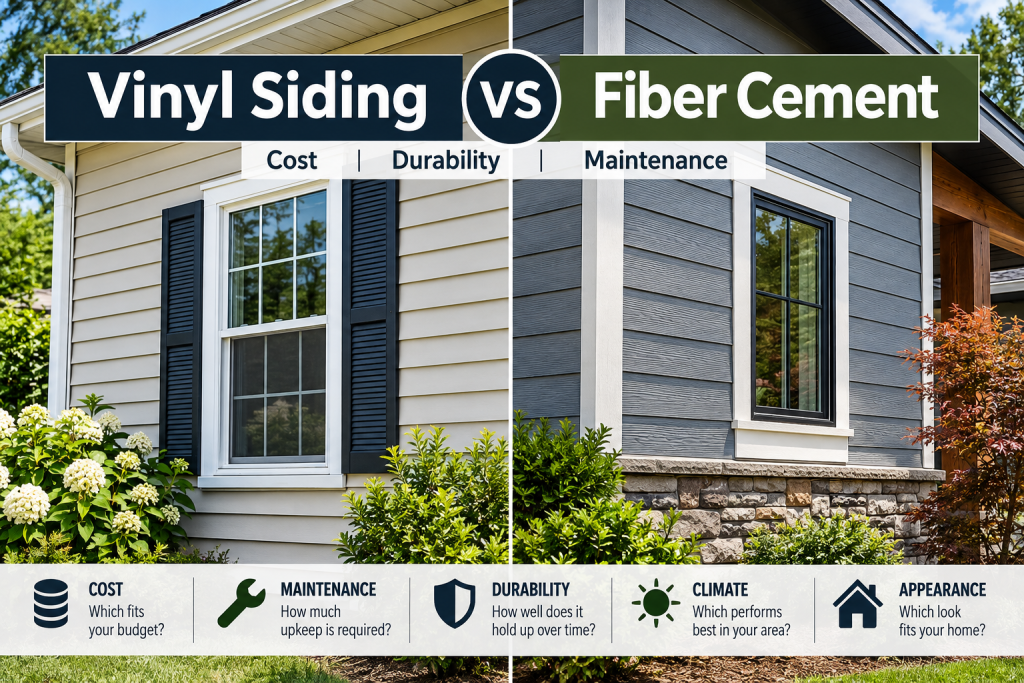
Vinyl Siding vs. Fiber Cement at a Glance
| Factor | Vinyl Siding | Fiber Cement |
|---|---|---|
| Typical Cost Level | Low–Moderate | Moderate–High |
| Maintenance | Low | Low–Moderate |
| Durability | Good | Very good |
| Moisture Resistance | Does not rot; wall still needs drainage | Highly rot-resistant; clearances and drainage still matter |
| Pest/Rot Resistance | Excellent | Excellent |
| Fire Performance | Can melt or deform under high heat | Noncombustible |
| Impact Resistance | Can crack or puncture | Rigid but can chip or crack |
| Appearance | Many colors and profiles | Painted-board and wood-look options |
| Installation Complexity | Moderate | Higher due to weight, cutting, and handling |
The biggest practical difference is straightforward: vinyl emphasizes affordability and minimal upkeep, while fiber cement emphasizes rigidity, fire performance, and the appearance of painted siding.
Cost
Vinyl siding usually starts at the lower cost position of the two. The material is relatively lightweight, widely available, and generally faster to handle than fiber cement.
Fiber cement typically costs more to install. Boards are heavier, handling is more demanding, and cutting and fastening require greater care. Depending on the product, finishing or painting may also be part of the project.
The condition of the existing wall can matter as much as the siding choice. Removing old siding, replacing damaged sheathing, correcting flashing, working around many windows, or dealing with a multi-story house can substantially change the total project cost.
For homeowners whose first priority is limiting initial spending, vinyl will often deserve the first estimate. Fiber cement is more likely to appeal to someone willing to spend more for its particular durability, appearance, and fire-performance characteristics.
For a deeper look at pricing on the vinyl side of the comparison, our vinyl siding cost guide breaks down material, labor, installed price, and the factors that can raise the total.
Durability
Both materials can provide long service when installed correctly, but they respond differently to damage and weather.
Vinyl does not rot, absorb water like wood, or provide food for termites. It also tolerates normal wetting well. Its weaknesses are more likely to involve physical damage and temperature-related movement. A hard impact can crack or puncture a panel, especially when the material is cold, and improper installation can interfere with the expansion and contraction vinyl needs.
Fiber cement is rigid, dimensionally stable compared with many wood products, and resistant to rot and insect damage. It handles normal weather exposure well when required clearances, flashing, fastening, and finishing details are followed.
Its rigidity is also a limitation. Severe impacts or rough handling can chip edges or crack boards. Fiber cement is durable, but it is not indestructible.
Product quality, wall preparation, and installation often make a larger difference than broad material labels suggest.
Maintenance
Vinyl has the advantage when the goal is the least routine finish maintenance.
It does not require repainting as part of normal upkeep. Homeowners generally need to keep it reasonably clean and watch for loose, cracked, warped, or damaged panels.
Fiber cement maintenance depends partly on how it is finished. Factory-finished products can reduce early finish work, while painted fiber cement may eventually require repainting as coatings weather.
Fiber cement installations should also be checked for deteriorated paint, damaged boards, joint or trim problems, and incorrect or changing clearances near roofs, decks, soil, or hard surfaces.
Neither material is maintenance-free. Caulked transitions, flashing, penetrations, trim, and nearby building components can still deteriorate regardless of which siding covers the wall.
Moisture and Rot Resistance
Neither vinyl nor fiber cement should be treated as a waterproof exterior wall.
Vinyl itself does not rot, which is a major advantage in wet environments. But wind-driven rain and other moisture can get behind vinyl siding. The wall therefore depends on properly integrated flashing, a water-resistive barrier, and drainage paths behind the cladding.
Fiber cement is also highly resistant to rot and insect damage. Even so, persistent moisture exposure can create problems when boards are installed too close to roofs, decks, paving, soil, or other surfaces, or when flashing and drainage details are poor.
The important comparison is not simply which material handles water better. In either case, the wall behind the siding must be able to manage and drain moisture correctly.
Fire Performance
Fire performance is one of the clearest differences between the two materials.
Fiber cement is a noncombustible cladding material. This can make it particularly attractive where exterior fire exposure is an important consideration.
Vinyl is combustible and can soften, melt, or deform when exposed to sufficiently high heat. Heat exposure does not have to come from a building fire; unusually concentrated exterior heat can also damage siding.
This does not mean fiber cement siding alone makes a house wildfire-safe. Roof coverings, vents, windows, decks, fences, landscaping, wall assemblies, and openings where embers can enter all influence a home’s vulnerability.
Impact Resistance
Vinyl siding can flex under minor contact, but sharp or forceful impacts may dent, puncture, or crack it. Cold temperatures can make some vinyl products more vulnerable to cracking from impacts.
That can matter around driveways, play areas, heavily landscaped walls, or homes exposed to hail and wind-driven debris.
Fiber cement is considerably more rigid. It handles many everyday bumps well, but a strong concentrated impact can chip or crack a board.
Neither material eliminates damage risk. If impacts are a major concern, compare the specifications of the actual products being considered rather than assuming every vinyl or fiber cement line performs identically.
Appearance
Appearance often becomes the deciding factor when cost and maintenance are both acceptable.
Vinyl is available in a broad range of colors, horizontal profiles, shakes, shingles, and vertical styles. Higher-grade products may use deeper profiles and surface textures designed to produce a more substantial appearance.
Because color is typically integral to the siding, normal scratches may be less conspicuous than damage to a painted surface. The tradeoff is that changing the exterior color later is less straightforward than repainting a material designed for regular refinishing.
Fiber cement can closely resemble painted wood lap siding, shingles, or panels. Its rigid boards and defined edges appeal to homeowners who prefer a traditional painted-siding appearance.
It also offers greater flexibility for future color changes because many installations can be repainted. That flexibility comes with the eventual maintenance associated with exterior coatings.
Neither appearance is automatically better. Vinyl suits homeowners who value factory color and minimal finish work, while fiber cement may suit those who place more value on a rigid painted-board look.
Climate Performance
Both materials are used across a wide range of climates, but local exposure changes which characteristics deserve the most attention.
Cold Climates
Vinyl expands and contracts as temperatures change, and some products can become more vulnerable to impact damage in cold weather. Proper fastening must allow the panels to move.
Fiber cement avoids the same type of thermal movement but still depends on correct fastening, joints, clearances, and moisture management. Freeze-thaw climates make it especially important to keep water from becoming trapped where it can damage the surrounding wall assembly.
Hot and Sunny Climates
Vinyl must be installed so it can expand and contract rather than being fastened too tightly. Strong sun can also affect color over time, while concentrated reflected or radiant heat can damage some vinyl products.
Fiber cement is dimensionally stable and handles heat well, but its painted or factory-applied finish still experiences sun and weather exposure. Finish quality and color selection can affect long-term appearance.
Wet and Humid Climates
Both products can work in wet climates when the wall assembly manages water properly.
Vinyl cannot rot, and fiber cement is highly resistant to decay, but neither eliminates the need for flashing, drainage, and a properly installed water-resistive barrier.
Moisture trapped behind either material can damage wood framing, sheathing, trim, and other components even when the siding itself remains intact.
Coastal Conditions
Salt, wind-driven rain, and strong winds increase the importance of the entire fastening and water-management system.
Fasteners and accessories should be appropriate for the exposure, and the siding product should be installed according to its requirements for local wind conditions. Coastal product restrictions or specifications should also be checked before purchase.
Installation Differences
Fiber cement is generally the more demanding material to install. Boards are heavy, can break if handled poorly, and require careful fastening and clearances.
Cutting fiber cement can also generate respirable silica dust. Installation requires appropriate cutting methods and dust controls rather than casual dry cutting without protection.
Vinyl is much lighter, but that does not make installation detail unimportant. Panels need room for thermal movement and should not be fastened so tightly that they cannot expand and contract.
Both systems rely on correct flashing, penetrations, trim details, and wall preparation. New siding should never be used to conceal existing rot or unresolved water intrusion.
Older siding creates additional concerns. Some older cementitious products may contain asbestos and should not be cut, drilled, sanded, broken, removed, or otherwise disturbed when asbestos is suspected. Older painted exterior surfaces may also contain lead and require appropriate lead-safe practices if work will disturb the coating.
Repairability
Vinyl can be relatively straightforward to repair when matching replacement panels are available. The difficulty is often appearance: older siding may have faded, or the exact profile and color may no longer be manufactured.
Removing and replacing one damaged section can also affect neighboring panels, so an apparently small repair is not always invisible.
Individual fiber cement boards can also be replaced, but the material’s rigidity and weight make repairs more involved. Matching the existing paint color may be easier than matching an older factory-colored vinyl panel, particularly when repainting is already planned.
For either material, keeping records of the manufacturer, product line, profile, and color can make future repairs easier.
Which Is Better for Low Maintenance?
Vinyl generally has the edge for homeowners who want the least routine exterior maintenance.
There is no normal repainting cycle, and the material does not rot or attract wood-destroying insects. Most routine attention involves cleaning and checking for physical damage or loose panels.
Fiber cement remains relatively manageable, but painted finishes may eventually require repainting. Homeowners should also monitor joints, coatings, and clearances.
If minimizing future finish work is one of your highest priorities, vinyl is usually the stronger fit of these two materials.
Which Is Better for Durability?
Fiber cement offers several durability advantages, including rigidity, noncombustibility, and strong resistance to rot and insects.
Vinyl brings different strengths. It does not rot, tolerates ordinary moisture exposure, and has no painted surface that needs periodic refinishing. Its main vulnerabilities include impacts, high heat, and installation errors that prevent proper movement.
The more useful question is which type of durability matters most for your home. Hail, wildfire exposure, intense heat, repeated impacts, moisture, and maintenance expectations can point the decision in different directions.
Which Is Better for Budget-Conscious Homeowners?
Vinyl generally makes more sense when controlling the initial project cost is the priority.
Fiber cement’s material handling, weight, cutting requirements, and installation demands commonly place it at a higher cost level.
That difference does not automatically make vinyl the better long-term purchase. Homeowners who strongly prefer fiber cement’s appearance, fire performance, or rigidity may consider the higher initial cost worthwhile.
Which Is Better for Long-Term Ownership?
For long-term ownership, compare the maintenance you expect to perform as well as the price paid today.
Vinyl minimizes repainting and finish maintenance but may require occasional panel replacement after impact damage. Matching an older color or profile can become harder as product lines change.
Fiber cement may involve future painting but offers a rigid exterior and strong resistance to rot, pests, and fire exposure.
Local contractor experience matters too. A material is easier to own when qualified installers and repair contractors are readily available and familiar with the specific siding system.
Vinyl Siding vs Fiber Cement: How to Choose
Vinyl may be the better fit when your priorities include:
- Lower upfront cost
- Minimal routine maintenance
- No normal repainting requirement
- Broad product and installer availability
- Relatively straightforward isolated repairs
Fiber cement may be the better fit when your priorities include:
- Noncombustible exterior cladding
- A rigid painted-board appearance
- Strong rot and pest resistance
- Greater flexibility to repaint later
- Willingness to accept higher installation cost and finish maintenance
Before making the final decision, compare actual products and installation proposals rather than material names alone. Wall preparation, flashing, trim work, installer experience, and local climate can affect the result as much as the siding itself.
If you want to compare these two materials against the rest of the market before deciding, our guide to the best siding for a house covers the main options by cost, maintenance, durability, climate, and overall fit.
Final Thoughts
The central vinyl siding vs fiber cement tradeoff is affordability and low upkeep versus rigidity, fire resistance, and a painted-board appearance. Vinyl usually costs less and requires less finish maintenance, while fiber cement generally demands more upfront investment and may eventually need repainting.
Neither material is automatically the better siding for every house. Choose according to your budget, local climate, preferred appearance, maintenance tolerance, and the quality of installation available in your area.