
best siding for a house: how to choose the right material
The best siding for a house depends on what matters most for that particular home: upfront cost, maintenance, climate, durability, appearance, and how long you expect to own it. Vinyl, fiber cement, wood, engineered wood, masonry, stucco, and metal can all make sense in the right situation. The practical goal is to narrow the field to two or three materials whose tradeoffs fit your priorities.
Best Siding Options at a Glance
Use this table as a starting point rather than a final ranking. Cost and performance can vary with the specific product, wall design, installation quality, climate, and condition of the existing house.
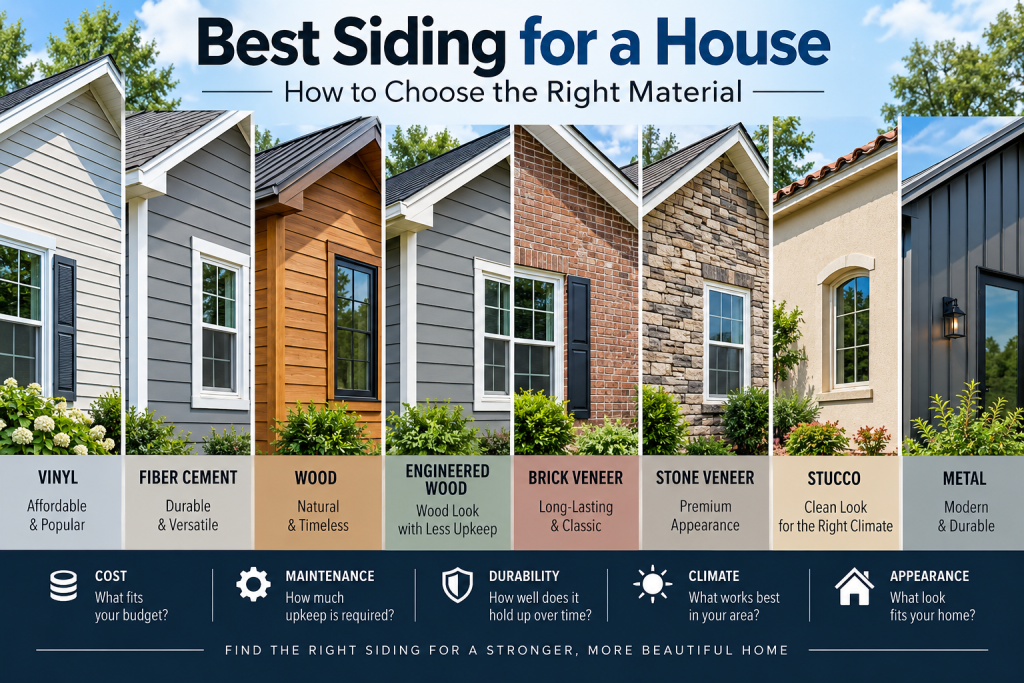
| Siding Material | Cost Level | Maintenance | Durability | Best Fit For | Main Tradeoff |
|---|---|---|---|---|---|
| Vinyl | Low–Moderate | Low | Good | Budget-conscious, low-upkeep projects | Impact and heat sensitivity |
| Fiber cement | Moderate–High | Low–Moderate | Very good | Durability with a painted-wood look | Weight and installation complexity |
| Wood | Moderate–High | High | Good with upkeep | Authentic natural appearance | Ongoing finish and moisture maintenance |
| Engineered wood | Moderate | Moderate | Good–Very good | Wood appearance with less upkeep | Moisture details still matter |
| Brick veneer | High | Low | Very good | Long-term masonry exterior | Cost and specialized installation |
| Stone veneer | High | Low–Moderate | Very good | Premium masonry appearance | Cost and water-management details |
| Stucco | Moderate | Moderate | Good–Very good | Seamless finishes and suitable climates | Cracking and moisture concerns |
| Metal | Moderate–High | Low–Moderate | Very good | Modern designs and durable exteriors | Dents, corrosion considerations, and cost |
No column tells the whole story. A lower-cost siding that fits your maintenance expectations can be a better purchase than a premium material whose upkeep, appearance, or installation needs do not suit the house.
For a broader overview of the major materials before narrowing your choices, see our guide to the different types of house siding and how they compare.
Best Siding for a Tight Budget
For homeowners focused on keeping the initial project cost manageable, vinyl siding is usually one of the first materials worth pricing. It combines relatively low material cost with low routine maintenance and is widely available in different colors, profiles, and textures.
Vinyl also avoids painting, staining, rot, and termite damage. Its limitations include the potential for cracking from impacts, movement from temperature changes, and heat-related distortion under certain conditions. Product quality and proper installation matter.
Engineered wood may also deserve consideration when a homeowner wants a more substantial painted-wood appearance without moving directly to traditional wood or masonry. Its price position varies by product and region.
Standard vinyl generally costs less than insulated vinyl. Insulated vinyl adds rigid foam to the back of the cladding, making it a more specialized choice for homeowners who want that construction rather than simply the lowest-cost siding.
A tight budget should not mean choosing on material price alone. Removing old siding, repairing damaged sheathing, replacing flashing, working around complex architectural features, and addressing trim can affect the project substantially.
If vinyl is on your shortlist because of price, our vinyl siding cost guide breaks down material, labor, installation, and the factors that can raise the final project total.
Best Siding for Low Maintenance
Several siding families can keep routine exterior maintenance relatively modest, but low maintenance does not mean no maintenance.
Vinyl requires no repainting and cannot rot. Routine care primarily involves cleaning and checking for cracked, loose, or damaged panels.
Fiber cement can also have relatively low upkeep, particularly when purchased with a durable factory-applied finish. Painted fiber cement may eventually need refinishing, and joints, penetrations, clearances, and surrounding details still need inspection.
Brick veneer requires little surface maintenance compared with painted siding. Mortar joints, sealant transitions, flashing, and drainage openings may still need attention as the house ages.
Many metal siding systems also require limited routine upkeep. Coatings and exposed areas should be monitored for damage or corrosion, especially in demanding environments.
Wood sits at the other end of the maintenance scale. Its natural appearance comes with greater responsibility for maintaining paint or stain and catching moisture problems before decay develops.
A practical maintenance grouping looks like this:
- Lower routine upkeep: vinyl, brick veneer, many factory-finished fiber cement products, and suitable metal systems.
- Moderate upkeep: engineered wood, stucco, stone veneer, and field-painted fiber cement.
- Higher ongoing upkeep: traditional wood, especially where weather exposure is severe.
Best Siding for Long-Term Durability
For homeowners placing durability high on the priority list, brick veneer, fiber cement, properly detailed stone veneer, and quality metal systems are all worth investigating.
Brick has a strong record as an exterior masonry material, but a brick veneer wall still depends on flashing, drainage space, weeps, and the wall assembly behind it. The visible brick is only one part of the system.
Fiber cement resists rot and insect damage and is well suited to homeowners who want a durable board or panel product without maintaining natural wood. Many fiber cement products also provide noncombustible exterior cladding.
Metal avoids rot and insect damage and can provide a long-lasting exterior when the metal, coating, fasteners, and installation are appropriate for the environment. Dents and corrosion deserve consideration when comparing particular systems.
Stone veneer can also provide a durable exterior finish, although natural and manufactured stone products differ. Proper support, flashing, drainage, and transitions are especially important.
Durability should include repairability as well. Ask whether damaged sections can be replaced without dismantling large areas and whether contractors familiar with the material are readily available in your area.
Two popular choices with very different maintenance and durability profiles are compared in detail in our vinyl siding vs. fiber cement guide.
Best Siding for a Wood-Look Appearance
If appearance is the leading priority, start by deciding how much authenticity and maintenance matter.
Natural wood provides real grain, variation, and texture. It can be painted or stained and works with many traditional architectural styles. The tradeoff is greater vulnerability to moisture, decay, insects, and coating failure if maintenance slips.
Engineered wood retains a wood-based construction while offering manufactured consistency and improved resistance to some of traditional wood’s vulnerabilities. It can be a useful middle ground for homeowners who want a convincing painted-wood appearance without choosing solid wood boards.
Fiber cement is available in profiles and textures designed to resemble painted lap siding, shingles, and other traditional materials. Higher-quality vinyl also offers deeper profiles and wood-grain textures, although it remains visually different from genuine wood when inspected closely.
Board-and-batten siding belongs in this appearance discussion because it is a style, not one material. The vertical board-and-batten look can be produced with wood, engineered wood, fiber cement, vinyl, or metal. Choose the material first based on performance and maintenance, then decide whether the vertical style suits the house.
How Climate Changes the Best Siding Choice
Climate does not automatically eliminate most siding materials, but it changes which weaknesses matter most.
Wet or Humid Climates
In wet environments, prioritize moisture tolerance and a wall assembly that can drain and dry.
Fiber cement, vinyl, masonry, stucco, engineered wood, and metal can all be used successfully when the system is designed correctly. Wood-based materials demand particular attention to clearances, coatings, cut edges, and persistent dampness.
No siding makes a wall waterproof by itself. Water that gets behind the exterior cladding needs a controlled path out through properly integrated flashing and a water-resistive drainage layer.
Cold Climates
Cold climates introduce freeze-thaw cycles, snow, ice, and repeated temperature changes.
Moisture management remains essential because trapped water can create problems as temperatures cycle. Some vinyl products can also become more vulnerable to impact damage in cold conditions, making product quality and protection from likely impacts worth considering.
Fiber cement, engineered wood, metal, masonry, and properly maintained wood are all possible choices. What matters is whether the specific product and wall assembly are designed for the local exposure.
Insulated vinyl siding may interest homeowners in colder areas because rigid foam is attached behind the vinyl panels. It can contribute some continuous insulation, but it should be evaluated as part of the entire wall rather than treated as a substitute for a properly insulated and air-sealed home.
Homeowners considering vinyl in a heating-dominated climate may also want to compare insulated vinyl siding, which adds foam backing for greater rigidity and modest additional thermal resistance.
Hot and Sunny Climates
Intense sun makes color retention, coating quality, heat movement, and product limitations more important.
Stucco and masonry are familiar choices in many hot regions, while fiber cement and appropriate metal systems can also work well. Vinyl is widely used in warm climates, but installation must accommodate thermal movement, and unusual sources of concentrated heat can damage some products.
Dark colors can place different thermal demands on exterior products than lighter colors. Follow the specific manufacturer’s approved color and installation requirements rather than assuming every profile or coating behaves the same way.
Coastal Areas
Coastal homes combine wind-driven rain, salt exposure, strong winds, and often intense sun.
For metal siding, do not judge products simply as “steel” or “aluminum.” Base metal, coating system, exposed edges, compatible fasteners, distance from saltwater, and manufacturer coastal restrictions all matter. A system suitable inland may not be the right specification near salt spray.
Other siding materials still depend on corrosion-resistant fasteners, appropriate flashing, good drainage, and wind-rated installation. Coastal conditions make the entire exterior assembly important.
Wildfire-Prone Areas
Where wildfire exposure is a serious concern, noncombustible or ignition-resistant exterior materials deserve special consideration. Fiber cement, stucco, brick, masonry, and properly designed metal assemblies may be parts of a more fire-resistant exterior strategy.
That does not make any siding choice a complete wildfire solution. Windows, vents, roofs, decks, fences, vegetation, gaps, and ember entry points can all affect vulnerability. Local wildfire requirements and the complete wall assembly should guide the decision.
Best Siding for Homeowners Staying Long Term
A homeowner expecting to stay for many years may reasonably give more weight to maintenance demands and repair logistics than someone planning a shorter ownership period.
Think beyond how the new siding looks immediately after installation. Consider whether it will need periodic painting or staining, how easily individual damaged pieces can be repaired, and whether specialized contractors will still be needed for future work.
Long-term ownership can make durable materials such as masonry, fiber cement, and metal attractive despite higher initial costs. It can also make traditional wood perfectly reasonable for someone who values its appearance enough to accept the upkeep.
Availability matters as well. A theoretically excellent material becomes less convenient if experienced installers and repair contractors are difficult to find locally.
How Much Should Cost Influence the Decision?
Cost should narrow your choices, but it should not be the only filter.
The siding material itself is only one part of a replacement project. Other potential costs include:
- Removal and disposal of existing siding
- Repairs to sheathing or other wall components
- Flashing and water-management improvements
- Trim and accessory work
- Labor rates in your region
- Multiple stories or difficult access
- Corners, windows, gables, and complex wall shapes
- Future painting or other maintenance
This is why a simple low-to-high material ranking cannot predict the final cost of a particular house.
It is also useful to separate upfront affordability from long-term ownership cost. A lower-cost material with little routine finishing can fit one homeowner well, while another may willingly spend more initially for masonry, fiber cement, metal, or another material that better matches long-term priorities.
Questions to Ask Before Choosing Siding
Before requesting final quotes, use a short checklist to eliminate options that do not fit the project.
- What is my realistic total project budget?
- How much exterior maintenance am I willing to take on?
- Which weather conditions are hardest on my house?
- Do I want a painted surface, stained wood, masonry, or a factory-finished exterior?
- How important is an authentic wood or stone appearance?
- How concerned am I about impact damage, rot, insects, corrosion, or fire exposure?
- Are experienced installers for this material available locally?
- Can isolated damage be repaired without disturbing large areas?
- Is the existing wall dry and structurally sound?
- Are HOA, historic-district, or neighborhood restrictions involved?
- How long do I expect to own the house?
After answering those questions, most homeowners can reduce the field substantially without trying to identify one material that wins every comparison.
Why Installation Quality Matters as Much as Material
Even the best siding for a house can perform poorly when the wall behind it is not managed correctly.
Exterior cladding should work with a water-resistive barrier and properly integrated flashing so water that passes the siding can drain back outside. Windows, doors, roof-to-wall intersections, utility penetrations, and transitions between materials deserve particular attention.
The siding itself also has material-specific requirements for fasteners, spacing, joints, clearances, trim, and movement. Those instructions are part of the system, not optional finishing details.
New siding should not simply conceal an unresolved leak, wet sheathing, rot, or damaged wall components. If existing siding removal exposes significant water damage, the underlying cause needs to be identified before the wall is covered again.
Older homes can also present hazardous materials. Some older cementitious siding may contain asbestos and should not be cut, drilled, sanded, broken, removed, or otherwise disturbed when asbestos is suspected. Older painted siding and trim may contain lead and require appropriate lead-safe practices when work will disturb the coating.
When to Get Professional Estimates
Professional estimates are especially useful when you are comparing a whole-house replacement rather than a small isolated repair. They allow you to see how different materials affect labor, trim, flashing, wall preparation, and other project-specific work.
Get qualified contractors involved early when the house has multiple stories, complex gables or wall shapes, masonry cladding, heavy siding products, extensive trim changes, or signs of moisture damage behind the existing siding.
The most useful estimates clearly describe the proposed siding system and the work required underneath it. That makes it easier to compare two or three realistic material choices instead of comparing prices that include different scopes of work.
Final Thoughts
There is no universal best siding material. Vinyl can make sense when affordability and low upkeep lead the decision; fiber cement, masonry, and metal can appeal to homeowners prioritizing durability; wood emphasizes authentic appearance; and engineered wood, stucco, stone veneer, and specialized options fill other useful roles.
Start with your budget, climate, maintenance tolerance, appearance preferences, and expected ownership period. Narrow the list to two or three siding families that genuinely fit the house, then compare the specific products and installation proposals available in your area.