
water coming up through a basement floor: causes and next steps
When you see water coming up through basement floor areas, the water may be moving through a crack, joint, penetration, or the slab itself as groundwater rises beneath the house. But water can also travel from the basement perimeter, leak from plumbing or appliances, or collect as condensation and make the floor look like the source.
Start by noting exactly where the moisture first appears and when it happens. Those clues can narrow the cause before you consider any repair.
Do not enter standing water if outlets, wiring, appliances, sump equipment, or other electrical components may be energized. Do not touch electrical equipment that is wet or has been submerged. Water that may contain sewage should be treated as contaminated, not as ordinary groundwater.
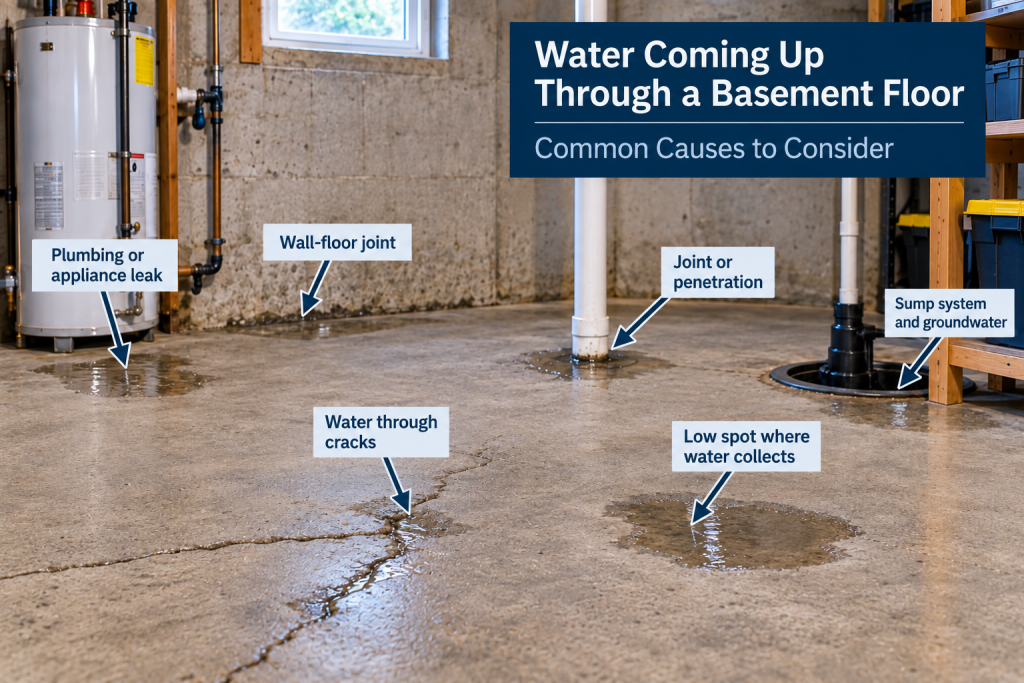
| Where or when water appears | Possible cause | Useful clue |
|---|---|---|
| Floor cracks after prolonged rain | Rising groundwater or saturated soil | Follows wet-weather pattern |
| Wall-floor perimeter | Water reaching foundation perimeter | Begins at edge rather than slab center |
| Around a pipe or floor penetration | Water following an opening | Concentrated around one location |
| Low spot in middle of floor | Water traveling across slab | First visible point may not be entry point |
| Near water heater, washer, piping, or drain | Plumbing or appliance leak | May occur without rain |
| Thin dampness during humid weather | Condensation | Surface moisture without obvious entry path |
What Water Coming Up Through a Basement Floor Can Mean
A basement slab is not always a completely watertight barrier. Depending on how the house was built and current conditions around it, moisture may reach the basement through cracks, construction joints, openings around pipes, or gaps at the slab perimeter.
In some cases, water may also migrate through porous concrete as moisture rather than appearing as a clear stream.
The visible location can be misleading. Basement floors are rarely perfectly level, so water entering at one point may travel across the slab and collect in a low area. A puddle in the middle of the room does not necessarily mean water entered directly beneath that puddle.
That is why diagnosis should focus on where the water starts, not simply where the largest amount accumulates.
Why Prolonged Rain and Snowmelt Matter
Water that appears after several hours or days of rain often points toward changing soil and groundwater conditions around the foundation.
As soil becomes saturated, it has less capacity to absorb additional water. Groundwater around and beneath the house may rise. Seasonal snowmelt can create a similar effect, especially when melting occurs rapidly or the ground is already wet.
Water beneath a basement floor can exert upward pressure on the slab and seek available paths into the basement.
This is commonly described as hydrostatic pressure. At a homeowner level, it simply means that water in saturated ground creates pressure against below-grade walls and floors. Cracks, joints, and openings can become pathways when water levels are high enough.
A leak that appears only after prolonged wet periods therefore tells you something different from moisture that occurs on dry days as well.
One storm does not always reveal the full pattern. The amount of previous rainfall, soil saturation, snowmelt, and groundwater conditions can all affect whether water reaches the basement.
Where Floor Water May Be Entering
Through cracks in the slab
Cracks provide an obvious route for water when groundwater or saturated soil conditions develop beneath the basement.
A crack does not automatically indicate a structural problem. Concrete can crack for several reasons. What matters diagnostically is whether water repeatedly appears along the crack and whether the slab shows other concerning changes.
Watch for displacement, significant widening, uneven slab sections, or other movement. Those conditions deserve professional evaluation rather than a DIY crack repair.
Do not assume that filling the visible crack will correct the moisture source. If pressure or excess water remains below the floor, the underlying condition still needs to be understood.
Through joints and penetrations
Basement slabs can contain joints as well as openings around pipes, drains, columns, or other penetrations.
Water may use these boundaries because they interrupt the continuous slab surface. Look for a clearly defined wet ring, line, or recurring path around one of these locations.
Before concluding that groundwater is responsible, make sure the pipe or fixture itself is not leaking.
At the wall-floor joint
Water appearing where the basement wall meets the floor can look like water rising through the slab, but it is a different diagnostic pattern from water emerging through the middle of the floor.
The wall and floor are separate parts of the foundation assembly, and the perimeter can become an entry path when water accumulates around the foundation.
If the first wetness consistently follows the basement edge, treat that as an important clue. Do not assume the slab itself is leaking simply because the water eventually spreads across the floor.
Through the middle of the floor
Water that clearly originates at a floor crack, joint, or penetration well away from the walls puts more attention on conditions beneath the slab.
This pattern becomes more significant when several floor locations become wet during the same prolonged rain or snowmelt event.
A single wet low spot, however, is less conclusive. Water can travel surprisingly far across a smooth floor before collecting where you notice it.
How an Existing Sump or Drainage System May Relate
If your basement already has a sump pit or foundation drainage system, its behavior during wet weather can provide another clue.
A sump pump that runs much more frequently after prolonged rain suggests that the drainage system is receiving increased groundwater or foundation drainage. That does not by itself mean anything is wrong with the pump.
More concerning signs include a sump pit rising faster than the system can manage, water appearing on the floor even while the system is operating, or a pump that is not operating when the pit level rises.
Limit homeowner checks to safe observations. Do not reach into a wet sump, handle electrical connections while standing on a wet floor, or work on energized equipment.
If the pump, receptacle, wiring, or controls have been exposed to flooding, have the electrical condition evaluated appropriately before continued use.
This article does not cover sump installation or below-slab drainage design. If the existing system cannot manage recurring groundwater, a basement drainage or waterproofing professional can evaluate why.
If a sump pump is part of the system, our guide on how to test a sump pump explains how to verify basic automatic operation safely before heavy rain.
Rule Out Plumbing and Appliance Leaks
Not every wet basement floor is a groundwater problem.
Before tying the symptom to the foundation, look at nearby water sources. These may include:
- Water-supply piping
- Water heaters
- Washing machines and hoses
- Utility sinks
- Condensate drains
- Plumbing fixtures above the basement
- Floor drains and nearby drain piping
Timing can help. Water that appears during dry weather, after running a fixture, or when an appliance operates may point toward plumbing instead of groundwater.
If practical, dry the area and observe where moisture first returns without opening walls or dismantling equipment.
A plumber is the appropriate next call when the pattern follows plumbing use, a supply line is leaking, drainage is backing up, or the source cannot be safely accessed.
If the water has an odor, contains waste, or may be connected to a sewer backup, avoid contact and use professional cleanup and plumbing help.
Could It Be Condensation Instead?
Condensation can sometimes make a basement floor look as though moisture is seeping upward.
Warm, humid air can contact a cool concrete slab and leave the surface damp. This is more likely to appear as general dampness or a thin film of moisture rather than water actively flowing through a crack.
Clues favoring condensation include:
- Moisture appearing during humid weather without rain
- Broad surface dampness instead of a distinct entry point
- Similar condensation on cold pipes or other cool surfaces
- No obvious relationship to cracks, joints, or groundwater conditions
A dehumidifier can help with excess airborne humidity, but it will not stop groundwater entering through the floor.
If moisture repeatedly follows heavy rain or snowmelt and begins at a defined opening, groundwater or seepage deserves more attention than condensation.
Simple Homeowner-Safe Observations
You do not need to open the slab to gather useful information.
When conditions are safe, document:
- The first place water becomes visible
- Whether it starts at the perimeter or farther into the floor
- Whether a crack, joint, drain, or penetration is involved
- How long after rain or snowmelt the water appears
- Whether the sump system is operating differently
- Whether nearby plumbing or appliances were recently used
- Whether the water spreads toward a low spot
Photographing the same locations during several events can reveal a pattern that is hard to recognize from memory.
Also note whether the problem is isolated or widespread. One recurring wet spot around a penetration suggests a different problem from water emerging through several cracks and perimeter areas during the same storm.
Why Floor Paint or Sealer May Not Solve the Problem
A surface coating can be useful for certain concrete-floor purposes, but it should not be treated as a cure for significant water pressure beneath a basement slab.
Paint, epoxy, or a basement floor sealer applied to the visible surface does not remove saturated soil, lower groundwater, or correct a drainage problem below the floor.
If water repeatedly enters through cracks, joints, or the slab, diagnose the moisture source before choosing a coating. Otherwise, continued moisture can undermine the intended finish or simply find another available path.
Likewise, do not make structural crack repair a DIY experiment when the slab shows meaningful displacement, movement, or other foundation concerns.
If water is entering because of a larger moisture-control problem, compare the main basement waterproofing options before treating the slab surface as the primary fix.
When Professional Evaluation Makes Sense
The type of professional depends on the pattern you find.
A basement drainage or waterproofing professional may be appropriate when water repeatedly follows prolonged rain or snowmelt, appears through multiple slab locations, overwhelms an existing sump system, or seems related to elevated groundwater.
A plumber is appropriate when the moisture follows fixture or appliance use, appears near supply or drain piping, or may involve sewage.
A foundation or structural professional should evaluate significant slab movement, displaced cracks, changing cracks, or other signs that the issue involves more than moisture alone.
An electrician should be involved when water has reached electrical equipment, wiring, receptacles, controls, or appliances. Do not enter standing water to reach a breaker or disconnect if doing so could expose you to energized equipment.
Recurring or substantial water coming up through basement floor areas deserves more than a surface repair. The goal is to determine why water is reaching the slab and which system needs attention before damage becomes more extensive.
Final Thoughts
Start diagnosing floor water by identifying exactly where it first appears and what was happening beforehand. Water at the perimeter, through a floor crack, around a penetration, or in a low spot can point toward different causes, while timing after prolonged rain or snowmelt makes groundwater conditions more likely.
Rule out plumbing leaks and condensation before assuming every wet slab has the same cause. If water repeatedly enters through the floor, an existing drainage system cannot keep up, or structural or electrical concerns are present, move from observation to the appropriate professional evaluation rather than trying to seal over the symptom.