What size dehumidifier do i need for a basement?
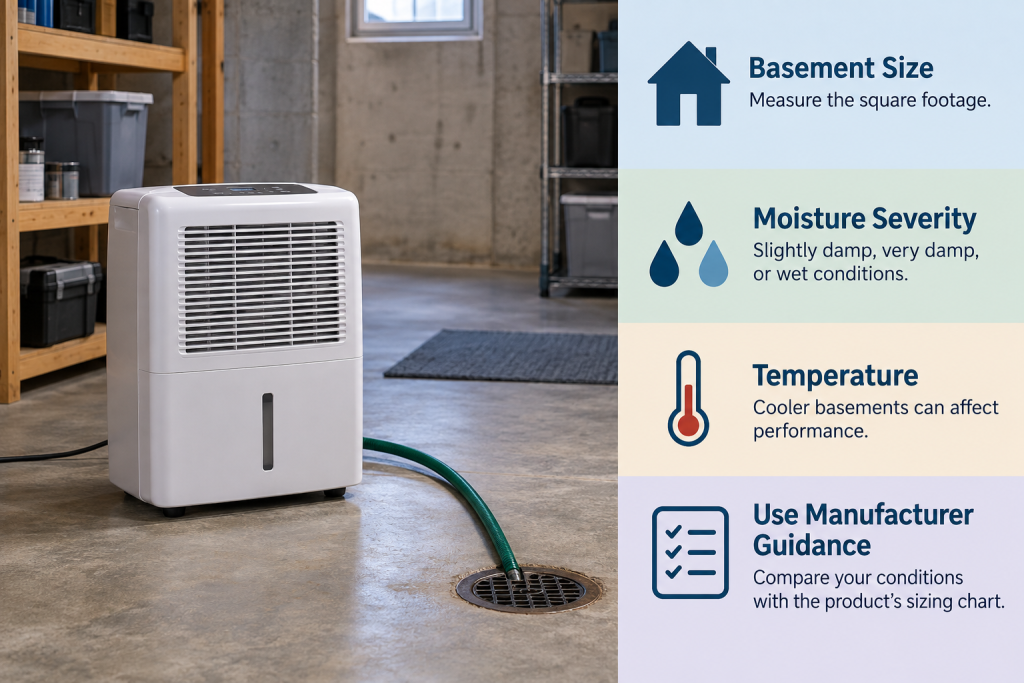
Homeowners asking “what size dehumidifier for basement use do I need?” should start with three factors: basement square footage, moisture severity, and typical temperature. A larger or wetter basement generally needs more moisture-removal capacity, but square footage alone does not determine the right size.
For current portable dehumidifiers, capacity is normally stated as the number of pints of water the unit can remove in 24 hours under standardized test conditions. Use that rating as a starting point, then check the manufacturer’s sizing chart for the specific model you are considering.
Do not operate a dehumidifier in standing water or where outlets, cords, appliances, or other electrical equipment have become wet. If the basement has active flooding, correct the water source and address electrical safety before using drying equipment.
| Basement condition | Current general capacity starting point |
|---|---|
| Slightly to moderately damp, under 2,000 sq. ft. | About 20–30 pints/day |
| Very damp, under 2,000 sq. ft. | About 25–40 pints/day |
| Wet conditions, under 2,000 sq. ft. | About 30–50 pints/day |
| More than 2,000 sq. ft. | Often 30+ to 50+ pints/day depending on severity |
These are general sizing ranges, not a universal formula. Manufacturers may rate coverage differently, so confirm your choice against current product documentation.
What Dehumidifier Capacity Actually Means
A dehumidifier’s capacity tells you how much moisture it can remove from the air in 24 hours under specified test conditions.
A 35-pint unit is rated to remove more moisture than a 20-pint unit under the same conditions, but that does not mean it will collect exactly 35 pints from your basement every day.
Actual moisture removal varies with temperature, relative humidity, air circulation, the humidity setting, and how much moisture is entering or stored in the space.
Capacity is therefore best used for comparing units, not predicting exactly how much water will appear in the bucket.
Why Square Footage Alone Is Not Enough
Two basements with the same floor area can have very different moisture loads.
A finished, relatively warm 1,000-square-foot basement that becomes slightly humid in summer may need much less capacity than a cool masonry basement of the same size that regularly feels damp.
That is why sizing should combine square footage with moisture severity. Basement temperature and room layout can also affect how well one unit performs.
How to Decide What Size Dehumidifier for Basement Use
Start by measuring the area, then classify how damp the basement becomes without dehumidification.
Step 1: Measure the basement floor area
For a rectangular basement, multiply length by width.
A basement measuring 30 feet by 40 feet is:
30 × 40 = 1,200 square feet.
For an irregular basement, divide the floor into simple rectangles, calculate each area separately, and add the results.
Measure the area you expect the unit to serve. If the basement is divided into several closed rooms, total square footage may not accurately reflect how well one portable dehumidifier can control humidity throughout the space.
Step 2: Judge the moisture severity
Consider the basement under normal conditions without dehumidification.
Slightly to moderately damp: The basement may feel damp or develop a musty odor during humid weather, but surfaces generally remain dry.
Very damp: The space regularly feels damp, and you may find persistent moisture on some walls or floors without standing water.
Visibly wet: Condensation or obvious surface moisture is common, creating a heavier moisture load.
If “wet” means liquid water is actively entering through a wall, floor, crack, window, plumbing leak, or other opening, a dehumidifier is not the repair. Correct the source of the water first.
Step 3: Compare the result with current sizing guidance
For spaces under about 2,000 square feet, current general guidance uses approximately:
- 20–30 pints per day for slightly to moderately damp conditions
- 25–40 pints per day for very damp conditions
- 30–50 pints per day for wet or high-moisture conditions
For spaces above 2,000 square feet, capacity generally moves toward 30 pints or more for moderate moisture, 40 or more for very damp conditions, and 50 or more for heavier moisture loads.
Treat these numbers as starting ranges rather than automatic purchase rules.
Step 4: Check the manufacturer’s chart
Once you know the basement area and moisture level, compare them with the manufacturer’s current sizing guidance for the model you are considering.
If your basement falls near the upper end of a recommended range, the next appropriate capacity may provide useful reserve during humid weather. Do not assume that buying the largest unit available is automatically better.
If you are still comparing which type of unit to buy, our guide to the best dehumidifier for basement use explains the key features, drainage options, controls, and performance factors to consider.
Why Old and New Pint Ratings Can Be Confusing
Portable dehumidifier ratings changed after the U.S. Department of Energy revised the test procedure.
Current units are tested at cooler conditions than under the older method. Because cooler air contains less removable moisture, a newer dehumidifier may carry a lower pint-per-day rating even when its practical capability is similar to an older model with a larger number.
As a rough comparison, older 70-pint units corresponded to about 40–45 pints per day under the newer procedure, while an older 50-pint rating was roughly comparable to about 30 pints.
These are approximate comparisons, not exact conversions for every model.
When replacing an older dehumidifier, do not assume you need the same pint number printed on the old unit. Compare new products using current ratings.
Cooler Basement Temperatures Can Change Performance
Basements are often cooler than upstairs living spaces, which matters for refrigerant-style portable dehumidifiers.
Current standardized testing uses a 65°F condition that better represents basement use than the warmer conditions used under the older procedure.
At cooler temperatures, frost can form on the coils of some units. Defrost controls may temporarily stop moisture removal while the fan continues operating, reducing effective performance.
If your basement routinely stays below about 65°F, check the manufacturer’s specified operating-temperature range before buying. Do not assume that choosing a larger pint capacity will solve poor low-temperature performance.
Open Basements and Divided Rooms Need Different Thinking
One portable dehumidifier can usually serve an open basement more effectively than several isolated rooms.
A unit placed in a central room may control that area well while humidity remains higher behind closed doors.
Before sizing one unit for the entire basement, consider whether doors stay open, whether air moves freely between rooms, and whether one area has a much heavier moisture load.
Several separated rooms may require better air circulation or more than one dehumidification point rather than a single oversized portable unit.
A Bigger Dehumidifier Does Not Fix Water Intrusion
Sizing applies to excess moisture in the air. A larger dehumidifier does not correct:
- Rainwater seeping through basement walls
- Groundwater coming through the floor
- Standing water
- Plumbing leaks
- Water entering around windows
- Major exterior drainage problems
- A failing foundation drainage or sump system
A dehumidifier can help control humidity after a minor moisture source has been corrected, but it should not substitute for repairing active water entry.
Persistent liquid water can overwhelm even a high-capacity unit and may create additional concerns involving building materials, mold, and electrical equipment.
If the basement has active seepage or recurring water entry, see our basement waterproofing options guide before relying on a larger dehumidifier to solve the underlying problem.
Why Long Runtime Does Not Automatically Mean the Unit Is Too Small
A dehumidifier may run for long periods when first started because walls, concrete, wood, and furnishings can continue releasing stored moisture as humidity drops.
Long runtime may also occur during unusually humid weather.
Before deciding the unit is undersized, check for other causes such as open doors or windows, active water entry, poor airflow, very low humidity settings, or cool conditions that trigger frequent defrost cycles.
Runtime is more useful when considered alongside actual humidity readings and basement conditions.
Signs Your Dehumidifier May Be Too Small
A unit may be undersized if the basement remains too humid even when there is no active water intrusion and operating conditions are within the manufacturer’s limits.
Possible signs include:
- Humidity remains consistently above the selected setting
- The unit runs nearly continuously without gaining control
- Musty conditions persist throughout an otherwise closed basement
- Humidity improves near the unit but remains high across a large open space
- Normal seasonal humidity repeatedly overwhelms the unit
Before replacing it, rule out leaks, unusually cold temperatures, restricted airflow, and other conditions that can make an adequately sized unit appear too small.
Continuous Drainage and Capacity
Higher-capacity units can collect substantial amounts of water under humid conditions. If the bucket fills, many portable dehumidifiers stop removing moisture until it is emptied.
Continuous drainage usually means connecting a drain hose to the dehumidifier and routing that hose directly to a basement floor drain or another gravity-drain location approved by the manufacturer. For gravity drainage to work, the hose must slope downward from the dehumidifier, and the drain point must be lower than the dehumidifier’s drain outlet.
Keep the hose free of kinks and route it where it will not create a trip hazard. Follow the manufacturer’s instructions for the specific unit and drain location.
Continuous drainage does not increase moisture-removal capacity. A 35-pint unit remains a 35-pint unit. Continuous drainage only removes the need to empty the collection bucket manually.
Drainage method is therefore separate from capacity sizing. First determine how much moisture-removal capacity you need, then decide whether continuous drainage suits the location.
Do not use extension cords merely to reach a convenient installation point. Keep electrical connections away from water, and do not operate equipment that has been flooded or electrically compromised until it has been properly evaluated.
Practical Basement Dehumidifier Sizing Checklist
Before buying, confirm:
- The basement’s approximate square footage
- Whether conditions are slightly damp, very damp, or heavily moisture-loaded
- Whether active seepage, leaks, or standing water must be corrected first
- Typical basement temperatures during dehumidifier season
- The model’s approved operating-temperature range
- Whether the basement is open or divided into isolated rooms
- The manufacturer’s current sizing recommendation
- Whether you are comparing current rather than older pint ratings
- Whether the unit can operate in a safe location with adequate airflow and electrical access
- Whether frequent water collection makes continuous drainage useful
If several of these answers are uncertain, measure the basement and monitor its humidity and temperature before buying. That will give you better sizing information than square footage alone.
Final Thoughts
The answer to what size dehumidifier for basement use you need depends on both the area being dried and the amount of moisture the unit must remove. For basements under about 2,000 square feet, current general guidance spans roughly 20 to 50 pints per day as conditions move from moderately damp to heavily moisture-loaded, but the manufacturer’s current sizing chart should guide the final choice.
Also account for basement temperature and room layout. If liquid water is actively entering the basement, correct that source first rather than trying to compensate with a larger dehumidifier.