
best dehumidifier for a basement: what to look for before you buy
The best dehumidifier for basement use is not necessarily the largest model on the shelf. The right choice depends on how damp the basement gets, how cool it stays, how the unit will drain, how much maintenance you are willing to handle, and whether noise matters in the space.
Start with drainage and operating conditions before comparing convenience features. Most importantly, remember that a dehumidifier controls moisture in the air. It does not repair active wall seepage, water coming through the floor, plumbing leaks, or standing water.
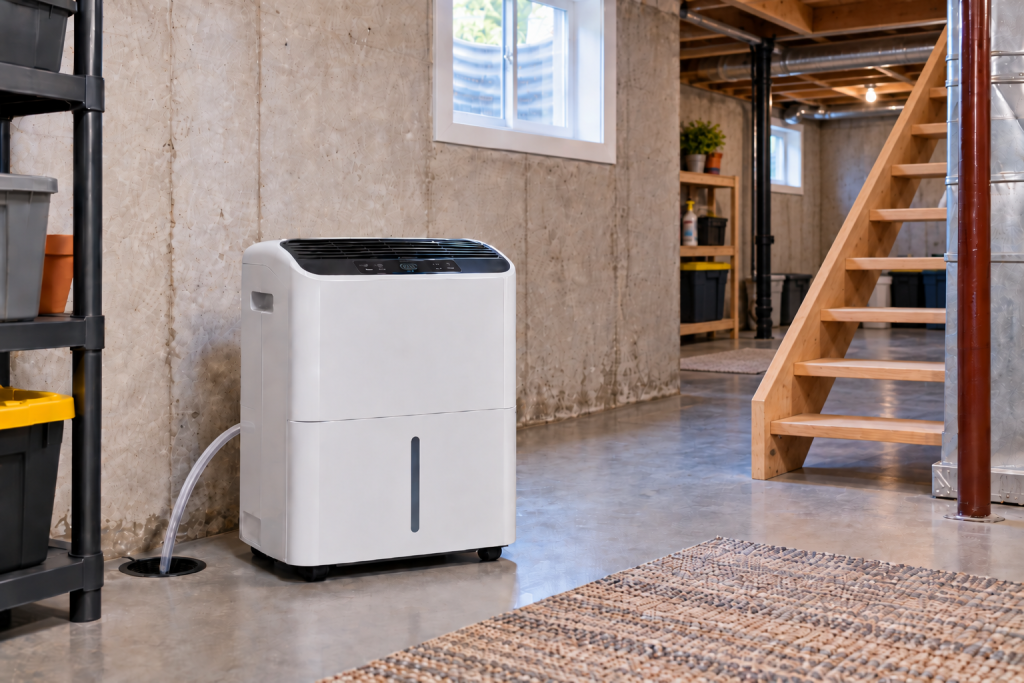
What Makes a Dehumidifier Suitable for a Basement?
Basements can present different operating conditions than finished rooms above grade.
They may stay cooler, experience heavier seasonal humidity, or require a dehumidifier to run for longer periods. An unfinished utility basement may also make continuous drainage easy, while a finished basement may put more emphasis on noise and appearance.
The most useful buying factors are:
- Moisture conditions
- Capacity appropriate for the space and moisture load
- Basement temperature
- Bucket, gravity-drain, or pump drainage
- Humidity controls
- Energy efficiency
- Noise
- Placement options
- Filter and drain maintenance
Do not assume every basement needs the same feature set. A small finished basement with moderate summer humidity may need something very different from a large basement that stays damp for much of the year.
Confirm That Humidity Is Actually the Problem
Before buying, measure the basement’s relative humidity with a hygrometer.
EPA guidance recommends keeping indoor relative humidity below 60%, ideally around 30% to 50% where practical. Condensation on cool pipes or other surfaces, clammy air, and consistently elevated humidity readings can all support the case for dehumidification.
But visible water changes the decision.
A dehumidifier may reduce the humidity created by water intrusion, but it does not correct:
- Active wall seepage
- Water entering through the floor
- A plumbing or appliance leak
- Recurring standing water
- Exterior drainage or foundation water-entry problems
If the basement has those symptoms, identify and correct the moisture source rather than expecting a dehumidifier to serve as the repair.
If you are not sure whether excess moisture is really a humidity problem, see our guide to basement humidity for target levels, common causes, and ways to monitor conditions.
Capacity Matters, but Do Not Overbuy Blindly
Dehumidifier capacity describes how much moisture a unit can remove under specified test conditions, commonly expressed in pints per day. Current U.S. ratings use standardized Department of Energy test procedures, and capacity must be considered alongside the size and moisture conditions of the space.
For basement buying, the important point is simple: capacity needs to match the actual job.
Consider:
- Approximate basement size
- Whether the space feels slightly damp or persistently wet
- Typical humidity levels
- Basement temperature
- How often the dehumidifier is likely to run
Do not choose solely by the largest capacity number you can find. A dedicated basement-sizing guide is the better place to work through the detailed capacity calculation.
For a closer look at matching capacity to basement size and moisture conditions, see our guide on what size dehumidifier for basement use you need.
Choose the Drainage Method Before You Buy
Drainage is one of the most important practical differences between basement dehumidifiers.
A unit that performs well but requires an inconvenient bucket trip twice a day may become frustrating very quickly.
| Drainage option | Best use | Main advantage | Main limitation |
|---|---|---|---|
| Bucket | Occasional or moderate use | Simple setup | Requires regular emptying |
| Gravity drain | Continuous use near a suitable drain | Little routine water handling | Drain must be lower than the outlet |
| Built-in pump | No convenient lower drain point | Can move water upward to an approved discharge point | Adds cost, complexity, and maintenance |
Bucket-only drainage
Portable dehumidifiers commonly collect water in a removable bucket. Many models shut off automatically when the bucket is full, preventing normal operation until it is emptied. ENERGY STAR buying guidance identifies removable buckets and full-bucket shutoff as common features of portable units.
Bucket drainage can work well when:
- Humidity is moderate
- The unit runs seasonally
- Someone regularly uses the basement
- Emptying the bucket is convenient
It becomes less attractive when the basement produces large amounts of condensate or the house may be unattended for extended periods.
Gravity-drain dehumidifiers
Many portable units can drain continuously through a hose.
Gravity drainage can eliminate routine bucket emptying, but water must have a suitable downhill path to the drain. Hose routing should also avoid kinks, obstructions, electrical equipment, and trip hazards.
Before buying, confirm that the manufacturer’s drain connection and installation instructions fit the location you intend to use.
If the only suitable drain is higher than the dehumidifier’s outlet, gravity drainage alone will not move the water uphill.
Built-in pump dehumidifiers
A pump-equipped model can be useful when condensate must be lifted to reach a suitable discharge point.
This can provide more placement flexibility than a gravity-only setup, especially when no convenient lower drain is nearby.
The tradeoff is additional equipment to maintain. Pump operation, hose requirements, allowable lift, and discharge arrangements vary by model, so check the current manufacturer’s specifications rather than assuming every pump-equipped unit works the same way.
Do not improvise electrical or plumbing changes to accommodate the machine. If safe drainage or power requires work beyond ordinary setup, use the appropriate professional.
If your basement already has persistent water entry rather than ordinary humidity, compare the main basement waterproofing options before relying on a dehumidifier as the primary solution.
Pay Attention to Basement Temperature
Cooler basement temperatures can affect dehumidifier performance.
Refrigerant-based portable dehumidifiers cool air below its dew point so moisture condenses on a coil. Under sufficiently cool conditions, frost can develop on the coil and interfere with moisture removal.
ENERGY STAR specifically advises shoppers with cooler spaces to check whether a model is designed for lower-temperature operation and notes that some units include automatic frost-control features.
Rather than relying on a generic temperature claim, check the manufacturer’s rated operating-temperature range for the exact model.
An automatic defrost or anti-frost function is especially worth considering if your basement regularly stays cool.
Look for a Useful Humidistat and Controls
An adjustable humidistat allows you to choose a target relative humidity instead of running the machine without feedback.
Once the target is reached, a properly functioning controlled unit can cycle as needed rather than simply operating continuously. ENERGY STAR-certified portable dehumidifiers include built-in humidistats under current program guidance.
Useful controls may include:
- Adjustable humidity setting
- Digital humidity display
- Automatic cycling
- Full-bucket shutoff
- Automatic restart after a power interruption, where offered
- Timer functions
The humidity setting and automatic cycling affect day-to-day operation more than a decorative display or extensive menu system.
A separate hygrometer can also be useful for checking conditions away from the machine.
How to Choose the Best Dehumidifier for Basement Drainage
For many homeowners, drainage should narrow the shopping list before smart features, appearance, or extra modes enter the discussion.
Choose bucket drainage when the moisture load is manageable, and you do not mind emptying the container.
Choose gravity drainage when the dehumidifier can sit close to a suitable lower drain, and you want continuous operation with minimal water handling.
Choose a built-in pump when continuous drainage is important, but gravity cannot carry the water to the intended discharge point.
This decision also affects placement. Before buying, picture exactly where the machine will sit, where the water will go, and whether the route works without unsafe cords or hoses crossing the space.
Noise and Placement Matter in Finished Basements
Noise may be a minor concern in an unfinished utility basement and a major one in a basement office, bedroom, media room, or family space.
Dehumidifiers use a fan and refrigeration equipment, so sound is unavoidable. If noise matters, compare published sound information when manufacturers provide it, but do not assume numbers from different products were measured under identical real-world conditions unless the test method is clear.
Placement affects performance too.
The unit needs adequate airflow at its intake and exhaust. Follow the manufacturer’s placement instructions rather than assuming a universal wall-clearance distance.
Also consider:
- Whether doors divide the basement into separate rooms
- Whether furniture blocks airflow
- How easily the filter can be removed
- Access to the bucket or drain connection
- Whether the drainage hose creates a trip hazard
A centrally located machine may serve an open basement more effectively than one tucked into an isolated corner, provided the manufacturer’s airflow requirements are met.
Consider Energy Use for Long Runtime
A basement dehumidifier may operate for many hours during humid periods, so efficiency matters.
Current ENERGY STAR requirements use Integrated Energy Factor, or IEF, as the efficiency metric for dehumidifiers. A higher IEF indicates more water removed per unit of electricity under the test procedure.
ENERGY STAR states that certified dehumidifiers use more efficient components to remove moisture while using less energy than comparable non-certified models.
When comparing otherwise suitable units, efficiency certification can therefore be a useful buying factor.
Do not assume that buying the largest available machine automatically produces the lowest operating cost. Matching capacity to conditions, using a reasonable humidity setting, and preventing unnecessary moisture from entering the basement all affect runtime.
Make Maintenance Easy Enough That You Will Actually Do It
A dehumidifier depends on unrestricted airflow and reliable water removal.
Before buying, look at how easily you can reach:
- The air filter
- The bucket
- The drain connection
- The intake and exhaust
- The pump components, if applicable
Filters may be washable or replaceable depending on the model. Follow the manufacturer’s cleaning and replacement schedule.
For continuous drainage, periodically inspect the hose for kinks, blockage, movement, or leaks. Pump-equipped systems may have additional maintenance requirements.
Good service access matters more than it may seem in a product listing. A feature is less valuable if normal maintenance requires moving heavy furniture or disconnecting an awkward installation.
Features Worth Paying For
Not every basement needs every option, but several features can solve genuine operating problems.
| Feature | Why it matters | Most useful for |
|---|---|---|
| Continuous drain | Reduces bucket emptying | Frequent operation |
| Built-in pump | Helps where gravity drainage is impractical | Basements without a lower nearby drain |
| Adjustable humidistat | Controls toward a chosen humidity level | Almost any regular-use setup |
| Automatic defrost | Helps manage cool operating conditions | Cooler basements |
| Auto restart | Restores operation after some outages | Unattended or frequent-use areas |
| Easy filter access | Simplifies maintenance | Every regularly used unit |
| Full-bucket shutoff | Prevents normal operation with a full bucket | Bucket users |
| Wheels or handles | Makes repositioning easier | Multi-use or storage spaces |
Choose features because they solve a condition in your basement, not because the control panel has more buttons.
Features That May Be Optional
Wi-Fi controls, phone apps, elaborate displays, remote controls, and smart-home integration can be convenient.
They should usually come after the essentials.
A connected unit with poor drainage options or unsuitable operating conditions is still the wrong machine. Prioritize capacity, drainage, temperature compatibility, humidity control, service access, and efficiency before convenience technology.
Portable Versus More Permanent Dehumidification
Portable room dehumidifiers are self-contained units designed to operate within the space being dehumidified. They are usually the simplest choice when one basement or open area needs humidity control.
Larger basement- or crawlspace-oriented equipment may offer different drainage, airflow, or installation options.
Whole-home dehumidifiers are designed to work with ducting and can serve multiple areas rather than one room. ENERGY STAR distinguishes portable and whole-home equipment as separate product types.
Ducted or HVAC-integrated dehumidification should be properly sized and installed. Do not treat it as an ordinary portable-appliance setup.
When a Dehumidifier Is Not the Real Solution
Do not buy a larger dehumidifier to compensate for an unresolved water problem.
A dehumidifier does not repair:
- Wall seepage
- Water entering through floor cracks or joints
- Plumbing leaks
- Failed exterior drainage
- Standing water
- Foundation water intrusion
It may lower the humidity those problems create, but source correction still matters.
Standing water near electrical equipment also requires particular caution. Do not enter water around energized electrical components or create temporary extension-cord arrangements to operate a dehumidifier in a wet area.
If the basement smells musty even when humidity is being controlled, our guide on how to get rid of musty smell in basement spaces can help you trace the underlying moisture source.
What to Check Before You Buy
Before choosing a model, write down the conditions it actually needs to handle:
- Approximate basement size
- Typical humidity or dampness severity
- Typical basement temperature
- Whether a suitable continuous drain is available
- Whether gravity drainage will work
- Whether a built-in pump would solve a real drainage problem
- Acceptable noise level
- Available placement and airflow
- Filter and bucket accessibility
- Humidistat and control needs
- Energy-efficiency information
- Manufacturer support and warranty terms
Then compare models against that list rather than shopping by capacity, price, or feature count alone.
Final Thoughts
The best basement dehumidifier is the one matched to the basement’s actual conditions. Capacity matters, but drainage, temperature compatibility, humidity controls, energy use, noise, placement, and maintenance can determine whether a unit works well in everyday use.
Confirm that excess airborne humidity is the problem first. Then choose the drainage method and operating features that fit the space. If the basement has active seepage, standing water, or another ongoing water source, correct that problem instead of asking a dehumidifier to do a job it was never designed to handle.