hardwood floor cupping: causes and what it means
Hardwood floor cupping means the edges of a hardwood board sit higher than its center. It usually indicates that the underside of the board contains more moisture than the top, although the source of that moisture can vary.
Cupping is a symptom, not the underlying cause. Before considering sanding or board replacement, look for leaks, moisture below the floor, humidity changes, wet subflooring, or installation conditions that could be creating the imbalance.
| What you notice | Likely cause | What it suggests | What to check |
|---|---|---|---|
| Mild cupping across a large room | Seasonal humidity or broad moisture change | Environmental conditions may be affecting many boards | Whether the pattern changes seasonally |
| Cupping near dishwasher or refrigerator | Appliance or supply-line leak | Moisture may have reached beneath the boards | Leak history and damp materials nearby |
| Cupping above a crawl space | Moisture from below | Board undersides may be exposed to higher moisture | Crawl-space dampness or condensation |
| Cupping after plumbing leak | Water beneath flooring | Surface may dry before the floor system does | Subfloor and surrounding materials |
| Cupping plus damp subfloor | Ongoing moisture imbalance | Cause extends below the hardwood | Source and condition of subfloor |
| Cupping that improves seasonally | Environmental moisture changes | Some movement may be reversible | Seasonal pattern and room conditions |
| Severe cupping remaining after drying | Permanent deformation may be present | Later repair may be needed | Whether moisture has fully stabilized |
| Raised board centers after sanding | Crowning | Floor may have been sanded before stabilizing | Moisture history and previous refinishing |
If cupping followed a leak involving wet appliances, receptacles, cords, or other electrical equipment, do not handle wet electrical components. Keep clear of the affected area and get qualified help when energized equipment may be involved.
What Hardwood Floor Cupping Looks Like
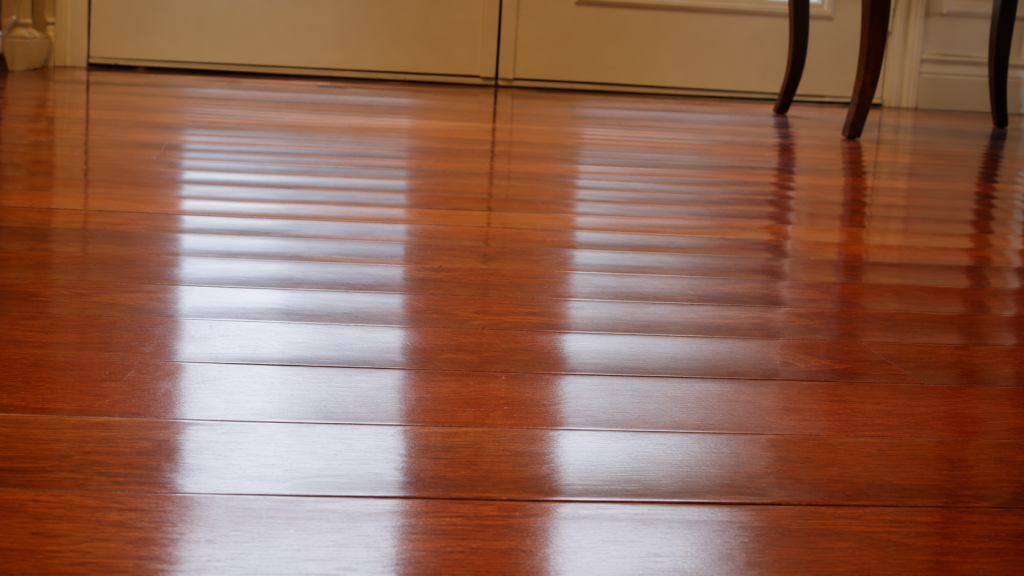
Cupping changes the shape of individual boards across their width.
The edges sit higher than the center, creating a shallow curved profile. Depending on lighting, the floor may show alternating highlights and shadows that make the distortion more noticeable.
Cupping can affect:
- A few boards near a moisture source
- One section of a room
- Most of a room
- Several rooms exposed to similar conditions
Two related symptoms are worth distinguishing.
Crowning
Crowning is the opposite shape. The center of the board sits higher than the edges.
Buckling
Buckling is more severe movement in which boards lift substantially away from the subfloor.
Cupping, crowning, and buckling can all involve moisture, but they describe different board shapes and should not be treated as interchangeable.
Why Moisture Causes Hardwood to Cup
Wood changes dimensions as its moisture content changes.
When the underside of a hardwood board contains more moisture than the top, the lower portion can expand more. That uneven expansion can bend the board so its edges rise.
This does not mean every cupped floor has standing water underneath it. The moisture difference may result from a leak, damp subfloor, crawl-space conditions, high indoor humidity, or conditions present when the flooring was installed.
Finding that source is more important than immediately trying to flatten the boards.
Common Causes of Hardwood Floor Cupping
Several moisture conditions can create cupping.
Common causes include:
- Plumbing leaks
- Dishwasher or refrigerator leaks
- Wet plywood or OSB
- Crawl-space moisture
- Basement moisture
- High indoor humidity
- Moisture moving upward from below
- Poor moisture conditions before installation
- Inadequate acclimation
- Environmental conditions outside flooring requirements
The location and timing of the damage can help narrow the possibilities.
Cupping concentrated near one appliance points toward a different cause than mild cupping appearing across an entire floor during a humid season.
Cupping After a Water Leak
A leak can wet the underside of hardwood without leaving the top surface visibly wet for long.
Water may travel:
- Between boards
- Beneath the flooring
- Into plywood or OSB
- Under cabinets
- Toward walls
The visible hardwood may dry before the materials underneath.
That is why cupping can appear or remain after the original leak has been stopped.
If the floor cupped after a plumbing or appliance leak, check for continued moisture, damp trim, subfloor concerns, or other signs that water traveled farther than the visible spill area.
If the cupping began after a plumbing or appliance leak, our guide to hardwood floor water damage explains what to check before making repair or refinishing decisions.
Cupping From Moisture Below the Floor
Sometimes the room itself appears dry while the underside of the hardwood is exposed to higher moisture.
Possible sources include:
- Damp plywood or OSB
- Crawl-space humidity
- Basement moisture
- Ground moisture
- Plumbing below the floor
- Moisture migrating upward through the floor system
This type of problem may affect a broad area rather than just one board.
A persistent moisture difference from below can keep the floor cupped even when the room above seems comfortable.
Treat the hardwood shape as a clue to investigate the moisture source rather than a problem that can be solved at the surface alone.
Crawl-Space and Basement Moisture
Floors above crawl spaces and basements can be affected by conditions below them.
Possible clues include:
- Cupping concentrated above the same lower-level area
- Musty conditions below
- Damp wood
- Wet insulation
- Condensation
- Seasonal worsening
These signs do not identify the exact cause by themselves, but they make below-floor moisture more likely.
Do not focus only on the hardwood. If the lower area remains damp, the floor may continue responding even after cosmetic repairs.
Crawl-space, basement, drainage, or structural moisture problems may require qualified evaluation rather than a flooring-only repair.
Can High Indoor Humidity Cause Cupping?
Yes, but the pattern matters.
High indoor humidity can raise the moisture content of hardwood throughout a room. Mild cupping may sometimes appear when humid conditions persist.
Pronounced cupping, however, often points toward a meaningful difference between moisture at the top and bottom of the boards.
Consider humidity together with:
- Season
- HVAC operation
- Floor location
- Moisture below the floor
- Recent leaks
- Flooring manufacturer requirements
Do not assume humidity is the cause simply because the weather is humid. A plumbing leak or wet subfloor can create a similar symptom.
Can Hardwood Cupping Be Seasonal?
Some mild seasonal cupping can occur.
Wood floors may change slightly as indoor moisture conditions shift throughout the year. If mild cupping appears during humid periods and improves when normal conditions return, the floor may be responding to seasonal moisture.
Repeated severe cupping deserves more attention.
If the boards deform substantially every year, remain cupped for long periods, or the condition worsens, investigate whether excessive moisture is coming from the room, subfloor, crawl space, basement, or another source.
Seasonal does not necessarily mean harmless when the deformation is pronounced.
Will Cupped Hardwood Flatten Again?
Sometimes.
Improvement is more likely when:
- The moisture source is corrected
- Exposure was limited
- Boards remain structurally intact
- Moisture equalizes gradually
- The subfloor dries appropriately
Mild cupping can lessen considerably as the floor stabilizes.
Cupping is more likely to remain when:
- Moisture exposure was severe
- Boards stayed wet for a long period
- Board edges or fasteners were damaged
- The wood has permanently deformed
- Underlying moisture continues
Avoid expecting a fixed recovery timeline. Hardwood, subfloor construction, room conditions, and the amount of moisture involved all affect how the floor responds.
Do Not Sand a Cupped Floor Too Soon
Do not use sanding as the first response to a newly cupped floor.
Cupped boards may flatten partially as moisture conditions return toward normal. While the boards are still curved, their edges sit higher than their centers.
Sanding at that stage removes extra material from the raised edges.
If the boards later flatten, the previously sanded edges may end up lower than the centers. The floor can then develop a crowned profile instead.
Before considering refinishing:
- Identify the moisture source
- Correct the moisture problem
- Allow the floor system to stabilize
- Determine whether the remaining deformation is permanent
Refinishing should address stable flooring, not wood that is still changing shape.
Hardwood Cupping vs Crowning
The difference is simple.
Cupping
The edges of the board are higher than the center.
Crowning
The center is higher than the edges.
Crowning can develop from different moisture conditions, but it may also occur when a cupped floor is sanded before the wood has stabilized.
That is one reason diagnosis and patience matter before refinishing a cupped floor.
Hardwood Cupping vs Buckling
Cupping usually means the board remains generally attached to the floor while curving across its width.
Buckling involves more dramatic movement. Boards may lift away from the subfloor or lose their normal attachment.
Buckling generally suggests a more severe problem and warrants closer evaluation of moisture, attachment, and the materials underneath the hardwood.
If the boards are lifting substantially away from the subfloor rather than simply curving across their width, see our guide to hardwood floor buckling.
Cupping in Solid vs Engineered Hardwood
Both solid and engineered hardwood can deform when moisture conditions are unfavorable.
Solid hardwood
Solid wood can experience substantial dimensional movement as its moisture content changes.
Engineered hardwood
Layered construction generally improves dimensional stability, but engineered flooring can still cup, distort, or delaminate when exposed to enough moisture.
Product construction, installation method, and environmental conditions all matter.
Do not assume engineered hardwood is immune to moisture-related deformation.
What Homeowners Can Check
A simple observation-based inspection can provide useful clues.
Check:
- Where the cupping occurs
- Whether it is localized or widespread
- Whether a recent leak occurred
- Whether nearby walls or baseboards are damp
- Whether the floor is above a crawl space or basement
- Whether boards move underfoot
- Whether the condition changes seasonally
- Whether musty odors or damp materials are present below
- Whether the floor is improving, stable, or worsening
Avoid destructive inspection just to confirm a suspected cause.
If older flooring, tile, sheet goods, mastics, or adhesives may contain asbestos, do not sand, scrape, grind, cut, drill, or demolish suspect materials. Obtain appropriate evaluation or testing before they are disturbed.
Signs the Problem Is More Serious
Closer evaluation is appropriate when you find:
- Severe cupping
- Cupping across several rooms
- Wet or soft subflooring
- Persistent moisture below the floor
- Buckling
- Loose boards
- Structural movement or sagging
- Strong persistent musty odor
- Visible rot
- Extensive mold growth
- Continued deformation after the moisture source is corrected
These conditions suggest the issue may extend beyond a cosmetic surface problem.
Common Mistakes
Avoid these responses to a cupped floor:
- Sanding immediately
- Assuming the finish caused the problem
- Treating the board shape without finding the moisture source
- Assuming the floor is dry because the top feels dry
- Forcing boards flat
- Applying excessive heat
- Covering wet subflooring
- Ignoring crawl-space or basement moisture
- Replacing boards before correcting the cause
- Disturbing suspect older flooring or adhesive without considering asbestos
The lasting fix depends on correcting the moisture condition first.
Questions to Ask About Hardwood Floor Cupping
Before deciding what to do, ask:
- When did the cupping begin?
- Is it localized or widespread?
- Was there a recent leak?
- Is the floor above a crawl space or basement?
- Are walls or baseboards damp?
- Does the condition change by season?
- Is the subfloor wet?
- Are boards loose?
- Is buckling present?
- Is the floor solid or engineered hardwood?
- Was the floor recently installed?
- Is the deformation improving, stable, or worsening?
These answers can help separate mild environmental movement from a more significant moisture problem.
When Professional Evaluation Makes Sense
A mildly cupped board does not automatically require professional repair.
Qualified evaluation makes sense when there is:
- Severe or widespread cupping
- An unknown moisture source
- Cupping after a large leak
- Persistent subfloor moisture
- Crawl-space or basement moisture problems
- Buckling or loose boards
- Structural movement
- Significant subfloor damage
- Visible rot
- Extensive mold growth
- No improvement after moisture conditions are corrected
- A recently installed floor with possible acclimation or installation issues
- Suspected asbestos-containing flooring, mastic, or adhesive
A flooring professional can evaluate the hardwood itself, while plumbing, moisture, structural, crawl-space, or hazardous-material specialists may be more appropriate when the source lies elsewhere.
Final Thoughts
Hardwood floor cupping means the edges of the boards are higher than their centers, usually because moisture is affecting the underside differently from the top. The key decision is not how to flatten the boards immediately, but where the moisture is coming from and whether the condition is still changing.
Some cupping improves after the source is corrected and the floor stabilizes. Severe or persistent deformation may require later repair, but sanding should wait until moisture conditions are understood and the flooring has stopped changing shape.