
grout keeps cracking: causes and what to do
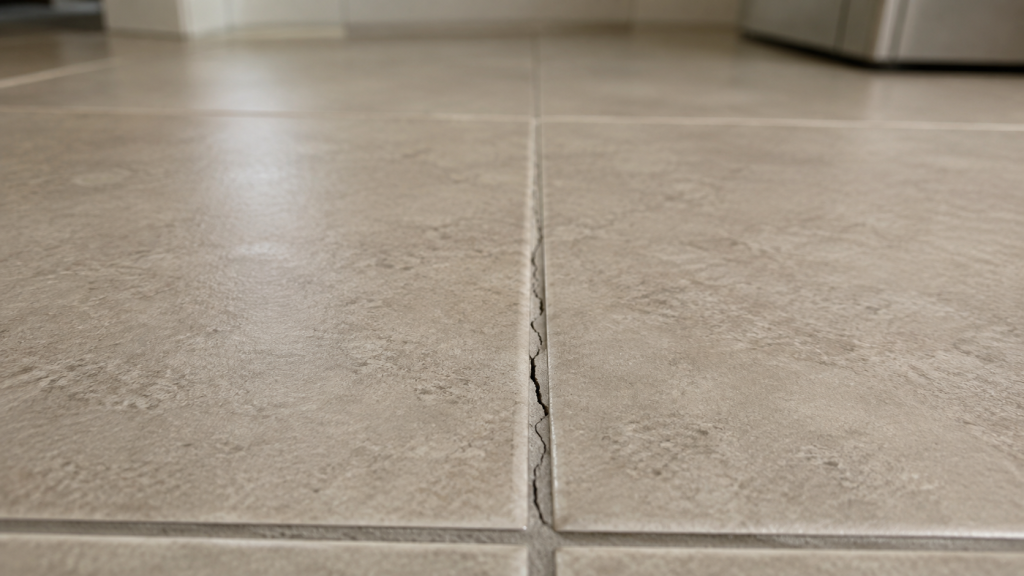
If your grout keeps cracking in the same place, the grout itself may not be the main problem. Weak grout installation can cause failure, but repeated cracking often points to movement in the tile, subfloor, substrate, or surrounding floor assembly.
Replacing cracked grout without correcting loose tile, floor flex, substrate movement, expansion stress, or moisture can lead to another failure. Before regrouting, look at the crack pattern and whether the nearby tile is moving, lifting, sounding hollow, or showing other damage.
| What you notice | Possible cause | How concerning? | What to check |
|---|---|---|---|
| One thin stable grout crack | Minor shrinkage or isolated defect | Usually low | Whether tile remains stable |
| Grout repeatedly cracking in same joint | Ongoing movement | More concerning | Tile movement and floor flex |
| Several joints cracking in a straight line | Substrate or floor movement | Concerning | Whether tile cracks follow the same path |
| Grout crumbling or powdering | Weak grout or installation problem | Depends on extent | Whether many stable joints are affected |
| Grout cracking beside loose tile | Tile movement or bond failure | Concerning | Whether tile rocks or shifts |
| Grout beside hollow-sounding tile | Possible support or bond difference | Sometimes | Whether the tile also moves |
| Grout cracking around lifting tile | Physical movement or expansion stress | Concerning | Whether lifting is spreading |
| Cracks near doorway or transition | Concentrated movement or stress | Sometimes | Whether the same location repeatedly fails |
| Cracks plus noticeable floor movement | Subfloor or structural movement | High concern | Bounce, softness, sagging, loose tile |
If tile is loose, lifting, or broken, avoid walking directly on unstable areas where sharp edges or trip hazards are present.
Older flooring, mastics, adhesives, or underlayments may contain asbestos. Do not sand, grind, scrape, cut, drill, or demolish suspect materials before appropriate evaluation or testing.
Why Grout Cracks
Cured grout is rigid. It works well between stable tiles, but it does not tolerate repeated movement.
Possible causes of cracked floor grout include:
- Tile movement
- Floor flexing
- Substrate movement
- Poor grout installation
- Excess water during mixing or cleanup
- Inadequately filled joints
- Movement at transitions
- Expansion stress
- Moisture-related changes below the tile
- Loose tile
A grout crack does not automatically mean the floor has a structural problem.
One isolated hairline crack may be a minor installation defect. Several recurring cracks beside moving tile suggest a different problem entirely.
One Small Grout Crack vs Repeated Cracking
The history of the crack matters.
One small stable crack
A single crack may result from:
- Minor shrinkage
- A local grout defect
- Small isolated movement
If the crack remains unchanged and the surrounding tile is firm, the issue may be mostly cosmetic.
Recurring grout crack
If the same joint is repaired and cracks again, investigate what is moving.
Possible causes include:
- Loose tile
- Substrate movement
- Floor flex
- Expansion pressure
- Moisture
- Movement between adjoining materials
Repeated failure is a stronger diagnostic clue than one isolated crack.
Why Grout Keeps Cracking in the Same Spot
Repeated cracking in the same location usually means the joint is being stressed again after every repair.
Possible causes include:
- A loose tile
- A flexing floor
- A substrate seam or crack
- Movement between different materials
- Repeated stress near a doorway
- Expansion pressure
- Moisture-related movement
- A localized installation problem
If new grout repeatedly cracks in the same place, stop treating grout replacement as the entire repair.
New grout is still rigid. If the floor or tile beneath it continues moving, the repaired joint is exposed to the same stress and may simply crack again.
Tile Movement: A Common Cause
Grout sits between rigid tiles. If one tile moves independently from the next, the grout joint can be repeatedly pulled, compressed, or twisted.
Clues include:
- Tile rocking underfoot
- Vertical tile movement
- Grout separating from one tile edge
- Cracks returning around the same tile
- Clicking or shifting when stepped on
A moving tile needs diagnosis before another grout repair.
Regrouting may temporarily hide the gap, but it will not restore the tile’s bond or support.
Floor Flexing and Deflection
A floor that bends noticeably under load can stress both tile and grout.
Possible signs include:
- Grout cracks in traffic paths
- Several joints fail in the same area
- The floor feels bouncy
- Tile cracks are also present
- Cracks follow a repeating panel or framing pattern
This does not mean every small grout crack indicates structural failure.
However, noticeable sagging, softness, or substantial floor movement deserves qualified evaluation rather than repeated cosmetic grout repair.
Grout Cracking Over a Wood Subfloor
Wood-framed floors can move as plywood, OSB, framing, and other materials respond to loads and moisture.
Possible contributors include:
- Plywood or OSB movement
- Panel seams
- Inadequate floor stiffness
- Moisture-damaged wood
- Underlayment problems
- Installation assembly issues
Grout cannot compensate for a supporting floor that flexes excessively.
If grout cracking occurs with tile movement, bounce, softness, or repeated failure along the same line, investigate the supporting floor before repairing the joint again.
Grout Cracking Over Concrete
Concrete can also move and crack.
Possible contributors include:
- Slab cracking
- Shrinkage
- Settlement or movement
- Installation conditions
- Moisture-related problems
- Movement transferring through the tile assembly
A straight line of grout cracks, especially when tile is also cracked, may sometimes follow movement below the surface.
That pattern does not prove foundation failure. It does mean the underlying condition deserves more attention than a one-joint grout defect.
Cracked Grout Beside a Loose Tile
Loose tile is stronger evidence of movement than the grout crack itself.
If a tile rocks, shifts, or moves vertically, regrouting alone is unlikely to last.
The bond or support beneath the tile should be evaluated before the grout is treated as the primary problem.
This is especially important when the same joint has already been repaired more than once.
Cracked Grout Beside a Hollow-Sounding Tile
A hollow sound alone does not prove that a tile has failed.
Some stable tiles sound different because support or mortar contact varies beneath them.
The hollow sound becomes more relevant when it appears with:
- Tile movement
- Grout cracking
- Lifting
- Repeated failure
If the tile remains solid and the crack is stable, the condition may only need monitoring. Movement changes that decision.
If the tile sounds hollow but does not move, our guide to hollow sounding tile explains when the sound can be monitored and when it suggests a bond or support problem.
Grout Cracking Around Lifting or Tented Tile
Tile that is lifting or tenting is already moving physically.
Grout around those tiles may crack because:
- Tiles are pressing against one another
- Bond has failed
- Expansion pressure is present
- Supporting materials are moving
Do not simply regrout around lifted tile.
The cause of the lifting needs to be corrected first, or the new grout is likely to fail again.
If the tile itself is rising or tenting, see our guide to floor tile lifting for the likely causes and what to check before repairing the grout.
Grout Cracking With Cracked Floor Tile
When a crack continues through both grout and tile, movement beneath the finished surface becomes more likely.
A continuous line can sometimes reflect:
- A substrate crack
- A concrete slab crack
- A panel seam
- Floor movement
This does not automatically mean the structure is failing.
The pattern simply suggests that the crack may be transferring through the tile assembly rather than originating in the grout alone.
Grout Crumbling or Turning Powdery
Cracking and crumbling are not always the same problem.
Grout that becomes weak or powdery may be related to:
- Weak grout
- Installation or mixing problems
- Excess water
- Inadequately filled joints
- Deterioration
- Repeated movement
If grout is deteriorating across many joints while the tiles remain stable, grout quality or installation may be more relevant than one localized movement problem.
If the crumbling is concentrated around moving tiles, movement becomes more important.
Grout Separating From the Tile Edge
A narrow crack along one side of a grout joint can result from several conditions.
Possible causes include:
- Tile movement
- Shrinkage
- Weak grout within the joint
- Movement between adjoining materials
Check whether the tile itself moves.
Repeated separation along the same side of the same tile makes ongoing movement more likely than a one-time cosmetic defect.
Grout Cracking Near Doorways and Transitions
Doorways and floor transitions can concentrate stress because different materials, traffic patterns, and floor assemblies meet in a small area.
Possible factors include:
- Heavy foot traffic
- Changes in floor construction
- Different substrate materials
- Movement between adjoining areas
- Transition stress
A single small crack may be minor.
Repeated failure at the same doorway or transition deserves diagnosis before the joint is repaired again.
Movement Accommodation and Perimeter Stress
Buildings and tile assemblies undergo small dimensional changes.
Rigid grout should not be expected to absorb all movement within a large tiled area.
Stress can develop near:
- Room perimeters
- Long tile runs
- Transitions
- Changes in substrate
- Fixed objects
Do not cut grout or tile at a perimeter based only on a guess about expansion.
Movement details vary by installation, and the actual cause should be understood before the floor is altered.
Can Moisture Cause Grout to Crack?
Moisture can contribute indirectly.
It may affect:
- Plywood or OSB
- Underlayment
- Bonding materials
- Other supporting layers
Possible clues include:
- A recent plumbing leak
- Damp baseboards
- A soft floor
- New tile movement
- Swollen wood substrate
- Repeated cracking after water exposure
Correct active moisture problems before making cosmetic grout repairs.
Moisture that continues changing the supporting floor can cause newly repaired grout to fail again.
Can You Just Regrout the Cracked Area?
Sometimes.
A localized grout repair may make sense when:
- Tile does not move
- The floor feels solid
- The crack is isolated
- No moisture problem is present
- The joint has not repeatedly failed
- Nearby tile and grout remain stable
Regrouting alone is less likely to last when:
- The same joint repeatedly cracks
- Tile moves
- The floor flexes
- Tile is lifting
- Tile itself is cracked
- Moisture remains
- A broader movement pattern is present
The stability of the tile assembly should determine whether regrouting is a repair or merely a temporary cosmetic patch.
Why Regrouting Sometimes Fails Again
Fresh grout does not eliminate movement.
If the underlying problem remains, the repaired joint experiences the same stress that cracked the old grout.
Repeated failure can indicate:
- Tile remains loose
- The substrate continues moving
- Moisture is still affecting the floor
- Expansion stress remains
- The wrong type of repair was used for a movement location
Repeated grout replacement can hide the symptom briefly without solving its cause.
What Homeowners Can Check Safely
Use observation rather than destructive inspection.
Check:
- Is one joint cracked or many?
- Does the same joint keep failing?
- Does nearby tile move?
- Is any tile cracked?
- Is tile lifting?
- Does a nearby tile sound hollow?
- Does the floor feel soft or bouncy?
- Was there a recent leak?
- Does the crack follow a straight line?
- Is the problem near a doorway or transition?
- Is grout crumbling throughout the floor?
- Is the affected area spreading?
These clues can help distinguish a grout-quality issue from a movement problem.
Signs the Problem May Be More Serious
Further evaluation makes sense when you notice:
- Repeated cracking in the same location
- Several grout joints failing
- Loose or moving tiles
- Cracked tiles
- Lifting or tenting
- Noticeable floor movement
- Sagging
- Soft supporting material
- Persistent moisture
- Long straight cracking patterns
- Widespread deterioration
These symptoms suggest more than a simple grout defect.
Common Mistakes
Avoid these common responses:
- Regrouting the same moving joint repeatedly
- Assuming every grout crack means bad grout
- Assuming every grout crack means structural failure
- Ignoring loose tile
- Ignoring floor flex
- Regrouting around lifting tile
- Ignoring moisture
- Using a rigid repair while movement remains unresolved
- Demolishing old flooring without considering asbestos-containing materials
Diagnosis before repair gives the new grout a better chance of lasting.
When Professional Evaluation Makes Sense
One small stable grout crack does not automatically require professional repair.
Qualified evaluation becomes more appropriate when there is:
- Recurring cracking after repair
- Multiple loose tiles
- Tile lifting or tenting
- Significant floor movement or sagging
- Soft or damaged subflooring
- Persistent moisture
- Cracks extending through grout and several tiles
- Large straight-line cracking patterns
- Widespread grout failure with no clear cause
- Suspected slab or structural movement
- Suspected asbestos-containing flooring, mastic, adhesive, or underlayment
A flooring professional can assess tile movement and installation conditions. Structural movement, moisture problems, or hazardous materials may require another appropriate specialist.
Final Thoughts
When grout keeps cracking, the most important question is whether the grout itself is weak or whether movement below or around the tile is repeatedly stressing the joint. One stable crack may be cosmetic, while recurring cracks beside loose, lifting, or moving tile deserve a broader diagnosis.
Before regrouting the same area again, check whether the tile and supporting floor are stable and whether moisture or movement is still present. Correcting the cause first is what makes a grout repair more likely to last.