
basement waterproofing options: what homeowners should know before choosing a fix
Basement waterproofing is not a single product or repair. The right approach depends on whether moisture is coming from humid air, rainwater at the foundation, groundwater pressure, a localized opening, or an indoor leak. Some problems may respond to a coating or localized repair, while recurring seepage can require drainage or exterior water-management work.
Before choosing a system, identify the moisture pattern. Otherwise, it is easy to spend money treating the visible symptom while water continues to enter from somewhere else.
If standing water is near outlets, wiring, appliances, a sump system, or other electrical equipment, do not enter the water or touch wet electrical components. Sewage or potentially contaminated water also requires appropriate professional cleanup rather than ordinary basement troubleshooting.
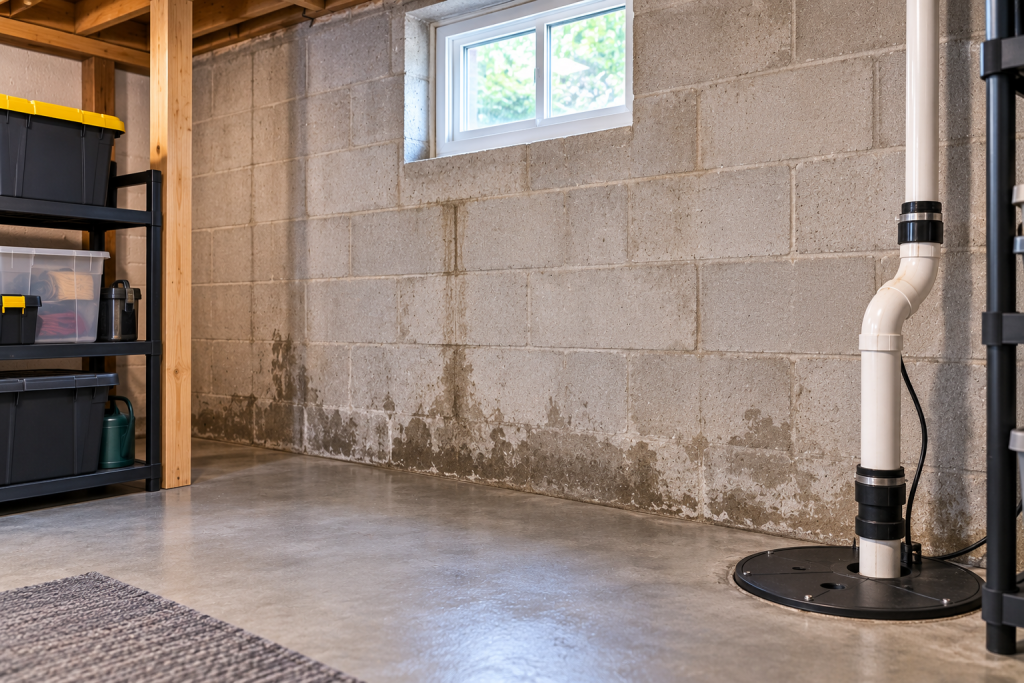
How to Compare Basement Waterproofing Options
Start with where the moisture appears and when it happens.
Condensation across several cool surfaces points toward excess indoor humidity. Dampness that develops after rain may indicate exterior water reaching the foundation. Water appearing through floor joints or low areas after prolonged wet weather can suggest saturated soil or groundwater. One wet spot around a window, penetration, pipe, or crack may have a more localized source.
Those distinctions matter because different approaches solve different problems.
| Approach | Best suited for | Main limitation | DIY or professional tendency |
|---|---|---|---|
| Interior sealer or coating | Certain damp masonry or vapor-control situations | Does not correct major active water entry | Some products may be homeowner-applied |
| Localized crack or joint sealing | Specific, identifiable entry points | Not appropriate for structural movement or broad seepage | Often professional when actively leaking |
| Interior drainage and sump system | Recurring wall-floor or below-slab water | Manages collected water rather than stopping all exterior exposure | Professional |
| Exterior drainage and waterproofing | Water reaching below-grade foundation surfaces | Access, excavation, disruption, and system design | Professional |
| Window-well correction | Water concentrated around basement windows | Only solves the localized entry problem | Varies with cause |
| Humidity control | Condensation and excess airborne moisture | Does not stop liquid water intrusion | Usually homeowner-manageable |
A basement can also have more than one moisture source. For example, seepage may raise indoor humidity, producing condensation in addition to the original water-entry problem.
Interior Basement Waterproofing Approaches
Interior approaches range from surface treatments to systems designed to collect and remove entering water. They should not all be treated as interchangeable forms of “waterproofing.”
Interior sealers and coatings
Masonry sealers and coatings are attractive because they can appear to offer a straightforward way to deal with damp walls.
Their usefulness depends on what is causing the moisture and on the condition of the surface. Some products can be appropriate for particular masonry moisture or vapor-control applications when the substrate and moisture conditions are suitable.
Their limitation is important: a coating on the inside of a wall does not correct saturated soil, failed exterior drainage, groundwater pressure, or another continuing source of bulk water.
If liquid water is actively seeping through masonry, repeatedly wetting the wall-floor joint, or causing coatings to blister or peel, simply adding another coating may not address the underlying problem.
Surface products should therefore be chosen only after determining whether the problem is primarily surface dampness or actual water intrusion.
Crack and joint sealing
A specific crack, joint, pipe penetration, or other small opening can sometimes be the identifiable path by which water enters.
Localized sealing may be part of the solution when the entry point is limited, and the surrounding foundation is otherwise stable. However, identifying a crack as wet does not explain why the crack exists or whether water pressure elsewhere is contributing.
Cracks accompanied by widening, displacement, bowing, shifting, or other signs of foundation movement should not be treated as a basic waterproofing project. Have the foundation evaluated by an appropriate structural or foundation professional.
Structural crack repair is also different from simply sealing a path against moisture. Do not use a waterproofing product as a substitute for evaluating suspected structural movement.
Interior drainage and sump-based systems
When water repeatedly reaches the basement at the wall-floor joint, beneath the slab, or around the perimeter, an interior drainage system may be considered.
At a high level, these systems collect water and direct it toward a sump or other designed discharge method. Instead of relying on an interior wall coating to resist all incoming water, the system provides a controlled path for managing it.
That distinction matters. Interior drainage generally manages water that reaches the foundation area; it does not necessarily prevent exterior soil or foundation surfaces from getting wet.
Major interior drainage installation can involve concrete removal, below-slab work, sump equipment, discharge planning, and electrical considerations. It is therefore professional work rather than an appropriate homeowner waterproofing tutorial.
If an existing sump system is involved, make sure any evaluation of pumps or electrical equipment is performed without entering standing water or working on energized components.
Exterior and Localized Water-Entry Approaches
Sometimes the better strategy is to deal with water before it reaches the inside surface of the foundation.
Exterior drainage and waterproofing
Exterior approaches can include measures intended to keep surface water away from the foundation, provide drainage beside below-grade walls, and protect foundation surfaces from moisture.
This category can become extensive because the appropriate system depends on the foundation, soil, drainage conditions, access, and location of the actual water source.
It can also involve excavation around the foundation. Excavation creates safety concerns and can affect utilities, structures, landscaping, drainage, and access. Major exterior basement waterproofing should therefore be designed and performed by qualified professionals rather than approached as an experimental DIY project.
Exterior work may make more sense when the evidence shows that water is repeatedly reaching a particular below-grade wall and managing it solely from indoors would not address the broader condition.
Before assuming extensive exterior work is necessary, however, check the simpler water-management picture. Roof runoff, grading, downspouts, and surface pooling can contribute to foundation saturation. Those issues have their own repair methods and should be evaluated separately rather than folded into a major waterproofing project automatically.
Window wells and other localized entry points
A wet basement window does not necessarily mean the entire foundation needs waterproofing.
Water collecting in a window well, entering around a window assembly, or appearing at one utility penetration can point toward a localized problem. The appropriate response depends on whether the water is coming from surface runoff, drainage around the well, deterioration at the opening, or another nearby source.
Watch the area during or immediately after rain when it is safe to do so. A repeatable localized pattern can help prevent unnecessary work elsewhere in the basement.
Do not assume that filling a visible gap is sufficient when water continues accumulating outside the opening. The source and drainage pattern still need to be addressed.
If water is collecting around a basement window, see our guide to window well drainage for common pooling causes and the checks that can help narrow the problem.
Humidity Control Is Not the Same as Waterproofing
A humid basement can feel damp without liquid water entering through the foundation.
Warm, moisture-laden air can condense on cooler basement walls, floors, pipes, ducts, and other surfaces. In that situation, humidity control may be more useful than applying a waterproofing coating.
A hygrometer can help distinguish excess airborne moisture from obvious bulk-water entry. Dehumidification, air conditioning, and appropriate moisture control can reduce condensation when humidity is the main problem.
But a dehumidifier is not a basement waterproofing system.
If the wall becomes visibly wet after storms, water enters through a floor joint, or a puddle repeatedly forms in the same area, removing moisture from the air does not correct the source of that liquid water.
The opposite is also possible. A basement with corrected water entry can remain humid enough to need dehumidification. Waterproofing and humidity control solve different parts of the moisture problem and sometimes both are necessary.
Choose the Fix Based on Severity, Access, and Disruption
Once you understand the likely water source, compare solutions based on the actual scope of the problem rather than on which product appears easiest to apply.
Severity matters. Occasional surface dampness is different from recurring flowing water or standing water. The more substantial and persistent the intrusion, the less reasonable it is to rely on a surface treatment alone.
Location matters. One leaking window or penetration may call for a localized solution. Water appearing along much of a wall-floor joint points toward a broader moisture pathway.
Access matters. Exterior foundation work can be complicated by decks, driveways, porches, landscaping, property boundaries, buried utilities, and other obstacles. Interior systems create a different type of disruption.
Finished space matters. Waterproofing work in a finished basement may require access behind wall coverings or flooring before the source and extent of moisture can be understood. Replacing finishes before the moisture problem is corrected can hide recurring damage.
Cost matters, but compare scope as well as price. A lower-cost treatment is not a bargain if it does not address the actual moisture path. Likewise, a large drainage project is difficult to justify when the evidence points to one localized source that can be corrected more directly.
When comparing contractor proposals, make sure you understand what each proposal is intended to accomplish. One contractor may be proposing to block a particular entry point while another is proposing to manage water around a larger portion of the foundation. Those are not necessarily equivalent fixes.
If you are still determining where the water is entering, our guide to water in the basement after rain can help you compare wall, floor, crack, and window-related entry patterns.
When Professional Evaluation Is Appropriate
Professional evaluation becomes particularly useful when the source cannot be confidently identified or when the likely correction exceeds surface-level maintenance.
Arrange appropriate help when you have:
- Recurring standing water
- Substantial or persistent wall seepage
- Water repeatedly entering at the wall-floor joint
- Water apparently rising through the basement floor
- Multiple entry points rather than one localized leak
- A moisture problem that persists despite basic source-control measures
- Standing water near electrical equipment
- Sewage or potentially contaminated water
- Extensive suspected mold growth
- Cracks with displacement, bowing, widening, or other movement
- Conditions likely to require excavation
- A proposed major interior drainage or sump installation
- A proposed exterior foundation drainage or waterproofing system
The right professional depends on the problem. A plumbing leak calls for a plumber rather than a waterproofing contractor. Drainage and foundation-water problems may require a basement waterproofing or drainage specialist. Suspected structural movement requires someone qualified to evaluate the foundation itself.
For larger projects, the most useful evaluation should connect the observed moisture pattern with the proposed solution. Ask what evidence indicates where the water is coming from and how the recommended system addresses that path.
Final Thoughts
Choosing basement waterproofing starts with diagnosis, not with a coating, pump, or drainage system. Interior sealers may have a role in appropriate surface-moisture conditions, localized sealing may address specific entry points, drainage systems can manage recurring water, and exterior approaches may be appropriate when water must be controlled outside the foundation.
Match the response to the source, severity, and location of the moisture. When water is persistent, structural movement is present, or the solution involves major drainage, excavation, electrical exposure, or foundation work, professional evaluation is the safer and more useful next step.