basement floor sealer options: how to choose a treatment for an exposed concrete slab
A basement floor sealer can make an exposed concrete slab easier to maintain, reduce surface dusting, improve stain resistance, or change the floor’s appearance. The right treatment depends on the condition of the concrete, moisture moving through the slab, the finish you want, and whether you may install flooring later.
Do not choose a sealer simply because the basement feels damp. If water is actively entering through slab cracks or joints, recurring on the surface, or creating standing water, diagnose that moisture problem before applying a coating or sealer.
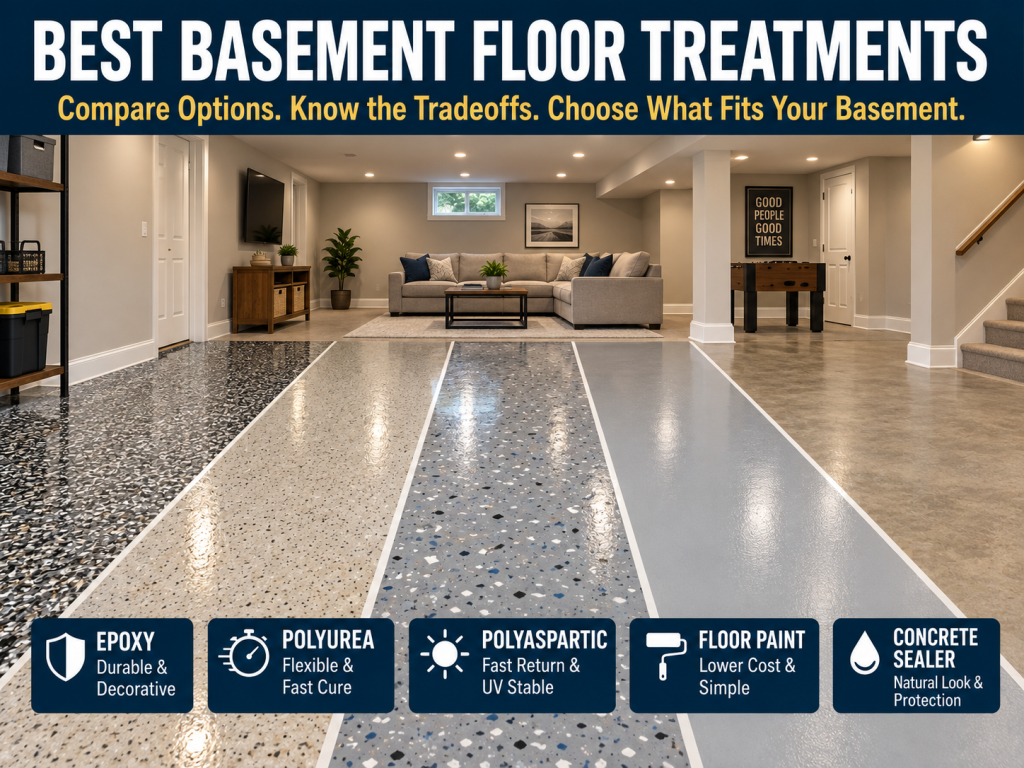
| Treatment type | Best suited for | Typical appearance | Main limitation |
|---|---|---|---|
| Penetrating sealer | Concrete where a natural look is preferred | Little visible film or sheen | Not a decorative coating or cure for active water entry |
| Film-forming sealer | Floors needing a protective surface film | Clear finish from low sheen to glossy | Moisture and adhesion conditions become important |
| Concrete paint or coating | Floors where color and a finished appearance matter | Opaque or decorative finish | Requires compatible, well-prepared concrete |
| No surface treatment yet | Slabs with active seepage or uncertain moisture conditions | Existing concrete | Moisture source should be evaluated first |
Understand the Moisture Before Choosing a Basement Floor Sealer
Basement concrete can receive moisture from several directions. Humid indoor air may condense on a cool slab, water vapor may move through concrete, or liquid water may enter through cracks, joints, or other paths.
These conditions are not interchangeable.
A floor that is merely dusty but otherwise dry may be a good candidate for a straightforward surface treatment. A floor with coatings that repeatedly blister or areas that become wet after prolonged rain requires more investigation.
Watch for:
- Dark or persistently damp areas
- Water at cracks or floor-wall joints
- White mineral deposits
- Previous coating failure
- Condensation beneath objects stored on the slab
- Recurring wet spots after rain or snowmelt
- Standing water
If the slab is actively taking on liquid water, adding another surface product may hide the symptom temporarily without addressing the source.
Some film-forming products are also more sensitive than others to moisture moving through concrete. Excess moisture can interfere with adhesion and contribute to blistering, whitening, or delamination.
Check the specific product’s moisture requirements before buying rather than assuming that anything labeled “concrete sealer” will tolerate basement conditions.
If the slab is showing recurring dampness or active moisture, our damp basement guide can help you separate humidity, seepage, groundwater, and indoor moisture sources before choosing a sealer.
Penetrating Sealers
Penetrating sealers soak into porous concrete rather than creating a thick surface film.
Depending on the formulation, this category can include products based on silanes, siloxanes, siliconates, silicates, or other chemistries. Those products do not all perform the same job, so the chemical family alone should not determine your purchase.
A penetrating treatment may be worth considering when you want:
- A largely natural concrete appearance
- Little or no glossy surface film
- Protection without turning the slab into a visibly coated floor
- A treatment specifically approved for the conditions and use of your basement slab
Because these products work within the concrete rather than leaving a substantial film above it, they generally will not create the look of a painted or decorative coated floor.
They also should not be expected to hide stains, fill cracks, level worn concrete, or stop active groundwater entering through the slab.
Some penetrating sealers are marketed primarily for exterior concrete. Before using one indoors, verify that the manufacturer specifically lists interior horizontal concrete as an approved application.
Film-Forming Sealers
Film-forming sealers create a protective layer on top of the concrete.
Depending on the product, this category can include acrylics, polyurethanes, epoxies, and other resin systems. Their appearance, durability, vapor permeability, maintenance requirements, and application conditions can differ substantially.
A film-forming sealer may make sense when you want:
- More stain protection at the surface
- A noticeable sheen
- Enhanced color in decorative concrete
- A smoother, more finished appearance
The tradeoff is that the condition of the slab becomes especially important.
If moisture is moving through the concrete at a level the product cannot tolerate, a surface film may develop adhesion or appearance problems. The manufacturer may require particular moisture conditions or testing before application.
Do not assume a thicker or less permeable film is automatically better for a basement floor. The treatment needs to be compatible with the slab’s actual moisture behavior.
Concrete Coatings and Floor Paints
Concrete floor coatings and paints are appropriate when the goal is to create an opaque or more decorative finished surface rather than simply seal bare concrete.
This category can include products with very different resin systems and performance characteristics. Some are relatively simple residential floor finishes, while others are professional multi-component coating systems.
Consider a coating when appearance is a priority, and the concrete is suitable for the product.
Before buying, check whether the coating is approved for:
- Interior basement floors
- Previously coated or uncoated concrete
- The moisture conditions of the slab
- The intended level of foot traffic
- Any future maintenance products you expect to use
Do not use a coating to conceal a water-entry problem. Active seepage and significant moisture movement can cause problems that surface preparation alone cannot solve.
Professional coating systems may also require specialized surface preparation, moisture testing, ventilation, or application equipment. Those systems are outside the scope of an ordinary homeowner sealing project.
Surface Condition Can Determine Whether a Product Works
Even a suitable sealer can perform poorly on a surface it cannot bond to or penetrate.
Before purchasing, determine what is already on the floor.
Existing coatings
An old paint, wax, sealer, adhesive residue, or previous coating can prevent a penetrating product from reaching the concrete or prevent a new film from bonding properly.
Do not assume a new product can simply be applied over an unknown old finish.
Check the new product’s requirements for previously coated surfaces. If extensive coating removal or mechanical grinding would be necessary, consider having the floor evaluated rather than turning the project into an uncontrolled surface-preparation job.
Oil, dirt, and other contamination
Concrete in utility areas may have accumulated oils, cleaners, spills, or other contaminants.
Surface contamination can affect both penetration and adhesion. A product that works well on clean porous concrete may not perform the same way over contaminated areas.
Choose only after you know whether the slab can be prepared within the manufacturer’s requirements.
Weak or dusty concrete
Some unfinished basement slabs shed fine surface dust even when they are dry.
Certain concrete treatments can help reduce dusting by hardening or sealing the surface, depending on why the concrete is deteriorating and which product is used.
A sealer will not rebuild severely deteriorated concrete, however. If the surface is extensively scaling, crumbling, or breaking apart, determine why before selecting a cosmetic treatment.
Natural Finish or Coated Look?
Appearance is one of the easiest ways to narrow your options.
If you want the concrete to remain visually close to bare concrete, start by comparing products that do not create a prominent surface film.
If you want a richer color, sheen, or clearly finished appearance, a film-forming sealer or coating may be more appropriate.
Remember that sheen can affect how dirt, scratches, wear, and surface imperfections appear. A glossy coating may emphasize flaws that were less noticeable on unfinished concrete.
Test areas may be useful where the manufacturer permits them, especially when the final appearance is important.
Consider Slip Resistance
Basement floors can occasionally become damp from spills, condensation, tracked-in water, or plumbing problems.
Some smooth or glossy sealed surfaces may become more slippery when wet.
If slip resistance matters, look for products and finish systems specifically intended for the type of floor and use you have. Some manufacturers offer compatible traction additives or textured finish options.
Do not mix sand, aggregate, or another improvised material into a coating unless the manufacturer specifically permits that method. Changing a product outside its instructions can affect appearance and performance.
Think About Durability and Maintenance
A basement workshop, storage room, laundry area, and finished recreation space do not place the same demands on a floor.
Before buying, consider:
- Amount of foot traffic
- Furniture and storage use
- Potential spills
- Desired appearance
- Cleaning routine
- Whether scratches will be noticeable
- Whether periodic recoating is acceptable
A highly decorative finish may require more attention to appearance than a natural-looking penetrating treatment.
Also check what the manufacturer requires for routine cleaning and eventual recoating. Some systems can accept another compatible coat after preparation, while others may require more substantial work.
Avoid relying on broad claims such as “permanent” or “maintenance-free.” Read the maintenance information for the exact product you are considering.
Check Compatibility With Future Flooring
If you expect to install vinyl plank, tile, carpet, engineered wood, or another finished floor later, think carefully before sealing the slab now.
Flooring systems may rely on adhesives, primers, underlayments, or other materials that need direct contact with properly prepared concrete. An existing sealer or coating can sometimes interfere with that bond or require removal.
Future flooring may also have its own requirements for moisture testing and vapor control.
If a finished floor is likely in the near future, choose the flooring system first and determine what its manufacturer allows beneath it. Applying an unnecessary sealer now can create additional preparation later.
A basement floor sealer should not be treated as a substitute for a flooring vapor-control system unless the entire finished-floor assembly specifically calls for that product.
How to Compare Products Before Buying
Once you understand the slab and your goal, compare product documentation rather than shopping by marketing terms alone.
Check:
- Whether interior basement floors are an approved use
- Whether the product penetrates or forms a surface film
- Intended appearance and sheen
- Requirements for bare versus previously coated concrete
- Moisture limitations
- Surface-preparation requirements
- Ventilation and safety requirements
- Slip-resistance information
- Cleaning and maintenance instructions
- Recoating requirements
- Compatibility with future finishes or flooring
Also confirm whether the product is water-based, solvent-based, or another formulation and follow its safety instructions.
Some products can produce strong fumes or involve flammable solvents. Basements are enclosed spaces, so ventilation and ignition-source warnings on the product label matter. Do not improvise chemical handling or use a product in conditions the manufacturer prohibits.
When a Floor Sealer Is Not the Solution
Do not treat sealing as the first response to water actively entering through the slab.
A surface treatment is not a cure for:
- Groundwater entering through floor cracks
- Water coming through joints
- Recurring standing water
- Major hydrostatic-pressure problems
- Significant drainage failures
- Structural slab movement
If water repeatedly appears despite dry indoor conditions, investigate the moisture source before coating the floor.
Professional evaluation is also appropriate when coatings have failed repeatedly, the source of slab moisture is unclear, extensive grinding or moisture mitigation is proposed, structural movement is visible, or contaminated water has entered the basement.
If standing water is near electrical equipment, do not enter the water or handle energized devices.
If water is actually entering through the slab rather than just affecting the surface, see our guide to water coming up through basement floor areas for likely causes and next steps.
Final Thoughts
Choose a basement floor sealer based on what you want the exposed concrete to do and what moisture conditions actually exist. Penetrating treatments can preserve a more natural appearance, while film-forming sealers and coatings can provide a more finished surface and different levels of protection.
The condition beneath the treatment matters just as much as the product itself. Confirm moisture conditions, existing finishes, surface soundness, maintenance needs, and future flooring plans before buying. If water is actively entering through the slab, solve or evaluate that problem before trying to seal it under a new finish.