
why is my basement damp? common causes and what to check
A damp basement usually results from one or more of four moisture paths: humid indoor air and condensation, rain or surface water reaching the foundation, groundwater pressing against or beneath the foundation, or an indoor plumbing, appliance, or mechanical source.
The first step is identifying which path best matches the timing and location of the moisture. A dehumidifier may help with humid air, for example, but it will not correct water actively entering through a wall or floor.
If standing water is near outlets, appliances, wiring, or other electrical equipment, do not enter the water or touch wet electrical equipment. Have the electrical hazard addressed before entering the area or restoring affected equipment.
| Moisture clue | Likely source category | Best next check |
|---|---|---|
| Clammy air and condensation during humid weather | Indoor humidity | Measure relative humidity |
| Dampness appears after storms | Rain or surface water | Note which wall or corner gets wet first |
| Water appears at floor cracks or wall-floor joints | Groundwater or saturated soil | Compare timing with prolonged rain or snowmelt |
| One small area stays wet in dry weather | Plumbing, appliance, or mechanical source | Inspect nearby pipes, fixtures, appliances, and drains |
| White mineral deposits on masonry | Moisture moving through masonry | Check whether the area becomes actively damp |
| Recurring standing water | Significant water intrusion | Identify the pattern and arrange professional evaluation |
What a Damp Basement Actually Means
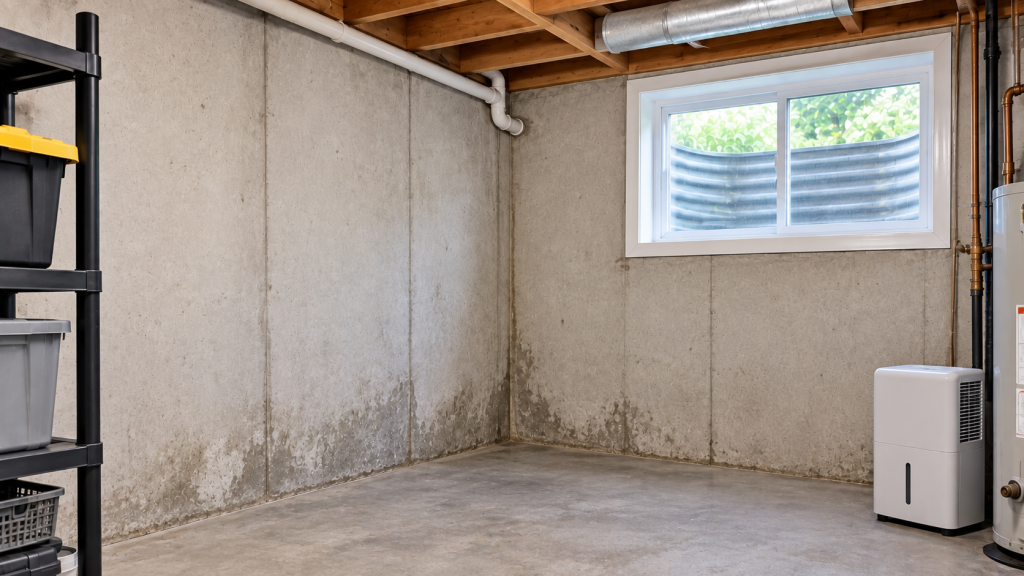
“Damp” can describe several different conditions. A basement may have excess moisture in the air, condensation on cool surfaces, damp masonry, a localized leak, intermittent seepage, or actual water entering after rain.
Common signs include:
- Clammy or humid air
- Condensation on pipes, windows, ducts, or masonry
- A musty odor
- Darkened concrete or masonry
- Damp or wet spots
- Peeling or blistering coatings
- White mineral deposits
- Moisture along the wall-floor joint
- Wet areas around windows or utility penetrations
- Water that returns after storms
No single clue proves the cause. Peeling paint shows that moisture has affected the surface, for example, but it does not tell you whether the moisture came from condensation or through the wall.
The most useful diagnosis combines timing, location, weather conditions, humidity readings, and visible evidence.
Start With Timing to Narrow Down the Cause
When the basement becomes damp can quickly eliminate some possibilities.
Damp during humid summer weather
If the basement feels clammy mainly during hot, muggy weather, indoor humidity and condensation are strong possibilities.
Basement walls, floors, pipes, and ducts can remain cooler than the surrounding air. Moisture in warm air can condense when it reaches those cooler surfaces.
Damp after heavy rain
Moisture that appears during or soon after storms points more strongly toward rainwater reaching the foundation.
Watch where it appears first. A particular wall, corner, window well, or section of the floor-wall joint can help identify the area that deserves closer inspection.
Damp during snowmelt or long wet periods
Moisture that develops after several wet days or during spring thaw may indicate saturated soil or rising groundwater around the foundation.
This pattern may develop more gradually than water entering immediately during a storm.
Damp during dry weather
Persistent dampness when it has not rained makes a purely storm-related source less likely.
Check basement humidity along with nearby plumbing, appliances, drains, HVAC equipment, and other indoor water sources. Groundwater can also persist after surface conditions have dried.
One isolated wet area
A localized wet spot often points toward a localized source.
Inspect nearby pipes, fixtures, appliances, mechanical equipment, penetrations, windows, and the corresponding exterior area. Whole-basement humidity usually affects more than one isolated location.
How to Check Humidity and Condensation in a Damp Basement
A small digital hygrometer is useful because it measures relative humidity instead of relying on how the room feels.
Check readings at different times over several days. Indoor relative humidity should generally remain below 60%, with roughly 30% to 50% considered a practical target where conditions allow.
A high reading does not prove humidity is the only problem. Water entering through masonry can also raise basement humidity.
Look for condensation on cool surfaces
Check:
- Cold-water pipes
- Metal ductwork
- Basement windows
- Concrete walls and floors
- Cool metal fixtures
- Items stored against foundation walls
Droplets forming across several cool surfaces during muggy weather support a condensation diagnosis.
By contrast, water entering through masonry may create localized damp areas, staining, mineral deposits, or a pattern that repeatedly follows storms.
Do not assume outdoor air will dry the basement
Opening windows during humid summer weather can make a cool basement wetter by bringing in warm, moisture-laden air.
Ventilation is useful only when incoming air is actually drier. Air conditioning or dehumidification may be more appropriate when airborne moisture is the main issue.
If humidity appears to be the main issue, see our guide to basement humidity for target levels, common causes, and practical ways to control excess moisture.
Look for Rain-Related Moisture and Groundwater Patterns
Rain-related water and groundwater can look similar, but their timing and entry points often differ.
Rain and surface-water patterns
Clues include:
- One wall becoming damp after storms
- Wetness below or around a basement window
- Water collecting in a window well
- Staining that follows a repeatable route down masonry
- Dampness near a wall-floor joint
- Seepage that worsens during intense rainfall
From the ground outside, look for obvious conditions that direct water toward the affected part of the foundation.
Roof runoff, downspouts, grading, pooling, and window wells can all contribute. Those systems have their own repair considerations, so use them here as diagnostic clues rather than assuming one correction will solve every basement moisture problem.
Groundwater and saturated-soil patterns
After prolonged wet weather or snowmelt, groundwater may rise, and soil around the foundation may remain saturated.
Possible clues include:
- Water appearing through floor cracks or joints
- Seepage around the floor perimeter
- Moisture at several low points
- Water appearing after extended wet weather rather than immediately after one storm
- Moisture seeming to rise through the slab
Persistent groundwater-related seepage may require professional drainage or waterproofing evaluation.
Do not excavate around the foundation or attempt a major interior or exterior drainage installation based only on a visual diagnosis.
If the dampness appears mainly after storms, our guide to water in the basement after rain can help you compare likely entry points and moisture patterns.
Check Indoor Sources and Read the Walls and Floor
Not every wet basement is a foundation problem. A localized indoor source can create similar symptoms.
Plumbing, appliances, and HVAC equipment
Inspect visible areas around:
- Water-supply and drain piping
- Laundry connections
- Washing machines and utility sinks
- Water heaters
- Water-treatment equipment
- HVAC equipment and condensate components
Look for dripping, staining, dampness directly below equipment, or a wet path that begins at one component.
A localized leak that occurs regardless of weather is more consistent with an indoor source than with rain-related seepage.
Keep HVAC checks visual. Water inside equipment, repeated condensate problems, electrical involvement, or anything requiring disassembly should be handled by a qualified technician.
Utility penetrations
Pipes, cables, conduits, and other penetrations are worth checking when moisture is concentrated in one small area.
If dampness repeatedly starts at a penetration, note whether it happens during rain or under dry conditions.
White deposits on masonry
White, powdery or crystalline deposits may be efflorescence. These minerals can remain after moisture travels through masonry and evaporates.
Efflorescence can therefore indicate past or ongoing moisture movement, but it is not the same as active liquid water.
Do not identify an unfamiliar wall growth as mold or efflorescence from color alone.
Peeling coatings and cracks
Blistering or peeling paint often means moisture has affected the surface, but repainting does not correct the underlying source.
Cracks can also provide a path for water. Observe whether a crack becomes wet, but do not treat basic moisture troubleshooting as structural crack repair.
Cracks accompanied by displacement, bowing, widening, shifting, or other signs of foundation movement require professional evaluation.
If moisture seems to be entering through the wall itself, see our guide to water seeping through a basement wall for common pathways and next steps.
Damp Basement Versus Actual Water Intrusion
Different moisture conditions can overlap, but they do not require the same response.
Elevated humidity means excess moisture is present in the air, sometimes without visible water.
Condensation is liquid water forming on a cooler surface.
Damp masonry means a wall or floor contains or transmits moisture without necessarily producing flowing water.
Seepage means liquid water is actively entering through a joint, crack, penetration, wall, or floor.
Standing water or flooding is a bulk-water problem and should not be treated as ordinary humidity.
A basement can have more than one problem at once. Foundation seepage may raise indoor humidity, while humid air may add condensation to already damp surfaces.
If recurring water intrusion points to a larger moisture-control problem, compare the main basement waterproofing options before deciding which type of fix may fit the situation.
What to Do Once You Identify the Likely Source
Once the pattern is clearer, match the response to the moisture path.
Humidity and condensation
Monitor relative humidity and control excess moisture in the air with appropriate ventilation, air conditioning, or dehumidification.
If distinct wet areas remain after humidity is controlled, continue investigating another source.
Rain-related moisture
Look at exterior water management near the affected wall or corner, including roof drainage, downspouts, grading, pooling, and window wells.
Use the appropriate focused repair guidance for any problem you identify rather than relying on an interior surface coating alone.
Wall or floor seepage
Document where water appears and under what weather conditions.
Recurring seepage through masonry, cracks, joints, or the slab may warrant drainage or waterproofing evaluation, especially if it is substantial or difficult to trace.
Localized indoor moisture
If water clearly originates near plumbing, an appliance, or HVAC equipment, address that source directly.
A plumber, HVAC technician, appliance professional, or other appropriate service provider may be the right next step.
When a Dehumidifier Helps — and When It Does Not
A dehumidifier can reduce excess airborne moisture and help control condensation.
It cannot stop active rainwater, groundwater, plumbing leaks, appliance leaks, or seepage through a wall or floor.
If the basement keeps developing wet spots or visible water while the air is being dehumidified, the moisture source needs further investigation.
When a Damp Basement Needs Professional Evaluation
Basic homeowner observation should stop when the problem involves significant water, contamination, electrical hazards, structural concerns, or work beyond safe troubleshooting.
Arrange appropriate professional evaluation for:
- Recurring standing water
- Substantial or persistent wall or floor seepage
- Water near energized electrical equipment
- Electrical components or appliances that have been significantly wetted
- Sewage or potentially contaminated water
- Extensive suspected mold growth
- Cracks with displacement, bowing, widening, or other structural movement
- Persistent moisture that cannot be traced
- Conditions that appear to require excavation
- Major interior or exterior drainage-system installation
- Structural foundation work
The professional depends on the source. Plumbing leaks call for a plumber, condensate or equipment problems may require an HVAC technician, persistent foundation water may require a drainage or waterproofing specialist, and structural movement requires an appropriate foundation or structural professional.
How to Reduce the Chance of the Problem Returning
Once the likely source has been addressed, monitor the basement rather than assuming the problem is permanently resolved.
- Keep an eye on basement humidity.
- Recheck previously affected areas after heavy rain.
- Inspect visible drainage components periodically.
- Address plumbing and mechanical leaks promptly.
- Watch for recurring staining, mineral deposits, peeling coatings, or musty odors.
- Note weather conditions when moisture returns.
Photos and simple notes about timing can make recurring patterns easier to identify.
Final Thoughts
A damp basement is a symptom, not a single diagnosis. Start by deciding whether the pattern best fits humid air and condensation, rain reaching the foundation, groundwater around or beneath the foundation, or a localized indoor moisture source.
Use timing, location, humidity readings, weather, and visible clues together. Once the most likely moisture path is clear, you can choose a focused response instead of relying on a dehumidifier, coating, or waterproofing measure that may not address the actual source.