
best attic insulation: How to choose by climate, attic, and budget
There is no single best attic insulation for every home. The right choice depends on climate, target R-value, attic configuration, existing insulation, available space, air sealing, moisture conditions, ventilation design, installation access, and budget. Installation quality matters just as much as material choice: poorly fitted or uneven insulation can undermine an otherwise suitable product.
Before comparing materials, inspect the attic safely. Do not step on ceiling drywall, balance on exposed joists, work around damaged or energized wiring, or disturb questionable insulation. If you see pebble-like vermiculite insulation, leave it undisturbed and have it professionally evaluated before insulation work proceeds.
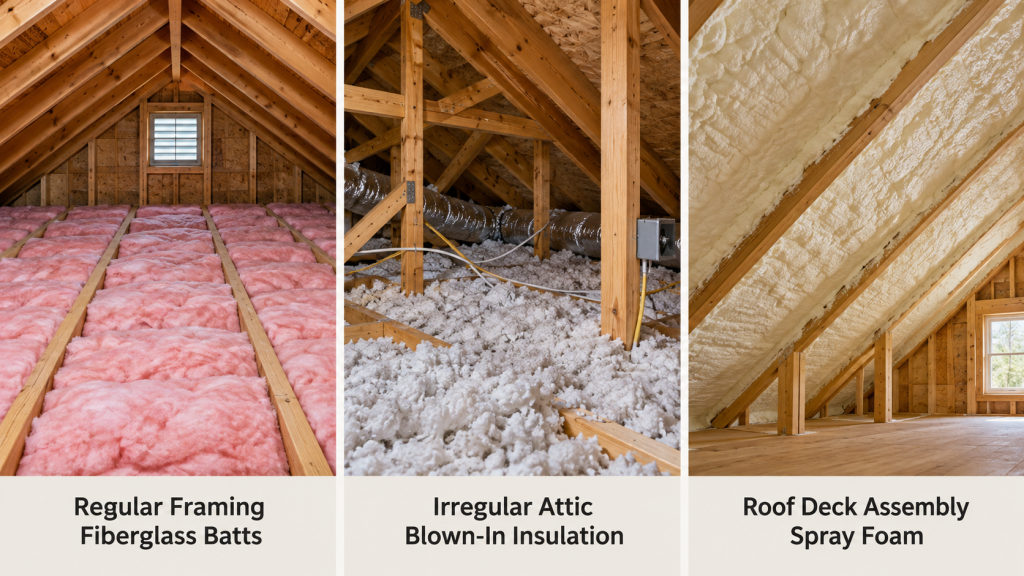
| Insulation type | Typical attic use | Main strength | Main limitation | DIY or pro? | Relative cost |
|---|---|---|---|---|---|
| Fiberglass batts | Open, regular framing bays | Straightforward and accessible | Gaps and compression hurt performance | DIY possible | Lower |
| Blown-in fiberglass | Open and irregular attic floors | Even coverage around obstacles | Depth and airflow control matter | DIY or pro | Low to moderate |
| Cellulose | Existing and irregular attic floors | Conforms well around framing | Settling and moisture sensitivity | DIY or pro | Low to moderate |
| Spray foam | Roof decks and specialized assemblies | Insulates and air seals | Complex design and installation | Professional | Higher |
| Mineral wool | Batts and specialized assemblies | Dense with strong fire characteristics | Higher material cost | DIY possible | Moderate to higher |
| Rigid foam | Specialized roof, wall, or enclosure details | Useful where continuous insulation is needed | Not a typical open-attic-floor solution | Assembly-dependent | Moderate to higher |
What Makes One Attic Insulation Better Than Another?
R-value matters, but choosing insulation by R-value per inch alone can lead to the wrong decision.
The material must fit the attic well enough to create a continuous thermal layer. Gaps around framing, compressed batts, shallow loose-fill areas, and uncovered sections can all reduce real-world performance.
Consider these factors together:
- the R-value the home needs
- available insulation depth
- framing and obstructions
- existing insulation
- moisture history
- vented versus conditioned attic design
- installation and future service access
- DIY versus professional installation
- total project cost, including preparation
The most expensive insulation is not automatically the most effective choice. Correcting air leaks, moisture problems, blocked ventilation, or unsafe fixture conditions may be more important than upgrading to a premium material.
Comparing the Best Attic Insulation Options
Fiberglass Batts
Fiberglass batts are preformed sections commonly sized for standard framing spaces. They work best where joist bays are open, regular, and easy to reach.
Their main advantage is straightforward installation without blowing equipment. They also remain relatively easy to move if future access is needed.
Their weakness is fit. Wiring, pipes, braces, and irregular framing can create gaps, while squeezing a batt into too little space can reduce its performance.
Batts are most practical when framing is regular, careful fitting is possible, and the attic offers safe access. They can be homeowner-friendly in simple attics, but complicated layouts often favor a material that conforms more easily around obstacles.
Blown-In Fiberglass
Blown-in fiberglass uses loose fibers distributed across the attic floor. It can cover irregular framing and broad areas more continuously than individually fitted batts.
The main challenge is maintaining consistent installed depth while keeping intended ventilation paths clear. Loose material near eaves may also need appropriate containment or baffles so soffit airflow is not blocked.
Blown fiberglass can work well for topping up an attic or covering complex floor layouts. Installation equipment and access determine whether homeowner installation is practical or whether a professional is the better choice.
Cellulose
Cellulose is another loose-fill material commonly used on attic floors and over existing insulation. It conforms readily around framing and obstructions, making it useful in older or irregular attics.
Its main limitations are settling and sensitivity to moisture. Active leaks or recurring moisture problems should be corrected before additional cellulose is installed.
Cellulose can be a relatively affordable top-up option and may be homeowner-manageable in a straightforward attic with appropriate equipment. Installation can be dusty, and complicated access or existing damage can make professional work more practical.
Spray Foam
Spray polyurethane foam can provide insulation and air sealing in the same assembly. In attics, it is often considered for roof-deck applications rather than simply as another material spread across the attic floor.
That distinction matters. Moving the thermal and air boundary to the roofline can affect attic ventilation, moisture behavior, roof sheathing, HVAC equipment, fire-protection requirements, and future roof inspection or repair.
Spray foam is therefore a building-envelope and assembly decision, not automatically a premium replacement for fiberglass or cellulose. Roof-deck applications and conditioned or unvented attic designs should be professionally planned and installed.
Mineral Wool and Rigid Foam
Mineral wool is available in batts and boards and provides good thermal performance along with strong fire-resistant characteristics. Its density can also be useful where sound control or a firm friction fit matters.
It generally costs more than common fiberglass or cellulose approaches and is less common for covering large open attic floors. It makes the most sense when its particular characteristics justify the added expense.
Rigid foam boards belong mainly in specialized roof, knee-wall, hatch, or enclosure assemblies. They can provide continuous insulation where space or thermal bridging is a concern, but they are not the default solution for a conventional open attic floor.
If fiberglass and cellulose are your leading choices, our cellulose vs. fiberglass insulation comparison breaks down the differences in coverage, settling, moisture behavior, and installation.
Batt vs. Blown-In Insulation: Which Fits the Attic Better?
When comparing blown-in insulation vs. batt insulation, attic layout often matters more than choosing a universal winner.
Batts work well where framing creates predictable spaces that can be filled accurately. Blown-in material has an advantage across irregular or already-insulated attic floors because it can surround framing and obstructions without requiring numerous fitted pieces.
| Consideration | Batts | Blown-in insulation |
|---|---|---|
| Regular framing | Very practical | Also suitable |
| Irregular spaces | Harder to fit | Conforms more easily |
| Existing loose-fill insulation | Often less convenient | Common top-up approach |
| Installation equipment | Little specialized equipment | Blower generally required |
| Future access | Easy to move individual sections | Material must be displaced |
| Gap risk | Higher if poorly fitted | Lower with even coverage |
| Depth control | Set by batt thickness | Must be maintained during installation |
For batt vs. blown in insulation, topping up an existing attic often favors loose fill, while a clean, accessible attic with regular framing may make batts more convenient. Neither approach compensates for moisture, air-leakage, clearance, or ventilation problems that should be corrected first.
Choosing Insulation for Different Attic Configurations
Open, Unfinished Vented Attics
Fiberglass batts, blown-in fiberglass, and cellulose are common choices when the thermal boundary belongs at the attic floor.
Regular, unobstructed framing can favor batts. Irregular layouts or extensive existing insulation often make loose fill more practical. Whichever material is used, intended soffit and other ventilation paths must remain open.
Low-Clearance Attics
Low headroom makes fitting batts and moving around the attic more difficult. Loose-fill material may reach irregular areas more readily, but restricted access can make professional installation safer and more practical.
Where available insulation depth is limited, thermal performance per inch becomes more important, although the complete assembly still matters more than one specification.
Attics With Existing Insulation
Existing insulation that is dry, reasonably clean, and compatible with the planned work can often remain in place.
Blown-in fiberglass or cellulose may be convenient for adding coverage over an existing layer. Batts can also work in suitable assemblies, but they should not create unnecessary compression or conceal damage that needs repair.
Attics With Ducts or HVAC Equipment
Ducts and mechanical equipment make service access and the location of the thermal boundary more important.
Conventional attic-floor insulation may still be appropriate, but some homes warrant evaluation of a conditioned-attic design. Moving insulation to the roof deck is a larger building-envelope decision, not a simple change of insulation material.
Finished Attics and Knee Walls
Finished attic spaces can include knee walls, sloped ceilings, short floor sections, and several transitions in the thermal boundary.
Those details may call for combinations of batts, boards, or other insulation systems rather than one material throughout. Complex finished assemblies are good candidates for professional evaluation.
Knee-wall areas have their own insulation challenges, including gaps and weak transitions, which we cover in our attic knee-wall insulation guide.
How Climate and Budget Change the Decision
Climate influences the target R-value, available depth, moisture risk, condensation potential, and whether heating or cooling loads dominate.
Cold climates place greater emphasis on limiting winter heat loss and managing moisture near cold surfaces. Hot climates place greater emphasis on controlling heat gain. Mixed climates need an assembly that performs through both seasons.
Climate does not automatically select fiberglass, cellulose, mineral wool, or foam. A material still has to suit the attic and be installed correctly.
Budget usually separates options in broad terms. Fiberglass batts and cellulose are often among the lower-cost approaches. Blown fiberglass can also be economical, although equipment and labor affect the project. Mineral wool generally costs more, while professional spray foam and complex assembly changes usually sit at the higher end.
Do not spend the entire budget on insulation while leaving known air leaks, moisture problems, blocked ventilation, or unsafe conditions unresolved.
Climate also affects how much thermal resistance you may need, so review our attic insulation R-value guide before comparing materials by price alone.
DIY vs. Professional Attic Insulation
Some insulation projects can fall within homeowner scope when the attic is simple, dry, accessible, and free of unusual hazards.
Carefully fitting fiberglass batts in regular framing is among the more approachable options. Loose-fill insulation can also be feasible when the installer can use the equipment safely, maintain consistent coverage, protect ventilation openings, and preserve required clearances.
Professional help is more appropriate for:
- spray-foam installation
- suspected vermiculite or other possible asbestos-containing material
- mold or recurring moisture
- significant pest or other contamination
- damaged or questionable wiring
- uncertain recessed-light, flue, or heat-clearance conditions
- complex conditioned-attic or roof-deck assemblies
- inaccessible or unsafe work areas
- major insulation removal
Do not disturb vermiculite to inspect beneath it or make room for new insulation. Older insulation should not automatically be assumed to contain asbestos, but questionable materials deserve evaluation before they are disturbed.
What to Fix Before Adding Insulation
Insulation performs best when the attic is ready for it.
Correct active roof leaks, recurring moisture, pest problems, damaged building components, and other conditions that could compromise the new work. Air leakage through the ceiling plane should also be considered before additional insulation makes those areas harder to reach.
In vented attics, insulation should not block intended soffit or other airflow paths. Heat-producing fixtures, flues, and similar components may require specific clearances rather than being buried under insulation.
These preparation items can change the material decision. An attic that initially appears to need only a top-up may instead need moisture correction, air sealing, or professional evaluation before more insulation is added.
Before installing more insulation, address accessible ceiling-plane leakage points using our attic air sealing guide.
How to Choose the Best Attic Insulation for Your Home
Start with the attic, not the product label.
For regular framing and good access, fiberglass batts can be a practical and relatively affordable choice when they can be fitted accurately.
For irregular attic floors or existing insulation that needs topping up, blown-in fiberglass or cellulose often makes continuous coverage easier.
Mineral wool becomes more appealing when its density, fire characteristics, or use in a specialized assembly justifies the higher material cost.
Spray foam belongs on the shortlist when a professionally designed project specifically benefits from roof-deck insulation, a conditioned attic, or the material’s combined insulating and air-sealing properties. Rigid foam similarly belongs in particular details rather than as a default open-attic material.
Before choosing, confirm that the attic is dry, major air-leakage and ventilation issues have been considered, and the selected insulation can reach the needed thermal performance without creating access, clearance, or installation problems.
Frequently Asked Questions
Is blown-in insulation better than batts?
Not universally. Blown-in insulation is often easier to distribute around irregular framing and existing insulation, while batts work well in accessible, regular framing bays. Installation quality can make either approach perform well or poorly.
Can you add new insulation over old insulation?
Often, yes, when the existing insulation is dry, reasonably clean, and compatible with the upgrade. Moisture, mold, contamination, hazardous materials, or needed repairs should be addressed before they are covered.
What attic insulation is best for cold or hot climates?
Climate changes the required thermal performance and moisture considerations, but it does not automatically determine one material. The attic assembly, installation quality, available space, and moisture strategy remain important.
Is spray foam worth the extra cost?
It can be when a professionally planned roof-deck or conditioned-attic assembly benefits from its combined insulation and air-sealing properties. For a straightforward vented attic that only needs more insulation at the ceiling plane, redesigning the assembly may not be necessary.
Final Thoughts
The best attic insulation is the option that fits the home’s thermal target, attic configuration, existing conditions, installation method, and budget while allowing continuous, properly installed coverage.
For many conventional vented attics, the practical choices are fiberglass batts, blown-in fiberglass, or cellulose. Mineral wool and rigid foam serve more specialized situations, while spray foam belongs mainly in professionally designed assemblies. Correct moisture, air-leakage, ventilation, and safety problems before assuming that a more expensive insulation material is the better solution.