
do ultrasonic pest repellers work? what the evidence shows
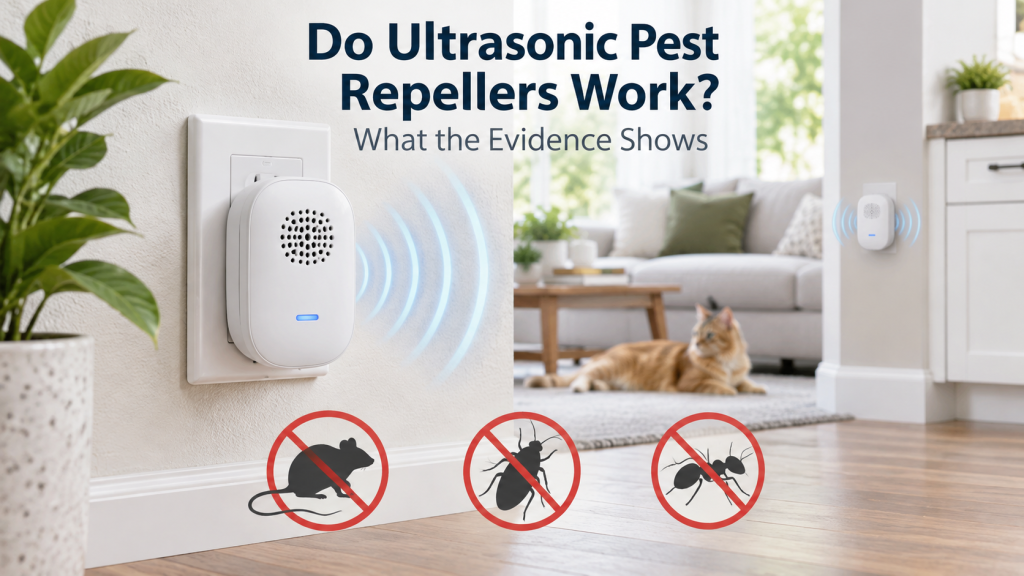
Do ultrasonic pest repellers work? The evidence does not support relying on them as a dependable stand-alone solution for most household pest problems. Some pests may react temporarily to certain sounds, but that response does not necessarily produce lasting control. Exclusion, sanitation, moisture reduction, trapping, baiting, and other pest-specific methods remain more reliable.
| Common claim | What the evidence suggests | Practical takeaway |
|---|---|---|
| Drives pests out of a room | Temporary responses can occur, but lasting control is inconsistent | Do not rely on ultrasound alone |
| Works on many different pests | Species respond differently | Look for pest-specific evidence |
| Covers a large area | Walls, furniture, and room layout affect sound | Treat broad coverage claims cautiously |
| Replaces traps or other control | Reliable replacement has not been broadly demonstrated | Continue proven pest-control measures |
| Requires little effort | Devices are easy to operate | Convenience does not establish effectiveness |
What Ultrasonic Pest Repellers Are
Ultrasonic pest repellers are plug-in or battery-powered devices designed to produce high-frequency sound, often above the typical adult human hearing range.
They are marketed for pests ranging from mice and rats to cockroaches, ants, spiders, mosquitoes, and other insects. Some claim to protect a single room, while others advertise much broader coverage.
The basic idea is to create sound that a target pest finds unpleasant enough to avoid. The important question is whether that reaction produces reliable, long-term pest control in a normal home.
What Manufacturers Claim
Marketing commonly says ultrasonic devices can drive away rodents, discourage insects, protect large areas, and reduce the need for traps or pesticides.
Those statements should be treated as product claims rather than established facts unless they are supported by credible evidence.
Regulators have previously challenged unsupported pest-control claims involving electronic repellers, which is one reason phrases such as “scientifically proven,” “100% effective,” or “works on every pest” deserve scrutiny.
Do Ultrasonic Pest Repellers Work in Real Homes?
Some animals can detect ultrasonic frequencies, and certain experiments have produced short-term behavioral responses. That does not automatically mean a consumer plug-in device can clear an established pest problem from a house.
The central issue is reliability.
Research and pest-management guidance have not demonstrated consistent long-term household control broadly enough to make ultrasonic devices a dependable primary strategy. A pest may initially react to unfamiliar sound and later become accustomed to it, a process known as habituation.
Normal homes also differ from controlled experiments. Walls, cabinets, furniture, room shape, distance from the device, available food, and hidden shelter can all influence what happens.
This does not mean every ultrasonic device is incapable of affecting any pest. It means short-term behavioral effects should not be confused with dependable household control.
What the Evidence Shows
Several themes appear repeatedly in research and pest-management guidance.
Short-term reactions may fade
A mouse or another pest may avoid an unfamiliar sound at first. If the sound does not represent an actual threat, the animal may eventually resume normal behavior.
That distinction matters because temporary avoidance is not the same as eliminating or controlling an infestation.
Laboratory results do not automatically predict household results
Controlled testing can hold frequency, distance, pest species, and room conditions steady.
A kitchen, basement, or bedroom contains obstacles, adjoining rooms, food sources, harborages, and concealed spaces that make real-world performance harder to predict.
One pest does not represent every pest
Evidence involving one species cannot automatically be extended to mice, cockroaches, ants, spiders, fleas, mosquitoes, and other unrelated pests.
Broad multi-pest claims therefore require stronger evidence than a demonstration involving only one animal or one set of conditions.
Why Ultrasonic Results Can Be Inconsistent
Ultrasonic sound does not move through a furnished home without interference. Walls, furniture, cabinets, curtains, corners, and other obstacles can block, reflect, or weaken it.
That makes large coverage claims difficult to judge from square footage alone. A device operating in an open room should not be assumed to produce the same conditions behind a cabinet or through a wall.
Pest behavior also varies. Even an animal capable of hearing a particular frequency may continue using an area if food, water, or shelter remain available.
Most importantly, an electronic repeller does not correct the reason pests are present. It does not seal an entry hole, clean spilled food, repair a screen, remove nesting material, eliminate a moisture problem, or remove a breeding source.
Do Ultrasonic Repellers Work for Mice?
Mice can hear frequencies humans cannot, and unfamiliar sounds may temporarily affect their behavior.
The limitation is that a temporary response does not reliably remove an established mouse problem. Long-term control still depends on measures such as preventing entry, limiting food access, using appropriate trapping, and addressing persistent activity.
An ultrasonic unit may be tried as a supplement, but it should not replace those methods.
For a practical prevention approach, see how to keep mice out of your house by sealing entry points, reducing attractants, and monitoring for continued activity.
Do They Work for Roaches?
Ultrasonic devices should not replace an established cockroach-control plan.
Reliable roach management focuses on food, moisture, shelter, monitoring, exclusion, and appropriately selected targeted controls such as bait.
Even if ultrasound temporarily changes insect movement, it does not remove egg cases, harborages, food access, or moisture that allows the infestation to continue.
If you are dealing with active roach activity, see our low-risk guide on how to get rid of roaches using sanitation, moisture control, monitoring, exclusion, and targeted bait.
What About Ants, Spiders, and Other Insects?
Claims covering many unrelated insects should be approached cautiously.
Different pests detect and respond to environmental signals differently. Evidence involving one species does not establish that the same device will work against ants, spiders, fleas, mosquitoes, silverfish, or other pests.
If favorable food, moisture, shelter, or entry conditions remain, those conditions still need to be addressed.
Can You Hear Ultrasonic Pest Repellers?
Many products are designed to operate mainly at frequencies above normal adult human hearing.
That does not guarantee every unit will be completely silent. Some electronics may produce audible clicks, hums, or other sounds, and individual hearing sensitivity varies.
If a device begins producing an unexpected audible noise, check its instructions and discontinue use if the sound suggests a malfunction.
Are Ultrasonic Pest Repellers Safe for Pets?
Do not assume that a frequency humans cannot hear is irrelevant to every animal.
Dogs and cats hear differently from people, and individual response can vary with the device, frequency, placement, and animal.
Pet rodents deserve particular caution. A product marketed to repel mice or rats may also be relevant to pet mice, rats, hamsters, gerbils, guinea pigs, or similar animals.
Before using a device around pets:
- Read the manufacturer’s warnings and instructions
- Check which animals the product is intended to affect
- Avoid placing a rodent-repelling device beside a pet rodent enclosure
- Watch for unusual behavior after installation
- Ask a veterinarian when suitability is uncertain
Blanket claims that all ultrasonic repellers are harmless to every pet are not justified.
Do They Interfere With Electronics?
Typical consumer ultrasonic repellers are designed to produce sound rather than radio-frequency signals.
Follow the manufacturer’s installation instructions and any warnings supplied with the device. Claims involving medical devices, hearing technology, security equipment, or other sensitive electronics should be checked against the documentation for the specific equipment rather than assumed either way.
How to Evaluate an Ultrasonic Pest Repeller Before Buying
If you want to try one, focus on evidence and practical details rather than dramatic marketing.
Specific pest claim
Look for a product that clearly identifies the pest it is designed to affect.
Be cautious when one small device claims equal effectiveness against rodents and a long list of unrelated insects.
Supporting evidence
Useful evidence should identify what pest was tested, under what conditions, and what outcome was measured.
Statements such as “scientifically proven” or “advanced technology” are not substitutes for transparent test information.
Coverage claims
Large square-footage numbers do not tell you how ultrasound behaves around walls, furniture, cabinets, and separate rooms.
Consider the actual layout rather than assuming one device can influence an entire floor or house.
Return policy and warranty
Because results can be uncertain, reasonable return terms can reduce purchasing risk if the device does not help in your situation.
A return policy is not evidence of effectiveness, but it is a practical buying consideration.
Pet and placement guidance
Check instructions for pets, children, outlet placement, furniture, moisture, and other restrictions.
A device that cannot be positioned appropriately where you need it may not be a useful purchase.
Red Flags in Product Marketing
Treat these claims cautiously:
- Instant pest elimination
- 100% effectiveness
- One device works on nearly every household pest
- Whole-house coverage regardless of walls or obstacles
- Permanent control without addressing food, water, shelter, or entry
- No need for trapping, sanitation, exclusion, or other pest-control measures
- Scientific claims with no meaningful supporting information
Testimonials can describe individual experiences, but they do not by themselves establish that ultrasound caused the result.
When an Ultrasonic Repeller May Still Appeal to Homeowners
The appeal is understandable. These devices are easy to plug in, require little daily effort, avoid traps that need emptying, and generally do not involve applying pesticides.
A homeowner may decide those conveniences make a device worth trying as a supplemental measure.
The important distinction is supplemental versus primary control. Proven measures should continue, and actual pest activity should determine whether the device appears to be contributing anything useful.
How to Tell Whether a Device Is Actually Helping
Before installation, note where pests are appearing and how often. Existing monitoring traps, droppings, sightings, or other objective signs can provide a better baseline than memory alone.
After installing the device, continue tracking the same signs.
Be careful when several things change at once. If you also seal gaps, improve sanitation, set traps, repair leaks, or enter a different season, fewer sightings do not prove the ultrasonic unit caused the improvement.
Likewise, continued activity is a practical sign that the device is not providing sufficient control for the problem.
Should You Buy an Ultrasonic Pest Repeller?
A homeowner may reasonably choose to experiment with an ultrasonic repeller when the cost is acceptable, the product targets the relevant pest, and the return terms are practical.
The evidence is not strong enough, however, to rely on one as the primary solution to an established pest problem.
A better buying standard is to look for pest-specific evidence, realistic coverage information, clear pet guidance, and measurable results after installation. Continue using the established control measures appropriate to the pest.
When Professional Pest Control Makes More Sense
Professional help is appropriate when rodents remain active, a cockroach infestation persists, pest numbers are increasing, significant contamination is present, or the source cannot be identified.
Professional evaluation also makes sense when structural pests are suspected, or reasonable homeowner measures have not resolved the problem.
Final Thoughts
So, do ultrasonic pest repellers work well enough to replace conventional pest control? The available evidence does not support relying on them that way. Some pests may react temporarily under certain conditions, but short-term behavior changes are not the same as consistent long-term household control.
If you choose to try one, treat it as a supplement and monitor the results. Keep addressing the food, moisture, shelter, and entry conditions supporting the pest problem, because those established control measures remain important regardless of what an electronic repeller promises.