
attic insulation guide: R-value, depth, upgrades, and common problems
Attic insulation helps slow heat transfer between the conditioned living space and the attic, improving comfort and reducing unnecessary heating and cooling demand. How well it works depends on more than thickness alone. Installed R-value, even coverage, material condition, air sealing, moisture control, and unobstructed ventilation paths all affect the performance of the attic as a system.
Safety note: Limit homeowner inspections to areas you can observe from a stable, safe access point. Never step on ceiling drywall, balance on exposed joists, or work around exposed or energized wiring. If you see pebble-like vermiculite insulation, do not disturb it. Have it properly evaluated before any work that could move or expose the material.
| What to check | Why it matters | Possible concern |
|---|---|---|
| Insulation coverage | Reduces heat transfer across the ceiling | Thin spots, gaps, exposed framing |
| Insulation condition | Helps preserve expected R-value | Compression, moisture, contamination |
| Air sealing | Limits air moving through the ceiling plane | Gaps around penetrations and chases |
| Ventilation paths | Allows a vented attic to function properly | Buried soffit vents or missing airflow paths |
| Fixtures and equipment | May require clearance from insulation | Unsafe contact with heat-producing components |
What Attic Insulation Does
Heat naturally moves from warmer areas toward cooler ones. In winter, heat from the living space tends to move toward the colder attic and outdoors. In summer, heat from a hot attic can move toward the cooler rooms below.
Insulation slows that heat transfer. In a typical vented attic, the insulation usually sits at the attic floor, establishing a thermal boundary between the conditioned rooms and the unconditioned attic above.
That boundary matters for comfort as well as energy use. Weak or uneven insulation can contribute to rooms that are harder to keep comfortable, surfaces that feel unusually warm or cold, and longer heating or cooling cycles.
Insulation is only one part of the system, however. Air can also move through cracks and openings in the ceiling. Moisture can damage materials. Poorly placed insulation can interfere with ventilation. Good attic performance depends on these parts working together rather than on insulation thickness alone.
How Attic Insulation R-Value and Depth Work
R-value describes a material’s resistance to heat flow. A higher R-value provides more resistance than a lower R-value when the materials are properly installed and compared under appropriate conditions.
The amount appropriate for an attic varies with climate, the home’s construction, the location of the thermal boundary, existing insulation, and applicable energy requirements. This is why a single recommended R-value should not be applied automatically to every house.
Depth is only part of the calculation
Insulation depth and R-value are related because adding more of a particular insulation generally increases its thermal resistance. But different materials provide different R-values for the same thickness.
Ten inches of one material therefore may not perform the same as ten inches of another.
Condition also matters. A deep layer with low spots, gaps, severe compression, moisture damage, or displaced material may perform worse than its average depth suggests. A depth measurement is useful only when you also know what material you are looking at and whether it remains in good condition.
For the same reason, exposed joists can be a helpful visual clue but are not a complete insulation assessment. The actual target should be based on the home’s climate and assembly rather than on a universal number of inches.
For a closer look at how climate, insulation type, and depth affect performance, see our guide to attic insulation R-value.
Common Types of Attic Insulation
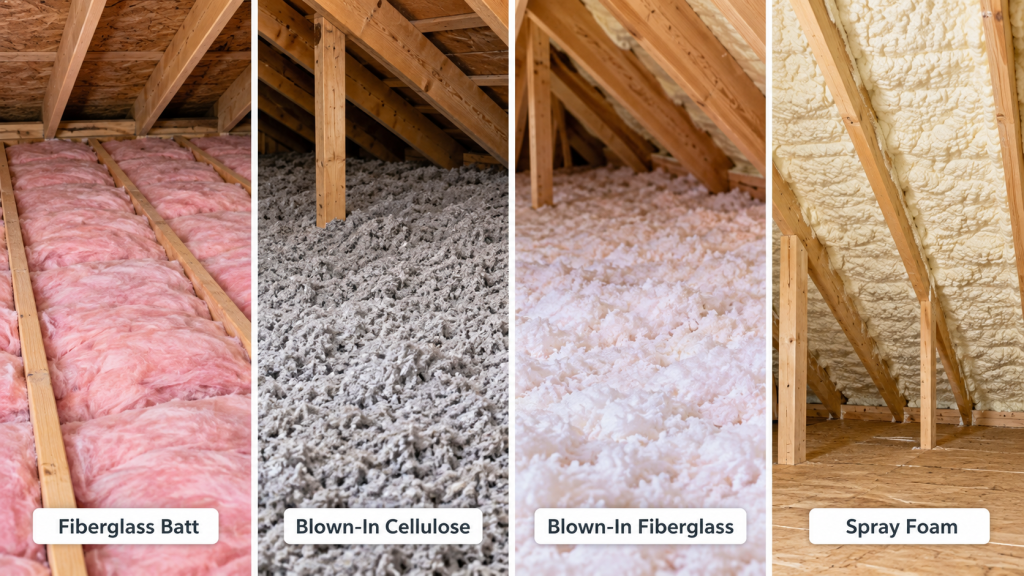
Several materials are commonly found in residential attics. Each has different installation characteristics, so identifying what is already present is useful before planning an upgrade.
Fiberglass batts come in flexible sections designed to fit between framing members. They can perform well when correctly sized and installed without gaps or compression. Poor fitting around wires, framing, or irregular spaces can leave weak areas.
Blown-in fiberglass consists of loose fibers distributed across an attic floor. It can provide relatively continuous coverage across irregular areas, although it still needs consistent depth and protection from displacement.
Cellulose is another common loose-fill material. It can conform around framing and obstructions and is frequently found in existing attics. Like other loose-fill insulation, its installed depth and coverage can change because of settling or disturbance.
Spray foam is applied as a liquid that expands and cures. Depending on the building design, it may be used at a roof deck or in other parts of an attic assembly. Spray-foam projects affect air, moisture, ventilation, fire-safety, and building-envelope considerations, so professional installation and appropriate design are important.
Less-common attic materials include mineral wool and various rigid insulation products used for particular assemblies. The right material depends on much more than nominal R-value, including the attic configuration, existing materials, moisture strategy, installation access, and upgrade goals.
If you are comparing fiberglass, cellulose, spray foam, mineral wool, and other options, our attic insulation types guide explains where each one fits.
How to Tell if an Attic May Be Under-Insulated
A safe visual inspection can reveal several reasons to investigate insulation levels more closely.
Thin or uneven coverage is one of the clearest clues. You may see areas where framing is prominently exposed while nearby sections have considerably more material. Loose-fill insulation may be piled deeply in one location but shallow near the eaves or in areas disturbed by previous work.
Batts can develop different problems. They may be compressed under stored items, ducts, boards, or other materials. Poorly fitted batts can also leave gaps along framing and around obstructions.
Look for:
- exposed framing or obviously shallow areas
- large differences in insulation depth across the attic
- compressed, folded, or poorly fitted batts
- gaps or voids near penetrations and access points
- loose-fill insulation that has been pushed aside or disturbed
- areas where previous electrical, HVAC, plumbing, or other work appears to have displaced insulation
Comfort problems can provide supporting clues. Significant temperature differences between otherwise similar rooms or unusually high heating and cooling demand may justify an attic inspection. Neither proves that insulation is the cause, however. Air leakage, ducts, windows, HVAC problems, solar exposure, and other conditions can produce similar symptoms.
Common Attic Insulation Problems
Insulation can remain in place for a long time, but its performance depends heavily on its condition.
Compression and settling
Fibrous insulation works partly by trapping air within its structure. Compressing insulation into less space than intended can reduce its ability to resist heat flow.
Loose-fill materials may also settle over time. Some settling is expected with certain products, but substantial low areas or uneven distribution can leave portions of the ceiling with less insulation than planned.
Moisture damage
Wet insulation needs attention, but the source of the water matters more than simply replacing the affected material.
A roof leak, condensation problem, plumbing issue, or another moisture source should be corrected before an insulation upgrade proceeds. Adding new material over an unresolved moisture problem can conceal damage rather than solve it.
Wet, matted, deteriorated, or mold-affected insulation may require removal as part of the repair. Significant or recurring mold, widespread hidden moisture, and uncertain roof-deck moisture conditions warrant professional evaluation.
Contamination and pests
Rodents, birds, insects, or other pests can disturb insulation and leave contamination behind. Pest-contaminated insulation should not be treated as an ordinary insulation top-up project. Address the infestation and determine whether professional cleanup or removal is appropriate first.
Displaced insulation and gaps
Attic work often leaves insulation pushed away from wiring, plumbing, ducts, framing, or other penetrations. Wind entering near eaves can also disturb loose-fill material in some attics.
These problems create localized weak spots even when the attic’s average insulation depth looks adequate.
Blocked soffit ventilation
In a vented attic, insulation should not plug soffit vents or eliminate the intended airflow path near the eaves. Baffles or other appropriate details may be needed to maintain that pathway while allowing insulation to extend toward the perimeter.
Insulation around heat-producing components
Not every recessed light, flue, chimney, electrical component, or other heat-producing item can safely be buried in insulation.
Do not assume a fixture is rated for insulation contact. If its rating, required clearance, wiring condition, or surrounding assembly is uncertain, leave the area undisturbed and have it evaluated by an appropriate professional.
Should You Add Insulation or Replace It?
Existing insulation does not automatically need to be removed before an upgrade.
Adding insulation over an existing layer may make sense when the old material is dry, reasonably clean, compatible with the planned assembly, and free of problems that need access for repair. Correcting gaps and increasing overall thermal resistance can often be accomplished without discarding serviceable material.
Replacement becomes more reasonable when insulation is wet, badly contaminated, severely compressed, substantially damaged, pest-affected, or displaced to the point that correction is impractical. Removal may also be necessary when insulation interferes with repairs or when mold, hazardous materials, or other conditions require professional remediation.
Age by itself is not a sufficient reason for replacement. Insulation that has remained dry, protected, and properly positioned may continue doing its job long after another home’s newer insulation has been compromised by leaks or poor installation.
If vermiculite insulation is present or suspected, do not disturb, sample, rake, vacuum, or remove it as part of an ordinary upgrade. Obtain appropriate professional guidance before work proceeds.
Why Air Sealing and Ventilation Matter Before an Upgrade
Insulation and air sealing do different jobs. Insulation resists heat transfer through the building assembly. Air sealing limits uncontrolled airflow through openings between the living space and attic.
If significant ceiling-plane leaks remain, adding insulation alone may leave an important source of energy loss and moisture movement uncorrected. For that reason, attic air sealing is normally evaluated before additional insulation covers the areas that may need attention.
Common leakage locations can occur around penetrations, framing transitions, access openings, and utility chases. Some areas involve electrical components, chimneys, flues, or heat-producing fixtures with special clearance and fire-safety requirements. Those are not places for improvised sealing methods.
Ventilation needs separate attention. In a conventional vented attic, intake and exhaust paths must remain functional after the insulation work is complete. Adding more insulation should not mean burying soffit vents.
An attic designed as an unvented or conditioned assembly follows a different building strategy. Do not assume the ventilation practices for a vented attic apply unchanged to a roof-deck spray-foam assembly or another specialized design.
Before adding insulation, check the ceiling plane for leakage points using our attic air sealing guide.
Planning an Attic Insulation Upgrade
A good upgrade starts by understanding the attic that already exists rather than immediately adding more material.
First, inspect the attic from a safe location and determine what insulation is present, how evenly it is distributed, and whether obvious moisture, pest, wiring, fixture, or ventilation problems exist.
Next, resolve conditions that could compromise the new work. Active roof leaks, recurring moisture, pest activity, and damaged building components should be handled before they are covered.
Evaluate air leakage before adding another layer of insulation. This is also the time to determine whether soffit and other intended ventilation paths need protection from loose-fill material.
Then establish an appropriate insulation target for the home’s climate and construction and choose a material suitable for the existing attic. Material selection should account for available space, the existing insulation, accessibility, installation method, moisture strategy, and any ducts or mechanical equipment in the attic.
After the upgrade, the finished insulation should provide continuous, reasonably even coverage without being unnecessarily compressed. Ventilation paths, required clearances, access points, and equipment should remain functional and safe.
A final inspection is worthwhile because small missed areas can matter. Perimeter sections, narrow spaces, access openings, and locations disturbed during other work are common places to find incomplete coverage.
How Long Does Attic Insulation Last?
Attic insulation does not have a universal expiration date.
Many insulation materials can remain useful for decades when they stay dry, undisturbed, uncontaminated, and properly installed. The calendar is therefore less informative than the insulation’s actual condition.
Water intrusion can shorten useful life quickly. Pest activity, severe compression, repeated foot traffic, storage, air movement, renovations, HVAC work, and electrical or plumbing projects can also damage or displace material.
Previous work is particularly easy to overlook. A contractor may move insulation to reach a ceiling penetration or equipment and unintentionally leave a thin area afterward. An attic that once had good coverage can therefore develop weak spots without the insulation material itself having “worn out.”
Attic Insulation Maintenance and Inspection
Attic insulation usually needs observation rather than routine replacement.
Include the attic in periodic home inspections when it can be viewed safely, and check it after events likely to affect it, such as a roof leak, pest problem, or significant attic repair.
Look for changes rather than trying to perform a complicated test. New water staining, disturbed loose fill, compressed batts, exposed areas, blocked vents, or insulation moved away from its previous position are reasons to investigate.
If depth needs to be measured, do so only where you can reach the insulation without unsafe footing or disturbing questionable materials. Never step between framing members onto ceiling drywall.
Good records can also help. Knowing what insulation was installed, approximately when it was installed, and what other attic work occurred afterward makes future inspections and upgrades easier to evaluate.
When Professional Help Makes Sense
A straightforward insulation assessment does not always require a specialist, but some conditions move the project beyond a homeowner-safe visual inspection.
Professional evaluation is appropriate when the attic contains suspected vermiculite, extensive pest contamination, significant mold, recurring or unexplained moisture, damaged electrical wiring, uncertain recessed-light clearances, structural damage, or inaccessible areas that cannot be inspected safely.
Help is also sensible when determining the correct thermal boundary is complicated by finished attic rooms, knee walls, extensive ductwork, HVAC equipment, unusual roof assemblies, or existing spray foam.
Professional spray-foam installation should not be treated as a routine homeowner project. Likewise, insulation work should not become an excuse to modify roof framing, perform uncertain electrical work, disturb suspected hazardous materials, or work from an unsafe location.
The purpose of an inspection is to learn enough to make a sound decision. If getting that information requires disturbing questionable material or taking physical risks, the safer decision is to stop and bring in the appropriate professional.
Final Thoughts
Effective attic insulation is less about achieving a particular number of inches than creating a complete, durable thermal boundary. R-value matters, but so do even coverage, installation quality, air sealing, moisture control, proper clearances, and working attic ventilation.
Before adding or replacing insulation, identify what is already there and correct conditions that could undermine the upgrade. Keep existing insulation when it remains serviceable, remove it only when there is a clear reason, and treat moisture, contamination, hazardous materials, and unsafe attic conditions as problems to resolve before new insulation goes in.