
best roach bait: how to choose the right type for your home
The best roach bait depends on where roaches are active, how the bait can be placed safely, and whether a gel or enclosed station fits the situation better. Gel offers precise placement in accessible protected areas, while stations provide cleaner handling and a more contained format. Neither is universally best, and both work only when roaches can find and feed on the bait.
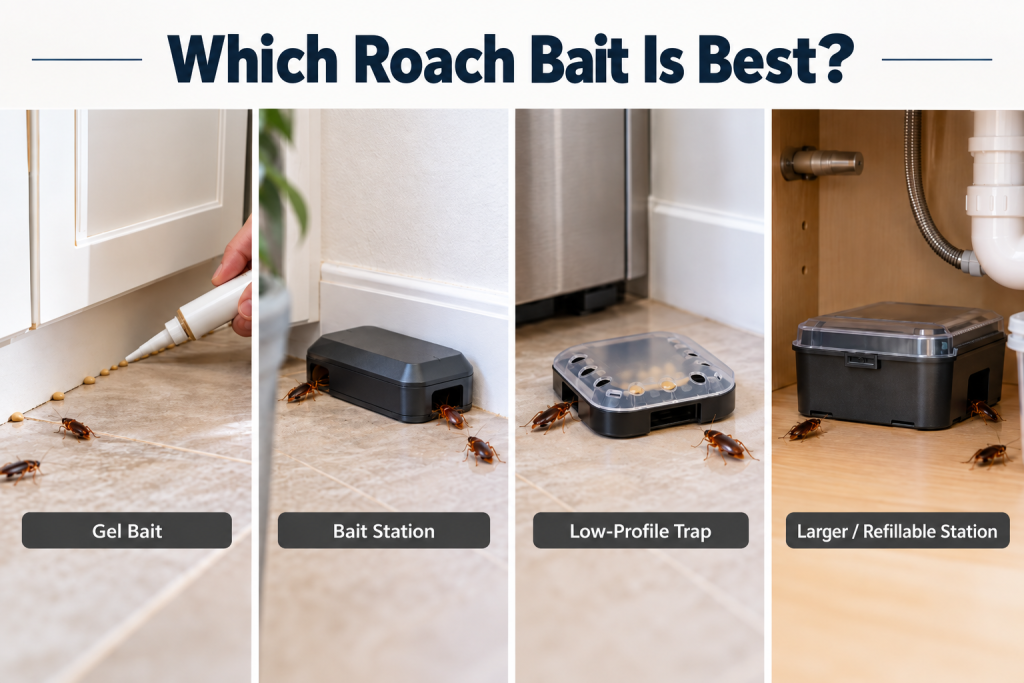
| Bait Type | Best Fit | Main Advantage | Main Limitation |
|---|---|---|---|
| Gel bait | Tight, protected areas near activity | Flexible, precise placement | Can dry out or become contaminated |
| Enclosed bait station | Convenient household placement | Cleaner, contained format | Bulkier and may be ignored if misplaced |
| Larger or refillable station | Areas needing longer service | Fewer complete-unit replacements | Larger and more visible |
What Roach Bait Is and How It Works
Roach bait combines an attractive food source with an insecticidal active ingredient. Roaches must find the bait and feed on it for the product to work.
That makes bait different from a contact spray. Results are not necessarily immediate, and bait placed far from roach activity may do little even if the product itself is effective.
For a homeowner, the practical point is simple: bait works best when it stays usable and is placed where roaches are likely to encounter it.
Always use the product according to its label, including restrictions involving children, pets, food, water, and placement.
For the broader control process around food, moisture, hiding places, bait use, and monitoring, see our guide on how to get rid of roaches with a low-risk homeowner approach.
Main Types of Roach Bait
Gel roach bait
Gel bait is useful when you need targeted placement close to known activity.
Depending on the label, gel may be suitable for small accessible cracks, corners, edges, and protected locations where roaches travel or hide. Its flexibility makes it useful when a station would be too bulky.
The tradeoff is that exposed gel requires more careful handling. It can dry out, collect dust, become contaminated by cleaners or sprays, or be placed somewhere children or pets can reach it.
Do not inject gel into walls, electrical equipment, appliances, or inaccessible cavities. Keep applications to accessible, label-approved locations.
Enclosed bait stations
Bait stations contain bait inside a housing that roaches enter to feed.
They offer convenient handling and reduce direct contact with bait compared with exposed gel. This can make them appealing in kitchens, bathrooms, and other household areas where the label permits use.
Stations are not automatically child-proof or pet-proof. They still need to be positioned where children and animals cannot handle or chew them.
Their main limitation is fit. A station takes up more space than gel and works only if roaches encounter and enter it.
Larger-capacity or refillable bait stations
Some bait stations are larger or designed for longer service.
Possible advantages include easier monitoring and fewer complete-unit replacements. The tradeoffs are size, appearance, and placement flexibility.
Refillable designs also require careful attention to product instructions. Use only the bait and refill method intended for that station.
Gel vs. Bait Stations
Choose gel when placement flexibility matters
Gel may be the better fit when roaches are active along accessible edges, corners, or protected cracks where a station would be awkward.
It offers precise placement, but you need to watch for drying and contamination.
Choose stations when contained handling matters
Stations may be more convenient when you want a premeasured, enclosed format that is easy to place and inspect.
They reduce direct handling of exposed bait but are bulkier and still depend on good placement.
Neither format compensates for poor location. Roach baits generally work best near activity rather than across the room from where roaches are hiding or feeding.
How to Choose the Best Roach Bait for Your Home
Start with the activity area, then consider safety and practicality.
Match the bait to the location
Ask where the roaches are appearing most often.
A narrow cabinet edge may favor gel. An open area beneath a sink may accommodate a station. A damp location may require a product and placement that will remain usable there.
Then consider whether you can safely inspect or replace the bait later.
Check household exposure risks
Before buying, consider:
- Whether children can reach the area
- Whether pets can reach or chew the product
- Whether food or dishes are stored nearby
- Whether the bait could contact water
- Whether the location is routinely cleaned or washed
- Whether the product can remain undisturbed
The best bait is not the one with the strongest package claim. It is the one you can use correctly where the roaches are actually active.
Best Roach Bait for Kitchens
Kitchens require extra attention to food-contact surfaces, competing food, and access by children or pets.
An enclosed station can be convenient where there is enough space for it. Gel can fit more precisely along protected accessible edges or corners.
Whichever format you choose, keep bait away from exposed food, dishes, utensils, food-preparation surfaces, and standing water.
Grease and crumbs can compete with bait, so obvious competing food should be cleaned up.
Best Roach Bait for Bathrooms and Damp Areas
Bathrooms and utility areas add moisture to the decision.
Choose a product whose label allows the intended location and position it where it will not sit in standing water or be repeatedly splashed or washed away.
A station may offer a contained format in some locations, while gel may work in a protected dry edge where the label allows it.
Persistent plumbing leaks should be corrected separately.
Best Roach Bait for Tight Cracks and Crevices
Gel is generally the more flexible format when activity is concentrated in narrow, accessible protected areas.
That does not mean bait should be pushed into walls, electrical equipment, appliance interiors, or other inaccessible spaces.
Use only accessible cracks, edges, or crevices permitted by the label. If locating the activity would require appliance disassembly, electrical access, or opening the structure, stop there.
Best Roach Bait Around Children and Pets
An enclosed station may reduce direct contact with bait compared with exposed gel, but no roach bait should be treated as harmless.
Place any bait where children and pets cannot reach, handle, lick, chew, or play with it.
Keep unused bait in its original packaging and store it securely away from children, pets, food, and animal feed.
If safe placement is not possible in the active area, that product or location is not a good choice.
Where to Place Roach Bait
Placement should follow known activity rather than random distribution.
Depending on the label, useful zones may include:
- Along wall edges near activity
- Near cabinet corners
- Beneath sinks where appropriate
- Behind appliances where safely accessible
- Near accessible cracks or crevices
Avoid food-preparation surfaces, standing water, electrical equipment, and locations children or pets can reach.
Do not dismantle appliances or inject bait into walls to get closer to a suspected hiding area.
Why Roach Bait May Not Be Working
Common reasons include:
- The bait is too far from activity
- Competing food is more attractive
- Gel has dried out
- The bait has been contaminated
- A station is poorly positioned
- Roaches are active elsewhere
- Sprays have been used around the bait
- Conditions are still supporting heavy activity
Reassess placement and bait condition before increasing the amount.
If recurring activity may be tied to food, moisture, shelter, or entry points elsewhere in the home, our whole-home guide explains how to keep bugs out by addressing those broader conditions.
Should You Use Spray With Roach Bait?
Spraying directly on or around active bait can interfere with bait use.
Contact sprays may kill or repel roaches before they feed, and some sprays can contaminate bait or make it less attractive.
More pesticide is not automatically better. If different products are used in the same area, follow each label rather than inventing a combined treatment strategy.
How Long Does Roach Bait Last?
There is no universal replacement schedule.
Useful life depends on the product, bait format, heat, moisture, contamination, how much is consumed, and whether exposed bait dries out.
Inspect accessible bait as directed and follow the label for replacement.
How Many Roach Baits Do You Need?
The right quantity depends on the size of the affected area, number of active zones, bait format, and product directions.
Do not assume more bait means faster control.
Well-placed bait near actual activity is generally more useful than random overapplication throughout the home.
What Features Matter When Comparing Products
Before buying, check:
- Gel or enclosed station format
- Labeled indoor use
- Placement flexibility
- Child and pet considerations
- Food-area restrictions
- Moisture limitations
- Ease of inspection
- Refill or replacement needs
- Ongoing cost
- Visibility
- Cleanup requirements
- Clear label directions
These factors usually matter more to household usability than front-of-package marketing language.
When Roach Bait Is Not Enough
Reassess the situation when activity remains heavy, several rooms are affected, roaches appear frequently during the day, or properly placed bait is repeatedly ignored.
Professional pest evaluation may also be useful when activity appears to come from shared walls, neighboring units, inaccessible structural areas, or locations you cannot safely reach.
Final Thoughts
The best roach bait is the one that fits the location and household conditions while remaining accessible to roaches and inaccessible to children, pets, food, and water. Gel offers flexible, precise placement, while enclosed stations provide cleaner handling and simpler setup.
Choose the format based on where activity is occurring, how safely you can place and monitor the bait, and how well the product fits the environment. If activity remains heavy despite appropriate placement, reassess the broader problem rather than simply applying more bait.