
mold on basement walls: what to do, moisture causes, and when to call a pro
Mold on basement walls usually means moisture has been present long enough to support growth. The priority is not identifying the mold by color or appearance. It is finding and correcting the moisture source, determining how extensive the affected area is, and deciding whether limited cleanup is reasonable or professional help is safer.
If growth is extensive, keeps returning, involves sewage or contaminated water, appears to extend into hidden materials, or is associated with major water damage, do not disturb it as a routine cleaning project. People with asthma, chronic lung disease, significant mold allergies, or weakened immune systems should also avoid mold cleanup and seek appropriate professional guidance.
Why Mold Develops on Basement Walls
Mold needs moisture, so visible growth on a basement wall is usually evidence of a dampness problem rather than an isolated surface issue.
Several moisture sources are common.
High humidity and condensation
Warm, humid air can condense on cool basement walls, pipes, windows, and other surfaces.
If the basement stays humid for extended periods, wall surfaces and nearby materials may remain damp enough to support mold growth. This can be especially noticeable during warm weather when humid outdoor air enters a cooler basement.
Condensation becomes more likely when you also see droplets on cold-water pipes, windows, ducts, or other cool surfaces.
Damp concrete or masonry
Concrete and masonry can contain or transmit moisture without producing obvious flowing water.
A wall may remain darker or damp in one area, develop mineral deposits, or repeatedly affect materials stored against it. Persistent masonry moisture can create conditions where surface growth develops, particularly on paint, dust, drywall, wood, or other materials near the wall.
Rain-related seepage
If visible growth occurs where a wall repeatedly gets damp after rain, the underlying problem may be water reaching the foundation.
Look for moisture near:
- Wall-floor joints
- Basement windows
- Cracks or joints
- Utility penetrations
- Previously stained areas
The detailed waterproofing solution depends on how water is entering. For this diagnosis, the important point is that cleaning the wall without correcting recurring seepage makes regrowth more likely.
Plumbing, appliance, or HVAC moisture
Not every damp basement wall is receiving moisture through the foundation.
A nearby pipe leak, appliance connection, water heater, or HVAC condensate problem can keep one wall area wet. Localized growth that does not correspond with rainfall deserves a close look at nearby indoor water sources.
Keep the inspection visual. Do not open walls or disassemble HVAC equipment to search for mold or leaks. Hidden plumbing problems and water inside mechanical equipment should be evaluated by the appropriate professional.
Do Not Identify Mold by Color or Appearance Alone
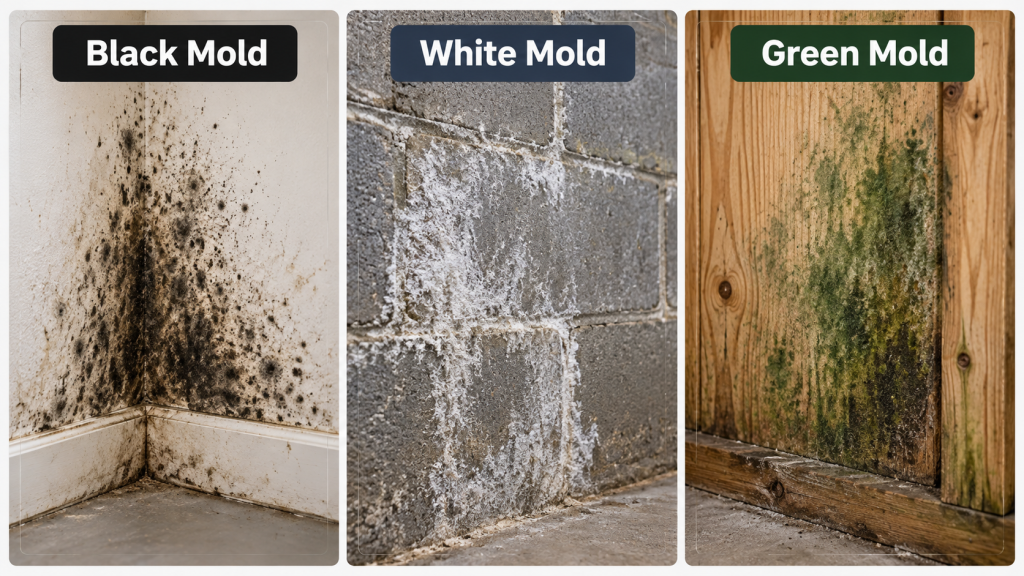
Mold can appear in many colors and textures, and different substances can look similar on a basement wall.
Black, green, gray, white, brown, or spotted growth does not provide a reliable species identification. A musty odor can indicate a moisture problem, but smell does not identify a mold species either.
For most homeowners, species identification is less important than answering two practical questions:
- Is there visible growth associated with moisture?
- What is keeping the area damp?
If the affected area is extensive or the situation requires specialized testing for a specific reason, professional evaluation may be appropriate.
What about white powder on masonry?
White powdery or crystalline material on concrete or masonry may be efflorescence rather than mold.
Efflorescence consists of mineral deposits left behind when moisture moves through masonry and evaporates. Its presence can still be an important moisture clue.
Do not rely on color alone to decide what an unfamiliar substance is. The detailed distinction between efflorescence and mold requires its own evaluation; here, treat either recurring condition as a reason to investigate moisture.
If you are unsure whether a white deposit is mineral buildup or possible biological growth, see our guide to efflorescence vs mold for the most useful visual and moisture clues.
How to Inspect Mold on Basement Walls Safely
Start by determining the size of the visible problem and looking for the moisture pattern without disturbing materials unnecessarily.
Step 1: Look at the surrounding area
Check the affected wall, floor edge, nearby windows, visible pipes, and adjacent equipment.
Look for:
- Damp or darkened masonry
- Condensation
- Water stains
- Peeling coatings
- Wet floor edges
- Plumbing drips
- Evidence of recent seepage
- Damp cardboard, wood, carpet, or other porous materials nearby
Note whether the growth is confined to one small accessible surface or appears across several areas.
Do not cut into drywall, remove wall coverings, or open cavities simply to find out whether additional mold is present.
Step 2: Compare the problem with weather and household conditions
Timing helps narrow the moisture source.
Growth near an area that repeatedly becomes wet after storms points toward water intrusion. Dampness that becomes worse during humid summer weather may involve condensation or high indoor humidity.
A localized wet patch near plumbing or mechanical equipment may indicate an indoor source.
Step 3: Check basement humidity
Use a hygrometer to monitor relative humidity.
A single reading is only a snapshot, so watch the pattern over several days. Compare readings with humid weather, rainfall, air-conditioning use, and any periods when basement windows are open.
High humidity can support persistent damp conditions, but a normal humidity reading does not rule out localized seepage or a plumbing leak.
If humidity is staying high, our basement humidity guide explains target levels, common causes, and practical ways to keep excess moisture under control.
Step 4: Decide whether homeowner cleanup is reasonable
For a small, accessible area—roughly less than about 10 square feet in otherwise uncomplicated conditions—homeowner cleanup may be reasonable.
That does not apply when the problem involves extensive growth, significant water damage, sewage, contaminated water, hidden mold, repeated regrowth, or health concerns.
If the affected area turns out to be larger or more complicated than it first appeared, stop and arrange professional evaluation.
Limited Cleanup for a Small Accessible Area
The first cleanup step is always moisture control. If a leak or recurring dampness remains, cleaning the visible surface alone is unlikely to provide a lasting result.
For a small area on an ordinary washable surface:
- Correct or control the moisture source first.
- Use a cleaning product appropriate for that specific surface.
- Follow the product label and ventilation requirements.
- Avoid unnecessary spreading or disturbance of the growth.
- Dry the cleaned area thoroughly.
- Monitor it for recurring moisture or growth.
Do not mix cleaning chemicals. Do not treat bleach as a universal solution for mold or assume it is suitable for every wall material.
Porous materials require additional judgment. Moldy drywall, insulation, carpet, cardboard, or similar materials may not respond like a washable masonry or other hard surface. If porous material is extensively affected or the damage extends beyond what is plainly accessible, professional guidance is appropriate.
Drying and Moisture Control Matter More Than Repainting
Painting over visible growth does not correct the condition that allowed it to develop.
A new coating may temporarily hide discoloration while the wall remains damp underneath. If moisture continues entering through the wall, condensing on the surface, or leaking from another source, the problem can return.
Before refinishing an affected wall, make sure the moisture source has been corrected and the wall has been allowed to dry appropriately.
The necessary response depends on the cause.
If humidity is excessive, a dehumidifier or air conditioning may help control moisture in the air. If the wall gets wet after rain, investigate water intrusion. If the moisture begins near a pipe or HVAC component, address that system instead.
A dehumidifier can help control airborne moisture. It cannot stop active wall seepage or repair a leak.
When Mold Keeps Coming Back
Repeated regrowth is a sign to revisit the moisture diagnosis rather than using stronger cleaners.
Check whether:
- Basement humidity remains elevated
- Condensation continues forming
- The wall gets wet after rain
- A plumbing or HVAC leak persists
- Materials behind or beside the wall may have been water-damaged
- The foundation has ongoing seepage
Recurring mold in the same location usually means the conditions supporting it have not been fully corrected.
Persistent wall seepage may require drainage or waterproofing evaluation. A plumbing source calls for a plumber, while HVAC condensate problems may need an HVAC technician.
Cracks accompanied by displacement, bowing, widening, or other structural movement should be evaluated by an appropriate foundation or structural professional rather than treated as a mold-cleaning issue.
When to Call a Professional
Professional evaluation is appropriate when the mold or moisture problem exceeds a small, accessible surface condition.
Seek appropriate help for:
- Extensive visible growth
- Growth covering more than a small area
- Repeated regrowth after cleaning and drying
- Significant water damage
- Suspected mold behind walls or in inaccessible cavities
- Sewage or potentially contaminated water
- Persistent foundation seepage
- A moisture source you cannot identify
- Significant suspected mold associated with HVAC equipment
- Structural movement or foundation concerns
- Situations involving people with respiratory conditions, significant mold sensitivity, or weakened immune systems
The professional you need depends on the underlying problem. Mold remediation may address extensive contamination, but moisture control may also require a plumber, HVAC technician, drainage specialist, waterproofing professional, or structural professional.
If standing water is near outlets, wiring, appliances, or other electrical equipment, do not enter the water or touch wet electrical components. Have the electrical hazard addressed before accessing the area.
Preventing Mold From Returning
Prevention depends on keeping basement materials from remaining persistently damp.
- Monitor humidity with a hygrometer.
- Control condensation during humid weather.
- Address plumbing and mechanical leaks promptly.
- Recheck previously affected walls after heavy rain.
- Keep moisture-sensitive stored materials away from damp masonry.
- Correct recurring seepage rather than repeatedly cleaning the surface.
- Watch repaired areas for renewed staining, dampness, or growth.
A clean-looking wall is not the final test of success. The more important result is whether the area stays dry.
Final Thoughts
Mold on basement walls should be treated first as a moisture warning. Do not try to identify the species from its color or smell, and do not rely on repainting or repeated cleaning while the wall remains damp.
For a small, accessible surface area in otherwise uncomplicated conditions, limited cleanup may be reasonable once the moisture source is controlled. Extensive growth, repeated regrowth, hidden moisture, contaminated water, health concerns, persistent seepage, or structural problems are signs to stop routine homeowner cleanup and bring in the appropriate professional.