best waterproof flooring for your home
The best waterproof flooring depends on where the floor will be used and what kind of moisture it needs to handle. Porcelain and ceramic tile tolerate surface water extremely well, while many luxury vinyl products combine strong water performance with more comfort underfoot. Waterproof laminate can also work in some rooms, but its limitations vary by product.
“Waterproof” usually describes the flooring material under specified conditions. It does not mean the room is waterproof, the subfloor is protected from every leak, or water cannot travel through edges, transitions, walls, penetrations, or beneath the finished floor.
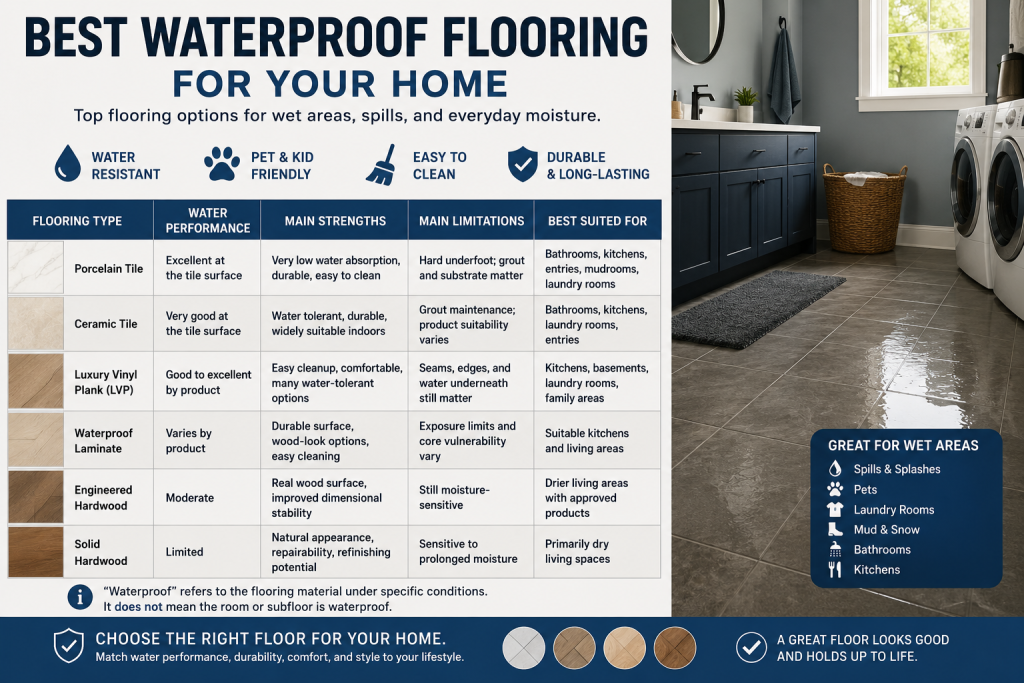
| Flooring type | Water performance | Main strengths | Main limitations | Best suited for |
|---|---|---|---|---|
| Porcelain tile | Excellent at the tile surface | Very low water absorption, durable, easy to clean | Hard underfoot; grout and substrate matter | Bathrooms, kitchens, entries, mudrooms, laundry rooms |
| Ceramic tile | Very good at the tile surface | Water tolerant, durable, widely suitable indoors | Grout maintenance; product suitability varies | Bathrooms, kitchens, laundry rooms, entries |
| Luxury vinyl plank / vinyl | Good to excellent by product | Easy cleanup, comfortable, many water-tolerant options | Seams, edges, and water underneath still matter | Kitchens, basements, laundry rooms, family areas |
| Waterproof laminate | Varies by product | Durable surface, wood-look options, easy cleaning | Exposure limits and core vulnerability vary | Suitable kitchens and living areas |
| Engineered hardwood | Moderate | Real wood surface, improved dimensional stability | Still moisture-sensitive | Drier living areas with approved products |
| Solid hardwood | Limited | Natural appearance, repairability, refinishing potential | Sensitive to prolonged moisture | Primarily dry living spaces |
Performance depends on product construction, installation, room conditions, and manufacturer requirements. No flooring material should be used to cover an unresolved leak or moisture problem.
If older tile, sheet flooring, mastics, or adhesives could contain asbestos, do not sand, grind, scrape, cut, or remove the material until it has been appropriately evaluated or tested. Do not attempt DIY asbestos removal.
What Waterproof Flooring Really Means
A waterproof flooring material and a waterproof floor assembly are not the same thing.
Some vinyl products use cores and surfaces that do not swell or deteriorate easily when exposed to water. Porcelain has extremely low water absorption. Those characteristics can make the flooring itself highly tolerant of moisture.
The finished installation still has vulnerable areas, including:
- Seams
- Perimeter gaps
- Doorways
- Transitions
- Plumbing penetrations
- Wall edges
- Openings around cabinets or fixtures
Water can sometimes reach those areas even when the visible flooring remains undamaged.
Water-resistant flooring provides a lower or more conditional level of protection. It may tolerate normal spills when they are cleaned promptly but have limits on exposure duration, volume, or installation location.
Manufacturer definitions matter because “waterproof” is not a reason to ignore product instructions. Installation method, sealing requirements, approved rooms, exposure limits, and warranty terms can differ.
Moisture from below is another issue. Concrete can transmit moisture vapor, and waterproof planks do not automatically prevent that moisture from affecting the flooring system, underlayment, adhesive, or surrounding materials.
Porcelain Tile
Porcelain tile is one of the strongest choices for rooms where surface water is common.
Porcelain is dense and has very low water absorption. That makes it well suited to bathrooms, mudrooms, kitchens, laundry rooms, and entry areas that may regularly see wet footwear or spills.
It also offers excellent durability and is easy to clean. Ordinary household water is unlikely to harm a properly selected porcelain tile itself.
The complete floor still depends on more than the tile. Grout joints require maintenance, and water can potentially move through or around parts of the installation. Porcelain flooring does not turn the room into a watertight basin.
The substrate beneath the tile must also be suitable. Tile is rigid, so movement or deflection in the supporting floor can contribute to cracked tile or grout.
Porcelain is also hard underfoot. That may be an acceptable tradeoff in a bathroom or mudroom but less appealing in a room where people stand for long periods.
For homeowners prioritizing maximum surface-water tolerance along with strong wear resistance, porcelain deserves serious consideration.
Ceramic Tile
Ceramic floor tile also performs very well in rooms exposed to spills and routine surface moisture.
It can be a practical option for bathrooms, kitchens, laundry rooms, and entries when the specific tile is intended for floor use. Its surface is generally easy to clean, and many products provide more water tolerance than wood-based flooring.
Ceramic and porcelain are related materials, but homeowners should not assume they are interchangeable. Porcelain is generally denser and absorbs less water, while ceramic products vary more widely in construction and intended application.
That difference does not make ceramic unsuitable for normal residential wet areas. A properly chosen ceramic floor tile can perform very well where the room conditions fit its intended use.
As with porcelain, grout needs maintenance, and the supporting floor must be stable enough for tile. Cracking usually involves more than the tile’s water resistance alone.
Luxury Vinyl Plank and Vinyl
Luxury vinyl plank is frequently marketed as waterproof because many products use water-tolerant synthetic cores and surfaces.
That makes LVP appealing for kitchens, laundry rooms, basements, family spaces, and other rooms where spills are likely. It is also easier on the feet than tile and generally simple to clean.
The important distinction is between the plank and the complete floor system.
A plank may tolerate being wet without swelling, while water can still move:
- Through perimeter areas
- Around transitions
- Through penetrations
- Beneath floating flooring
- Into adjacent walls or trim
If significant water remains underneath the flooring, the planks themselves may survive while the subfloor, underlayment, adhesives, or surrounding building materials remain wet.
LVP performance also depends on the subfloor. Excessive unevenness can stress joints or cause movement, while moisture coming through concrete may require specific preparation or moisture-control measures.
Some products include an attached pad. Others require or permit a separate underlayment. Adding an extra layer without approval can create problems rather than improving water protection.
For many homeowners, LVP offers one of the most practical combinations of moisture tolerance, comfort, appearance, and maintenance. The exact product requirements still need to match the room.
If you choose LVP, the layer beneath it still matters, so review our guide to the best underlayment for vinyl plank flooring before installation.
Waterproof Laminate
Traditional laminate flooring is moisture-sensitive because its core can swell if enough water reaches vulnerable areas.
Newer laminate products may offer much stronger water-resistance or waterproof claims. These can make laminate practical in situations where older laminate would have been a poor choice.
The claims need to be read carefully.
Different products may have different requirements for:
- Exposure time
- Perimeter treatment
- Approved rooms
- Installation methods
- Cleaning practices
- Water entering seams or edges
If water penetrates to a vulnerable core or remains long enough to exceed the flooring’s limits, swelling or permanent deformation can still occur.
For that reason, waterproof laminate should not automatically be treated as equivalent to porcelain, ceramic, or vinyl simply because all are described with water-related marketing terms.
It can be a useful option when homeowners want a durable wood-look floor and the product is specifically approved for the expected room conditions.
Engineered Hardwood
Engineered hardwood offers better dimensional stability than solid hardwood because its real wood surface is supported by a layered core.
That stability does not make it waterproof.
The surface is still genuine wood, and significant moisture can cause staining, swelling, finish damage, or movement. Water can also affect edges, joints, and the flooring beneath the visible surface.
Engineered hardwood may be suitable in some kitchens, living spaces, or installations over concrete when the particular product and installation method are approved for those conditions.
It is generally not the first material to consider when maximum water tolerance is the main goal.
Homeowners choosing engineered wood should do so because they value the appearance and feel of real wood and are comfortable with its moisture limitations.
If these two flooring types are still on your shortlist, compare vinyl plank vs engineered hardwood before making the final decision.
Solid Hardwood
Solid hardwood is one of the more moisture-sensitive flooring choices in this comparison.
Prolonged water exposure can cause staining, swelling, finish damage, cupping, or other movement. Severe exposure can result in permanent damage.
For that reason, solid hardwood is generally not a first choice for bathrooms, wet basements, or other spaces with frequent moisture.
Some homeowners still choose hardwood for kitchens because they value the appearance, continuity with nearby rooms, and long-term repairability. That decision requires accepting greater risk from sink, refrigerator, dishwasher, and plumbing leaks.
When maximum water tolerance is the priority, tile or suitable vinyl products are usually more practical categories to consider first.
Best Waterproof Flooring by Room
The room often determines which water-tolerant flooring makes the most sense. Moisture risk, comfort, cleaning, and the condition beneath the finished floor should all be considered.
Kitchens
Kitchens experience routine spills along with the possibility of larger leaks from sinks, refrigerators, dishwashers, and supply lines.
Appropriate LVP offers strong water tolerance with more comfort underfoot than tile. Porcelain and ceramic tile provide excellent surface-water performance and stand up well to frequent cleaning.
Waterproof laminate may also be suitable when the manufacturer approves it for kitchen use and its exposure limits match the household’s needs.
No finished flooring protects the kitchen from every appliance or plumbing failure. A significant leak can travel beneath cabinets, into walls, or below the flooring.
Bathrooms
Porcelain and ceramic tile are natural candidates for bathrooms because they tolerate surface water well and are easy to clean.
Suitable LVP can also work when the product is approved for bathroom use. It provides a softer, warmer-feeling surface than tile.
Traction deserves attention with any bathroom floor. A highly polished or smooth surface can become slippery when wet.
Flooring selection also does not replace any waterproofing required elsewhere in the bathroom construction. The visible floor is only one part of moisture management.
Laundry Rooms
Laundry rooms need flooring that can handle small spills as well as the possibility of washer leaks, hose failures, drain problems, or detergent spills.
Porcelain tile, ceramic tile, and suitable LVP are strong candidates because they tolerate routine surface moisture and frequent cleaning.
A waterproof finished floor does not prevent a major appliance leak from reaching the subfloor, adjacent walls, or nearby rooms. Floor selection should not substitute for correcting leaking equipment or plumbing.
Basements
Basements introduce moisture concerns that can come from both above and below the flooring.
Possible sources include:
- Plumbing leaks
- High humidity
- Concrete slab moisture
- Groundwater-related problems
- Condensation
Tile and suitable LVP can be practical choices when the slab and installation conditions meet product requirements.
Do not cover an actively wet slab or unresolved basement moisture problem with new flooring. A waterproof plank cannot correct the source of moisture beneath it.
Mudrooms and Entryways
Mudrooms and entrances regularly see rainwater, snow, wet footwear, mud, road salt, and grit.
Porcelain and ceramic tile perform well where maximum hardness and easy cleaning are priorities. Suitable LVP offers strong moisture tolerance with a more forgiving feel underfoot.
Surface texture matters in these rooms because wet shoes can reduce traction.
Grit control matters too. Mats and routine cleaning help prevent abrasive dirt from scratching both resilient and hard flooring surfaces.
Living Areas
A living room does not automatically need waterproof flooring, but water-tolerant materials can still make sense in an open-plan home or a household with pets and children.
LVP may be especially practical where living areas connect directly to a kitchen or entry. Waterproof laminate can also provide a wood-look option where the room and manufacturer requirements are appropriate.
If moisture exposure is unlikely, homeowners have more freedom to prioritize appearance, comfort, repairability, or natural materials instead.
Best Waterproof Flooring for Pets
Pets bring several types of flooring challenges together.
Water bowls can spill repeatedly. Accidents may sit unnoticed. Dogs can carry in mud and rainwater. At the same time, claws, traction, noise, and comfort matter.
Tile handles water and cleaning extremely well, but it can be hard and slippery for some animals.
LVP often provides a useful compromise between moisture tolerance and comfort. Its scratch resistance varies, so households with large or active dogs should consider surface durability along with the waterproof claim.
Suitable laminate may offer stronger scratch resistance than some vinyl products, but its exact water limitations need careful review.
There is no universal pet winner. A homeowner with an older dog may prioritize traction and comfort differently from someone with several young, active pets.
Best Waterproof Flooring for Homes With Children
Children can subject flooring to spilled drinks, food, crafts, wet shoes, dropped toys, moving chairs, and frequent cleaning.
LVP can be practical because it handles many everyday spills while remaining softer than tile.
Tile offers excellent surface-water performance and durability but is hard underfoot and unforgiving when objects are dropped.
Waterproof laminate can provide a durable wood-look surface where the specific product supports the expected exposure.
The best family choice depends on whether moisture tolerance, scratch resistance, comfort, appearance, or easy cleaning is the greater priority.
Waterproof Flooring Over Concrete
Concrete can look dry while still transmitting moisture vapor.
That matters for basements, slab-on-grade rooms, and other installations where flooring is placed directly over concrete.
Depending on the flooring system, manufacturers may require:
- Concrete moisture evaluation or testing
- An approved underlayment
- Specific adhesives
- Vapor-control measures
- Limits on acceptable slab conditions
A waterproof LVP plank does not automatically solve moisture coming through the slab. Water resistance at the finished surface and moisture control beneath the flooring are separate issues.
If you are installing vinyl plank over a slab, see our guide to using a vapor barrier for vinyl plank flooring on concrete.
Persistent dampness, visible water, or unresolved slab moisture should be addressed before installing a new finished floor.
What Waterproof Flooring Cannot Protect Against
Waterproof flooring can reduce the chance that ordinary spills ruin the flooring material, but it cannot protect the entire building from water damage.
It does not automatically prevent damage from:
- Major plumbing leaks
- Flooding
- Water entering walls
- Water traveling beneath the flooring
- Wet insulation
- Saturated subflooring
- Rot
- Mold conditions
- Structural moisture problems
A floor can look intact while moisture remains trapped elsewhere.
When a major leak occurs, the important question is not only whether the flooring survived. The materials underneath and around the floor also need to dry properly and remain structurally sound.
What to Look for When Buying Waterproof Flooring
Once you choose a material category, compare actual product requirements rather than relying only on the word “waterproof” on the package.
LVP and Vinyl
Check:
- The manufacturer’s exact waterproof claim
- Core construction
- Wear surface
- Approved rooms
- Attached-pad or underlayment requirements
- Subfloor requirements
- Warranty exclusions
- Perimeter and installation requirements
Water performance should be considered alongside scratch resistance, dent resistance, joint construction, and suitability for the subfloor.
Laminate
Review:
- Whether the product is called waterproof or water-resistant
- Stated exposure limitations
- Core construction
- Edge treatment
- Approved rooms
- Warranty terms
- Cleaning restrictions
Do not assume two waterproof laminate products provide identical protection.
Tile
For ceramic and porcelain, confirm:
- Floor-use suitability
- Intended application
- Surface texture
- Slip considerations
- Water absorption where relevant
- Compatibility with the supporting floor
The tile itself may tolerate water extremely well, but the entire floor still depends on the substrate, grout, joints, and surrounding construction.
Questions to Ask Before Choosing Waterproof Flooring
Before making a final decision, ask:
- What type of water exposure is most likely here?
- Will the room see normal spills or a realistic risk of larger leaks?
- Is the room above grade or below grade?
- Will the flooring be installed over concrete?
- Could slab moisture be an issue?
- Are pets or children likely to create frequent spills?
- How important is comfort underfoot?
- How important is scratch resistance?
- What happens if water reaches beneath the finished flooring?
- Can individual damaged pieces be replaced?
- What underlayment or moisture-control measures are required?
- What installation and perimeter requirements does the manufacturer specify?
- Is the product approved for this particular room?
The strongest choice is a flooring system suited to both the visible water exposure and the conditions underneath it.
When Professional Evaluation Makes Sense
Choosing among ordinary flooring materials does not normally require professional evaluation. Existing moisture or structural problems sometimes do.
Get qualified help when you find:
- Persistent basement or slab moisture
- Active plumbing leaks
- Extensive previous water damage
- Rot or significant subfloor deterioration
- Large or moving concrete slab cracks
- Structural movement or substantial floor deflection
- Moisture conditions you cannot identify or control
- Suspected asbestos-containing flooring, mastic, or adhesive
If older flooring or adhesive may contain asbestos, stop disturbing it. Do not sand, grind, scrape, cut, drill, or remove suspect material until it has been appropriately evaluated or tested.
Resolve active leaks, structural problems, and significant moisture before installing a finished floor over the affected area.
Final Thoughts
The best waterproof flooring is the material that matches the room’s realistic water exposure without creating unacceptable tradeoffs in comfort, durability, maintenance, or appearance. Porcelain and ceramic tile provide excellent surface-water tolerance, while suitable LVP can offer a more comfortable and versatile alternative. Waterproof laminate can also fit some homes when its limitations are clearly understood.
Whatever material you choose, verify the manufacturer’s room, subfloor, underlayment, moisture, and installation requirements. Waterproof flooring can protect the finish material from many everyday spills, but protecting the subfloor and the rest of the home still depends on the complete flooring system and proper moisture control.